
When companies evaluate warehouses, location usually tops the checklist. But here’s the truth: even the perfect location won’t deliver results if your facility can’t efficiently handle the flow of goods in and out.
That’s where ingress (getting goods in) and egress (getting goods out) come into play. These aren’t just technical details. They determine whether your warehouse is a well-oiled machine—or a daily traffic jam.
Poor ingress and egress can lead to backups, higher labor costs, safety incidents, and frustrated carriers. Optimized ingress and egress, on the other hand, mean smoother operations, reduced downtime, and happier customers.
Why Ingress and Egress Make or Break Operations
Think of a warehouse like a human body. Location is the skeleton, but ingress and egress are the arteries and veins. If they’re clogged or poorly designed, the whole system suffers.
- Lost time adds up fast. A truck waiting in queue isn’t just idle—it’s costing upwards of $70 per hour in wasted productivity. Multiply that by several trucks per day, and the annual losses run into six figures.
- Safety is at risk. According to OSHA, nearly 1 in 5 warehouse accidents happen during vehicle operations. Many are preventable with better layouts and visibility.
- Customer expectations don’t allow delays. In the age of same-day and next-day shipping, a single bottleneck can ripple down the supply chain.
The bottom line: optimizing ingress and egress isn’t optional. It’s mission-critical.

Parking Lot Design: The First Test of Efficiency
Your parking lot sets the stage for everything else.
A stretch of asphalt, yes, but its design dictates how smoothly trucks, forklifts, and employees move through your site.
A well-designed lot provides seamless traffic flow and staging. A poor one creates daily chaos.
Key considerations include:
- Turning radius: Semi-trucks require 45–50 feet. Tight corners mean delays and accidents.
- Staging space: Each queued truck needs about 15 feet by 70 feet. A 10-dock facility requires at least 7,000 sq. ft. dedicated to truck flow.
- Buffer capacity: Experts recommend 20–25% extra space to handle surges during peak demand.
- Separate access: Truck entrances should be entirely separate from employee and visitor parking.
- Traffic control: Clear lanes, arrows, and signage reduce confusion and collision risks.
- Overnight staging: Dedicate 5–10% of your lot to overnight parking to avoid daytime congestion.
When these elements are neglected, congestion spreads like wildfire. Trucks block each other, shipments fall behind schedule, and carriers dread returning to your site. But when they’re executed well, trucks move in and out without delay, forklifts operate safely, and carriers appreciate your facility’s efficiency.
Dock Levelers: Bridging Gaps That Slow You Down
After trucks are staged, the next challenge is loading and unloading. Here, dock levelers play a pivotal role. By adjusting for height differences between trailers and dock platforms, they create a safe, stable surface that makes material handling faster and safer.
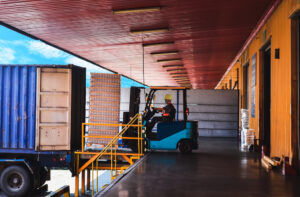
The benefits are hard to ignore:
- Adaptability: Dock levelers accommodate varying trailer sizes—critical when working with mixed fleets.
- Productivity: They reduce loading/unloading time by 20–25%, which means more throughput per shift.
- Safety: By eliminating unstable ramps, dock levelers can reduce workplace injuries by 15–20% annually.
- Downtime reduction: Warehouses using them effectively see up to 30% fewer slowdowns.
What to evaluate when selecting dock levelers:
- Type: Hydraulic for high-frequency operations, mechanical for lighter needs, and air-powered for balance.
- Capacity: Always match the leveler to your heaviest expected load—cutting corners here risks safety and equipment life.
- Durability: Steel or aluminum alloy models withstand harsh use and can last 20 years with proper maintenance.
- Maintenance: Easy-access components and scheduled inspections minimize downtime.
Best practice is to pair dock levelers with bumpers to protect both the dock and trailers. And don’t underestimate staff training. Even the best equipment fails if it isn’t used properly.
Dock Lights: Small Detail, Big Impact
Lighting is often an afterthought, but it has an outsized impact on both safety and productivity. Workers unloading a dimly lit trailer face higher risks of accidents, product damage, and delays. Dock lights solve this problem—especially modern LED systems.
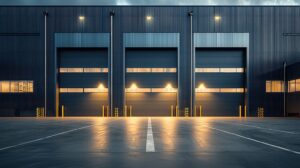
Why dock lights matter:
- Safety: Proper illumination prevents injuries and mishandling of goods.
- Productivity: Workers load and unload up to 25% faster when visibility is clear.
- Cost savings: LED dock lights use 75% less energy, produce less heat, and last up to 50,000 hours.
Features worth prioritizing:
- Brightness in the 5,000–10,000 lumen range for most loading applications.
- Impact-resistant designs built for high-traffic areas.
- Compatibility with motion sensors to cut energy waste.
Warehouses that switch to LEDs report saving around $1,200 per dock annually on energy costs alone—while also improving working conditions. That’s a win-win for safety and the bottom line.
The Big Picture for Tenants
Square footage is table stakes. What separates a merely adequate warehouse from a high-performer is how cleanly goods move through the property—gate to yard to dock to floor and back out again. That flow lives or dies on ingress and egress: the geometry of your yard and parking, the way trucks queue and turn, the handoff at the dock, and the visibility your teams have while they work. Treat these as a system, not a set of fixtures.
Think in flows, frictions, and feedback:
- Flows: truck arrival patterns, door turns per shift, forklift travel paths, pedestrian crossings.
- Frictions: tight radii, shallow aprons, under-sized staging, mismatched dock heights, dark trailers.
- Feedback: real-time dwell, queue length at peak, door utilization, incident rates, and energy burn at the dock.
Three operational truths drive your ROI:
- Time is the hidden rent. Every minute a trailer idles or a forklift waits for a safe gap costs more than rent per square foot. Door turns and trailer dwell predict on-time performance better than any lease comp.
- Safety is throughput. Near-misses and low-light picks slow people down—long before an incident shows up in the log. Safer docks move faster, with fewer reworks and claims.
- Capacity is shape, not just size. A yard that’s 10% larger but poorly shaped can perform worse than a tighter site with the right turning radii, staging density, and sightlines.
Finally, remember the geometry rules that quietly decide performance:
- Turning: design to the longest unit you’ll accept, with true 45–50 ft tractor turning radii and clear sightlines.
- Apron depth: enough for backing, swing, and a safety envelope; adding 10–15 ft of clear depth can flip your peak from brittle to resilient.
- Separation: trucks, forklifts, and passenger vehicles should have physically distinct paths—paint is not a barrier.
- Light: aim for consistent illumination into the trailer where work happens, not just on the dock face.
Do these well and the benefits compound:
- Faster door turns and tighter SLAs with carriers.
- Lower labor per shipment and fewer overtime spikes.
- Fewer claims and lower liability exposure.
- Predictable performance under peak load instead of “all hands” firefights.
Neglect them and you’ll pay twice: once in direct cost, again in reputation and lost carrier goodwill.
How Reoptimizer® Helps
Reoptimizer® is software that connects operational performance with real estate strategy. It takes the guesswork out of ingress and egress by showing you where bottlenecks exist, what fixes would cost, and how those improvements change your lease economics.
And when you’re choosing between locations, Reoptimizer® lets you weigh rent and incentives against actual operational performance—so the “cheaper” site doesn’t cost you more in hidden inefficiencies.
The result: clarity. You know whether to renew, right-size, renegotiate, or relocate—and you have data-backed leverage to get the best deal.
Want to learn more about how Reoptimizer® can turn your warehouse from just square footage into a true performance asset? Click below to discover how this could be the edge your portfolio needs.