Industrial ingress and egress design is the planning of how trucks, forklifts, cars, and pedestrians enter, circulate, queue, load, and exit a facility safely and efficiently. The most effective way to reduce congestion and incident risk is to separate traffic types, minimize reversing, size apron space correctly, and place docks to reduce forklift travel and cross-traffic.
Poor layouts don’t just waste time and fuel—they create higher-consequence conflict points where heavy equipment and people intersect.

What Is Causing Warehouse Yard Congestion (And How Do You Spot It Fast)?
Most ingress/egress problems come from one of these root causes:
-
No Truck Queue/Waiting Area → trucks stack at doors and block circulation
-
Undersized Apron Depth → repeated repositioning + slow dock cycles
-
Mixed Traffic Zones (trucks + cars + pedestrians) → stop-and-go patterns and near misses
-
Too Much Backing (forced reversing) → higher-risk maneuvers and longer cycle time
-
Dock Layout Forces Crossing Movements (receiving/shipping overlap) → forklift gridlock and staging conflicts
If your yard “feels busy” but not controlled, you’re usually missing one of the above.
What Is The Material Transfer Zone (MTZ) And Why Is It “Ground Zero” For Risk?
The Material Transfer Zone (MTZ) is where trailers, forklifts/pallet jacks, dock doors, levelers, and people converge. It’s high-risk because it compresses heavy equipment, blind spots, and time pressure into limited space.
MTZ Safety Must-Haves
-
Trailer Movement Control (restraints) to prevent creep
-
Barrier Gates to prevent edge falls and equipment damage
-
Preventive Maintenance (levelers, bumpers, lighting, seals)
-
Leveler Capacity Matched To Load + Frequency
Best Practice: powered hydraulic levelers (push-button) typically improve ergonomics and consistency versus manual mechanical units.

Are Your Loading Docks In The Best Spot? (How Dock Placement Affects Forklifts, Staging, And Delays)
Your docks are in the best spot when they:
-
Minimize Forklift Travel between receiving → storage and picking → shipping, and
-
Avoid Forced Crossing between trucks, forklifts, and pedestrians.
But dock placement isn’t just a building decision—it’s a flow decision. The “right” configuration depends on how many truck moves you handle, how much staging space you have, and whether you can keep inbound/outbound activity from competing in the same footprint.
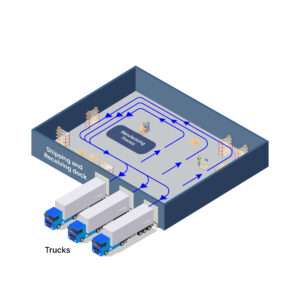
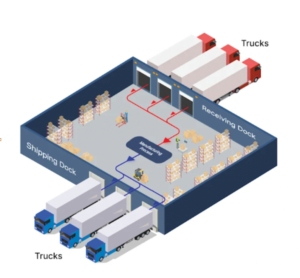
In practice, most dock strategies fall into two common types: a Combined Dock Layout (shared receiving and shipping at one dock face) and a Separated Dock Layout (distinct receiving and shipping zones).
We’ll explain when each layout works, where it breaks down, and what to look for so the design supports fast turnarounds without increasing conflict and congestion.
Combined Receiving + Shipping Dock Layout
Best For
Trade-Offs
-
Inbound/outbound compete for the same face
-
Staging becomes cluttered faster
-
Forklift travel lengthens (small minutes compound across a shift)
Separated Receiving And Shipping Dock Layout
Best For
Advantages
-
Cleaner staging discipline
-
Fewer forced interactions
-
Easier to maintain predictable yard flow
What Is The Best Traffic Flow Pattern For A Warehouse Site?
The best yard flow is predictable and reduces reversing. A common “win” pattern is a one-way circulation loop plus dedicated truck waiting space so the dock face stays clear.
Recommended Site Traffic Flow Design
-
One-Way Circulation where feasible
-
Dedicated Truck Waiting/Queue Area off the dock face
-
Separate Truck Routes From Employee Parking/Pedestrian Entrances
Common Baseline Geometry (53-Ft Trailer Planning)
-
Inside Turning Radius: ~26 ft
-
Outside Turning Radius: ~50 ft
-
One-Way Access Road Width: ~13 ft minimum
-
Two-Way Access Road Width: ~26 ft minimum
(These are baseline planning numbers—final design should be validated to your design vehicle and constraints.)
What Is Dock Apron Space—And How Much Do You Need For 40’, 48’, And 53’ Trailers?
Apron space is the maneuvering area in front of the dock that lets trucks align and back safely. Undersized aprons cause:
Practical Apron Depth Guidance
A commonly used planning table for 40-ft trailers often lands around ~108–120 ft depending on center-to-center spacing.
Scaling guidance used in planning:
Takeaway: If you handle 53-footers and see repeated alignment delays, apron depth is often the hidden bottleneck.

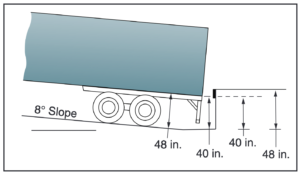
What Dock Height Is Standard (And Why Does It Matter)?
A common warehouse dock height range is 48″–52″, depending on the trailers served. Correct height reduces:
How Steep Can A Dock Approach Slope Be For Forklifts?
Steep slopes increase tipping risk and reduce load stability.
Common guidelines:
-
Electric Forklifts: max ~10% slope
-
Gas/Diesel Forklifts: max ~15% slope
-
Ideal Recessed Dock Slope: ≤ ~6%
If you’re above ~10% where forklifts carry load and speed, you’re compounding risk and inefficiency.
How Do You Reduce Parking Lot Accidents At Industrial Sites?
The highest-ROI move is traffic separation:
-
Separate employee parking from truck yards
-
Build protected pedestrian paths (not shared asphalt)
-
Use controlled crossings, clear sightlines, signage, speed control
-
Keep visitor circulation away from dock maneuvering zones
This reduces conflict structurally instead of relying on perfect behavior.
How Do You Execute This During Site Selection And Keep It From Drifting During The Project?
Once you know the “right answers” (apron depth, turning room, separation, dock placement), the challenge becomes: can the site support it—and will the project deliver it? This is where REoptimizer® becomes the execution layer.
REoptimizer® For Industrial Site Selection
Use REoptimizer® to compare candidate sites by making key factors visible in one place—especially the constraints that drive ingress/egress success:
-
Site Access And Circulation Feasibility (how trucks can realistically enter/exit and loop)
-
Geographic Considerations (grade, adjacency, road context, space depth)
-
Separation Potential (truck yard vs employee parking vs pedestrian routes)
-
Dock Strategy Fit (can you support separated zones or will you be forced into a combined face?)
REoptimizer® For Project Monitoring (Design → Build → Operate)
Use REoptimizer® to keep the original flow-and-safety intent from getting diluted across revisions:
-
Track whether apron depth, turning assumptions, and queue areas survive redesigns
-
Maintain visibility into dock placement logic and forklift travel implications
-
Flag when changes reintroduce mixed traffic zones or forced backing
In other words: the guide tells you what “good” is; REoptimizer® helps you select sites that can actually deliver it and monitor the project so it stays aligned.
Frequently Asked Questions
What Does “Ingress And Egress” Mean In Warehouse Design?
It refers to how vehicles and people enter, circulate, queue, interact with docks, and exit—safely and efficiently.
What Is The Most Common Warehouse Yard Bottleneck?
Typically: undersized apron space, no truck waiting area, or dock placement that forces crossing/competition.
Should Receiving And Shipping Docks Be Separated?
For high-volume facilities, separation often improves flow by reducing competition and simplifying staging and forklift routing.
How Much Apron Depth Do I Need For 53-Ft Trailers?
Many layouts require substantially more than 40-ft baselines; designs can reach ~140 ft depending on spacing and maneuver strategy.
What Is Standard Dock Height?
Often 48″–52″, depending on the trailer fleet served.
What Slope Is Safe For Forklifts At Dock Approaches?
A common guideline is ≤10% electric and ≤15% gas/diesel, with ≤6% preferred where possible.
How Does REoptimizer® Help With Ingress/Egress Decisions?
It supports site selection (seeing feasibility against geographic and layout constraints) and project monitoring (keeping circulation, separation, and dock requirements visible through revisions). Learn more about how it can level up your industrial portfolio today.
Learn More
When companies evaluate warehouses, location usually tops the checklist. But here’s the truth: even the perfect location won’t deliver results if your facility can’t efficiently handle the flow of goods in and out.
That’s where ingress (getting goods in) and egress (getting goods out) come into play. These aren’t just technical details. They determine whether your warehouse is a well-oiled machine—or a daily traffic jam.
Poor ingress and egress can lead to backups, higher labor costs, safety incidents, and frustrated carriers. Optimized ingress and egress, on the other hand, mean smoother operations, reduced downtime, and happier customers.
Why Ingress and Egress Make or Break Operations
Think of a warehouse like a human body. Location is the skeleton, but ingress and egress are the arteries and veins. If they’re clogged or poorly designed, the whole system suffers.
- Lost time adds up fast. A truck waiting in queue isn’t just idle—it’s costing upwards of $70 per hour in wasted productivity. Multiply that by several trucks per day, and the annual losses run into six figures.
- Safety is at risk. According to OSHA, nearly 1 in 5 warehouse accidents happen during vehicle operations. Many are preventable with better layouts and visibility.
- Customer expectations don’t allow delays. In the age of same-day and next-day shipping, a single bottleneck can ripple down the supply chain.
The bottom line: optimizing ingress and egress isn’t optional. It’s mission-critical.

Parking Lot Design: The First Test of Efficiency
Your parking lot sets the stage for everything else.
A stretch of asphalt, yes, but its design dictates how smoothly trucks, forklifts, and employees move through your site.
A well-designed lot provides seamless traffic flow and staging. A poor one creates daily chaos.
Key considerations include:
- Turning radius: Semi-trucks require 45–50 feet. Tight corners mean delays and accidents.
- Staging space: Each queued truck needs about 15 feet by 70 feet. A 10-dock facility requires at least 7,000 sq. ft. dedicated to truck flow.
- Buffer capacity: Experts recommend 20–25% extra space to handle surges during peak demand.
- Separate access: Truck entrances should be entirely separate from employee and visitor parking.
- Traffic control: Clear lanes, arrows, and signage reduce confusion and collision risks.
- Overnight staging: Dedicate 5–10% of your lot to overnight parking to avoid daytime congestion.
When these elements are neglected, congestion spreads like wildfire. Trucks block each other, shipments fall behind schedule, and carriers dread returning to your site. But when they’re executed well, trucks move in and out without delay, forklifts operate safely, and carriers appreciate your facility’s efficiency.
Dock Levelers: Bridging Gaps That Slow You Down
After trucks are staged, the next challenge is loading and unloading. Here, dock levelers play a pivotal role. By adjusting for height differences between trailers and dock platforms, they create a safe, stable surface that makes material handling faster and safer.
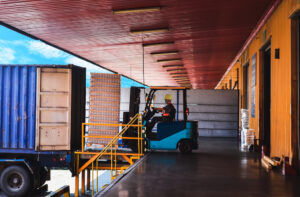
The benefits are hard to ignore:
- Adaptability: Dock levelers accommodate varying trailer sizes—critical when working with mixed fleets.
- Productivity: They reduce loading/unloading time by 20–25%, which means more throughput per shift.
- Safety: By eliminating unstable ramps, dock levelers can reduce workplace injuries by 15–20% annually.
- Downtime reduction: Warehouses using them effectively see up to 30% fewer slowdowns.
What to evaluate when selecting dock levelers:
- Type: Hydraulic for high-frequency operations, mechanical for lighter needs, and air-powered for balance.
- Capacity: Always match the leveler to your heaviest expected load—cutting corners here risks safety and equipment life.
- Durability: Steel or aluminum alloy models withstand harsh use and can last 20 years with proper maintenance.
- Maintenance: Easy-access components and scheduled inspections minimize downtime.
Best practice is to pair dock levelers with bumpers to protect both the dock and trailers. And don’t underestimate staff training. Even the best equipment fails if it isn’t used properly.
Dock Lights: Small Detail, Big Impact
Lighting is often an afterthought, but it has an outsized impact on both safety and productivity. Workers unloading a dimly lit trailer face higher risks of accidents, product damage, and delays. Dock lights solve this problem—especially modern LED systems.
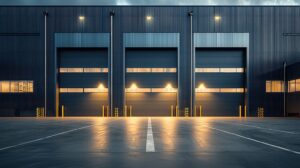
Why dock lights matter:
- Safety: Proper illumination prevents injuries and mishandling of goods.
- Productivity: Workers load and unload up to 25% faster when visibility is clear.
- Cost savings: LED dock lights use 75% less energy, produce less heat, and last up to 50,000 hours.
Features worth prioritizing:
- Brightness in the 5,000–10,000 lumen range for most loading applications.
- Impact-resistant designs built for high-traffic areas.
- Compatibility with motion sensors to cut energy waste.
Warehouses that switch to LEDs report saving around $1,200 per dock annually on energy costs alone—while also improving working conditions. That’s a win-win for safety and the bottom line.
The Big Picture for Tenants
Square footage is table stakes. What separates a merely adequate warehouse from a high-performer is how cleanly goods move through the property—gate to yard to dock to floor and back out again. That flow lives or dies on ingress and egress: the geometry of your yard and parking, the way trucks queue and turn, the handoff at the dock, and the visibility your teams have while they work. Treat these as a system, not a set of fixtures.
Think in flows, frictions, and feedback:
- Flows: truck arrival patterns, door turns per shift, forklift travel paths, pedestrian crossings.
- Frictions: tight radii, shallow aprons, under-sized staging, mismatched dock heights, dark trailers.
- Feedback: real-time dwell, queue length at peak, door utilization, incident rates, and energy burn at the dock.
Three operational truths drive your ROI:
- Time is the hidden rent. Every minute a trailer idles or a forklift waits for a safe gap costs more than rent per square foot. Door turns and trailer dwell predict on-time performance better than any lease comp.
- Safety is throughput. Near-misses and low-light picks slow people down—long before an incident shows up in the log. Safer docks move faster, with fewer reworks and claims.
- Capacity is shape, not just size. A yard that’s 10% larger but poorly shaped can perform worse than a tighter site with the right turning radii, staging density, and sightlines.
Finally, remember the geometry rules that quietly decide performance:
- Turning: design to the longest unit you’ll accept, with true 45–50 ft tractor turning radii and clear sightlines.
- Apron depth: enough for backing, swing, and a safety envelope; adding 10–15 ft of clear depth can flip your peak from brittle to resilient.
- Separation: trucks, forklifts, and passenger vehicles should have physically distinct paths—paint is not a barrier.
- Light: aim for consistent illumination into the trailer where work happens, not just on the dock face.
Do these well and the benefits compound:
- Faster door turns and tighter SLAs with carriers.
- Lower labor per shipment and fewer overtime spikes.
- Fewer claims and lower liability exposure.
- Predictable performance under peak load instead of “all hands” firefights.
Neglect them and you’ll pay twice: once in direct cost, again in reputation and lost carrier goodwill.
How Reoptimizer® Helps
Reoptimizer® is software that connects operational performance with real estate strategy. It takes the guesswork out of ingress and egress by showing you where bottlenecks exist, what fixes would cost, and how those improvements change your lease economics.
And when you’re choosing between locations, Reoptimizer® lets you weigh rent and incentives against actual operational performance—so the “cheaper” site doesn’t cost you more in hidden inefficiencies.
The result: clarity. You know whether to renew, right-size, renegotiate, or relocate—and you have data-backed leverage to get the best deal.
Want to learn more about how Reoptimizer® can turn your warehouse from just square footage into a true performance asset? Click below to discover how this could be the edge your portfolio needs.
Learn More
Commercial real estate is your company’s second-largest expense, and while parking may seem like a small piece of that puzzle, its operational impact is enormous:
- Employee Productivity: Every extra minute spent searching for parking cuts into work time.
- Customer Experience: Clients who struggle to park are less likely to return.
- Recruitment & Retention: In competitive talent markets, amenities like safe, convenient parking are differentiators.
- Cost Efficiency: Poorly planned parking can inflate CAM charges or lead to costly mid-lease adjustments.
Poor parking planning doesn’t just create daily headaches… it quietly inflates costs, from higher CAM charges to expensive mid-lease fixes. And if you’re managing multiple locations? Those headaches multiply fast. Without a clear way to track parking capacity, ratios, and costs across your portfolio, you’re flying blind… and paying for it. So let’s discuss everything corporate tenants need to know about commercial parking.
Understanding Parking Ratios
Time and again, the parking ratio is the key factor in determining whether a property’s parking will work. The parking ratio, usually represented by spaces per 1,000 square feet of rentable space, is the key metric.
For example: A 40,000-square-foot building with 200 spaces has a ratio of 5:1,000 — standard for many suburban offices. Higher ratios mean more available spaces per square foot; lower ratios often reflect urban settings with public transit access.
Key considerations for executives:
- Property Type: Medical offices may require higher ratios than warehouses.
- Workforce Density: More employees per square foot means more parking demand.
- Regional Norms: Suburban markets often expect higher ratios than urban cores.

What Defines the “Right” Ratio?
There’s no universal number. It depends on:
- Employee Commute Habits: If 90% of your workforce drives, you’ll need higher ratios.
- Customer Traffic: Retail and service locations may need overflow capacity.
- Public Transit Access: Properties near major transit hubs can sustain lower ratios.
And ratios aren’t just about capacity, they’re about cost.
Higher parking ratios can increase property expenses, which, across dozens of leases, can significantly impact your portfolio budget.
Lease Clauses Executives Can’t Ignore
Parking terms are often vague, but vague clauses create expensive surprises.
As you evaluate leases across your portfolio, focus on:
- Demised Parking Spaces – Exclusive use, but with maintenance responsibilities.
- Rights to Park – Can be general (first-come, first-served) or exclusive to certain spaces.
- Accessibility Requirements – Compliance with ADA regulations (at least one accessible space per 25 total).
- Relocation Provisions – Whether spaces can be moved or reallocated mid-lease.
- Security & Lighting Commitments – Who pays for cameras, attendants, or improved lighting?
For multi-site portfolios, tracking these details is crucial. Overlooking even one clause can cascade into operational headaches across multiple properties.
Geography’s Influence on Parking
The “right” parking strategy changes dramatically by location:
- Urban Cores: Lower ratios (1:1,000 or less) due to land scarcity and transit access.
- Suburbs: Higher ratios (5–6:1,000) are common, especially in driver-heavy regions.
- Climate Factors: Hot or snowy climates may require covered or structured parking for employee comfort and vehicle protection.
When comparing markets, remember that the same parking ratio can carry very different cost implications depending on local land values.
Obviously parking is not going to be the same in the suburbs versus city centers.

Structured vs. Surface Parking
When it comes to parking, you’ve really only got two options: build up or spread out. And each comes with its own price tag, timeline, and headaches.
Structured Parking (Garages)
Think multi-level garages. They’re a lifesaver when land is tight, density is high, or you want to keep cars out of the sun, snow, and rain.
- Cost per space: Around $22,000 — yes, per space.
- Build time: 18–24 months if everything goes smoothly.
- Why it works:
- Keeps cars (and people) out of extreme weather
- Controlled entry points and better security
- Packs a lot of cars into a small footprint — ideal for high-value land
- Looks and feels like a premium amenity
The flip side: You’ll pay more to build it, more to maintain it, and you need the patience (and budget) to wait up to two years before it’s ready. For short-term leases? Forget it — you’ll never see the return before you’re out.

Surface Parking (Lots)
This is your at-grade, asphalt (or gravel) lot. It’s the simple, no-frills option — and for a lot of situations, it’s exactly what you need.
- Cost per space: $1,500–$3,000 — a fraction of structured.
- Why it works:
- Quick to build and ready to use
- Cheaper to maintain over time
- Easy to expand or reconfigure if your needs change
The flip side: Takes up a ton of land, offers zero weather protection, and doesn’t have the same security advantages. In dense urban markets, it’s often not even an option because land costs make it impractical.
Safety, Security, and Wellbeing
Executives must view parking as part of the workplace environment.
A poorly lit, isolated lot can undo every other amenity your property offers. A secure, well-planned one? It quietly boosts morale and keeps risk low.
Here’s what a safer parking environment looks like:
- Bright lighting so no one’s walking to their car in the dark
- CCTV coverage to deter problems before they start
- Clearly marked pedestrian paths so cars and people don’t mix dangerously
- Emergency call boxes where help is one button away
- Fire safety systems in garages for worst-case scenarios
- Accessible spaces near entrances so everyone can get in easily
These features not only improve daily experience but also reflect positively on corporate brand standards.
Future-Proofing Parking
Parking isn’t static — the way people get to work is changing fast, and your parking strategy needs to keep up. What worked ten years ago may be outdated in five. Future-proofing isn’t just about making life easier for employees today — it’s about making sure your properties stay relevant and competitive tomorrow.
Here’s what’s shaping the future:
- EV Charging Stations – Electric vehicle adoption is climbing fast, and employees expect to be able to charge at work. Installing chargers now avoids a scramble later and signals your property is forward-thinking.
- Ride-Sharing & Drop-Off Zones – Uber, Lyft, and corporate shuttles are part of the commute mix. Designating safe, convenient pickup and drop-off areas keeps traffic flowing and reduces congestion at entrances.
- Bike Storage & Support – Secure, weather-protected bike parking (and even showers) make commuting by bike realistic for more people — and can help meet sustainability goals.
- Flexible Space Design – Surface lots and even parts of garages can be planned with adaptability in mind. If parking demand drops over time, those spaces can be converted to green space, outdoor seating, or even new building footprints.

The payoff? When you anticipate and build for these trends, you’re not just offering amenities — you’re protecting your property’s long-term value and keeping it aligned with market expectations for the next decade.
The Multi-Site Challenge
For a single location, parking planning is straightforward. For a large-scale portfolio, it’s a complex equation:
- Different markets, climates, and property types
- Multiple landlords with varying lease structures
- Inconsistent reporting on parking utilization and costs
Without a centralized view, executives risk making decisions in isolation. This means missing opportunities to renegotiate, consolidate, or optimize parking across the portfolio.
How Portfolio Intelligence Changes the Game
This is where modern CRE intelligence platforms make a measurable difference.
Imagine being able to:
- See parking ratios for every property in your portfolio at a glance
- Filter by lease expiration to identify renegotiation opportunities
- Compare parking costs across markets in seconds
- Layer in workforce commuting data to match parking to actual demand
That’s exactly the kind of portfolio insight solutions like REoptimizer® provide. By centralizing lease terms, property details, and utilization metrics, you can make proactive, data-driven decisions — including parking — with speed and precision.
Takeaways for Tenants
Parking may not be the most glamorous aspect of your portfolio, but it’s one of the most impactful. It touches employee satisfaction, customer experience, operational costs, and long-term property value.
For executives managing multiple sites, the key is visibility: knowing exactly what you have, what you need, and where the gaps are — across the entire portfolio.
When you have the tools to see all parking data side-by-side, you can negotiate smarter leases, design better employee experiences, and control costs more effectively.
And here’s the thing — you can’t manage what you can’t see.If your parking details are buried in leases, scattered in spreadsheets, or hidden in someone’s inbox, you’re making calls without the full picture. REoptimizer® fixes that. It pulls every detail — from parking ratios to EV chargers — into one clear dashboard. You decide what matters most, set your filters, and instantly see only the properties that meet your criteria. No noise. No guessing. Just the right options, ready to act on.
Learn more about how REoptimizer® gives your portfolio a new edge.
Learn More