
After decades of optimizing global supply chains around lower labor costs and offshore outsourcing, companies are entering a new phase of industrial strategy. The shift underway is not ideological and it is not nostalgic. It is pragmatic.
Onshoring—bringing manufacturing operations and critical services back into the same country—is gaining traction as companies reassess risk, cost structures, and operational control in a world defined by volatility. For corporate tenants, this shift is no longer abstract. It is reshaping industrial, warehouse, and manufacturing leasing decisions in real time.
The question facing many companies is no longer whether onshoring makes sense, but how to execute it without eroding competitiveness amid higher labor costs, rising production costs, and tightening real estate constraints.

Onshoring and the Shift from Global Supply Chains
The modern onshoring movement is being driven by several converging forces:
- Supply chain disruptions exposed the fragility of distant suppliers and just-in-time models
- Geopolitical tensions and tariffs increased the cost and unpredictability of offshore production
- Rising labor costs in developing countries narrowed historical labor savings
- Customer demands and consumer preferences increasingly favor faster delivery, transparency, and domestically produced goods
- Policy incentives such as CHIPS, IRA, and state-level programs materially changed investment math
As a result, many companies are rebalancing global manufacturing strategies. This does not mean abandoning global supply chains entirely. It means regionalizing production processes, shortening supply lines, and diversifying risk.
Onshoring and nearshoring—often to neighboring countries like Mexico or Central America—are now viewed as attractive alternatives to purely offshore models.
Manufacturing Demand Is Translating Into Real Estate Pressure
The onshoring narrative becomes tangible when it hits real estate.
Industrial demand tied to manufacturing has risen sharply. Manufacturing now accounts for nearly one-fifth of total industrial leasing activity, and projections suggest continued growth through the latter half of the decade.
Large capital commitments—from pharmaceutical, semiconductor, consumer goods, and advanced manufacturing firms—are adding millions of square feet to the domestic industrial footprint.
But this demand is not evenly distributed.
Corporate tenants are discovering that onshored production requires different buildings in different places, with different constraints:
- Smaller, more automated production facilities
- Higher power density and grid reliability
- Proximity to domestic markets and transportation corridors
- Zoning compatibility with advanced manufacturing and logistics
- Access to skilled workers within tight labor markets
For warehouse and industrial occupiers, onshoring does not just create demand for factories. It expands demand for supplier facilities, distribution centers, cross-dock operations, and service providers, often clustered within a few hundred miles.

Utilization Is Rising And Slack Is Disappearing
One of the most important signals for corporate tenants is utilization.
U.S. warehouse utilization is climbing steadily, led by manufacturing, e-commerce, and essential goods users. While headline vacancy rates may appear manageable, functional slack is shrinking, particularly in markets with strong infrastructure, labor availability, and power access.
Historically, when utilization rebounds after a period of excess capacity, markets tighten quickly. If current trends hold, many occupiers will find themselves competing for space sooner than expected.
For tenants, this creates urgency:
- Sites once considered “backup capacity” may be difficult or expensive to replace
- Delayed site selection decisions increase exposure to rent escalation and power constraints
- Expansion optionality is becoming as valuable as initial lease economics
Higher Labor Costs for Better Quality Control
The question everyone asking though is how onshoring affects cost strategy. The honest answer is nuanced.
Onshoring typically results in higher labor costs and higher production costs compared to offshore outsourcing. Domestic labor markets are tighter, wage expectations are higher, and regulatory compliance can increase expenses.
However, companies are increasingly evaluating total cost of ownership, not just unit labor cost.
Onshoring can:
- Reduce transportation and shipping costs
- Shorten lead times and improve operational efficiency
- Improve quality control and quality assurance through direct oversight
- Enhance intellectual property protection and data security
- Reduce exposure to supply chain disruptions and materials shortages
For many companies, the ability to mitigate risk, protect brand reputation, and respond quickly to market demands offsets higher nominal costs.
This is why onshoring is best understood as risk management, not cost arbitrage.

Power And Infrastructure Are Now Gating Factors
Location strategy for industrial real estate has fundamentally changed.
In 2026, power availability is no longer a secondary consideration. Automated manufacturing and high-throughput logistics facilities can require three to five times more power than prior-generation buildings. In many markets, grid capacity—not land or rent—is the limiting factor.
Corporate tenants must now evaluate:
- Existing electrical capacity and upgrade timelines
- Substation proximity and reliability
- Utility pricing volatility
- Broadband and data infrastructure
- Transportation access amid rising trucking costs
Markets that can guarantee uptime and scalability will command premium rents. Older industrial buildings with strong “bones”—heavy utilities, high floor loads, and favorable zoning—are being re-rated upward.
Workforce And Time Zone Advantages Matter More Than Ever
Onshoring also reshapes workforce strategy.
While some companies worry about access to specialized skills, others see advantages in operating within the same time zone, under local regulations, and with closer alignment between business operations and labor force availability.
Challenged Labor Market
That said, labor remains a constraint. Many onshoring companies report difficulty staffing new facilities quickly, especially for advanced manufacturing roles. This has elevated the importance of:
- Workforce development partnerships
- Community college and technical training pipelines
- Location selection that balances labor availability with cost

What This Means For Corporate Tenants And CRE Strategy
The industrial real estate market is not collapsing, and it is not overheating. It is tightening, re-sorting, and repricing around performance.
For corporate tenants, this creates several imperatives:
- Continuously monitor portfolio utilization, not just lease expirations
- Re-run network optimization models using updated assumptions for transportation costs, power, and labor
- Treat site selection as an ongoing process, not a one-time transaction
- Understand competitive demand beyond your own industry, including defense, advanced manufacturing, and e-commerce
The companies navigating this environment most effectively are those that treat logistics and industrial real estate as a strategic lever, not a back-office function.
Turning Insight Into Action
In a market defined by higher costs, tighter constraints, and faster change, static planning is a liability.
Corporate tenants need tools that allow them to:
- Monitor real-time utilization and portfolio risk
- Model onshoring and nearshoring scenarios across markets
- Identify optimal site selection options using layered data—traffic, infrastructure, labor, power, and cost
- Stress-test decisions against future transportation and supply chain disruptions
This is where platforms like REOptimizer® play a growing role. By combining portfolio intelligence with tools like CREsiteiq for mapping and site analysis, tenants gain visibility into how their current footprint performs—and where future opportunities or risks are emerging.
In an era where onshoring decisions directly affect real estate strategy, the ability to see, model, and adapt faster than competitors is becoming a competitive advantage. Request a demo to see how REOptimizer® can strategize your industrial portfolio like never before.
Book a Demo
The Bottom Line
Onshoring is not a temporary reaction. It is a structural shift shaped by risk, resilience, and realism.
For warehouse, industrial, and manufacturing tenants, the implications are clear:
- Space matters more
- Location matters differently
- Power, labor, and transportation matter earlier
- And decisions made today will define flexibility tomorrow
The companies that succeed will not be those chasing the lowest cost, but those optimizing for control, continuity, and performance in an uncertain world.
Frequently Asked Questions About Onshoring And Industrial Real Estate
What Is Onshoring In Business Operations?
Onshoring refers to the practice of relocating business operations—such as manufacturing operations, services, or production processes—within a company’s own country rather than outsourcing them to a foreign country. Companies pursue onshoring to improve quality control, reduce supply chain disruptions, protect intellectual property, and operate within the same regulatory and time zone environment.
What Are The Main Advantages Of Onshoring?
The primary advantages of onshoring include improved quality control, stronger supply chain resilience, reduced reliance on distant suppliers, and faster response to customer demands. Onshoring also enhances brand reputation by demonstrating commitment to the local economy and can improve data security and intellectual property protection through closer oversight of business operations.
What Are The Disadvantages Of Onshoring?
Onshoring can result in higher labor costs and higher production costs compared to offshore outsourcing, particularly in tight domestic labor markets. Companies may also face talent shortages if skilled workers are limited locally, and upfront investment in production facilities, automation, and workforce training can be significant.
Does Onshoring Reduce Transportation And Shipping Costs?
Onshoring can reduce transportation and shipping costs by shortening distances between production facilities, warehouses, and end consumers. While domestic logistics costs may still rise due to trucking constraints, companies often benefit from lower exposure to global freight volatility, port congestion, and long lead-time disruptions.
How Does Onshoring Improve Supply Chain Resilience?
Onshoring improves supply chain management by reducing dependence on global supply chains and offshore workers in distant regions. By operating closer to the domestic market, companies can mitigate risk from geopolitical tensions, tariffs, materials shortages, and international logistics disruptions while maintaining greater control over production schedules and inventory.
How Is Onshoring Impacting Industrial And Warehouse Leasing?
Onshoring is increasing demand for industrial, warehouse, and manufacturing leasing—particularly for power-ready, automation-capable facilities near major transportation corridors and population centers. Corporate tenants are competing for well-located industrial properties that support modern production processes, supplier adjacency, and efficient distribution networks.
How Does Onshoring Compare To Offshoring And Nearshoring?
Offshoring involves relocating operations to other countries, often to capture lower labor costs. Nearshoring moves operations to neighboring countries, such as Mexico or Central America, to balance cost savings with reduced risk. Onshoring keeps operations within the same country, prioritizing control, quality assurance, regulatory certainty, and proximity to the domestic marketplace—often at higher nominal costs but lower risk.
Which Industries Benefit Most From Onshoring?
Manufacturing, advanced technology, healthcare, financial institutions, defense-related industries, and certain customer service functions benefit most from onshoring. These sectors value quality control, data security, compliance with local regulations, and faster response times to market demands, making domestic operations strategically attractive.
Is Onshoring A Long-Term Trend Or A Short-Term Reaction?
While near-term activity can fluctuate due to political uncertainty and pricing pressures, onshoring is widely viewed as a long-term structural shift. Ongoing geopolitical risk, rising labor costs in developing countries, and the need for resilient supply chains suggest that many companies will continue bringing production and services closer to home over time.
How Can Corporate Tenants Evaluate Onshoring And Site Selection Decisions?
Corporate tenants should evaluate onshoring decisions using total cost of occupancy rather than rent alone. This includes labor costs, transportation costs, power availability, operational efficiency, and supply chain risk. Platforms like REoptimizer®, combined with tools such as CRESiteIQ™, help tenants analyze their current portfolio, compare site selection options, and monitor location-specific factors like traffic, infrastructure, and market dynamics.
Stagnant air, rising energy bills, and surprise equipment failures aren’t “normal warehouse problems”—they’re signs your commercial HVAC strategy isn’t matching the realities of an industrial space. Warehouse HVAC systems have to do more than cool or heat air. They must maintain fresh air, control contaminant buildup, prevent hot-air stratification near the roof, and protect occupant comfort across large, high-volume facilities.
The right solution starts with selecting commercial HVAC equipment and ventilation systems that match your building’s size, ceiling height, dock activity, internal heat loads, and air quality needs—then ensuring the installation, controls, and service plan keep performance stable over time.
Capacity And Energy Efficiency: The Two Metrics That Drive Warehouse HVAC Results
Capacity: Right-Size HVAC Systems For Real-World Loads
An undersized system can’t hold temperature during peak heat gain. An oversized system wastes energy and can short-cycle, reducing efficiency and reliability. Any “rules of thumb” are starting points only—warehouse capacity depends on factors that basic formulas miss:
-
Ceiling height and total air volume
-
Envelope performance (roof and wall construction)
-
Heat-generating equipment (conveyors, battery charging, process loads)
-
Dock doors, infiltration, and air exchange from traffic
-
Occupancy and work intensity
-
Ventilation requirements (outdoor air and exhaust replacement)
Practical takeaway: Capacity is only “right” if the air can be delivered where it’s needed. In warehouses, airflow distribution can make a correctly sized system feel undersized.

Energy Efficiency: Ratings Matter, But Controls And Airflow Often Matter More
Energy efficiency is influenced by equipment selection, but in industrial facilities, the biggest losses often come from poor airflow patterns and control strategy. Look for:
-
High-efficiency equipment where it fits your application
-
Variable-speed or staged operation for part-load efficiency
-
Tight, well-balanced ductwork and well-planned air distribution
-
Control strategies that match ventilation and conditioning to actual demand
If your system runs constantly but still can’t stabilize conditions, you likely have a distribution or ventilation problem—not just an efficiency problem.
Fresh Air And Outdoor Air: The Difference Between A Comfortable Building And A Compliance Risk
In warehouses, temperature control alone doesn’t protect operations. Without enough fresh air, you risk stagnant zones, moisture problems, airborne contaminant accumulation, and unpleasant or unsafe indoor conditions.
A strong warehouse ventilation strategy typically includes:
-
Controlled outdoor air intake to replace exhausted or stale air
-
Exhaust that removes heat or contaminants without destabilizing the building
-
Makeup air that maintains healthy pressure and reduces infiltration from unwanted sources
-
Air movement that prevents dead zones behind racking and in corners
If your facility exhausts air (process exhaust, restrooms, general exhaust) but doesn’t intentionally replace it, the building can pull air from dock doors and leaks—hurting comfort, increasing energy cost, and reducing system performance.

Air Handling Units And Outdoor Air Handling Units: When You Need Each
Air Handling Units (AHUs)
Air handling units are common in large commercial buildings and industrial facilities because they can move high volumes of conditioned air and support filtration and distribution through ductwork.
Best fit for warehouses when you need:
-
Higher airflow capacity across large spaces
-
Better filtration and consistent air distribution
-
Flexible integration with heating and cooling equipment
Outdoor Air Handling Units (OAHUs)
Outdoor air handling units are designed to manage outdoor air and deliver consistent fresh air without destabilizing indoor temperature control. In warehouses, they’re valuable when ventilation requirements are significant or when air quality control is a priority.
Best fit when you need:
-
Reliable fresh air delivery across changing occupancy or operations
-
Better control over temperature and humidity of incoming air
-
A clearer ventilation “backbone” that supports comfort and compliance
Bottom line: If “air quality,” odors, headaches, or stale air are the complaint, adding cooling capacity alone won’t fix it. Outdoor air strategy and air handling are often the real solution.
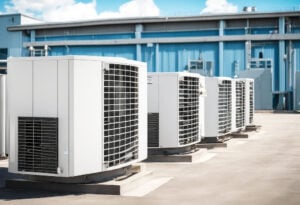
Types Of Commercial HVAC Equipment For Warehouses (Pros, Cons, And Applications)
Rooftop Units (RTUs)
RTUs are widely used in industrial and commercial facilities because they consolidate heating and cooling into packaged units and keep equipment off the floor.
Ideal for:
-
Large warehouses needing centralized heating/cooling
-
Facilities that want simpler access for service and maintenance
Key watch-outs:
-
Dust-heavy environments can reduce performance fast without proper filtration and service
-
High ceilings can create uneven comfort unless airflow distribution is addressed
-
Roof exposure can stress equipment without a reliability-focused maintenance plan

Variable Refrigerant Flow (VRF) Systems
VRF provides zoning flexibility and efficient part-load operation, especially helpful when warehouses include offices or temperature-sensitive zones.
Ideal for:
-
Facilities with mixed-use space (office + warehouse)
-
Operations needing different comfort needs in different areas
Key watch-outs:
-
VRF still needs a ventilation plan for fresh air
-
Best results require thoughtful design, controls, and commissioning
Evaporative Cooling (Where Climate Supports It)
Evaporative systems can be cost-effective in hot-dry regions and naturally move more air through the building.
Ideal for:
-
Hot, arid climates where humidity is consistently low
Key watch-outs:
-
Not well-suited to humid regions
-
Added moisture can conflict with product or material requirements in some facilities
HVLS Fans (High Volume, Low Speed)
HVLS fans don’t cool air directly, but they dramatically improve air movement and destratify hot air that gets trapped near the roof—boosting comfort and improving how well conditioned air reaches the floor.
Ideal for:
-
High-ceiling warehouses with hot pockets and uneven temperatures
-
Facilities aiming to improve occupant comfort and reduce stagnant air
Key watch-outs:
-
They are a support solution—pair them with HVAC and ventilation strategy for best results
-
Placement must consider racking, lighting, and fire protection constraints

Airflow Patterns: The Most Common Reason Warehouse HVAC “Doesn’t Work”
Warehouses often fail on airflow, not equipment. Red flags include:
-
Hot upper layers and cool lower layers (stratification)
-
Stagnant corners or mezzanine zones
-
Strong airflow in some aisles and no movement in others
-
Comfort complaints near dock doors (infiltration)
-
Equipment that runs constantly but never stabilizes conditions
Fix focus: Supply and exhaust placement, outdoor air strategy, mixing/destratification, and ductwork balance usually unlock performance faster than replacing units.
Control Technology: How To Improve Efficiency Without Replacing All Equipment
Modern control strategies can meaningfully improve performance and energy efficiency:
-
Demand-based ventilation (adjust fresh air to occupancy/CO₂ and humidity)
-
Scheduling and staging (avoid full-load operation when unnecessary)
-
Thermal mapping and zone sensing (find heat pockets early)
-
Automated dampers and louvers (optimize outdoor air and pressure balance)
-
Load shifting (pre-cool/pre-heat during off-peak utility periods)
In industrial facilities, better control is often the highest-value “innovation” because it improves outcomes using existing equipment—when the airflow strategy is solid.
Ductwork And Installation: Where Performance And Efficiency Are Won Or Lost
Even industry-leading equipment underperforms with weak installation. Common performance killers:
-
Leaky or poorly sealed ductwork
-
Imbalanced supply/exhaust causing pressure problems
-
Poor diffuser and return placement creating dead zones
-
Inadequate commissioning (systems never tuned to the building)
If two facilities install similar commercial HVAC equipment but get different results, the difference is often ductwork quality, airflow planning, and control configuration.
Reliability And Service: Protecting Compressors And Preventing Costly Breakdowns
Warehouse environments are tough on HVAC equipment. Reliability depends on a preventive plan that matches your facility:
-
Regular filter changes (especially in dusty operations)
-
Coil cleaning to maintain airflow and heat transfer performance
-
Refrigerant checks and inspections to protect compressors
-
Fan/motor/belt inspections to keep air moving reliably
-
Drain and moisture management to prevent corrosion and microbial growth
Operational value: reliability is not only about comfort—it protects uptime, reduces emergency service calls, and preserves energy efficiency over time.
How To Execute Warehouse HVAC Decisions During Site Selection And Keep Them On Track
The hardest part of warehouse HVAC isn’t understanding the options—it’s ensuring the building and the project can deliver the required performance.
REoptimizer® For Site Selection In Industrial Facilities
REoptimizer® supports site selection by helping teams evaluate a warehouse’s HVAC feasibility in context—seeing how building factors and geographic considerations can affect:
-
airflow distribution potential in large-volume space
-
viability of outdoor air strategies (including outdoor air handling units)
-
constraints that affect installation and long-term efficiency
-
comfort and sustainability requirements across facilities being compared
REoptimizer® For Project Monitoring And Performance Alignment
REoptimizer® supports project monitoring by keeping performance requirements visible as designs change:
-
maintaining clarity on ventilation intent and outdoor air assumptions
-
tracking decisions that affect airflow patterns and occupant comfort
-
supporting coordination around installation, controls, and deliverables
-
reducing the chance that scope changes undermine reliability and efficiency
In short: the right system is a combination of equipment, airflow design, and controls—and REoptimizer® helps teams choose facilities that can support that solution and keep the project aligned until handoff.

Frequently Asked Questions
What Does “Commercial HVAC” Mean For Warehouses?
In this context, commercial HVAC refers to industrial-grade heating, ventilation, and cooling systems used in warehouses and distribution facilities—focused on airflow, fresh air, energy efficiency, reliability, and occupant comfort at large scale.
What Commercial HVAC Equipment Is Most Common In Warehouses?
Many warehouses use RTUs or AHUs paired with mechanical ventilation or outdoor air strategies. HVLS fans are commonly added to improve airflow and destratification.
Do Warehouses Need Outdoor Air Handling Units?
Not always, but they’re often beneficial when consistent fresh air delivery, better air quality control, or stable ventilation performance is required.
Why Is My Warehouse Still Hot Even With Cooling?
Usually because of airflow distribution problems—stratification in tall spaces, dead zones, infiltration at dock doors, ductwork leakage, or poor supply/return placement.
What Improves Warehouse HVAC Energy Efficiency The Most?
Right-sizing, fixing airflow distribution, sealing ductwork, and implementing control strategies (demand ventilation, staging, scheduling) typically drive the biggest real-world gains.
When Prologis talks, the logistics world listens. With visibility into thousands of facilities across global markets their analysis is a working blueprint for how occupiers will need to adapt.
The short version: Vacancy is tightening where you want to be, utilization is rising, trucking is getting more expensive, power is the new gating factor, and specialized demand (e-commerce, manufacturing, defense) is quietly rewriting what “prime” industrial really means.
If you’re a large corporate tenant with a national or global footprint, this isn’t background noise. It’s a direct signal to reassess where you’re located, how much space you’re holding, and what kind of buildings you’ll need next.
1. Utilization Is Rising: Slack in the System Is Disappearing
Prologis’ analysis shows U.S. warehouse utilization is climbing but still below the expansionary threshold of 85.5%. The move upward in 2025 has been led by essential goods, e-commerce, and manufacturing users, with wholesalers and manufacturers frontloading inventory earlier in the year and retailers following heading into the holidays.

If the current pace continues, Prologis projects customers will hit functional capacity in 2026. Historically, this pattern has preceded sharp tightening: utilization rebounded quickly in 2014–2015 and 2021–2022 after periods of elevated vacancy and “logistics slack.”
Translation for occupiers: the window where you can “take your time” on new site decisions is closing.
What tenants should take from this:
- If you’re running hot on utilization today, assume you’ll be competing for space in 12–18 months — not browsing.
- If you’ve been using “excess” locations as a buffer, that slack may become more expensive to replace later.
- This is a good time to audit your portfolio: which sites are truly strategic, which are legacy, and where will you need expansion rights or options?
2. E-Commerce Is Still the Quiet Dominant Force in Leasing
Prologis expects e-commerce companies to account for nearly 25% of new leasing in 2026, as the proportion of goods sold online approaches about 20% globally. And this isn’t just Amazon in big U.S. metros anymore.
Key dynamics Prologis highlights:
- Global online penetration is expected to reach ~19.7% by 2026.
- Asian e-commerce players that entered the U.S. via direct leases and 3PLs are now expanding into Europe and Latin America for cross-border fulfillment.
- In India, platforms like Flipkart and Walmart are adding capacity to serve domestic and export demand.
- De minimis rule changes in the U.S. are pushing e-commerce companies toward blended strategies: onshore inventory, sea-cargo cross-docking, and faster regional fulfillment to manage duties and cross-border complexity.
Why this matters for large occupiers:
You don’t have to be an e-commerce brand to feel the impact. When 25% of new leasing is driven by one use case, that cohort sets the bar for location, speed, and building specs:
- Expect continued competition for close-in, high-throughput facilities in major consumption zones.
- E-commerce demand raises expectations for clear heights, loading ratios, parking, automation readiness, and power — and landlords will price accordingly.
- If your business model depends on slower decision cycles than e-commerce players, you’ll need better data and earlier internal approvals to avoid being outmaneuvered.

3. U.S. Gateways Are Back in Favor (on New Terms)
During the pandemic, coastal gateway markets like the Inland Empire and New Jersey saw rents spike far ahead of the rest of the U.S. That gap has since narrowed. Prologis notes:
- Rent premiums that “blew out” during the pandemic have compressed back toward pre-pandemic spreads.
- As networks evolve to manage both cost and service, coastal and near-port markets are poised for a demand recovery, with:
- Access to dense population centers
- Better availability of modern Class A stock
- Rents that have “reset” to more sustainable, though still premium, levels
Why this matters for your network design:
- If you pulled back from coastal markets purely on cost, it may be time to re-run the math. Transportation is getting more expensive (more on that below), which shifts the value back toward well-located, rent-pricier facilities.
- The price-to-value ratio for gateway locations looks more attractive than it did at the 2021–2022 peak.
- Corporate tenants that move early can secure modern buildings in strategic positions while there’s still some optionality.

4. Power Is the New Location Filter
Location used to mean proximity to ports, highways, labor, and rooftops. In 2026, power availability joins that list as a top-three factor in site selection, according to Prologis.
Several pressure points they highlight:
- In Europe, new development is constrained by grid connection delays and capacity caps, driving interest in micro-grid and on-site solutions.
- In Mexico’s manufacturing-heavy markets, lack of power is already the top constraint for new tenants; transformer utilization in major hubs exceeds recommended levels.
- In the San Francisco Bay Area, Prologis estimates only around 2% of 110/230 kV substations that can serve industrial/logistics users have available firm capacity.
- Fully automated facilities can use 3–5x more power than a 2024 baseline.
What tenants need to change in their approach:
- Stop treating power as a checkbox and start treating it as a core underwriting variable. It should sit alongside rent, TI, and transportation in your internal models.
- Ask for detailed utility profiles during site selection: existing capacity, potential upgrades, timing, and cost — not just “power: yes.”
- If automation, advanced manufacturing, or dense robotics are on your roadmap, you’ll need ahead-of-curve power planning, not “we’ll deal with that in phase two.”

5. Defense and Advanced Manufacturing Are Soaking Up Specialized Space
Prologis expects defense-related demand in the U.S. and Europe to create a new class of specialized logistics and industrial assets:
- European countries are signaling plans to increase defense spending to about 5% of GDP, up from an average of 2.5% in 2024.
- Spending and activity are clustering in strategic industrial corridors across Germany, France, Italy, the UK, the Netherlands, and Poland.
- In the U.S., elevated DoD spending supports steady demand, but what’s changing is the diffusion of work: more small and midsize suppliers entering the market and leasing industrial space for localized, secure, and often power-intensive operations.
- Many of these users are targeting older, well-located product that happens to feature strong power and heavy manufacturing specs built during prior industrial booms.
Why non-defense tenants should care:
- You may find yourself competing for the same high-spec, high-power, well-located assets, even if you’re not in aerospace or defense.
- Older buildings with strong bones and robust utilities are being re-rated upward, especially in legacy industrial corridors.
- If you rely on similar specs — heavy utilities, secure operations, specialized floor loads — you can’t assume legacy space will remain “discount” forever.

6. Trucking Capacity Is Shrinking — and Freight Costs Are Rising
If you build your network assuming transportation capacity will be there at the right price, 2026 may test that assumption. Prologis points to:
- A shrinking pool of U.S. truckers as the freight recession drags on and new regulations (including English language requirements) push some drivers out.
- Smaller carriers under stress, with active carrier authorities 12% below their 2022 peak.
- National tender rejections up over 100 basis points vs. 2024, foreshadowing tighter conditions and higher rates.
- Spot rates up 4% compared with the 2024 average, with further increases expected into 2026.
- Freight costs up 3.5% in 2025, with Prologis expecting double-digit rate hikes in 2026.
Their conclusion: transportation will take an even larger share of total supply chain spend, and well-located logistics real estate becomes a hedge against those rising costs.
The strategic takeaway for occupiers
- Your total cost of occupancy must now explicitly integrate transport cost trajectories, not just today’s rates.
- Facilities that shorten last-mile or middle-mile routes, reduce empty miles, or enable mode-shifting (e.g., to rail or port drayage) will justify higher rent — and still be cheaper on a total landed cost basis.
- Network optimization isn’t a one-off project. It’s now part of ongoing portfolio management.
So What Should Large Tenants Do Now?
Given Prologis’ vantage point and past predictive accuracy, it’s reasonable to treat these signals as a working scenario, not a speculative story. For large-scale corporate tenants and C-suite executives, the playbook for 2026 looks something like this:
- Audit your utilization and pipeline.
Know where you’re trending toward capacity, where you’re underutilized, and where you’ll need flexibility. Build options — not just fixed commitments — into critical markets. - Revisit your network design with updated cost assumptions.
Factor in rising freight costs, tighter trucking capacity, and more expensive power. Locations that once felt “too expensive” on rent may now be cheaper when you include transport. - Prioritize power in every RFP.
Require clear documentation of available capacity, upgrade paths, and timing. If automation or manufacturing are part of your plan, treat power as a board-level risk, not an engineering footnote. - Watch the competitive set beyond your own industry.
You’re not just competing with other retailers, manufacturers, or tech firms. You’re competing with e-commerce giants, defense suppliers, and advanced manufacturers for a finite pool of high-quality industrial product. - Use data to negotiate and prioritize.
Prologis’ research shows directional trends; your internal data shows your actual cost-to-serve by node. Combine the two to decide where rent truly matters and where transportation and power are the real swing factors.
The industrial market heading into 2026 isn’t collapsing, and it isn’t exploding. It’s tightening, re-pricing, and re-sorting around power, proximity, and performance. Prologis’ latest outlook offers a clear message: the companies that treat logistics real estate as a strategic lever — not a back-office line item — will be the ones that come out ahead.
The market is rewarding companies that treat logistics real estate as a strategic weapon. REoptimizer® shows you exactly where to cut cost, capture opportunity, and outmaneuver competitors. Spot inefficiencies, reveal savings, and model smarter logistics decisions in minutes. Discover the platform built for the new 2026 landscape. Unlock the insights — see how it works.
Learn More
The big-box industrial market has quietly shifted in ways that matter for every major occupier.
After two years of volatility—construction surges, vacancy swings, and demand patterns that refused to stay predictable—the data is finally pointing to a market that’s stabilizing, not stalling. Q3 delivered 36 million square feet of net absorption, the strongest quarterly performance since 2023, and vacancy held essentially flat at 7.5%. Supply pipelines have compressed to their lowest level in nearly a decade, and leasing velocity is improving in the segments that anchor national distribution networks.
It’s not a reset back to pre-pandemic norms, and it’s not a continuation of the warp-speed years either. It’s something more strategic: a market reorganizing itself around new operational priorities—labor, transportation, automation, reshoring, and cost discipline. And for large-scale tenants, this creates real decisions, real leverage, and real risk if they misread the moment.
1. Understanding the Market You’re Actually In
For the first time in several years, industrial fundamentals are behaving like a market with guardrails instead of an open throttle.
Absorption is Back — and Big-Box is Driving It
Newmark’s Q3 data shows that big-box facilities were the primary engine behind the quarter’s strength. This is consistent with recent research across the sector:
-
Over 159 million sq. ft. of big-box space was absorbed in 2023.
-
Retailers, wholesalers, and 3PLs represented more than 70% of leasing activity.
-
Vacancy rose from 3.3% in 2022 to 6.6% in 2023, then stabilized into 2024.
That movement from extremely tight to moderately supplied is the shift tenants have been waiting for.
Development is Shrinking — Fast
The construction pipeline shows the most meaningful structural change:
-
About 260 million sq. ft. is currently under construction—the lowest level since 2016.
-
Construction in progress in 2023 fell by nearly 50%, cutting future supply dramatically.
-
Many markets saw construction starts drop 50–70% from recent peaks.
This contraction means tenants temporarily benefit from more availability, but longer-term scarcity is baked into the next cycle.

Vacancy is Rising — But Not Everywhere
Markets with the lowest vacancy today include:
-
Los Angeles County: 4.2%
-
Minneapolis: 4.2%
-
Broward County: 4.7%
-
St. Louis: 4.8%
-
Detroit: 4.9%
High-supply markets like Dallas, Indianapolis, Phoenix, Savannah, and Central Florida, meanwhile, are posting 8–12% vacancies depending on size segment.
This is why it’s not a simple tenant’s market or landlord’s market — it’s a segmented market.
2. The Market’s “Balanced Phase” and What’s Actually Behind It
Executives don’t need slogans; they need to understand drivers. Here are the forces reshaping the market.
Demand is Normalizing, Not Disappearing
Occupier demand is still healthy:
-
Retailers & wholesalers remain the largest share of demand at about 36%.
-
3PLs are close behind at roughly 35%.
-
Food & beverage, automotive, medical, and other sectors continue to expand.
These groups aren’t shrinking — they’re recalibrating after years of overextension.
Supply Chain Resilience > Safety Stock
Occupiers are prioritizing:
-
Multi-node fulfillment networks
-
Proximity to customers
-
Transportation efficiency
-
Locations that can support automation
-
Labor availability and cost
This shift redefines what “good real estate” looks like.
Capital Markets are Stabilizing
Investment activity increased 11% YOY, led by major transactions and consistent pricing.
Cap rates held steady in the mid-5% range for 12 straight months, indicating:
-
Stable owner expectations
-
Reduced distress
-
More predictable underwriting
Tenants shouldn’t expect landlords to lower pricing out of financial pressure.
3. Regional Insights that Matter for National Occupiers
A national strategy only works when grounded in regional realities.
The Southeast remains the growth engine
Atlanta, Savannah, Nashville, and Central Florida continue to outpace national absorption. Savannah alone grew almost 13% in 2023, the highest in the country.
Vacancy is still manageable, and construction is slowing, giving tenants a valuable negotiation window.
Texas: strong demand, high supply, real leverage
Dallas–Fort Worth posted:
-
32.4M sq. ft. of leasing
-
28.3M sq. ft. of net absorption
-
53M sq. ft. of deliveries — the most in North America
Short term: tenants have leverage.
Long term: supply tightening is likely.
Houston delivered 32.7M sq. ft., equal to 14% of its inventory, driving vacancy to 7.8%, but absorption remained strong. Another tenant-friendly short-term environment.

The Midwest is Recalibrating After Heavy Development
Chicago, Indianapolis, and Columbus absorbed space but were hit by delivery waves:
-
Chicago vacancy climbed to 5.8%
-
Indianapolis spiked to 11.6%
-
Columbus settled at 7.4%
These markets currently present some of the strongest negotiating conditions for tenants.
Southern California Remains Supply Constrained
Inland Empire vacancy rose from 0.1% to 3.7% but remains among the tightest industrial markets globally. Rental rates continue to lead the continent. If IE is mission-critical, tenants must plan early.
4. What This Means for Tenants Right Now
This is the most strategically important window for big-box tenants since 2015.
1. You Have Leverage (Selectively)
Most negotiable markets today:
-
Dallas–Fort Worth
-
Indianapolis
-
Phoenix
-
Columbus
-
Central Florida
-
Savannah
If you have renewals or expansions in these regions, you should be running competitive site and landlord processes.

2. Renewals are a Major Opportunity
Landlords are increasingly open to:
-
Expansion rights
-
Renewal options at controlled pricing
-
Modified term structures
-
Early renewals
-
Concessions tied to operational improvements
Even in stronger markets, flexibility is more attainable than in the past three years.
3. Incentives and Labor Should be Weighted More Heavily
Labor represents 50–70% of total operating costs, and incentives can materially lower long-term occupancy costs.Top states and metros continue to deploy:
-
Job creation tax credits
-
Training grants
-
Payroll-tax incentives
-
Property tax abatements
-
Infrastructure assistance
These can offset millions over a 10-year term—often more than rent savings alone.
4. Automation-Readiness is Becoming Standard
Modern big-box requirements increasingly include:
-
Higher clear heights
-
Multiple mezzanine levels
-
Advanced sprinkler systems
-
Heavier floor loads
-
Abundant trailer and car parking
-
Significant power availability
Facilities without these capabilities will become less competitive and harder to renew into.
5. The Scarcity Cycle is Coming
With construction pipelines cut by half or more:
-
Availability will tighten in 2026–2027
-
Large-format spaces (750K+) will become scarce
-
Rental growth will resume, especially in port and inland-port markets
Tenants planning network expansions or consolidations should not wait.
5. What C-Suite Leaders Should Be Paying Attention To
Executives need visibility into the strategic implications—not just the leasing environment.
- Are we positioned in the right locations for future demand patterns? Population migration, manufacturing realignment, and nearshoring are reshaping logistics maps.
- Do we have the flexibility to pivot as operations evolve? Rights, options, and structuring matter more than simple rent levels.
- Are we exposed to labor risk? Labor availability should dictate more decisions than rental rates.
- Is our portfolio automation-ready? Facilities that can’t adapt will underperform operationally.
- How will our total cost of occupancy behave over the next decade? Transportation, labor, incentives, rent, and operating costs must be viewed as a unified system
The Advantage Belongs to Tenants Who Act in This Window
The industrial market is not overheated, chaotic, or unpredictable. It is measured, rational, and finally conducive to strategic planning again. For tenants, this period offers:
-
More optionality
-
More availability
-
More leverage
-
More strategic clarity
-
More opportunities to optimize cost and performance
But the window is temporary. Construction pullback guarantees future tightening, and demand is slowly regaining momentum.
The decisions major occupiers make in the next 12–24 months will determine their logistics performance and cost structure well into the next decade. The companies that act now will shape their portfolios proactively. Those that wait will navigate whatever the market gives them.
That’s where REoptimizer® becomes a strategic advantage.
As availability peaks, incentives expand, and market conditions vary by region and building type, REoptimizer® gives corporate occupiers the ability to:
-
See where the real leverage is — not just where asking rents look attractive
-
Map optimal locations based on labor, transportation, tax, and operational performance
-
Model long-term occupancy cost scenarios across multiple markets
-
Identify expansion, consolidation, or renewal opportunities before competitors move
-
Negotiate from a position of strength, backed by real-time market intelligence
This is the moment when tenants can materially reset their industrial portfolio — cost, performance, risk profile, and resilience.
And REoptimizer® is built for exactly this window:a shifting, opportunity-rich market where better information leads to better decisions.
If you’re planning renewals, evaluating network changes, or preparing for 2026–2027 scarcity, now is the time to act intentionally — and with the right platform.
Let’s position your portfolio to win the next cycle, not react to it. Learn more today.
If you follow the U.S. industrial market, you’ve probably gotten used to a particular storyline over the past few years: record-breaking e-commerce growth, tight vacancy rates, relentless rent growth, and construction cranes populating the skyline from the Inland Empire to Dallas–Ft. Worth to Kansas City. But in Q3 2025, the NYC Outer Borough industrial sector delivered a different kind of plot.
Leasing slowed, net absorption slid into the red, and tenants became noticeably more selective as economic conditions, policy uncertainty, and higher input costs shaped decision-making. Yet for all that, pricing barely budged, new supply barely materialized, and the region’s critical role in national supply chains—including distribution operations, manufacturing, and even emerging green energy and data center infrastructure—kept fundamentals stable.
Corporate real-estate teams tracking industrial properties, construction pipelines, and key markets across the country will find familiar patterns here: slowing but not collapsing demand, sticky rents, cautious investment activity, and a back-to-basics recalibration of how companies use space.
Let’s break down the key trends shaping the NYC market—and what large tenants should be doing now to stay ahead.

Leasing Activity Slows as the Market Takes a Breath
The headline from Q3 is simple: leasing cooled. According to the report, leasing activity dropped 52.8% from the previous quarter, totaling 735,469 square feet, and marking a 13.2% decline year-over-year. For context, this slowdown follows several multiple years of deals that often exceeded pre-pandemic levels, fueled by manufacturing investment, reshoring, and the national obsession with efficiency in logistics.
And while New York didn’t see the blockbuster “50 tenants fighting for one building” energy of 2021–2022, the industrial real estate market isn’t exactly collapsing. What’s really happening is a shift in who is transacting—and for how much space.
The Rise of the Small and Mid-Sized Tenant
Instead of big national 200,000-SF requirements, Q3 deals centered on smaller footprints, with Brooklyn and Queens representing 80% of all leases signed. The largest new lease? A modest 61,425-SF commitment in South Queens. Other notable deals clocked in at 50,000 SF, 35,000 SF, and 31,450 SF. In other words, demand hasn’t disappeared—it’s just wearing a smaller pair of shoes.
For corporate CRE teams with national portfolios, this mirrors what we’re seeing in several markets across the country: tenants using this phase of economic uncertainty to recalibrate operations, downsize inefficient footprints, or strategically expand only into buildings that offer compelling value.

Negative Absorption Pushes Availability to 9.7%—Still Low by National Standards
The market posted –161,306 SF of net absorption, pushing availability from 9.5% to 9.7%. Before you panic, let’s put that into perspective:
-
The Bronx and Staten Island—with large single vacancies—skew the average.
-
North Brooklyn sits at a virtually nonexistent 5.0% availability rate.
-
Northeast Queens is even tighter at 5.3%.
-
The national u.s. industrial vacancy rate is hovering around the mid-4% range.
So yes: New York saw negative absorption, but it remains one of the country’s most constrained industrial markets, with high barriers to entry, zoning constraints, and basically no land left unless someone wants to build a warehouse on the deck of the Kosciuszko Bridge.
The biggest drag on absorption was the return of a 127,587-SF warehouse in Central Queens to the market—one large block can swing a quarter’s statistics. Corporate occupiers reading too much into one quarter’s downward pressure might miss the bigger picture: this is a market that historically snaps back hard the moment demand firms.
Pricing Holds Firm Despite Softer Demand
Perhaps the most surprising storyline of Q3: rent growth did not fall off a cliff. The average asking rent ticked up slightly to $27.64 per square foot, though still 2.4% below the same period last year. Why is pricing so sticky? Because even when leasing slows, the supply of functional industrial buildings in New York is—technically speaking—laughably small.
A few factors keep rents elevated:
1. The Scarcity Index Doesn’t Lie.
Even with some new space hitting the market in recent years, the total industrial inventory is a rounding error compared to markets like Chicago or Dallas. When your entire borough’s available inventory fits into a single million-square-foot Midwestern mega-shed, rents aren’t likely to crater.
2. Class A Buildings Still Command Premiums.
Newer facilities—especially multi-story ones—are quoting rents in the mid-to-high $30s per square foot. And tenants pay it because access to dense populations shortens delivery windows, cuts last-mile costs, and supports distribution operations that depend on speed.
3. Landlords are Using Concessions Instead of Cuts.
Free rent and TI packages are up. Rent reductions? Still not fashionable.
Construction Starts Slow Dramatically—Which Supports Future Rent Growth
If you’re waiting for a wave of new construction deliveries to rebalance supply and put downward pressure on rents… don’t. New York saw no new inventory delivered this quarter, and just 1.2 million square feet remains under construction—barely 0.8% of total inventory. For context, the nation’s top key markets regularly have 20–40 million square feet under development at any given time.
Why the slowdown?
-
Higher input costs continue to make proformas painful.
-
Institutional investors have hit pause on speculative ground-up projects.
-
Trade policies, zoning hurdles, and permitting timelines slow everything.
-
Debt is pricey, even after anticipated future interest rate cuts.
Of the few projects moving forward, the biggest is a 682,000-SF multi-story development in Northwest Queens. Multi-story continues to dominate NYC industrial development, representing 70%+ of the pipeline. In short: supply is not coming to save tenants. Not soon, anyway.
What Tenants Need to Know Now: Strategy Matters More Than Ever
With markets across the country showing signs of transition, corporate occupiers are recalibrating their strategies nationwide. But New York requires especially sharp decision-making. Here’s what you need to focus on in the fourth quarter and into 2026:
1. Don’t Assume Slowing Demand Means Cheap Space.
The NYC industrial market is not like others. It does not respond quickly to economic uncertainty, nor do landlords panic when one quarter posts negative absorption. Expect modest rent growth to resume once demand stabilizes.
2. Start your Search Earlier than Ever.
With availability under 10% and much of that in buildings that would make your operations VP cry, tenants needing large blocks have limited options.And with so little new construction, options aren’t improving soon. Time is leverage—use it.
3. Evaluate Operational Fit, Not Just Rent.
Given the scarcity of space, many tenants are looking at Class B buildings, older warehouses, or locations they would have dismissed multiple years ago. Before signing:
-
Audit production and distribution workflows.
-
Reassess logistics models (especially if operating pre-pandemic layouts).
-
Evaluate whether expanding to adjacent markets improves cost-per-delivery.
The “best” building may not be in NYC at all—hence the rise of regional strategies involving New Jersey, Pennsylvania, and even Upstate.
4. Incorporate Resilience Planning Into Site Selection.
The “one-warehouse-to-rule-them-all” model is fading. Companies are prioritizing:
-
diversified supply chains
-
redundancy for data centers
-
alternative energy and green energy compatibility
-
proximity to labor pools and transportation
These are not fringe concerns anymore—they are corporate imperatives.
5. Consider Embedded Flexibility in Leases.
Shorter terms, contraction options, and expansion rights are back on the table. In a market with high rents and tight availability, flexibility is a form of insurance.
6. Use Market Intelligence to Negotiate Concessions.
Landlords may be holding the line on rents, but the moment your engagement sends a signal to the market, you’ll find:
-
more free rent
-
greater TI allowances
-
a willingness to subdivide or reconfigure space
-
landlord appetite for creative structures
Your advantage comes from knowing where the landlord’s pain points really are.

Zooming Back Out: How NYC Fits Into the National Industrial Story
Stepping outside New York for a moment, the national landscape is dominated by similar crosswinds:
-
Some markets showing positive absorption, others posting negative absorption.
-
New construction slowing across the country.
-
Manufacturers ramping up in select regions fueled by federal incentives like the Big Beautiful Bill Act (yes, it’s a working title people are actually using).
-
Shifts in trade policies affecting inventory strategies and operations.
-
Large amounts of new space delivered in 2022–2023 finally working through the system.
-
Corporate occupiers balancing the reality of policy uncertainty with the necessity of long-term planning.
For executives running multi-market portfolios, the message is consistent: Stay informed, stay flexible, and assume that the industrial sector will remain tight—even as demand ebbs and flows.
Final Takeaway: The NYC Industrial Market Isn’t Cooling—It’s Maturing
Q3 2025 was not a boom quarter. It wasn’t supposed to be. What it was, however, is a snapshot of a market finding equilibrium after an unprecedented run.
For tenants, the outlook is surprisingly favorable:
-
No race-to-the-bottom bidding wars.
-
Real opportunities for negotiation.
-
Strategic optionality in both core and adjacent geographies.
-
The ability to re-align footprints with long-term operational goals.
But don’t mistake opportunity for abundance. The fundamental truth of the NYC industrial market hasn’t changed:There’s still far more demand than supply—just momentarily taking a breath. For corporate leaders planning 2026 and beyond, now is the time to lock in space, maximize flexibility, and design operational frameworks that can withstand whatever the next chapter of the industrial sector brings. Because if history is any guide, the next surge in demand isn’t a matter of “if”—it’s a matter of which quarter it hits.
And in a market where leasing cools one quarter, rents hold firm the next, and supply barely trickles in, the companies winning are the ones with the best information—not the most time or the largest footprint.That’s where REoptimizer® and CRESiteIQ® come in.
REoptimizer® gives corporate tenants the ability to model scenarios, compare markets, and quantify the operational impact of everything from rent growth to supply chain shifts—long before a lease hits renewal.
CRESiteIQ® delivers real-time market intelligence across key industrial markets, tracking shifts in vacancy, absorption, construction, and pricing so you can anticipate change instead of react to it.
Together, they turn market volatility into strategic clarity—helping large occupiers negotiate smarter, plan earlier, and align real estate decisions with the future of their operations. Learn more about how they level up your portfolio today.
For the better part of a decade, industrial real estate has been defined by scale: million-square-foot behemoths, towering clear heights, and enough trailer parking to serve a small country. Corporate occupiers, retailers, logistics operators, and manufacturing giants all raced to build or lease the next large bulk distribution property in their supply chain.
But as economic cycles shift, consumer behavior evolves, and costs continue northward, a new workhorse asset class is stealing the spotlight—small-bay industrial.
Once dismissed as an unglamorous corner of the industrial sector—filled with HVAC contractors, micro-manufacturers and niche distributors—small bay industrial spaces have quietly become one of the most competitive, supply-constrained and strategically important components of modern logistics and operations planning. And now, national tenants, portfolio operators, and sophisticated corporate real estate teams are paying attention.
The question for corporate occupiers is no longer Why would we consider a small bay industrial property? It’s now How fast can we secure one before someone else does?
Let’s break down the data, the market trends, and most importantly, what large-scale occupiers need to understand as this asset class reshapes the industrial landscape.

Small Bay Is Outperforming Other Industrial Spaces
Across the U.S. industrial market, the story is remarkably consistent:
- Vacancy for small bay industrial spaces is just ~4.2%, compared to 7.4% for large properties.
- Rents for small bay industrial buildings have surged over 40% since 2020—outpacing most other forms of industrial real estate.
- In Q2 2025, 62% of all industrial sales under $25M were small-bay properties, totaling nearly $5.9B.
- Average sale prices have climbed 55% since 2020, reaching $104/SF.
After many years of “bigger is better,” the industrial sector has flipped its script. Today, smaller industrial spaces are commanding higher demand, stronger rent growth opportunities, and more investor attention than large bulk facilities.
Why? Because small bay industrial is structurally under-supplied—and tenants from nearly every industry segment have realized these buildings solve problems that large boxes simply can’t.
Why Commercial Real Estate Has Room for Small Spaces
Small bay industrial properties, typically 2,000 to 50,000 square feet (sometimes up to 150K SF depending on the market), bring a different value proposition—one that aligns tightly with modern operating pressures:
1. Strategic Infill Locations
Small bay industrial buildings are disproportionately located in dense, infill markets—where land is scarce, entitlement is arduous, and consumers live.
They offer:
- Easy access to city centers
- Shorter distances to customers
- Faster last-mile delivery
- Better connectivity for technicians, service providers, and field ops teams
These locations are also where new development rarely pencils—because replacement costs, zoning restrictions, and competition with residential or mixed-use projects make land prohibitively expensive.
This limited supply is exactly why property values and market rents are climbing so aggressively.
2. A Larger, More Diverse Tenant Base
Corporate tenants aren’t just competing with other large companies for these buildings—they’re competing with:
- Small businesses
- Local contractors
- Micro-fulfillment operators
- E-commerce brands
- Specialty manufacturers
- “Fabric of society” users—everything from millwork shops to batting cages
This diverse tenant base gives property owners pricing power, shorter WALT (weighted average lease term), and the ability to reprice rents frequently. For corporate tenants, it means competition is fierce—even for spaces that would’ve been considered “too small” five years ago.
3. Shorter Lease Terms = More Agility (and More Rent Increases)
While long-term leases provide stability for large bulk distribution properties, they can feel like handcuffs in volatile markets.
Small bay industrial spaces generally offer:
- 3-5 year lease terms, not 10-15
- More flexible expansion/contraction opportunities
- Lower absolute rent obligations
- Less risk exposure
That flexibility is appealing to corporate occupiers navigating rapid operational changes—but it also means frequent repricing, which supports landlords and gives them inflation protection.

4. Operational Efficiency
Many businesses have realized they don’t need—and often can’t effectively use—a million-square-foot warehouse. Small bay facilities offer:
- Right-sized footprints
- Lower energy and facility costs
- Faster occupancy build-outs
- “Close-to-customer” functionality
In an economy where margins are thin and speed is a competitive advantage, the right 10,000 SF in the right location can outperform a giant box 40 miles outside town.
The Supply Problem in the Industrial Sector
Here’s where things get tricky: Everyone wants small bay—but almost no one is building it.
Developers say new supply doesn’t pencil without rent levels that tenants simply won’t pay. Why?
- Construction costs for small buildings are higher per square foot.
- Land prices in infill locations are inflated and better suited for multifamily or retail.
- Municipal requirements (parking, landscaping, stormwater management) scale poorly with smaller footprints.
- Higher interest rates have made underwriting new development even tougher.
- And the walls—literally—cost more. Smaller rectangles require more perimeter walling relative to floor area.
Even when developers turn to cost-saving options like preengineered metal walls, the savings are often negligible unless the building shape is perfectly optimized. Investors dislike metal walls anyway because they trade at lower yields on exit.
The result? New development is nearly nonexistent, outside of:
- build-to-suit projects for users who can afford to control their real estate
- speculative flex parks on discounted land
- “friends and family” projects where local capital keeps costs manageable
This supply constraint is why small bay rents keep rising—even in markets with flat or declining big box rents.
Regional Hotspots: Where Demand Is Surging the Fastest
While small bay industrial demand is national, certain markets are experiencing explosive pressure:
West
- Phoenix East Valley
- Reno
- Boise
Drivers: affordability, population growth, proximity to West Coast consumers.
Midwest
- Grand Rapids
- Columbus
- Chicago suburbs
Drivers: manufacturing resurgence, reshoring, diversified local industries.
Southeast
- Central Florida
- Nashville
- Atlanta
Drivers: population inflows, logistics demand, rents up to 100% in some areas.

Northeast / Mid-Atlantic
- Lehigh Valley
- South Jersey
- NYC outer boroughs
Drivers: severe infill constraints, dominant last-mile demand, micro-industrial parks.
In markets like Philadelphia, shallow-bay rents are up ~9% year over year—faster than Chicago, Atlanta, and Dallas, according to CompStak.
But even with strong rent increases, the premium over large industrial properties in Philly remains just 7%, compared to 21% in other metro areas—showing how underpriced the segment still is.
Why Investors Are Buying Everything in Sight
Investors—private equity, REITs, international capital, and local owner-operators—have discovered what tenants know all too well: small bay industrial is operationally sticky and extremely difficult to replace.
They like this segment because it provides:
- High renewal probabilities
- Sticky tenants (moving is expensive for small businesses)
- Shorter leases = constant mark-to-market opportunities
- A compelling investment thesis amid inflation
Cap rates on stabilized assets are in the mid-6% range, with value-add targeting 7–8% yields on cost—very attractive relative to other commercial real estate categories.
Many investors are pursuing aggregation strategies: buying older 1970s–1990s light industrial buildings, upgrading them (lighting, loading docks, office refreshes), and bundling portfolios for institutional sale.
If it feels like every small bay facility in your market has suddenly been repainted and is asking $2/SF more than last year… that’s why.
What Corporate Tenants Need to Know (Before the Space Is Gone)
1. Start Early—and Move Quickly
Small bay industrial spaces lease fast. Very fast.
If you’re used to evaluating 500K-SF options over several months, the small bay market will feel like speed dating: If you wait, someone else will sign—often a small business willing to pay more.
2. Expect Higher Rents (and Faster Increases)
Market rents are rising sharply, and asking rents often lag behind.
Tenants should expect:
- Multiple rent increases during a single business cycle
- Stronger landlord leverage
- Higher renewal rates
- Limited concessions
Shorter leases are great for flexibility—but they also mean more exposure to repricing.
3. Think Multi-Site, Not Mega-Site
One large facility may no longer be the answer.
Corporate occupiers are increasingly:
- Creating satellite networks
- Mixing mid-bay and small-bay locations
- Using smaller spaces to handle overflow, field teams, and same-day distribution
- Bringing inventory closer to customer clusters
It’s the industrial version of “hub and spoke”—and it works.
4. Understand the Replacement-Cost Problem
Even if a building looks outdated, it might be the best option available—because it cannot be replicated today.
Replacement cost often exceeds market rents by 20–40%—if zoning even allows a new build.
This makes older small-bay inventory functionally irreplaceable.
5. Get Creative With Space Needs
If your requirement is exactly 30,000 SF with 24’ clear, 3 docks, and heavy power… congratulations, you and 200 other tenants are looking for the same thing.
The companies that win in this segment:
- Stay flexible
- Consider slight modifications
- Accept older features when necessary
- Prioritize location over perfect specs
You can upgrade lighting. You cannot relocate a building five miles closer to customers.

6. Small Bay Requires Active Management—But Offers Big Benefits
These spaces often involve:
- Frequent lease rollover
- More operational touchpoints
- Greater coordination with contractors and vendors
But they give companies:
- Agility
- Proximity to customers
- Lower occupancy costs
- Better resilience across economic cycles
It’s a tradeoff—but one that increasingly works in tenants’ favor.
Small Bay Isn’t “Small” Anymore; It’s Strategic
Small bay industrial is no longer the forgotten side of the industrial market. It’s a growing segment, a supply-constrained asset class, and a critical tool for businesses navigating rapid change.
The combination of:
- limited new supply
- consistent demand
- shorter lease terms
- inflation protection
- diverse users
- and strategic infill locations
…has created a market where the smallest spaces now carry the biggest competitive edge.
For corporate real estate teams and C-suite leaders, the era of “mega-warehouse only” strategies is over. The future supply chain is distributed, flexible, and built around proximity—not size.
Let’s retire the headline “industrial rents are cooling.” It’s technically true, and strategically incomplete.
The more interesting (and investable) story is where the market is cooling, how pricing discipline is reemerging, and why the new-lease premium is compressing across port gateways. That spread—the gap between what tenants pay on new deals versus in-place rents—was the loudest siren of the boom. Now it’s the canary in the comedown.
Here’s the nuance: broad rent levels are still high (Los Angeles is at $15.32/sf, Orange County at $16.91/sf). But the premium for new leases has thinned in most coastal markets. In a few interior hubs, it has flipped negative (Cincinnati, Kansas City, Columbus), meaning new leases are being signed below average in-place rents. This is a pricing reset with very different implications depending on your submarket, your lease term, and your operational clock speed.
So don’t read this as a downturn. Read it as the return of microeconomics. The post-pandemic “all boats rise” phase is over. Port markets are decoupling. Tenant leverage is cyclical again. And the right question in 2025 isn’t “Are rents up or down?” It’s “Where is the spread telling me to push—and where should I pivot?”
West Coast: From Market Power to Price Discipline
The West Coast still sets the tone, but the meter finally clicked down.
-
Los Angeles: In-place rents at $15.32/sf with single-digit growth. New deals are landing near parity with existing agreements—translation: the “pay up or miss out” tax is gone in many submarkets.
-
Inland Empire: A headline +16% YoY to $10.70/sf, yet the new-lease premium that once ran hot is receding. Occupiers have negotiating power again, especially on commodity boxes and later-cycle deliveries.
-
Bay Area: +2% to $13.78/sf—muted, but notable given how tech-adjacent logistics used to outrun fundamentals.
-
Orange County: Still the West’s high-water mark at $16.91/sf, but growth has flattened—which is a story in itself after years of outperformance.
-
Seattle: Vacancy at 8.5%, a meaningful YoY jump, even as new deals keep a $2.42/sf premium. That split—rising vacancy yet positive premiums—suggests the quality bar is doing the talking. Best-in-class space still clears; the rest sits.
Signal to watch: Spread compression in LA/IE says landlords are pricing to clear and valuing certainty over stretch. For tenants, this is a window to trade term length and credit quality for TI and concessions. For owners, the underwriting math pivots from rent pop to lease-up velocity and downtime risk.
Northeast & Mid-Atlantic: Tight Supply, Hyperlocal Surges
The Northeast never moved as a monolith; now the granularity is the headline.
-
New Jersey: $11.99/sf in-place, up $1.13 YoY, still the regional anchor. The tempo slowed, but fundamentals remain tight around core corridors.
-
Bridgeport, CT: Outlier city. New deals at +$5/sf versus in-place rents, the largest premium in the country. That’s supply scarcity and “next-node” discovery colliding.
-
Philadelphia: +9.2% to $8.63/sf, solid for a market that’s gained logistics credibility each year.
-
Boston: +8% to $11.56/sf and a $3.51/sf new-lease premium—limited high-spec space is still commanding a check.
What it really means: We’re seeing micro-surges around specific interchanges and drayage-advantaged pockets. “Metro averages” obscure the opportunity. If you’re an occupier, benchmark by interchange (and sometimes by ramp), not by MSA. If you’re an owner, the value isn’t just rent—it’s the permitability, labor access, and turn-time embedded in that site.
South: Growth, Yes—Mania, No
The South’s headline remains “expansion,” but the emotional premium has drained out.
-
Miami: Up 10% to $12.85/sf, still the regional pace car—yet new-lease premiums are narrowing. First time we’ve said that in a while.
-
Baltimore ($8.61/sf) and Tampa ($8.37/sf): High single-digit to low double-digit gains; nothing frothy.
-
Atlanta & Houston: Still power markets, but new-lease spreads now sit around $2.30–$3.50/sf, down from the pandemic surge.

Read it this way: Cost of capital, construction completions, and a more rational demand curve have pushed landlords to price closer to absorption reality. That’s healthy. Tenants should use the calmer backdrop to secure expansion options and escalation caps before the next capacity squeeze.
Midwest: Negative Spreads and the Anatomy of a Pause
Here’s where the spread talks loudest. Several Midwestern markets—Cincinnati, Kansas City, Columbus—show new leases below in-place averages. That’s a tenant’s tell. It doesn’t mean these hubs lost their logistics logic. It means delivery cadence + normalizing demand = bargaining power on a timer.
Chicago and Minneapolis-St. Paul are showing modest gains well under national averages. For occupiers, the Midwest is where you time renewals proactively, and where 2025 could be the cheapest multi-year control you’ll buy this cycle.
How to Read the Market Without Being Fooled by Averages
Averages flatten opportunity. In a spread-compression market, you need a tighter KPI stack:
-
New-Lease Premium (or Discount) vs. In-Place Rent
Why it matters: It’s the real-time sentiment gauge. Narrowing or negative spreads flag leverage.
How to use it: In renewal talks, anchor to today’s signed deals, not last year’s asking rents. -
Vacancy + Quality Split
Why it matters: A rising headline vacancy can mask a flight-to-quality. (See Seattle: higher vacancy, but still a premium for top tier.)
How to use it: Tier your comps by age, clear height, dock ratio, trailer parking, and proximity to ramps/ports—then bid on the right tier, not the aggregate. -
Concession Mix & Effective Rent
Why it matters: Free rent and TI are back in play. Two deals at the same face rate can be 15–20% apart on effective basis.
How to use it: Model total occupancy cost per turn (rent escalation + op-ex + TI amortization + racking + automation lead time). -
Delivery Pipeline vs. Absorption Timing
Why it matters: The next 6–12 months of completions will decide how long spreads stay compressed in markets like IE and parts of the Midwest.
How to use it: Pull forward options where supply is peaking; pace decisions where the pipeline is thinning. -
Truck-Time Economics
Why it matters: In tight nodes, a 10–20 minute reduction in drayage or linehaul can justify a higher rent.
How to use it: Monetize minutes. If a site saves you 30 minutes per turn across 40 turns/day, the rent “premium” may actually be a discount.
Occupier Playbook: Five Smart Moves for a Spread-Compression Cycle
-
Trade Term for Concessions—But Keep Optionality
Landlords want certainty; you want flexibility. Offer credit + 7–10 year terms to unlock TI and free rent, then bake in early-termination rights or expansion/relocation options. Negotiate assignment language up front if M&A or network redesign is plausible. -
Cap Escalations and Index Transparently
The 2022–2023 escalation spikes are gone, but don’t assume 3% forever. Push for fixed caps or blended CPI with ceilings, and lock the base year op-ex treatment tightly. In markets like LA/IE where face rents remain stout, the escalation math is the edge. -
Renewal Timing: Add a “Soft Hold” to Your Calendar
In the Midwest, where negative spreads exist, set two strike dates:-
Soft hold (12–15 months out): Test the market with an RFP and ask for non-binding term sheets.
-
Hard go/no-go (8–10 months out): Decide to renew, blend-and-extend, or move—with actual alternatives in hand.
-
-
Monetize Speed and Certainty in Negotiations
If your build-out is light and your credit is strong, you are a low-friction tenant. Ask for a speed premium rebate—faster lease execution and earlier occupancy in exchange for free rent, abated increases, or landlord-funded racking power. -
Portfolio Rebalance: “Port-Plus-One” Instead of “Port-Only”
Coastal proximity still matters, but the economics of secondary nodes (think Bridgeport’s premium or Midwest concessions) are real. Pilot a two-node model: keep one high-velocity port-adjacent facility and shift overflow/returns or slower SKUs to an interior hub at a lower all-in cost.
Owner/Investor Lens: Underwrite to Durability, Not Lift
If you’re on the capital side, the 2025 underwriting edge isn’t a heroic rent growth line; it’s durable cash flow and faster lease-up. Spread compression tells you tenants are price-sensitive again. Pay attention to:
-
Downtime and TI cycles: Your true yield is a function of what it costs to backfill—not just the next face rent.
-
Spec differentiation: Clear height, power, and trailer parking separate “market-clearing” from “nearly there.”
-
Micro-location: The interchange-level story in the Northeast and drayage savings in LA/Long Beach are cash-flow, not just marketing.
-
Seattle-style bifurcations: Rising vacancy doesn’t automatically mean capitulation if your asset quality sits in the “still-premium” bucket.

Where the Data Bites: Micro Cases to Reframe Your Assumptions
-
Bridgeport, CT: New deals at +$5/sf over in-place is the definition of localized scarcity. If you’ve written off Fairfield County as “too small to matter,” the tenant math just changed your thesis.
-
Inland Empire: +16% YoY headline growth but narrowing new-lease premiums says we’re past the “pay anything” era. Translate that into more generous TI asks and escalation caps—not a bet on falling face rates.
-
Seattle: 8.5% vacancy looks scary until you realize quality still clears with a premium. Don’t generalize the market from the wrong comp set.
-
Midwest trio (Cincinnati/KC/Columbus): Negative spreads are a scheduling gift. Renew early, blend-and-extend, or upgrade space with minimal rent shock. This is where efficiency upgrades (automation, energy, racking) get funded by the rent delta.
From Scarcity Pricing to Operations Pricing
During the boom, rent was a tax on scarcity. In 2025, rent is a function of operations again. The market is pricing time, certainty, and fitness for purpose more than raw square footage. That’s healthier for everyone—tenants can model total cost with less volatility; owners can plan cash flows without assuming perpetual double-digit lifts.
And because this is a spread-driven cycle, the best deals won’t show up in averages. They’ll show up in the way your comps are constructed, the sequence of your negotiations, and the credibility of your timing.

Quick Checklist: What to Bring to Your Next Negotiation
-
Three tiers of comps (A/B/C quality) with effective rent math (free rent, TI, escalations).
-
A written escalation framework you can accept (fixed or CPI-capped) to accelerate agreement.
-
A two-site scenario (port + interior) to leverage alternatives without bluffing.
-
Operational minutes-to-dollars map (drayage, linehaul, labor catchment).
-
Contingency path for delayed build-outs (swing space, phased racking).
-
Decision calendar with soft and hard strike dates—so the landlord knows you can move.
Bottom Line
The industrial market didn’t fall off a cliff. It got smarter. The easy money in “any box, any price” is over; the smart money is in spread awareness, submarket precision, and option value. West Coast power nodes are behaving rationally. The Northeast is a game of interchanges, not MSAs. The South is steady with a thinner emotional premium. The Midwest is the early-mover opportunity.
If you’re an occupier, 2025 is your chance to convert market sanity into multi-year control at disciplined terms. If you’re an owner, it’s time to win on execution, differentiation, and transparency.
Either way, stop asking if rents are up or down. Ask what the spread is telling you—and negotiate accordingly.
After years of whiplash, New York’s commercial real estate market has finally found its footing — but not in the way anyone expected.
Welcome to 2025, where Manhattan’s office market is roaring back to life while the city’s once white-hot industrial sector is easing off the gas.
It’s a tale of two recoveries: one fueled by confidence and competition, the other by caution and recalibration. The result? A market that’s finally learning to balance ambition with discipline — a rare mix in the city that never sleeps.
For tenants, the shift is full of opportunity — and a few warning lights. As office landlords tighten their grip on top-tier buildings, industrial users are starting to see leverage return to their side of the table. Navigating that split will be the key to winning this next phase of New York real estate.

Office Market: The Comeback No One Saw Coming
For the first time since the pandemic, Manhattan’s office leasing market is really performing.According to CoStar Analytics, 15.8 million square feet of new office space was leased in the first half of 2025 — up 14% from last year and higher than in most pre-pandemic years. That’s not just a rebound; that’s a full-on rally.
Between 2016 and 2019, new leases averaged around 15 million square feet in the first six months. Only 2018 beat that mark. To now surpass those levels after a global disruption that was supposed to “end the office”? That’s pure New York resilience and an inflection point for its real estate. The city’s office story has moved from “Will it recover?” to “How high can it go?”
Flight to Quality: Why Average Just Doesn’t Fly Anymore
If there’s a single phrase defining this recovery, it’s flight to quality — and the numbers back it up. Every one of Manhattan’s top 10 new leases in 2025 has landed in a four- or five-star building.Tenants are largely upgrading — trading tired floorplates for smarter, healthier, amenity-rich spaces that attract employees and reflect brand values.
Since early 2023, availability in New York’s trophy buildings has dropped from 17% to 10.7% — a 630-basis-point plunge. Nationwide? Trophy availability barely budged, slipping from 23.9% to 23.6%. In short, New York’s best buildings are becoming a finite resource. The city’s premier towers are commanding longer terms, stronger rents, and fewer concessions. The market’s message is clear: quality wins — but it doesn’t come cheap.
Read about JP Morgan’s new $3 billion office rebuild.

Midtown: Still the Beating Heart of the Market
Of course, where that quality lives matters just as much as what it looks like.Of the top 10 leases signed this year, seven are in Midtown Manhattan — proving that access, once again, trumps novelty.
Why Midtown? Two words: commuter convenience. With Penn Station and Grand Central funneling workers from New Jersey, Connecticut, Long Island, and Westchester directly into the core, Midtown has a logistical edge no other submarket can replicate. As hybrid work policies settle into the three-day in-office norm, proximity to transit isn’t just nice to have — it’s business-critical. It’s the difference between a packed office on a Tuesday and a ghost town.
What It All Means for Tenants
For occupiers eyeing new leases or renewals through 2026, this market demands strategy, not guesswork.
-
Start Early. Tightening availability means the best spaces don’t linger. Early engagement is the only way to secure flexibility and incentives.
-
Upgrade Smart. Many tenants are shedding underused square footage while upgrading quality. The equation has shifted from “more space” to “better space.”
-
Run the Numbers. Market spreads between Midtown, Downtown, and emerging boroughs remain wide. Tools like REoptimizer can model total occupancy cost scenarios and reveal which submarkets deliver the most value.
The key? Act with intent. The market no longer rewards hesitation — especially when Class A vacancy is trending downward and demand for premium space is intensifying.
Industrial Market: From “Full Throttle” to “Cautious Cruise”
While the office market accelerates, New York’s industrial sector is catching its breath.
After years of record-breaking construction driven by e-commerce demand and pandemic logistics, 2025 has brought a major cooldown. So far this year, just 1.8 million square feet of industrial space has broken ground — down 77% from 2024’s pace.
From 2020 to 2024, construction starts exceeded 10 million square feet annually, peaking at 15 million square feet. That boom now feels distant. The current slowdown signals a shift from explosive expansion to a more mature, measured phase of growth.
What’s Causing the Slowdown
Three headwinds are steering this market into moderation:
-
High Interest Rates. Tighter financing is curbing speculative construction, forcing developers to think twice before breaking ground.
-
Cooling Tenant Demand. Logistics and fulfillment firms are re-evaluating footprints as supply chains normalize and consumer spending steadies.
-
Crowded Competition. Years of new supply have given tenants choices — and landlords a new appreciation for aggressive dealmaking.
This doesn’t mean industrial is weak. It means it’s normalizing — something that, frankly, the market needed.
Leasing Trends: Tenants Take the Wheel
Leasing is still active but decelerating. Roughly 17.3 million square feet has been leased through Q3 2025 — 7% less than the same time last year. Meanwhile, availability nearly doubled from 5.5% in 2022 to 10.9% in mid-2025, before ticking down slightly to 10.6%.
That last figure — a small drop in vacancy — suggests the market might finally be stabilizing. But make no mistake: tenants have leverage again. Landlords who once enjoyed waiting lists are now fielding concessions and creative deal structures to fill space.
Tariffs, Uncertainty, and the Next Phase
One big unknown hangs over New York’s industrial pipeline: tariffs.
Policy shifts on imports are adding another layer of unpredictability to a market already rethinking its fundamentals.
Developers, wary of cost shocks and demand fluctuations, are keeping shovels idle until the trade picture clears. For tenants, that pause translates into short-term opportunity — but it could tighten supply in 18 to 24 months if few new projects launch now.
How Tenants Can Capitalize
For industrial occupiers, the current environment is a rare window of leverage.
-
Negotiate Boldly: Vacancy near 11% means landlords are listening. Push for rent reductions, tenant improvements, and flexible lease terms.
-
Pick Your Submarket: Softness is most visible in outer-borough and fringe areas, while core logistics zones near JFK, Hunts Point, and northern New Jersey remain competitive.
-
Play the Long Game: This lull in new construction won’t last forever. Locking in favorable deals now could pay dividends as supply tightens later.
The savvy tenant in 2025 knows when to push — and when to plant a flag.
The Bigger Picture: A City in Balance
Taken together, New York’s 2025 commercial landscape feels like a market that’s finally growing up.
The office sector isn’t rebounding because everything is booming — it’s succeeding because quality is winning. The industrial sector isn’t stalling because it’s broken — it’s pausing because it overachieved.
It’s the city’s own version of balance: chaos tamed by data, exuberance replaced with strategy.
Conclusion: The Winners Move with Intention
If there’s one theme tying both markets together, it’s this: strategy beats sentiment.
For tenants, 2025 isn’t the year to chase deals on instinct — it’s the year to analyze, anticipate, and act. Whether upgrading into a Midtown trophy tower or locking in an industrial lease while landlords are still negotiating, the edge belongs to the occupier who plans ahead.
In New York real estate, timing has always been everything. And right now, those who move with foresight — not fear — are poised to win this next cycle.
Every lease, renewal, and relocation decision has a window — and in a market moving this fast, that window doesn’t stay open for long. The difference between a good deal and a great one isn’t timing luck; it’s visibility. REoptimizer® gives you that visibility. Our platform pinpoints when to act, where your next opportunity lies, and how to lock in savings before the market shifts.When everyone else is reacting, you’ll already be optimizing.
The top markets for industrial space this year are winning because of their balance.
They’ve benefitted from combining proximity to customers with room to scale, and how to attract both investors and tenants looking for long-term efficiency.
That’s what puts Dallas–Fort Worth, Houston, Phoenix, the Inland Empire, and Columbus on the 2025 watchlist. Each city tells a different story about where industrial demand is heading — from reshoring-driven corridors in Texas to tech-fueled logistics in Arizona to distribution strongholds in the Midwest.
And understanding what’s driving them is the first step toward making smarter, data-backed portfolio moves in the year ahead.
1. Dallas–Fort Worth, TX (DFW)
Everything really is bigger in Texas—including industrial footprints.
DFW remains the heavyweight of U.S. logistics, thanks to its central geography, multimodal transport network, and relentless population growth. The market acts as a bridge between coasts and a launchpad for Mexico-U.S. trade.
Why it matters:
- According to Cushman & Wakefield’s Q3 2025 Industrial MarketBeat, DFW posted more than 3 million sq. ft. of net absorption in the quarter—among the nation’s leaders.
- CBRE consistently ranks DFW among its “core industrial markets,” driven by e-commerce, third-party logistics, and near-shoring flows.
What to watch:
- The tug-of-war between build-to-suit vs. speculative projects.
- How Mexico-U.S. supply-chain realignment shapes freight volumes along I-35.
- Whether high-spec sustainable facilities (automation-ready, solar-capable) continue to compress cap rates.
DFW is less about “if” demand holds—it’s about where that demand lands inside its sprawling metroplex. Expect tighter spreads between urban infill and outer-ring rents as tenants chase labor and logistics optionality.
2. Houston, TX
If DFW is Texas’s distribution heart, Houston is its logistics bloodstream—anchored by the Port of Houston and a rapidly diversifying economy.
Why it matters:
- Houston ranks in MMCG Invest’s Top Five U.S. Industrial Markets for 2025, sharing the stage with DFW, Phoenix, Chicago, and the Inland Empire.
- It’s one of the few metros where manufacturing, energy, and logistics overlap—a trifecta that insulates it from pure e-commerce volatility.
What to watch:
- Expansion of large industrial users—think EV battery plants, cold-chain distributors, and food manufacturers.
- Infrastructure strain: port congestion, highway freight capacity, and utility resilience.
- Whether rising land and construction costs trim developer margins heading into 2026.
Houston’s appeal is pragmatic: plenty of land, global connectivity, and industrial depth. It’s less speculative than strategic—a “slow burn” growth story likely to outlast flashier markets.
3. Phoenix, AZ
For years, Phoenix was the affordable alternative to California’s Inland Empire — the “spillover” market for tenants priced out of SoCal. Not anymore. Phoenix has carved out its own identity as a logistics and light manufacturing powerhouse, bolstered by demographic growth, lower operating costs, and proximity to key Western distribution corridors.
Why it matters:
- MMCG Invest names Phoenix one of the top five U.S. industrial markets in 2025, and for good reason.
- According to CommercialEdge, asking rents have climbed roughly 7% year-over-year, even as new construction continues at record levels.
- The city’s industrial inventory now tops 440 million square feet, with over 30 million square feet under development — signaling investor confidence despite a national construction slowdown.
What to watch:
- Vacancy rates: absorption has been strong, but a wave of speculative deliveries could test market balance in 2025.
- Competition with neighboring hubs like Las Vegas and Tucson for regional distribution and fulfillment demand.
- How electric vehicle manufacturing and semiconductor expansion (thank you, TSMC) reshape long-term industrial demand.
Phoenix has matured from “value alternative” to “strategic anchor.” It’s the kind of market where cost, reach, and growth all intersect—and where the right facility can serve both West Coast customers and the booming Southwest consumer base.

4. Inland Empire, CA (Southern California)
If Phoenix is the upstart, the Inland Empire remains the heavyweight champ of U.S. industrial real estate. It’s hard to overstate the region’s importance: it’s where much of America’s imported goods first touch land, and where logistics meets logistics at scale.
But that dominance now comes with growing pains. Vacancy is still low (under 4%), yet land and labor costs are climbing, and developers are running out of room to build.
Why it matters:
- The Inland Empire continues to top CBRE’s list of “core industrial markets”, alongside DFW and New Jersey/Pennsylvania.
- CommercialEdge reports in-place rents up 9.2% year-over-year, the strongest increase among major U.S. markets.
- Average asking rents are now more than double pre-pandemic levels, a testament to sustained demand despite macro headwinds.
What to watch:
- How supply-chain diversification — and port congestion fatigue — affects long-term leasing near Los Angeles and Long Beach.
- The ongoing shift toward automation, vertical warehousing, and ESG retrofits as tenants push for operational efficiency.
- Whether developers can find viable sites for new construction or pivot toward redevelopment of older assets closer to the coast.
The Inland Empire remains indispensable — but it’s evolving from a growth story to a maturity story. For occupiers, it’s not just about getting space here; it’s about getting the right space — efficient, sustainable, and technologically capable.

5. Columbus, OH
Columbus doesn’t always make headlines — and that’s exactly why it’s thriving.
This Midwestern quiet achiever has become one of the country’s most strategic logistics hubs. Sitting within a day’s drive of nearly half the U.S. population, Columbus offers unbeatable access to consumers without the congestion or cost of coastal metros.
Why it matters:
- CommercialEdge’s latest data puts average in-place rents at around $7.10 per sq. ft., up nearly 6% year-over-year.
- Roughly 7 million sq. ft. is under construction, driven by national retailers, 3PLs, and e-commerce operators seeking central distribution nodes.
- CBRE highlights Columbus alongside Louisville, Nashville, and Kansas City as part of an emerging “manufacturing-distribution belt” connecting reshored production with domestic delivery networks.
What to watch:
- The balance between manufacturing and warehousing demand, as the market attracts both sectors.
- Infrastructure investments — particularly around I-70 and Rickenbacker International Airport — which could unlock further regional growth.
- How rising institutional investment shapes land values and future cap rate compression.
Columbus is the kind of market that doesn’t need hype to perform. It’s efficient, cost-effective, and central — making it a natural fit for occupiers optimizing national footprints with tools like REoptimizer®.
Honorable Mention: Miami, FL
Miami has quietly moved from an import gateway to a full-fledged logistics growth story. Long known for its international trade ties, the city’s industrial market is now firing on all cylinders — fueled by population growth, e-commerce demand, and its unique position as a bridge between the U.S., Latin America, and the Caribbean.

Why it matters:
- Avison Young reports five consecutive quarters of rent growth, with Q3 2025 asking rents hitting $17.59 per sq. ft., the highest in Florida.
- Net absorption doubled from Q2 to Q3, reaching 670,000 sq. ft., signaling renewed leasing momentum after a brief cooling period.
- Miami and Fort Lauderdale together accounted for half of Florida’s industrial sales volume in Q3, led by a $130 million Terreno Realty acquisition.
What to watch:
- Port activity and trade diversification: Miami’s role in global logistics could strengthen as shipping routes shift from the Pacific to Atlantic ports.
- Land scarcity: With vacancy at 5.8%, redevelopment and vertical industrial formats are becoming more common.
- Investor appetite: Institutional capital continues to flow in, but rising construction costs may temper speculative building.
Miami’s industrial market is evolving fast — less about flashy growth, more about strategic density. It’s a market where location truly commands a premium, and for occupiers seeking international reach and resilient trade infrastructure, it’s worth keeping firmly on the radar.
For Tenants: Optimizing Your Next Move with REoptimizer®
Finding the right industrial space isn’t just about location anymore — it’s about alignment. Rent growth, labor pools, infrastructure access, and energy capacity all factor into long-term success.
REoptimizer® helps occupiers see the full picture before making a move. With portfolio analytics, scenario modeling, and lease comparison tools, you can identify which markets — and which properties — best fit your operational strategy and financial goals. Learn more today.
Learn More
It’s no secret that for the past five years, industrial real estate has been running at full speed. We’re talking fast production, breaking records, building nonstop, and redefining how supply chains work.
But as 2025 winds down, something new is happening: the sector isn’t cooling off, it’s growing up….
According to Prologis, the world’s largest industrial REIT, the industry is entering a more sustainable growth cycle. This is one that’s less about chasing square footage and more about building smarter, more efficient logistics networks.
In their latest earnings call, Prologis executives offered a peek behind the curtain of what’s next for warehouses, rents, and supply chains. And while the tone was measured, the message was clear: this is not the end of growth, it’s the beginning of a smarter phase of it. Let’s discuss what this means for tenants.

A Market Catching Its Breath
When Hamid Moghadam spoke on what would be his final earnings call as CEO of Prologis, he focused on what really moves the market: returns and replacement costs.
“At the end of the day, it’s the rate of return and replacement costs that drive long-term rents,” Moghadam said. “Stabilization will likely come on a much higher trend line over time.”
In other words: don’t expect rents to fall back to pre-pandemic levels.
Because even as leasing activity moderates, rents are finding a new floor…one that’s higher than ever before. The reasons are structural, not cyclical:
- Construction and labor costs are still up 20–25% compared to 2019.
- Energy-efficient and automated warehouses cost more to build — but are now the industry standard.
- Land scarcity near major population hubs is driving competition for prime space.
And while overall leasing volume has slowed, vacancy rates remain low, hovering around 4.5% nationally.
That’s tight enough to keep rent pressure elevated, especially for newer, high-spec facilities.
The Shift: From Expansion to Optimization
Prologis President Dan Letter described what’s happening now as a shift in mindset:
“Customers have become more desensitized to short-term noise.They’re focused on long-term efficiency rather than short-term uncertainty.”
Translation: instead of grabbing every available warehouse to “future-proof” against supply chain chaos, occupiers are optimizing what they already have.
That’s showing up in three big ways:
- Portfolio consolidation. Many companies are moving from multiple smaller leases to fewer, larger facilities with better automation and access to talent.
- Build-to-suit demand. Even as speculative construction slows, customized, tech-enabled facilities are booming.
- Longer lease terms. With higher construction costs, tenants are locking in 7–10 year leases to stabilize occupancy costs.
It’s no longer about how much space… it’s about how smart the space is.

Supply Chains Are Being Rewritten
Industrial real estate doesn’t move in isolation; it’s dependent on global supply chains. And the supply chain, right now, is rewriting itself.
Years of global disruption have changed how and where companies want to operate. “Nearshoring” and “reshoring” aren’t buzzwords anymore — they’re business strategies.
- Nearly 80% of major manufacturers are moving production closer to their end markets, according to Cushman & Wakefield.
- Mexico, Texas, and the U.S. Southeast are emerging as new logistics powerhouses, linking manufacturing with final-mile delivery.
- Port cities like Savannah, Charleston, and Houston are seeing record absorption rates as shipping patterns diversify away from the West Coast.
The outcome is a network of regional logistics hubs that concentrate industrial capacity near key population centers and transportation nodes, improving delivery efficiency by up to 30% while reducing average shipping distances and fuel use.
Examples of this regionalization are appearing across the country:
- Southern California’s Inland Empire continues to anchor West Coast imports, feeding fulfillment centers across Arizona, Nevada, and Utah.
- Dallas–Fort Worth has become a central distribution nexus connecting West Coast ports with major Southeastern and Midwest markets via I-20 and I-35.
- Savannah and Charleston are expanding as East Coast port hubs, driving warehouse growth throughout Georgia and South Carolina.
- Chicago and Columbus serve as core intermodal gateways, linking coastal shipments to national trucking and rail networks.
- In the Southwest, Houston and the Texas Triangle (Dallas, Houston, San Antonio) are evolving into integrated manufacturing-to-distribution corridors fueled by energy investment and nearshoring activity in Mexico.
The E-Commerce Effect Is Changing
Let’s be honest: e-commerce built the modern warehouse boom. But that story’s evolving, too.
While online retail still accounts for about 20% of Prologis’s new leases, the real growth is coming from sectors you might not expect:
- Food and beverage: Demand for cold storage is rising 15% year-over-year.
- Healthcare and pharmaceuticals: Clean, temperature-controlled logistics are expanding rapidly post-COVID.
- Automotive and EVs: Battery plants and electric vehicle suppliers are creating new industrial corridors across the Midwest and South.
These tenants sign longer leases, invest heavily in infrastructure, and demand higher-quality facilities making them exactly the kind of stable, long-term partners REITs want.
And here’s the kicker: today’s occupiers aren’t just renting boxes. They’re shopping for infrastructure…power, sustainability, automation, and labor access all matter more than ever.
If you’re a landlord, you’re not selling square footage; you’re selling capability.
What Tenants Are Really Looking For
According to new research from JPMorgan and Cresa, tenants today have a very clear checklist when evaluating industrial space:
- Power and automation readiness. Can the site support robotics, EV fleets, or AI-driven operations?
- Sustainability. Solar roofs, LED lighting, and low-carbon materials are now table stakes.
- Labor access. Proximity to population centers and transit is critical.
- Location intelligence. Every extra mile costs time, money, and emissions.
In fact, location is so critical that some occupiers are paying 10–15% premiums for properties closer to urban delivery zones.
What This Means for Occupiers
If you’re on the tenant side of the equation, this new phase of industrial real estate brings a mix of challenges and opportunities.
The Challenges
- Higher rent baselines: With stabilization happening at elevated levels, cost savings require smarter footprint planning.
- Tight supply: New, high-quality space remains limited in key logistics markets.
- Complex decision-making: Location, labor, and sustainability goals often pull in different directions.
The Opportunities
- Portfolio optimization tools like REoptimizer® can reveal hidden inefficiencies — helping occupiers right-size space, renegotiate leases, and model future cost scenarios.
- Creative lease structures are becoming more common, including early termination, contraction, or expansion options built into long-term deals.
- ESG-aligned spaces can reduce long-term costs through energy savings and access to green financing.
In short: smarter data equals smarter decisions.
What This Means for Landlords and Investors
For investors, the takeaway is equally compelling: industrial real estate may not be in a hypergrowth phase, but it’s in a durable value phase.
- Cap rates remain compressed, especially for Class A assets in logistics markets like Dallas-Fort Worth and Inland Empire.
- Balance sheets are strong. Prologis CFO Timothy Arndt said the company is “very capable of taking on a large volume of projects,” with plenty of liquidity to fund new developments.
- Modernization is the moat. Assets that can support automation, energy efficiency, and flexible design are commanding premium rents and longer leases.
As Arndt put it:
“Our balance sheet is built for growth. We’re positioned to take advantage of global supply chain modernization.”
The Bottom Line
Industrial real estate isn’t slowing down; it’s evolving.The explosive growth of the early 2020s built the foundation. Now comes the strategic part: smarter site selection, tighter portfolio management, and deeper integration with the global supply chain.
For occupiers, that means focusing on flexibility, data, and long-term value.
For landlords, it means investing in quality, technology, and sustainable design.
For investors, it’s about patience and precision — not speculation.
At its core, this next chapter is about efficiency, intelligence, and resilience. The buildings may look the same, but the game has changed.
Industrial real estate has entered its “smart growth” era — and everyone, from CFOs to warehouse managers, will need to optimize how they play it.
Because the next phase of industrial will reward strategy. REoptimizer® gives you the tools to see your portfolio clearly, model smarter site selection scenarios, and uncover hidden savings in your footprint. Because in today’s market, optimization isn’t optional; it’s the advantage.
Learn more about how the REoptimizer® platform empowers leaders to turn complex portfolios into clear, strategic insights.
Learn More
