Industrial ingress and egress design is the planning of how trucks, forklifts, cars, and pedestrians enter, circulate, queue, load, and exit a facility safely and efficiently. The most effective way to reduce congestion and incident risk is to separate traffic types, minimize reversing, size apron space correctly, and place docks to reduce forklift travel and cross-traffic.
Poor layouts don’t just waste time and fuel—they create higher-consequence conflict points where heavy equipment and people intersect.

What Is Causing Warehouse Yard Congestion (And How Do You Spot It Fast)?
Most ingress/egress problems come from one of these root causes:
-
No Truck Queue/Waiting Area → trucks stack at doors and block circulation
-
Undersized Apron Depth → repeated repositioning + slow dock cycles
-
Mixed Traffic Zones (trucks + cars + pedestrians) → stop-and-go patterns and near misses
-
Too Much Backing (forced reversing) → higher-risk maneuvers and longer cycle time
-
Dock Layout Forces Crossing Movements (receiving/shipping overlap) → forklift gridlock and staging conflicts
If your yard “feels busy” but not controlled, you’re usually missing one of the above.
What Is The Material Transfer Zone (MTZ) And Why Is It “Ground Zero” For Risk?
The Material Transfer Zone (MTZ) is where trailers, forklifts/pallet jacks, dock doors, levelers, and people converge. It’s high-risk because it compresses heavy equipment, blind spots, and time pressure into limited space.
MTZ Safety Must-Haves
-
Trailer Movement Control (restraints) to prevent creep
-
Barrier Gates to prevent edge falls and equipment damage
-
Preventive Maintenance (levelers, bumpers, lighting, seals)
-
Leveler Capacity Matched To Load + Frequency
Best Practice: powered hydraulic levelers (push-button) typically improve ergonomics and consistency versus manual mechanical units.

Are Your Loading Docks In The Best Spot? (How Dock Placement Affects Forklifts, Staging, And Delays)
Your docks are in the best spot when they:
-
Minimize Forklift Travel between receiving → storage and picking → shipping, and
-
Avoid Forced Crossing between trucks, forklifts, and pedestrians.
But dock placement isn’t just a building decision—it’s a flow decision. The “right” configuration depends on how many truck moves you handle, how much staging space you have, and whether you can keep inbound/outbound activity from competing in the same footprint.
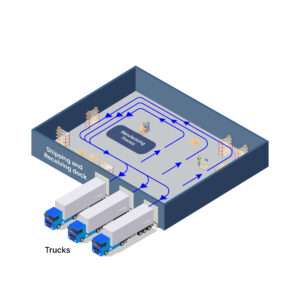
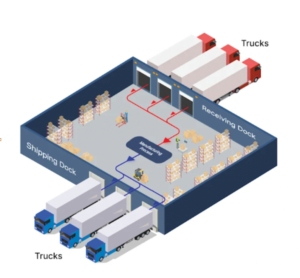
In practice, most dock strategies fall into two common types: a Combined Dock Layout (shared receiving and shipping at one dock face) and a Separated Dock Layout (distinct receiving and shipping zones).
We’ll explain when each layout works, where it breaks down, and what to look for so the design supports fast turnarounds without increasing conflict and congestion.
Combined Receiving + Shipping Dock Layout
Best For
Trade-Offs
-
Inbound/outbound compete for the same face
-
Staging becomes cluttered faster
-
Forklift travel lengthens (small minutes compound across a shift)
Separated Receiving And Shipping Dock Layout
Best For
Advantages
-
Cleaner staging discipline
-
Fewer forced interactions
-
Easier to maintain predictable yard flow
What Is The Best Traffic Flow Pattern For A Warehouse Site?
The best yard flow is predictable and reduces reversing. A common “win” pattern is a one-way circulation loop plus dedicated truck waiting space so the dock face stays clear.
Recommended Site Traffic Flow Design
-
One-Way Circulation where feasible
-
Dedicated Truck Waiting/Queue Area off the dock face
-
Separate Truck Routes From Employee Parking/Pedestrian Entrances
Common Baseline Geometry (53-Ft Trailer Planning)
-
Inside Turning Radius: ~26 ft
-
Outside Turning Radius: ~50 ft
-
One-Way Access Road Width: ~13 ft minimum
-
Two-Way Access Road Width: ~26 ft minimum
(These are baseline planning numbers—final design should be validated to your design vehicle and constraints.)
What Is Dock Apron Space—And How Much Do You Need For 40’, 48’, And 53’ Trailers?
Apron space is the maneuvering area in front of the dock that lets trucks align and back safely. Undersized aprons cause:
Practical Apron Depth Guidance
A commonly used planning table for 40-ft trailers often lands around ~108–120 ft depending on center-to-center spacing.
Scaling guidance used in planning:
Takeaway: If you handle 53-footers and see repeated alignment delays, apron depth is often the hidden bottleneck.

What Dock Height Is Standard (And Why Does It Matter)?
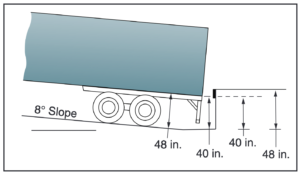
A common warehouse dock height range is 48″–52″, depending on the trailers served. Correct height reduces:
How Steep Can A Dock Approach Slope Be For Forklifts?
Steep slopes increase tipping risk and reduce load stability.
Common guidelines:
-
Electric Forklifts: max ~10% slope
-
Gas/Diesel Forklifts: max ~15% slope
-
Ideal Recessed Dock Slope: ≤ ~6%
If you’re above ~10% where forklifts carry load and speed, you’re compounding risk and inefficiency.
How Do You Reduce Parking Lot Accidents At Industrial Sites?
The highest-ROI move is traffic separation:
-
Separate employee parking from truck yards
-
Build protected pedestrian paths (not shared asphalt)
-
Use controlled crossings, clear sightlines, signage, speed control
-
Keep visitor circulation away from dock maneuvering zones
This reduces conflict structurally instead of relying on perfect behavior.
How Do You Execute This During Site Selection And Keep It From Drifting During The Project?
Once you know the “right answers” (apron depth, turning room, separation, dock placement), the challenge becomes: can the site support it—and will the project deliver it? This is where REoptimizer® becomes the execution layer.
REoptimizer® For Industrial Site Selection
Use REoptimizer® to compare candidate sites by making key factors visible in one place—especially the constraints that drive ingress/egress success:
-
Site Access And Circulation Feasibility (how trucks can realistically enter/exit and loop)
-
Geographic Considerations (grade, adjacency, road context, space depth)
-
Separation Potential (truck yard vs employee parking vs pedestrian routes)
-
Dock Strategy Fit (can you support separated zones or will you be forced into a combined face?)
REoptimizer® For Project Monitoring (Design → Build → Operate)
Use REoptimizer® to keep the original flow-and-safety intent from getting diluted across revisions:
-
Track whether apron depth, turning assumptions, and queue areas survive redesigns
-
Maintain visibility into dock placement logic and forklift travel implications
-
Flag when changes reintroduce mixed traffic zones or forced backing
In other words: the guide tells you what “good” is; REoptimizer® helps you select sites that can actually deliver it and monitor the project so it stays aligned.
Frequently Asked Questions
What Does “Ingress And Egress” Mean In Warehouse Design?
It refers to how vehicles and people enter, circulate, queue, interact with docks, and exit—safely and efficiently.
What Is The Most Common Warehouse Yard Bottleneck?
Typically: undersized apron space, no truck waiting area, or dock placement that forces crossing/competition.
Should Receiving And Shipping Docks Be Separated?
For high-volume facilities, separation often improves flow by reducing competition and simplifying staging and forklift routing.
How Much Apron Depth Do I Need For 53-Ft Trailers?
Many layouts require substantially more than 40-ft baselines; designs can reach ~140 ft depending on spacing and maneuver strategy.
What Is Standard Dock Height?
Often 48″–52″, depending on the trailer fleet served.
What Slope Is Safe For Forklifts At Dock Approaches?
A common guideline is ≤10% electric and ≤15% gas/diesel, with ≤6% preferred where possible.
How Does REoptimizer® Help With Ingress/Egress Decisions?
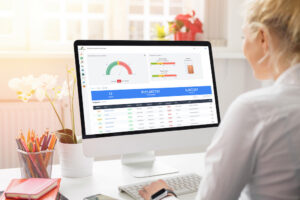
It supports site selection (seeing feasibility against geographic and layout constraints) and project monitoring (keeping circulation, separation, and dock requirements visible through revisions). Learn more about how it can level up your industrial portfolio today.
Learn More
Every boardroom is talking about AI.
The narrative is intoxicating — record-breaking productivity gains, limitless automation, billions in corporate investment. But if you strip away the marketing gloss, a deeper, more sobering reality emerges: AI’s acceleration isn’t just a technology revolution. It’s a spatial one.
AI has the potential to replace one third of white collar work.
But what’s coming isn’t a mass extinction of office work. It’s something subtler — and more expensive. Companies that don’t model for AI-driven shifts in how people work, how fast teams shrink or reskill, and how office utilization changes will be sitting on stranded square footage and inflexible leases long after the hype cycle cools.
“AI has the potential to be more transformative than electricity or fire.”
– Sundar Pichai, CEO of Google
It’s a dramatic claim — and yet, judging by the numbers, not an exaggeration. When Microsoft is investing $13 billion in a single quarter on AI and cloud infrastructure, the signal is unmistakable: the global economy isn’t gearing up to create more jobs, but different ones.
That evolution doesn’t just change who’s on payroll — it changes how organizations use space. As AI rewires workflows and redistributes labor, every square foot of the office portfolio becomes a reflection of how well a company is adapting to the new economics of productivity.

1. Don’t Confuse Growth in AI Spend with Growth in Headcount
It’s tempting to equate the explosion of AI budgets with expansion, but the two trends move in opposite directions. Billions are flowing into AI tools that can potentially replace repetitive knowledge work:
- Legal: Risk scanning, contract analysis, and compliance monitoring are being automated at scale.
- Accounting: Audits and reconciliations are executed in seconds.
- Customer Service: 85% of inquiries are resolved through automated systems.
- Software Development: Up to 45% of routine code is now machine-generated.
Every one of those functions represents entire categories of floor space once devoted to people who no longer need a seat.
C-suites need to start asking sharper questions:
- How will automation change our headcount profile over the next 24 months?
- Which departments will physically shrink — and which will redeploy talent instead?
- How does that map to our occupancy costs and lease timelines?
If you can’t answer those questions yet, you’re not forecasting for AI. You’re reacting to it.
2. The Utilization Reality Is Already Here
Badge-swipe data tells a harsh truth: office attendance in major metros still hovers around 55–56%, with even the busiest days topping out at 36–37%.
At the same time, sensors show that only about 25% of total office space is actively used on a given day.
That means the majority of your rent roll — the same one carefully negotiated pre-COVID — is now a legacy artifact. The office footprint no longer reflects business reality.
Even as companies tighten attendance policies, utilization peaks at just under half capacity. As AI amplifies hybrid efficiency, that gap will widen, not close.
The skeptical takeaway: the office isn’t dying; it’s underperforming. And your portfolio strategy must treat it like any other underperforming asset — by rebalancing exposure, tightening terms, and increasing flexibility.
3. Automate Your Forecast Before AI Automates You
McKinsey estimates that by 2030, up to 30% of all hours worked could be automated.
That number doesn’t translate neatly into layoffs. It translates into volatility — a workforce that expands and contracts as automation takes hold across functions.
For executives, the takeaway is clear: planning for disruption means planning for instability. Most lease portfolios, however, are built on the opposite assumption — steady headcount, slow change, predictable renewal cycles. That model won’t hold.
Instead, begin treating AI adoption as a variable inside your real estate forecast. Build scenarios that assume 10%, 20%, and 30% workforce shifts, and stress-test your footprint against each case.
In most enterprise portfolios, that range equates to tens of thousands of square feet that could be released — a full floor of Class A space, or more — without a single layoff.

If you aren’t embedding these forecasts into your lease strategy, you’re betting against math.
4. Flexibility Is the New Efficiency
The next generation of portfolio strategy isn’t about expansion or contraction — it’s about adaptation speed.
The companies that thrive will be those that treat lease portfolios like living systems, capable of reshaping themselves in response to automation.
That means:
- Shorter lease terms and rolling expirations.
- Blend-and-extend clauses tied to headcount thresholds.
- Expansion/contraction rights that mirror business cycles.
- AI “trigger” provisions that allow footprint recalibration as automation scales.
This is no longer a cost-avoidance tactic. It’s an operational hedge against a volatile future.
In practical terms: flexibility isn’t a perk. It’s your margin of error.
5. Class A Is the New Default
Here’s the structural market shift C-suites can’t ignore: As tenants downsize, they upgrade.
In Q1 2025, Class A and Trophy assets captured nearly 82% of all leasing activity. The bifurcation is clear — older Class B space is being left behind, often requiring up to $300 per square foot in renovation to stay competitive.

Landlords with “zombie” B buildings are facing existential math. Adaptive reuse is becoming the escape hatch, with 70,000 new apartment units expected from office conversions next year — triple 2022’s total.
For occupiers, this means two things:
- Commodity space will disappear under conversion or obsolescence.
- Premium space will become the stable middle ground — fewer total leases, but concentrated in resilient, high-performing buildings.
AI will compress demand, but concentrate quality.
6. Hybrid Isn’t Retreating — It’s Maturing
Despite the rhetoric about return-to-office mandates, hybrid isn’t going away; it’s crystallizing.
By the end of 2025:
- 67% of companies will enforce formal hybrid policies.
- 61% will set required in-office minimums.
But “hybrid” will look different in the AI era. As routine work disappears, the office becomes a collaboration and culture node, not a workstation.
Your office strategy should now center around two principles:
- Purpose density: Every square foot should justify itself through human value — creativity, mentoring, decision-making.
- Tech readiness: Buildings must support AI-enhanced workflows — data connectivity, smart sensors, and adaptive environments.
The office won’t die because of AI. It will survive because of what humans do best inside it.
7. Protect Against Landlord Risk
The next silent threat is financial, not technological. As capitalization rates rise and vacancies persist, landlords with leveraged assets will begin to struggle.

If your building changes hands, gets restructured, or defaults, your services and access could be disrupted.
Executives should treat lease clauses like insurance policies. Look for:
- Non-disturbance clauses ensuring continuity if the property is foreclosed.
- Essential service guarantees tied to building operations.
- Audit rights to monitor landlord solvency.
You can’t predict when a landlord’s debt load becomes your operational problem — but you can safeguard against it.
8. The Real Risk Is Complacency
AI will not erase offices overnight. But it will erase the strategic buffer between labor decisions and real estate outcomes.
The danger isn’t underutilized space — it’s unexamined assumptions:
- That job growth equals space growth.
- That hybrid attendance will rebound.
- That flexibility is a luxury, not a necessity.
Leaders who continue to plan for the world of 2019 will wake up in 2027 holding leases sized for teams that no longer exist.

Forecasting for AI disruption means leading with skepticism, data, and optionality.
The C-Suite Playbook for the Next Five Years
If you sit in the CFO, COO, or CRE seat, here’s what to start doing now:
- Run AI headcount models quarterly. Use conservative, base, and stretch forecasts.
- Tie lease terms to workforce scenarios. Don’t renew blindly — match expiration flexibility to your automation curve.
- Invest in portfolio intelligence. Know, in real time, how each site performs against utilization, cost, and resilience metrics.
- Concentrate in quality. Eliminate low-performing sites and reinvest in adaptable, high-demand assets.
- Reassess landlord exposure. Solvency is now a strategic variable.
This is not about being futuristic. It’s about being pragmatic in an age when the rate of change is outpacing the rate of renewal.
The Final Word: Build for Change, Not for Certainty
AI is not the apocalypse — but it is the reckoning.
The organizations that thrive will be the ones that treat disruption as a design constraint, not a surprise.
The future portfolio won’t be bigger. It’ll be smarter, smaller, and built to bend.
And when that future arrives, the question won’t be “Did you forecast AI?” It will be, “Did your portfolio?”
REoptimizer® helps enterprise tenants forecast disruption before it happens — modeling automation risk, right-sizing portfolios, and negotiating smarter renewals that protect flexibility and capital.
Because the next era of real estate strategy isn’t about predicting change.
It’s about building portfolios ready for it.
Learn More
When companies evaluate warehouses, location usually tops the checklist. But here’s the truth: even the perfect location won’t deliver results if your facility can’t efficiently handle the flow of goods in and out.
That’s where ingress (getting goods in) and egress (getting goods out) come into play. These aren’t just technical details. They determine whether your warehouse is a well-oiled machine—or a daily traffic jam.
Poor ingress and egress can lead to backups, higher labor costs, safety incidents, and frustrated carriers. Optimized ingress and egress, on the other hand, mean smoother operations, reduced downtime, and happier customers.
Why Ingress and Egress Make or Break Operations
Think of a warehouse like a human body. Location is the skeleton, but ingress and egress are the arteries and veins. If they’re clogged or poorly designed, the whole system suffers.
- Lost time adds up fast. A truck waiting in queue isn’t just idle—it’s costing upwards of $70 per hour in wasted productivity. Multiply that by several trucks per day, and the annual losses run into six figures.
- Safety is at risk. According to OSHA, nearly 1 in 5 warehouse accidents happen during vehicle operations. Many are preventable with better layouts and visibility.
- Customer expectations don’t allow delays. In the age of same-day and next-day shipping, a single bottleneck can ripple down the supply chain.
The bottom line: optimizing ingress and egress isn’t optional. It’s mission-critical.

Parking Lot Design: The First Test of Efficiency
Your parking lot sets the stage for everything else.
A stretch of asphalt, yes, but its design dictates how smoothly trucks, forklifts, and employees move through your site.
A well-designed lot provides seamless traffic flow and staging. A poor one creates daily chaos.
Key considerations include:
- Turning radius: Semi-trucks require 45–50 feet. Tight corners mean delays and accidents.
- Staging space: Each queued truck needs about 15 feet by 70 feet. A 10-dock facility requires at least 7,000 sq. ft. dedicated to truck flow.
- Buffer capacity: Experts recommend 20–25% extra space to handle surges during peak demand.
- Separate access: Truck entrances should be entirely separate from employee and visitor parking.
- Traffic control: Clear lanes, arrows, and signage reduce confusion and collision risks.
- Overnight staging: Dedicate 5–10% of your lot to overnight parking to avoid daytime congestion.
When these elements are neglected, congestion spreads like wildfire. Trucks block each other, shipments fall behind schedule, and carriers dread returning to your site. But when they’re executed well, trucks move in and out without delay, forklifts operate safely, and carriers appreciate your facility’s efficiency.
Dock Levelers: Bridging Gaps That Slow You Down
After trucks are staged, the next challenge is loading and unloading. Here, dock levelers play a pivotal role. By adjusting for height differences between trailers and dock platforms, they create a safe, stable surface that makes material handling faster and safer.
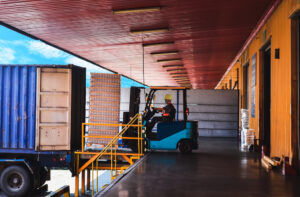
The benefits are hard to ignore:
- Adaptability: Dock levelers accommodate varying trailer sizes—critical when working with mixed fleets.
- Productivity: They reduce loading/unloading time by 20–25%, which means more throughput per shift.
- Safety: By eliminating unstable ramps, dock levelers can reduce workplace injuries by 15–20% annually.
- Downtime reduction: Warehouses using them effectively see up to 30% fewer slowdowns.
What to evaluate when selecting dock levelers:
- Type: Hydraulic for high-frequency operations, mechanical for lighter needs, and air-powered for balance.
- Capacity: Always match the leveler to your heaviest expected load—cutting corners here risks safety and equipment life.
- Durability: Steel or aluminum alloy models withstand harsh use and can last 20 years with proper maintenance.
- Maintenance: Easy-access components and scheduled inspections minimize downtime.
Best practice is to pair dock levelers with bumpers to protect both the dock and trailers. And don’t underestimate staff training. Even the best equipment fails if it isn’t used properly.
Dock Lights: Small Detail, Big Impact
Lighting is often an afterthought, but it has an outsized impact on both safety and productivity. Workers unloading a dimly lit trailer face higher risks of accidents, product damage, and delays. Dock lights solve this problem—especially modern LED systems.
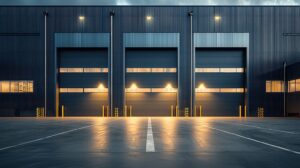
Why dock lights matter:
- Safety: Proper illumination prevents injuries and mishandling of goods.
- Productivity: Workers load and unload up to 25% faster when visibility is clear.
- Cost savings: LED dock lights use 75% less energy, produce less heat, and last up to 50,000 hours.
Features worth prioritizing:
- Brightness in the 5,000–10,000 lumen range for most loading applications.
- Impact-resistant designs built for high-traffic areas.
- Compatibility with motion sensors to cut energy waste.
Warehouses that switch to LEDs report saving around $1,200 per dock annually on energy costs alone—while also improving working conditions. That’s a win-win for safety and the bottom line.
The Big Picture for Tenants
Square footage is table stakes. What separates a merely adequate warehouse from a high-performer is how cleanly goods move through the property—gate to yard to dock to floor and back out again. That flow lives or dies on ingress and egress: the geometry of your yard and parking, the way trucks queue and turn, the handoff at the dock, and the visibility your teams have while they work. Treat these as a system, not a set of fixtures.
Think in flows, frictions, and feedback:
- Flows: truck arrival patterns, door turns per shift, forklift travel paths, pedestrian crossings.
- Frictions: tight radii, shallow aprons, under-sized staging, mismatched dock heights, dark trailers.
- Feedback: real-time dwell, queue length at peak, door utilization, incident rates, and energy burn at the dock.
Three operational truths drive your ROI:
- Time is the hidden rent. Every minute a trailer idles or a forklift waits for a safe gap costs more than rent per square foot. Door turns and trailer dwell predict on-time performance better than any lease comp.
- Safety is throughput. Near-misses and low-light picks slow people down—long before an incident shows up in the log. Safer docks move faster, with fewer reworks and claims.
- Capacity is shape, not just size. A yard that’s 10% larger but poorly shaped can perform worse than a tighter site with the right turning radii, staging density, and sightlines.
Finally, remember the geometry rules that quietly decide performance:
- Turning: design to the longest unit you’ll accept, with true 45–50 ft tractor turning radii and clear sightlines.
- Apron depth: enough for backing, swing, and a safety envelope; adding 10–15 ft of clear depth can flip your peak from brittle to resilient.
- Separation: trucks, forklifts, and passenger vehicles should have physically distinct paths—paint is not a barrier.
- Light: aim for consistent illumination into the trailer where work happens, not just on the dock face.
Do these well and the benefits compound:
- Faster door turns and tighter SLAs with carriers.
- Lower labor per shipment and fewer overtime spikes.
- Fewer claims and lower liability exposure.
- Predictable performance under peak load instead of “all hands” firefights.
Neglect them and you’ll pay twice: once in direct cost, again in reputation and lost carrier goodwill.
How Reoptimizer® Helps
Reoptimizer® is software that connects operational performance with real estate strategy. It takes the guesswork out of ingress and egress by showing you where bottlenecks exist, what fixes would cost, and how those improvements change your lease economics.
And when you’re choosing between locations, Reoptimizer® lets you weigh rent and incentives against actual operational performance—so the “cheaper” site doesn’t cost you more in hidden inefficiencies.
The result: clarity. You know whether to renew, right-size, renegotiate, or relocate—and you have data-backed leverage to get the best deal.
Want to learn more about how Reoptimizer® can turn your warehouse from just square footage into a true performance asset? Click below to discover how this could be the edge your portfolio needs.
Learn More