
Industrial ingress and egress design is the planning of how trucks, forklifts, cars, and pedestrians enter, circulate, queue, load, and exit a facility safely and efficiently. The most effective way to reduce congestion and incident risk is to separate traffic types, minimize reversing, size apron space correctly, and place docks to reduce forklift travel and cross-traffic.
Poor layouts don’t just waste time and fuel—they create higher-consequence conflict points where heavy equipment and people intersect.

What Is Causing Warehouse Yard Congestion (And How Do You Spot It Fast)?
Most ingress/egress problems come from one of these root causes:
-
No Truck Queue/Waiting Area → trucks stack at doors and block circulation
-
Undersized Apron Depth → repeated repositioning + slow dock cycles
-
Mixed Traffic Zones (trucks + cars + pedestrians) → stop-and-go patterns and near misses
-
Too Much Backing (forced reversing) → higher-risk maneuvers and longer cycle time
-
Dock Layout Forces Crossing Movements (receiving/shipping overlap) → forklift gridlock and staging conflicts
If your yard “feels busy” but not controlled, you’re usually missing one of the above.
What Is The Material Transfer Zone (MTZ) And Why Is It “Ground Zero” For Risk?
The Material Transfer Zone (MTZ) is where trailers, forklifts/pallet jacks, dock doors, levelers, and people converge. It’s high-risk because it compresses heavy equipment, blind spots, and time pressure into limited space.
MTZ Safety Must-Haves
-
Trailer Movement Control (restraints) to prevent creep
-
Barrier Gates to prevent edge falls and equipment damage
-
Preventive Maintenance (levelers, bumpers, lighting, seals)
-
Leveler Capacity Matched To Load + Frequency
Best Practice: powered hydraulic levelers (push-button) typically improve ergonomics and consistency versus manual mechanical units.
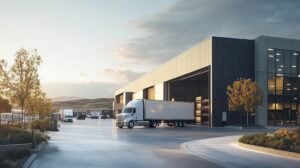
Are Your Loading Docks In The Best Spot? (How Dock Placement Affects Forklifts, Staging, And Delays)
Your docks are in the best spot when they:
-
Minimize Forklift Travel between receiving → storage and picking → shipping, and
-
Avoid Forced Crossing between trucks, forklifts, and pedestrians.
Combined Receiving + Shipping Dock Layout
Best For
-
Smaller operations and tighter sites
Trade-Offs
-
Inbound/outbound compete for the same face
-
Staging becomes cluttered faster
-
Forklift travel lengthens (small minutes compound across a shift)
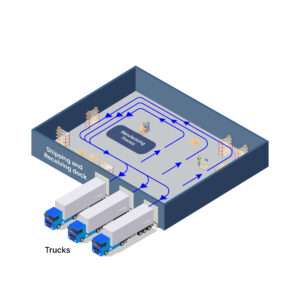
Separated Receiving And Shipping Dock Layout
Best For
-
Higher-volume distribution and facilities that need cleaner lanes
Advantages
-
Cleaner staging discipline
-
Fewer forced interactions
-
Easier to maintain predictable yard flow
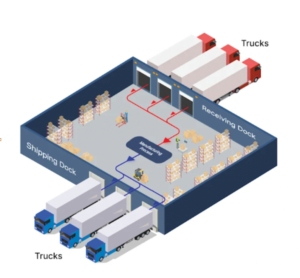
What Is The Best Traffic Flow Pattern For A Warehouse Site?
The best yard flow is predictable and reduces reversing. A common “win” pattern is a one-way circulation loop plus dedicated truck waiting space so the dock face stays clear.
Recommended Site Traffic Flow Design
-
One-Way Circulation where feasible
-
Dedicated Truck Waiting/Queue Area off the dock face
-
Separate Truck Routes From Employee Parking/Pedestrian Entrances
Common Baseline Geometry (53-Ft Trailer Planning)
-
Inside Turning Radius: ~26 ft
-
Outside Turning Radius: ~50 ft
-
One-Way Access Road Width: ~13 ft minimum
-
Two-Way Access Road Width: ~26 ft minimum
(These are baseline planning numbers—final design should be validated to your design vehicle and constraints.)
What Is Dock Apron Space—And How Much Do You Need For 40’, 48’, And 53’ Trailers?
Apron space is the maneuvering area in front of the dock that lets trucks align and back safely. Undersized aprons cause:
-
misalignment
-
longer dock cycles
-
more impacts/damage
-
repeated repositioning (“dock dance”)
Practical Apron Depth Guidance
A commonly used planning table for 40-ft trailers often lands around ~108–120 ft depending on center-to-center spacing.
Scaling guidance used in planning:
-
48-ft trailer: may require ~20% more apron than 40-ft
-
53-ft trailer: can push needs toward ~140 ft depending on spacing and maneuver strategy
Takeaway: If you handle 53-footers and see repeated alignment delays, apron depth is often the hidden bottleneck.

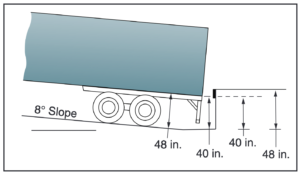
What Dock Height Is Standard (And Why Does It Matter)?
A common warehouse dock height range is 48″–52″, depending on the trailers served. Correct height reduces:
-
excessive leveler adjustment
-
forklift transition harshness (product damage risk)
-
cycle time variability
How Steep Can A Dock Approach Slope Be For Forklifts?
Steep slopes increase tipping risk and reduce load stability.
Common guidelines:
-
Electric Forklifts: max ~10% slope
-
Gas/Diesel Forklifts: max ~15% slope
-
Ideal Recessed Dock Slope: ≤ ~6%
If you’re above ~10% where forklifts carry load and speed, you’re compounding risk and inefficiency.
How Do You Reduce Parking Lot Accidents At Industrial Sites?
The highest-ROI move is traffic separation:
-
Separate employee parking from truck yards
-
Build protected pedestrian paths (not shared asphalt)
-
Use controlled crossings, clear sightlines, signage, speed control
-
Keep visitor circulation away from dock maneuvering zones
This reduces conflict structurally instead of relying on perfect behavior.
How Do You Execute This During Site Selection And Keep It From Drifting During The Project?
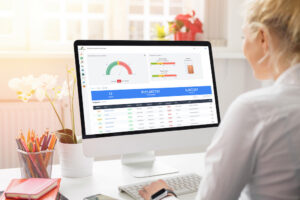
Once you know the “right answers” (apron depth, turning room, separation, dock placement), the challenge becomes: can the site support it—and will the project deliver it? This is where REoptimizer® becomes the execution layer.
REoptimizer® For Industrial Site Selection
Use REoptimizer® to compare candidate sites by making key factors visible in one place—especially the constraints that drive ingress/egress success:
-
Site Access And Circulation Feasibility (how trucks can realistically enter/exit and loop)
-
Geographic Considerations (grade, adjacency, road context, space depth)
-
Separation Potential (truck yard vs employee parking vs pedestrian routes)
-
Dock Strategy Fit (can you support separated zones or will you be forced into a combined face?)
REoptimizer® For Project Monitoring (Design → Build → Operate)
Use REoptimizer® to keep the original flow-and-safety intent from getting diluted across revisions:
-
Track whether apron depth, turning assumptions, and queue areas survive redesigns
-
Maintain visibility into dock placement logic and forklift travel implications
-
Flag when changes reintroduce mixed traffic zones or forced backing
In other words: the guide tells you what “good” is; REoptimizer® helps you select sites that can actually deliver it and monitor the project so it stays aligned.
Frequently Asked Questions
What Does “Ingress And Egress” Mean In Warehouse Design?
It refers to how vehicles and people enter, circulate, queue, interact with docks, and exit—safely and efficiently.
What Is The Most Common Warehouse Yard Bottleneck?
Typically: undersized apron space, no truck waiting area, or dock placement that forces crossing/competition.
Should Receiving And Shipping Docks Be Separated?
For high-volume facilities, separation often improves flow by reducing competition and simplifying staging and forklift routing.
How Much Apron Depth Do I Need For 53-Ft Trailers?
Many layouts require substantially more than 40-ft baselines; designs can reach ~140 ft depending on spacing and maneuver strategy.
What Is Standard Dock Height?
Often 48″–52″, depending on the trailer fleet served.
What Slope Is Safe For Forklifts At Dock Approaches?
A common guideline is ≤10% electric and ≤15% gas/diesel, with ≤6% preferred where possible.
How Does REoptimizer® Help With Ingress/Egress Decisions?
It supports site selection (seeing feasibility against geographic and layout constraints) and project monitoring (keeping circulation, separation, and dock requirements visible through revisions). Learn more about how it can level up your industrial portfolio today.