
Automation Has Crossed the Rubicon
In 2025, warehouse automation is no longer aspirational—it’s essential infrastructure.
The global warehouse-automation market reached $19.23 billion in 2023 and is projected to grow at a ~18.7 percent CAGR through 2030, topping $59 billion.
E-commerce, labor scarcity, and rising throughput demands continue to fuel adoption.
For CRE professionals, the impact is tangible: the very definition of “industrial” is being rewritten by robotics, compute density, and AI orchestration.
Humans + Robots: The New Warehouse Floor
If you want to see the future of logistics, look no further than the companies leading the robot revolution:
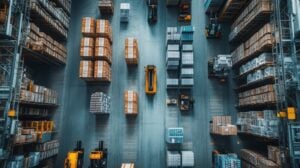
- Amazon now operates 750,000 + robots alongside employees and is piloting “Vulcan,” a robotic arm with tactile sensing that gives it a “sense of touch.”
- Symbotic completed its January 2025 acquisition of Walmart’s robotics unit, enabling deployment of up to 400 automated pallet dispensers (APDs) across Walmart’s network.
- Dexory raised $165 million (Oct 2025) to expand its autonomous inventory-robot platform for GXO, Maersk, and DHL.
- Hai Robotics’ HaiPick Climb earned the PACK EXPO 2025 Technology Excellence Award and the UKMHA Archies, recognizing its rack-mounted “climbing” ASRS innovation.
These examples prove robotics are no longer experimental. What used to be science fiction is rapidly becoming integral to modern logistics operations.
AI Augments, Not Replaces
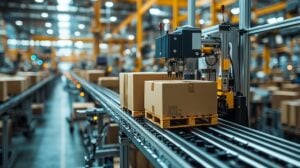
AI now plans, predicts, and orchestrates. Machine-learning systems optimize pick paths, forecast stockouts, and schedule maintenance before failures occur. The real disruption is not mechanical; it’s algorithmic.
Together, physical automation and AI orchestration form the backbone of what’s becoming known as the AI Factory.
AI Factories: The Compute Side of Warehousing
The rapid robotification of warehouses isn’t happening in isolation—it’s powered by a new breed of data infrastructure called AI factories. These are the compute engines that train, deploy, and manage the intelligence behind physical automation.
At the center of this evolution is NVIDIA’s Blackwell architecture, which delivers up to 25× lower cost and energy use for large AI workloads compared with its predecessor.
Its flagship system, the GB200 NVL72, runs trillion-parameter models up to 30× faster than the previous generation—while drawing roughly 120–132 kW per rack.
In the coming upgrade cycle:
-
Blackwell Ultra (GB300) ships in the second half of 2025.
-
Vera Rubin NVL144, the next-generation platform, follows in 2026, with Rubin Ultra expected in 2027.
These systems are purpose-built for robotics simulation, digital-twin modeling, and real-time inference—the digital brainpower that enables warehouses to think and adapt as they operate.
What an AI Factory Really Is
An AI factory is a compact, high-density compute site designed specifically for AI training, reasoning, and deployment—essentially the “data-center version” of a manufacturing plant.
Key characteristics include:
-
Smaller footprints — typically sub-50,000 sq ft, compared to hyperscale data centers that can exceed a million square feet.
-
Extreme rack density — often 100 kW + per rack, making liquid cooling mandatory to manage heat loads.
-
Urban or near-urban locations — positioned where existing power, cooling, and fiber infrastructure can be leveraged, reducing permitting and interconnect delays.
-
Sustainability trend — liquid-cooling adoption is already near one-third of AI data centers worldwide (TrendForce 2025).
Building these AI factories, however, comes with a new set of infrastructure realities.Packing massive computing power into smaller footprints dramatically increases energy demand and thermal output. As warehouses and data facilities converge, power capacity and cooling efficiency become the critical constraints—often defining whether a site is even viable for AI operations. That’s why the next frontier in automation isn’t just about chips and robots—it’s about electrification, cooling, and grid resilience.
Power, Cooling & Grid Dynamics
Electrification and Grid Stress
AI workloads are creating a new utility challenge. Analysts project U.S. data centers could consume up to ~12 percent of national electricity by 2030 under high-growth scenarios.
To offset risk, operators are pursuing on-site generation and microgrids. A leading example: Brookfield Renewable Partners + Bloom Energy’s $5 billion joint venture to deploy fuel-cell power for AI campuses.
Cooling Realities
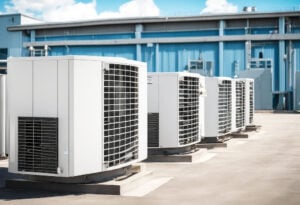
Air cooling can’t handle 100 kW+ racks. The industry is pivoting toward liquid-to-liquid cooling loops and modular immersion systems. Resilience planning now centers on redundant loops and serviceable “pod” architectures—vital in both data and fulfillment settings.
Quantifying the ROI of Robotification
The payoff for solving these infrastructure challenges is substantial.
As operators invest in advanced power systems and liquid cooling to sustain AI workloads, they’re also unlocking major efficiency gains. Early adopters are seeing measurable payback. A 2025 McKinsey study on logistics modernization found that full-automation programs improved throughput 20–25 percent, reduced labor costs 15–30 percent, and boosted inventory accuracy to ~99.5 percent when paired with AI-driven WMS platforms.
For corporate tenants, those gains translate into lower cost per order and three-to-five-year payback windows on automation capex.
Landlords benefit too: automated tenants commit to longer leases (10–15 years), accept higher rents, and fund infrastructure upgrades that raise building valuation.
In short, automation is proving accretive on both sides of the lease.
What CRE Professionals Must Watch
Building Envelope & Infrastructure
- Slab flatness (FF/FL) and point-load capacity must support heavy robots and racking.
- Ceiling height and column spacing should allow climbing ASRS and wide AMR corridors.
- Power availability: traditional facilities drew 5–10 W/SF; automation zones may need 10–20× that.
- Connectivity: dual-path fiber, 5G private networks, and edge servers minimize latency.
- Safety & HRC: design for mixed human-robot traffic with segregated aisles and dynamic fleet zones.
Lease Terms & Flexibility
Automation tech refreshes every 18–24 months; tenants should secure:
- Rights for additional power / cooling capacity.
- Roof and yard rights for condensers or liquid coolers.
- Phased-utility delivery clauses to accommodate staged deployment.
Landlords that pre-engineer these flexibilities will command premium occupancy.
Sustainability and Regulation
Automation and AI Factories also reshape ESG strategy.
On the plus side, AI-optimized routing and robotics can cut waste and emissions; DOE’s Smart Manufacturing Office reports 20–30 percent better energy intensity in automated warehouses versus legacy sites.
Yet the massive power appetite of AI compute raises new sustainability imperatives. Expect:
- Green-power purchase agreements embedded in industrial leases.
- Cooling-water and energy-use disclosures for ESG reporting.
- Emerging AI-compute-intensity metrics akin to PUE in data-center sustainability standards.
Cities such as Los Angeles and New York are already exploring frameworks for energy-dense facilities. Forward-thinking landlords will treat sustainability not as compliance but as a differentiator.
Repurposing & Urban Redevelopment
While hyperscale data centers cluster in rural zones, AI Factories and micro-fulfillment nodes are moving inward.
Their smaller footprints and high density make urban reuse feasible, particularly in districts with existing substations and dark-fiber access.
Vacant offices and retail shells are increasingly candidates for AI retrofits—a dual win: reviving tax rolls while satisfying compute demand.
Still, permitting complexity is rising; localities are rewriting data-center ordinances rather than issuing blanket approvals.
Risks and Realities
- Capital intensity: integration and maintenance remain expensive.
- Grid constraints: interconnect queues can delay go-lives by months.
- Labor shift: roles migrate from pick/pack to maintenance and analytics.
- Cyber and operational security: AI-robotic convergence widens attack surfaces.
- Obsolescence: rapid GPU cycles require modularity and refresh flexibility.
The 2026–2028 Outlook
- Robotics-as-a-Service (RaaS) will dominate deployments, lowering tenant capex.
- AI Factories will proliferate as modular extensions to logistics parks.
- Liquid cooling and on-site generation will become baseline specifications.
- The performance gap between automated and conventional warehouses will widen, reflected in throughput, labor safety, and lease value.
Takeaways for Tenants
The robotification of warehouses is a fundamental transformation of industrial real estate.
For tenants, success will depend on auditing existing facilities for power capacity, clear height, and digital connectivity, while structuring leases that allow flexibility for automation and AI upgrades.
For landlords and investors, the opportunity lies in repositioning assets to be automation-ready, AI-capable, and energy-resilient—the new gold standard for logistics and fulfillment spaces.
Those who move first will capture the competitive edge, commanding premium rents, longer lease terms, and stronger tenant retention as the industry transitions into the AI-driven era of logistics.
Next Step: Optimize Your Warehouse Strategy
The next generation of industrial space demands smarter decisions—on power, data, and flexibility. Luckily, tenants can use REoptimizer® to pinpoint facilities that can handle automation-level power loads, evaluate AI readiness across your portfolio, and negotiate lease terms built for the future of logistics.Transform your warehouse strategy today — start your REoptimizer® analysis now. Learn more about how the platform can give your portfolio the edge it needs.