

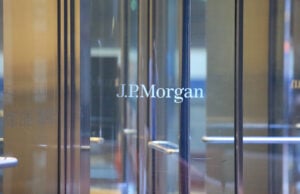
JPMorgan Chase opened its new headquarters at 270 Park Avenue, and it’s massive.
At 1,388 feet tall and 2.5 million square feet, the bank’s new global HQ is the most expensive single-asset office project in New York’s history. Designed by Foster + Partners, it’s being pitched as the office tower of the future: sustainable, smart, healthy, and flexible.
The project lands at a time when New York’s office vacancy is pushing 20%, and most landlords are fighting to keep tenants, not build new ones — which makes JPMorgan’s move both bold and hard to replicate.
Understanding what JPMorgan built (and why) offers a glimpse into how major occupiers are now thinking about space, investment, and long-term positioning in a volatile market.
A Building Built to Prove a Point
JPMorgan could’ve renovated its old headquarters. Instead, it demolished a 700-foot tower and started over — the tallest voluntary teardown in U.S. history.

That decision raised eyebrows, but it also sent a message: retrofits aren’t enough for companies that want total control over their workplace strategy.
To its credit, the project pushed environmental limits. Roughly 97% of the old building’s materials were recycled or reused, a benchmark even sustainability consultants didn’t expect. The new tower runs fully on hydropower, eliminating on-site combustion, and claims 40% lower water usage than standard code.
On paper, it’s one of the greenest towers in the world.
Still, this is a 2.5 million-square-foot, $3 billion building for one tenant — at a time when most major occupiers are still shrinking footprints and rethinking in-office utilization. JPMorgan’s bet is that if you make a space good enough, people will actually want to come in. We’ll see if that holds true when the novelty fades.
What’s Inside: Amenities, Algorithms, and Optics
The new 270 Park isn’t your father’s bank tower. It’s packed with the kind of amenities that define new “Class A+” space:
- A 20-vendor food hall, Irish pub, and a wellness-focused gym run by EXOS.
- A three-story “Exchange” hub combining dining, work, and event space.
- Touchless biometric entry, occupancy sensors, and an app that remembers lighting and temperature preferences.
- Air filtration and daylight levels above NYC code requirements, and enough acoustic insulation to make Midtown sound almost peaceful.
In short: the building is less about desks and more about experience engineering. JPMorgan wants the office to feel like an ecosystem — something that functions intuitively, not mechanically. But whether that model scales beyond the world’s biggest bank remains an open question.
For smaller occupiers, the capital expenditure behind these systems is a non-starter. The average retrofit budget in Midtown today is around $100–$150/SF. A tower like this pushes well beyond $1,000/SF in total build cost.
The Broader Play: Midtown as a Test Lab
JPMorgan isn’t just building a headquarters; it’s building a campus. Between 270 Park, 383 Madison Avenue, and 250 Park Avenue, the bank now controls nearly six million square feet within a few blocks. That’s an urban moat: three assets connected by design, technology, and culture.
It’s also a bet on Midtown East rezoning, which encourages teardown-and-rebuild projects that open the ground plane and add public plazas. JPMorgan’s new footprint includes wider sidewalks, open green space, and ground-level retail — things older Midtown blocks often lack.
But while 270 Park might be Midtown East’s success story, it’s not the norm. Most landlords in the district are struggling with 25–35% availability rates and tenant downsizing that hasn’t stopped since 2020. The bank’s investment helps the optics — but it doesn’t solve the vacancy math. It’s a striking outlier in a market still under strain, which makes it the perfect lens to understand how the office sector is fragmenting
What It Really Means for the Office Market
Let’s cut through the marketing: 270 Park isn’t a model most landlords can replicate. It’s a proof of concept for what’s possible at the very top of the market — and a useful lens into how the rest of the office sector is stratifying.
1. The “Flight to Quality” Isn’t Just a Buzzword
Tenants are trading quantity for quality.
Across major U.S. markets, occupancy recovery is strongest in the top 10–15% of buildings — those offering advanced air systems, hospitality-style amenities, and sustainability credentials. According to CBRE’s Q3 2025 data, Class A+ space in Manhattan is averaging 88% occupancy, while Class B sits closer to 67%, and Class C often below 50%.

Landlords without modern infrastructure or ESG performance metrics are losing tenants even if they cut rent. JPMorgan’s HQ simply illustrates the far edge of this curve: what happens when the “best of the best” becomes the new baseline for corporate environments.
2. New Construction Will Be the Exception, Not the Rule
Most office owners can’t start from scratch. With construction costs up 35–40% since 2019 and debt markets tightening, large-scale teardowns are the domain of cash-heavy owner-occupiers and sovereign funds.
Instead, the next cycle of supply will come from adaptive reuse and deep retrofits — targeting energy efficiency, daylighting, and new mechanicals without full demolition.
Expect Class B landlords to pivot toward conversion (residential, life science, education) while institutional owners invest selectively in repositioning high-potential assets. The gap between those who can finance modernization and those who can’t will continue to widen.
3. Workplace Experience Is the New Amenity War
The value proposition of the office has shifted from “where you work” to “why you’d bother coming in.” JPMorgan’s response — cafés on every floor, a 20-vendor food hall, gym, wellness suites, and prayer rooms — is expensive, but strategic.
Data from Kastle Systems shows that office attendance in NYC remains around 64% of pre-pandemic levels. That means companies are under pressure to earn their employees’ commutes. Amenities and health-driven design are now tools for talent retention, not perks.
For landlords, that translates to operational complexity: hospitality-level service expectations with office-level margins. Those who can deliver “experience as infrastructure” will command higher rents and longer leases. Those who can’t will rely on discounting.
4. Midtown’s Future Is Selective
JPMorgan’s move may revitalize Midtown East, but it won’t rescue the entire submarket.
Manhattan’s overall office vacancy remains around 20%, translating to roughly 95 million square feet of available space. Trophy towers like One Vanderbilt, 425 Park, and now 270 Park are leasing well, but older postwar stock continues to struggle.
That polarization will deepen. Expect Midtown to evolve into a two-tier landscape:
- Tier 1: ESG-compliant, amenity-rich towers (20–25% of inventory) attracting premium tenants and commanding $140–$200/SF rents.
- Tier 2: Legacy buildings facing value declines of 40–60% compared to pre-pandemic appraisals. Many will pivot to residential conversions under city incentive programs.
270 Park shows that the right project, in the right place, can reprice a district — but it also highlights how few owners can play at that level.
The Bottom Line
JPMorgan’s new HQ is both a marvel and a warning.
It proves that when capital, brand, and long-term vision align, the office can still be an asset worth building — not just maintaining. But it also underscores how uneven the recovery really is.
The future of office real estate isn’t a single trend — it’s a split market:
- For global corporations and institutional investors: High-performance campuses like 270 Park will serve as recruiting and cultural anchors.
- For everyone else: The challenge is survival — reconfiguring space, improving efficiency, and finding the right use case for aging square footage in a market where “good enough” no longer cuts it.
270 Park isn’t the future of every office. It’s the benchmark against which the rest of the market will now be judged.
The next phase of the office market won’t reward size; it will reward clarity.
The office landscape is diverging fast — utilization patterns are shifting, operating costs are volatile, and capital markets are punishing inefficiency. The winners will be those who can connect real-time data to real estate decisions, turning portfolio visibility into strategic action.

That’s where REoptimizer® comes in.
Our platform gives corporate real estate teams a 360° view of their portfolio — from occupancy and lease terms to trend metrics and cost performance. It helps you see what’s working, what’s not, and what’s next. Whether you’re rightsizing, renegotiating, or planning for future demand, REoptimizer® transforms raw data into clarity — and clarity into leverage.