
By early 2026, the real estate market has reached a critical inflection point. For institutional building owners and global corporate tenants, the conversation around office to residential conversion has matured from a speculative “doom loop” narrative into a surgical, data-driven trade. We are no longer discussing the death of the office market; we are analyzing the strategic birth of high-yield residential use from the chassis of obsolete office space.

The following points illustrate the nuance of this new conversion story:
- Beyond “Cutting Losses”: The narrative has moved past being a desperate solution to mitigate the drag of unoccupied space. It is now a proactive strategy to unlock value. As high-quality Class A+ assets find their footing, the commodity-grade older office buildings that once anchored the central business district have become “stranded assets”—properties whose utility has been outpaced by shifting market needs and strict ESG requirements.
- The “Basis Reset” as a Structural Catalyst: The current trend is not a reaction to a temporary vacancy spike; it is a permanent structural response to a fundamental valuation shift. This “Basis Reset” occurs as office investment values decline, allowing developers to acquire vacant office space at a low entry price (the “basis”). This reset is essential to offset conversion costs.
- A Shift in Management Philosophy: For the sophisticated owner, the story has shifted from merely managing occupancy to maximizing the terminal value of their portfolio. In 2026, the math is clear: if an office building can no longer compete for high-yield office space demand, its highest and best use is inevitably residential housing.
- Financial Feasibility and Yield Spreads: Institutional capital now focuses on the delta between a property’s Net Operating Income (NOI) as a struggling office versus its stabilized value as a multifamily asset. By leveraging tax incentives like NYC’s 467-m program and historic tax credits, developers are bridging the “capital stack” gap to achieve a positive Net Present Value (NPV).
The Strategic Re-Underwriting of Vacant Office Space
By early 2026, office vacancy rates have stabilized near 14% nationally, but this average masks the deep distress in central business districts. Office vacancy rates in major hubs like New York and San Francisco have hit a structural ceiling, often hovering between 20% and 30%.
However, this is not a universal failure; it is a bifurcation. While Class A+ trophy assets maintain a “flight to quality,” older office buildings and Class B/C commercial space are facing terminal economic obsolescence. The financial feasibility of converting these empty office buildings into residential units is driven by the widening delta between office NOI and surging apartment rents.
- The Basis Play: Sophisticated developers are targeting old offices where the acquisition cost is low enough to absorb conversion costs that frequently exceed $250 per square foot.
- Speed to Market: Adaptive reuse allows for residential construction that is 20% cheaper and 8–16 months faster than new construction, a critical advantage in a housing crisis where housing units are needed immediately.

Architectural Nuance: Navigating the Physical “Stranded Asset”
A large scale conversion is a surgical operation on a building’s DNA. Now, owners must move beyond the basic “floor plate” conversation to address the complex engineering required to turn a cube-farm into a luxury apartment.
Deep Core Modification & Natural Light
Most modern office buildings feature massive, deep floor plates (exceeding 100 feet in depth) that are fundamentally incompatible with living space requirements for natural light.
- Structural Voids: To meet building codes, developers are increasingly “carving out” the center of existing buildings to create light wells or atria. This reduces rentable square footage but maximizes the desirability—and the rent—of the units.
- HVAC and Air Conditioning: Transitioning from massive central chillers to individual, unitized air conditioning is one of the highest conversion costs. In 2026, the standard has shifted to high-efficiency VRF (Variable Refrigerant Flow) systems.
Sustainability and the ESG Premium
Reusing a commercial building shell is the “greenest” possible construction method.
- Embodied Carbon: Adaptive reuse saves 50–75% of the embodied carbon compared to a teardown.
- Federal Resources: The White House and federal agencies have unlocked federal resources and historic tax credits specifically for developers who can prove high-carbon savings through building conversions.
The Legislative Catalyst: 2026 Incentives and Tax Breaks
Local governments have finally pivoted from red tape to red carpet. To protect the tax base and the city’s transfer tax revenues, city leaders are aggressively subsidizing the office to residential pipeline.

The 467-m Property Tax Exemption (NYC)
The most significant policy of 2026 is NYC’s 467-m program, designed to turn obsolete buildings into affordable housing.
- The Mandate: 25% of the apartments must be affordable units (rent-restricted at 80% AMI).
- The Benefit: Developers receive a massive property tax abatement for up to 35 years, stabilizing the financial analysis of the most complex conversion projects.
National Comparisons of Conversion Policy
| City | Primary Incentive | Objective |
| Pittsburgh | “By-Right” Zoning | Bypasses zoning hearings for office conversions. |
| Los Angeles | Adaptive Reuse Ordinance | Targets multifamily housing in the urban core. |
| Chicago | LaSalle Reimagined | Grants for rent restricted units in high-vacancy zones. |
| Philadelphia | Historic Tax Credits | Preserves older office buildings while adding housing supply. |
Strategic Portfolio Defense: Beyond the Conversion Hype
While the headlines focus on large scale conversions, the reality for most global occupiers is a complex chess match of lease management and location strategy. As building owners seek financial feasibility for residential properties, tenants must understand how these shifts impact their specific office space demand.
The REoptimizer® Advantage: 8,000+ Data Points for Precision
REoptimizer® is the industry-standard transaction management software designed to help you play offense in a volatile market. It doesn’t just track dates; it synthesizes over 8,000 data points—from local vacancy rates to shifting building codes—to ensure your portfolio is a driver of value, not a drain on capital.
For the sophisticated corporate leader, REoptimizer® acts as a tactical defense layer:
- Local Market Benchmarking: Access real-time local vacancy rates and comparable lease data to identify exactly where you are paying over market.
- Negotiation Leverage: Armed with granular data, you can approach building owners from a position of strength, identifying opportunities for rent reductions or tenant improvement allowances based on the asset’s true market health.
- Lease Protection: Automatically flag vague or one-sided terms in your leases that could trigger unexpected costs or limit your ability to pivot as the office market bifurcates.
- Dynamic Portfolio Rightsizing: Use workplace analytics to bridge the gap between your current square feet and your actual utilization, allowing you to “shrink to grow” into higher-quality, better-located assets.
In a market where the line between commercial viability and structural obsolescence is thinner than ever, data is the only hedge against uncertainty. By transforming 8,000+ complex variables into clear, actionable intelligence, REoptimizer® ensures you aren’t just reacting to market shifts—you are anticipating them.
Stop overpaying for underutilized space and start optimizing your terminal value.
Book a Demo with REoptimizer® Today
Book a Demo
FAQ: The 2026 Conversion Landscape
What defines a viable office to residential conversion project?
Viability is dictated by floor plate depth, access to natural light, and the acquisition basis. Only about 30% of office buildings are suitable. Ideal candidates are usually older office buildings with shallower depths and high office vacancy.
How do conversion costs impact the financial feasibility of housing?
Conversion costs range from $100 to $500 per square foot. Because of these high costs, most large scale conversions require tax incentives or property tax abatements to produce affordable housing or rent restricted units while remaining solvent.
What are the main benefits of adaptive reuse over new construction?
Adaptive reuse is faster (saving up to 16 months) and more sustainable, as it rehabilitates an existing building. It also avoids the high cost of new foundations and site prep, making it a powerful tool to address the housing shortage.
How do local governments facilitate building conversions?
Local governments use “by-right” zoning, tax breaks, and historic tax credits to reduce the regulatory hurdles for building owners. These policies are designed to revitalize the central business district and increase the housing supply.
A lease is more than just a contract for space; it is a multi-million dollar bet on your landlord’s financial stability. Whether you are managing a global warehouse network or a large-scale office portfolio, your operational continuity depends on the person across the table. And in today’s volatile market, the most critical “inspection” isn’t of the brick and mortar—it’s of the debt service coverage ratio (DSCR).
If your landlord is facing financial strain, your “Class A” experience can quickly dissolve into deferred maintenance, tax liens, or even the nightmare of a mortgage loan foreclosure. Here is how sophisticated real estate investors and corporate tenants use DSCR to protect their interests and why REoptimizer® is the essential tool for flagging these risks before they become your problem.

What is DSCR (Debt Service Coverage Ratio)?
The Debt Service Coverage Ratio (DSCR) is a financial metric used by many lenders to determine a borrower’s capacity to repay a loan. In simple terms, DSCR measures whether the property generates enough cash flow to cover loan payments.
For a tenant, the landlord’s DSCR is a barometer for their ability to maintain the property. If the ratio is too low, the landlord is likely “robbing Peter to pay Paul”—diverting your monthly rent to cover current debt obligations instead of essential operating expenses.
How to Calculate DSCR
To calculate DSCR, you divide the property’s net operating income (NOI) by its total debt service:
DSCR=Total Debt ServiceNet Operating Income (NOI)
- Net Operating Income (NOI): This is the rental income minus operating expenses (such as taxes, insurance, and maintenance).
- Total Debt Service: This includes all principal and interest payments on the mortgage loan.
Benchmarks: What is an “Acceptable DSCR”?
Understanding the numbers is the first step in identifying financial difficulties in your landlord’s portfolio.
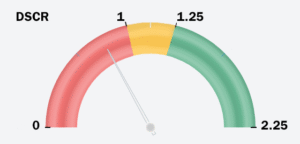
- DSCR > 1.25: This is the common industry standard for most real estate investors. It means the property generates 25% more income than is needed to cover loan payments.
- DSCR = 1.0: The property is just breaking even. One major vacancy or a spike in the annual interest rate could push the property into the red.
- DSCR < 1.0: A low DSCR indicates that the rental property’s cash flow is insufficient to cover mortgage payments.
The “Office Trap”: Why Office Tenants Face Higher Risk
For the office sector, a standard 1.25x DSCR is a starting point. Because office buildings have high tenant concentration and massive down payments required for tenant improvements (TIs), lenders often demand a minimum DSCR of 1.35x to 1.40x to approve an office mortgage loan.
The NOI Cash Flow Crisis
In the office world, Net Operating Income (NOI) is under siege. Unlike warehouse spaces with triple-net (NNN) leases that pass most costs to the tenant, office landlords often bear the brunt of:
- Skyrocketing Insurance Premiums: Insurance is a primary operating expense that has jumped 20–40% in some urban markets.
- Capital Expenditure (CapEx) vs. NOI: Standard DSCR calculation methods often exclude CapEx. However, an office landlord must spend heavily on lobbies and “amenitization” to attract tenants. If they are spending their cash on debt instead of CapEx, your building is effectively “dying on the vine.”
The Danger of Cross-Collateralization with a DSCR Loan
This is the “invisible” threat for a corporate tenant. Many large-scale office landlords use cross-collateralization, where multiple properties serve as collateral for a single mortgage loan (often called a blanket mortgage).
- The Scenario: Your office building might have a “healthy” individual DSCR of 1.30x.
- The Risk: If your landlord’s warehouse in another state loses its anchor tenant and its DSCR drops to 0.80x, the lender can trigger a cross-default.
- The Result: The lender could seize your building even if its performance is perfect. This “portfolio contagion” is why you must look beyond the single asset to the borrower’s capacity across their entire holdings.

Strategic Management: How to Audit Your Landlord
While you may not always have access to a landlord’s private tax returns, you can use the following factors to estimate their DSCR calculation:
- Analyze Market Rents: Use monthly rental income data for the property’s location to estimate the revenue.
- Monitor Tenant Turnover: If an office building has 20% of its leases expiring in the same period, the NOI is at extreme risk, which will tank the DSCR.
- Review Loan Terms: Research when the property was purchased. Loans from 2021 with low interest rates are now facing “refinancing cliffs” where the new annual interest rate will double the monthly payments.
Don’t Let Their Debt Become Your Disaster
In the current market, a strong DSCR is the ultimate sign of a reliable landlord. As a corporate tenant, you have the responsibility to understand the financial health of the entities housing your operations.
Are you ready to see the hidden risks in your CRE portfolio?
Stop guessing and start optimizing. REoptimizer® is the only transaction management software built to give corporate tenants an “institutional-grade” look at their landlords’ financial health. We don’t just help you manage leases; we help you audit the entities behind them.
Why REoptimizer® is Your Ultimate Shield:
- The Landlord Watchlist: Our platform flags landlords who are under financial strain based on real-time market data, debt maturity “cliffs,” and historical performance.
- Red & Yellow Flag Alerts: Instantly see which properties in your portfolio have a low DSCR or rising operating expenses that could trigger a service lapse.
- Cross-Collateralization Mapping: We reveal the hidden links in your landlord’s debt. If your warehouse is cross-collateralized with a failing office tower, REoptimizer® puts that risk on your dashboard before the lender sends a default notice.
- NOI Stress Testing: See how your building’s Net Operating Income holds up against shifting interest rates and inflation, giving you a clear picture of your borrower’s capacity.
Contact REoptimizer® today for a free portfolio health check. See exactly how our software can identify cross-default risks, flag high-risk debt obligations, and save you millions in hidden operational disruptions. Book a demo to see the difference it can have on your portfolio today.
Frequently Asked Questions: Navigating Landlord DSCR Risk
For corporate tenants, the financial health of a landlord is just as important as the physical health of the building. Below are the most common questions regarding the debt service coverage ratio and how it impacts your investment decisions.
How do you use the DSCR formula for a commercial landlord?
To perform a dscr calculation on a potential landlord, you need to estimate the building’s Net Operating Income (NOI) and divide it by the total debt service. While you may not have their exact ledger, you can use a dscr calculator approach by researching:
- Revenue: Estimated monthly rental income based on the building’s square footage and current market rates for the property’s location.
- Expenses: Standard operating expenses (usually 25–35% of gross income for office/warehouse) including taxes, insurance, and maintenance.
- Debt: Estimated principal and interest payments based on the property’s last recorded loan amount and the prevailing interest rate at the time of financing.
What is considered an acceptable DSCR for office vs. warehouse properties?
While many lenders accept a minimum DSCR of 1.25x for general investment property, the “safety zone” varies by asset class:
- Warehouse/Industrial: Because these often have stable, long-term NNN leases, a ratio of 1.20x to 1.25x is typically an acceptable DSCR.
- Office Space: Due to higher tenant turnover and the massive down payment required for tenant improvements (TIs), savvy tenants look for a landlord with a DSCR of 1.35x or higher. Anything lower suggests the landlord may lack the liquidity to fund your next office build-out.
How does a high interest rate impact a landlord’s debt service?
The annual interest rate is the most volatile component of the dscr formula. If a landlord has a floating-rate mortgage loan or an upcoming “refinancing cliff,” a 2% jump in the interest rate can instantly drop a healthy 1.30x DSCR to a sub-1.0 financial strain level. This is why REoptimizer® tracks market cycles—to warn you when your landlord’s borrower’s capacity is shrinking.
Can I use a DSCR loan calculator to estimate landlord risk?
Yes. A dscr loan calculator is a great “reverse engineering” tool. By inputting the property’s estimated value and the current loan to value (LTV) ratios, you can determine the maximum debt service the property can handle. If the resulting monthly payments are nearly equal to the estimated monthly rent, the landlord has zero margin for error.
What are the “other factors” that can tank a property’s DSCR?
Beyond the basic dscr calculation, tenants should watch for:
- Cross-Collateralization: If your office building is tied to a struggling retail mall in the same mortgage loan pool.
- Soft Market Conditions: Rising vacancy rates in the same period that expenses like insurance and taxes are increasing.
- Capital Expenditures: One-time costs (like a roof replacement) that aren’t in the NOI but drain the cash needed to repay the loan.
Proactive Portfolio Protection
In the high-stakes world of corporate CRE, information is your only shield. Don’t wait for a “For Sale” sign or a lapse in building services to realize your landlord is in trouble.
REoptimizer® gives you the data-driven edge to:
- Flag High-Risk Landlords: Identify owners with low DSCR and heavy debt obligations.
- Optimize Deal Terms: Use landlord financial weakness as leverage for better lease protections.
- Centralize Portfolio Health: See all your office and warehouse risks in one interactive dashboard.
The headlines of the last few years have vacillated between “the office is dead” and “the Great Return.” However, for corporate tenants managing large-scale, complex portfolios, the reality is far more nuanced. As we move into 2026, the data reveals a landscape defined not by a universal recovery, but by regional divergence and the solidification of a “new seasonal norm.”
According to recent data from Placer.ai, December 2025 marked the busiest holiday-season office month since the pandemic. Yet, national attendance remains 33.1% below 2019 levels. For the modern real estate executive, this isn’t just a statistic—it’s a signal to rethink footprint strategy, lease expirations, and the technology used to manage them.

The Bifurcation of the American Office Market
The recovery is not happening at the same speed everywhere. If your portfolio spans from Miami to San Francisco, you aren’t managing one real estate strategy; you’re managing two different worlds.
The Leaders: Sunbelt and Financial Hubs
The “flight to quality” and “flight to the sun” are no longer just theories. The top-performing markets have one thing in common: business-friendly environments and a high concentration of industries that value face-to-face interaction.
-
Miami (-10.9% from 2019): Miami remains the gold standard for office recovery. With the smallest gap in the nation, the “Wall Street South” movement has proven to be durable rather than a temporary migration.
-
Dallas (-18.8% from 2019): A powerhouse for corporate relocations and a hub for diversified logistics and finance, Dallas continues to outperform the national average significantly.
-
New York (-19.6% from 2019): Despite the high cost of living, NYC’s financial core has pulled the city back toward the 80% recovery mark, driven by aggressive return-to-office mandates from major banking institutions.
The Laggards: Tech Hubs and Urban Cores
On the opposite end of the spectrum, cities heavily reliant on the tech sector or those with long commute times continue to struggle.
-
Chicago (-47.6%): The widest gap in the nation, suggesting a fundamental shift in how the Midwest’s largest business hub utilizes its downtown core.
-
San Francisco (-44.8%): While still far from 2019 levels, San Francisco saw a staggering 17.9% year-over-year increase in 2024. This suggests a “rebound from the bottom” fueled by the AI boom.
-
Denver (-44.7%): Despite its lifestyle appeal, Denver’s office recovery has plateaued, showing only 0.6% growth year-over-year.

Understanding the “December Dip” and Seasonal Norms
Placer.ai’s latest report highlights a phenomenon called “the solidification of a new post-Covid seasonal norm.” In December 2025, visits per working day reached post-pandemic highs, yet overall attendance dipped compared to the autumn months.
For corporate tenants, this is a critical insight. The dip wasn’t a setback; it was a choice. Many employers are now easing in-office expectations during December to accommodate holiday travel.
Why this matters for your portfolio:
-
HVAC and Operations: If 30% of your office is empty for 1/12th of the year, are your building systems optimized for that vacancy?
-
Employee Value Proposition: Flexibility is becoming seasonal. If you are leasing 100,000 square feet, but your staff only utilizes 40,000 in December, the “cost per utilized square foot” skyrockets.
The Intersection of Office and Warehouse Space
For tenants managing mixed portfolios that include both high-tier office properties and massive warehouse footprints, the data suggests a symbiotic relationship.
In markets like Dallas and Miami, the strength of the office sector often mirrors the strength of the logistics sector. As more corporations move their headquarters to these hubs, the demand for regional distribution centers follows.

However, the “recovery” in these two asset classes looks very different:
-
Office: Recovery is measured by human presence and foot traffic.
-
Warehouse: Recovery is measured by throughput and vacancy rates.
The challenge for 2026 is managing the “Hybrid Creep.” As office mandates tighten, the need for integrated logistics—supporting employees who may be working from various locations—remains high. If your transaction management doesn’t account for the geographic proximity of your office talent to your warehouse operations, you are leaving money on the table.
The “Hybrid Creep” and the 2026 Outlook
Looking ahead, Placer.ai predicts a steady climb in office visits. This isn’t necessarily due to “Big Bang” return-to-office announcements, but rather “Hybrid Creep.”
This is the gradual increase of required days—from two to three, then three to four—often without a formal change in policy. This creates a “shadow demand” for space.
Critical considerations for 2026:
-
Lease Flexibility: With San Francisco and Chicago showing such volatile year-over-year swings, long-term, rigid leases are becoming liabilities.
-
Portfolio Right-Sizing: If national visits are down 33%, but your portfolio hasn’t shrunk by at least 20%, you may be over-leveraged in under-utilized assets.
-
Data-Driven Negotiations: You cannot negotiate a lease in 2026 using 2019 data. You need real-time foot traffic data and market-specific recovery metrics to push back on landlords.
Strategies for Portfolio Optimization in a Divergent Market
How should a corporate tenant respond to this data? It comes down to three pillars: Consolidation, Relocation, and Optimization.
-
Consolidate in Laggard Markets: In cities like Chicago or Denver, where recovery is stalled, tenants have the upper hand. This is the time to consolidate multiple satellite offices into a single, high-amenity “Class A” trophy space at a discounted rate.
-
Lock in Rates in Growth Markets: In Miami and Dallas, the window for “pandemic pricing” has closed. If you have upcoming expirations in these hubs, move early.
-
Leverage Technology for Transaction Management: You cannot manage a 50-property portfolio using spreadsheets. The delta between the “best” and “worst” markets is now over 35%. That margin is where your profit (or loss) lives.

Don’t Guess—Optimize with REoptimizer®
The Placer.ai data proves that the “national average” is a myth. To successfully manage a large-scale portfolio in 2026, you need granular, market-specific insights and a platform that can turn that data into actionable deals.
The complexity of today’s market—balancing office recovery trends, warehouse demand, and “hybrid creep”—requires more than just a broker. It requires a system.
REoptimizer® is the critical transaction management software designed for the modern corporate tenant. We help you:
-
Visualize Portfolio Gaps: See exactly where your space utilization lags behind market recovery trends.
-
Optimize Deal Flow: Standardize your transaction process across different regions, ensuring you get “Miami-level” precision in every market.
-
Reduce Occupancy Costs: Identify underperforming assets and execute on disposals or renegotiations before the “Hybrid Creep” makes them obsolete.
The office isn’t dead, but the old way of managing it is. In a world of 33% national vacancy gaps and 17% year-over-year surges, you need a tool that moves as fast as the market.
Ready to see how your portfolio stacks up against the latest recovery data? [Request a demo of REoptimizer® today] and start optimizing your deals for the new normal.
In 2026, volume is not the same as health. While Manhattan just posted its best leasing year since 2014, the “under the hood” data reveals a market of extreme volatility.
So, the “Manhattan Recovery” headline is a distraction. For enterprise tenants managing national portfolios, the real story in 2026 is the bifurcation of value. While Class A office leasing has hit its highest volume since 2014 (42.9 million SF), the cost of occupancy is being rewritten by unprecedented landlord concessions and industrial power shortages.
For corporate tenants with large-scale office and warehouse footprints, the goal has shifted from securing space to arbitraging the spread between landlord desperation and infrastructure scarcity.

The Office “Shadow Inventory” Reckoning
The 42.9 million square feet of signings in 2025 masks a critical metric: Net Absorption.
While firms are signing leases, they are simultaneously shedding “shadow space”—square footage that is leased but vacant.
- The Consolidation Ratio: For every 100,000 SF signed in 2025, an average of 125,000 SF was returned to the market or earmarked for disposal.
- The “Zombie” Floor: Approximately 15% of Manhattan’s “leased” space is currently underutilized. Smart tenants are using this as leverage to negotiate “early out” clauses and contraction rights that were unthinkable three years ago.
- Downtown’s Conversion Floor: The drop in Downtown availability to 19.9% is a result of “supply destruction.” When a building is slated for residential conversion, it disappears from the office supply, creating a false scarcity that landlords use to hike rents.
Industrial 2.0: The End of the “Dumb Box”
The industrial side of your portfolio is facing a different crisis: The Infrastructure Gap.
The “Great Rebalancing” means a 500,000 SF warehouse is a liability if it doesn’t have the power to support a 2026 tech stack.
The New Industrial Audit Requirements:
- Kilowatts over Square Feet: The rise of autonomous sorting and EV fleet mandates has increased power requirements by 3.5x compared to 2020. A site with a 4,000-amp service now carries a 20% valuation premium over a 2,000-amp site.
- The Speculative Hangover: There is currently a 189 million SF surplus of big-box speculative space. If your logistics provider isn’t demanding 12–18 months of free rent on 10-year deals in secondary markets, you are overpaying.
- The Resilience Premium: Onshoring has driven a 117% increase in demand for “Advanced Manufacturing” shells. These are no longer warehouses; they are high-spec hybrid facilities that require a specialized transaction approach. Read more about onshoring will affect your industrial portfolio.

The Power-Scarcity Squeeze
The convergence of AI-driven robotics and the mandatory transition to EV drayage has created a “waiting list” for energy that now dictates deal velocity more than location ever did.
- The 2-Year Interconnection Lag: In core markets like the Inland Empire and New Jersey, the lead time for a 4,000-amp service upgrade has blown out to 18–24 months. If you sign a lease on a “standard” warehouse today with the intent to automate by 2027, you may find yourself with a fleet of robots and nowhere to plug them in.
- The “Vampire” Load of Automation: A modern 500,000 SF automated hub, utilizing high-density Goods-to-Person (G2P) systems and autonomous mobile robots (AMRs), consumes up to 30 kWh per hour per heavy-duty unit. Across a fleet of hundreds, this “vampire load” creates a baseline energy requirement that can exceed the entire capacity of an older Class B facility.
- The “Microgrid” Advantage: To bypass utility delays, top-tier enterprise tenants are now prioritizing sites with on-site generation potential. In 2026, a rooftop that can support a 2-megawatt solar array paired with battery storage is no longer a “green luxury”—it’s a contingency plan for grid instability.
This infrastructure gap has inverted the traditional negotiation. You aren’t just negotiating with a landlord; you are negotiating for a slice of the local power grid. Sophisticated portfolios are moving away from “Gross” or “Triple Net” leases toward “Infrastructure-Indexed” agreements. These leases include specific guarantees on power delivery timelines and penalize landlords for utility-side delays that stall tenant occupancy.
Landlord Solvency: The New “Due Diligence”
In 2026, the most dangerous line item in your portfolio is a distressed landlord. With $2 trillion in debt maturing, your Tenant Improvement (TI) allowance is essentially an unsecured loan to a potentially insolvent entity.
- The $30 Net-Effective Spread: Landlords are artificially propping up “Face Rents” to satisfy lenders. A $90/SF lease often has a Net Effective Rent of $60/SF once you factor in the massive TI packages.
- TI Escrow as a Non-Negotiable: Sophisticated enterprise tenants are now mandating that TI funds be placed in third-party escrow accounts at lease signing. If the landlord defaults on their mortgage, your build-out capital must remain protected.
- The Service-Level Audit: Before renewing, run a 3-year CAPEX audit on the building. If the landlord has deferred elevator maintenance or HVAC upgrades to save cash, your “Class A” experience will degrade into “Class C” reality within 24 months.
Read more about how to identify a distressed landlord.

Portfolio Optimization: Moving Beyond the Spreadsheet
The complexity of the 2026 market has outpaced the capability of manual tracking. When your office footprint is contracting while your industrial power needs are exploding, you need a single source of truth.
Why REoptimizer® is Critical for 2026 Transaction Management:
To win in this “bifurcated” market, you need to see the data the landlords don’t want you to have. REoptimizer® provides the transparency required to optimize high-volume, large-scale portfolios.
- True-Cost Benchmarking: Our platform strips away the “Face Rent” illusions to show you the actual Net Effective Rents being signed in your submarket.
- Power-Grid Intelligence: For industrial assets, REoptimizer® tracks infrastructure specs, ensuring you don’t sign a 10-year lease on a building with an obsolete power profile.
- Landlord Risk Scoring: We integrate financial health data into your portfolio dashboard, flagging assets that are at risk of “Refinancing Gaps” before you commit capital.
- Transaction Acceleration: Centralize your deal flow to reduce the time-to-close by 30%, allowing you to lock in favorable concession windows before they close.
See the difference REoptimizer® can have on your portfolio today.
Learn More
2026 Portfolio Strategy: Frequently Asked Questions
Is the 2026 Manhattan office “recovery” real or a statistical anomaly?
The recovery is bifurcated. While leasing volume hit a 10-year high of 42.9 million SF in 2025, this growth is almost entirely concentrated in Class A+ and Trophy assets. For enterprise tenants, the headline “recovery” is a distraction from the reality of negative net absorption. The market is actually shrinking; for every 100k SF signed, 125k SF is being vacated. This creates a “Zombie Floor” of shadow inventory that smart tenants use to leverage high concessions.
What is “Shadow Inventory” and how does it impact my lease negotiations?
Shadow inventory refers to square footage that is technically under lease but physically vacant or underutilized. In early 2026, approximately 15% of Manhattan’s leased office space is considered “Zombie Space.”
- Tenant Leverage: Because landlords are desperate to keep these tenants from defaulting or non-renewing, you can negotiate “contraction rights” and “early-out clauses” that were previously off the table.
- Actionable Strategy: Use REoptimizer® to track your actual utilization—if your “occupied” space is only 50% full, your effective cost per employee is double your rent.
Why is warehouse “Power-Readiness” more important than location in 2026?
The industrial market has shifted from a “space” crisis to an “infrastructure” crisis. Automation and EV fleet mandates have increased power requirements by 3.5x since 2020.
- The Power Premium: A warehouse with a 4,000-amp service now commands a 20% rent premium because the lead time for utility upgrades in core markets has hit 18–24 months. * The Risk: Signing a lease on a “Dumb Box” without sufficient power can stall your automation rollout for years, making the real estate a literal bottleneck for your supply chain.
How do “Infrastructure-Indexed Leases” protect industrial tenants?
Infrastructure-Indexed Leases are a new 2026 standard for high-tech industrial users. Unlike a standard Triple Net (NNN) lease, these agreements include:
- Power Delivery Guarantees: Financial penalties for the landlord if the promised utility capacity is delayed.
- Grid-Interruption Abatements: Rent credits if the local grid cannot sustain the tenant’s documented “vampire load” from robotics.
- Microgrid Rights: Pre-negotiated rights for the tenant to install on-site solar and battery storage to bypass utility instability.
How can I protect my Tenant Improvement (TI) allowance from a distressed landlord?
With $2 trillion in CRE debt maturing by 2027, the risk of a landlord defaulting before paying out your TI is at an all-time high.
- TI Escrow: Always mandate that TI funds be placed in a third-party escrow account at lease signing.
- Face Rent vs. Net Effective: Remember that $90/SF “Face Rent” is often just a lender-friendly illusion. In 2026, the $30 concession gap means you should be pushing for $120+/SF in TI packages to offset your capital expenditure.
The U.S. commercial real estate market is not behaving uniformly — and that matters for enterprise real estate strategy. Let’s look at the market from a bird’s eye view.
Five data-backed realities are shaping tenant leverage heading into 2026:
- Pricing divergence is driven by liquidity and asset quality, not geography
- New supply is collapsing faster than demand is recovering
- Net absorption remains negative at the macro level
- Lower interest rates are increasing transaction velocity — not equalizing leverage
- Negotiating power is now asset-specific, not market-wide
For Fortune 1000 occupiers, this environment rewards precision, speed, and portfolio-level visibility — not broad market assumptions.
So let’s dive into these trends and discuss how to keep your portfolio nimble an well-performing in this environment.

The CRE Market Isn’t Splitting — It’s Sorting
Most commentary describes today’s commercial real estate environment as a “two-tier market.” That framing suggests a simple divide between winners and losers. The data tells a different story.
What’s happening instead is a sorting of assets and owners based on constraint — specifically, who can afford to wait and who cannot.
This sorting is driven by three measurable factors:
- Access to capital: Well-capitalized owners can refinance, carry vacancy, and delay leasing decisions. Less-capitalized owners often must trade rent, concessions, or term flexibility to secure occupancy.
- Ability to hold through uncertainty: Owners with longer investment horizons can withstand slower leasing velocity and evolving space utilization. Others are forced to reprice assets in real time.
- Flexibility to reposition assets: Buildings that can be upgraded, re-tenanted, or adapted to shifting tenant needs are retaining value. Assets without repositioning options are absorbing the bulk of pricing pressure.
As a result, pricing is adjusting selectively, not uniformly.
The market is clearing quietly — through deal terms, concessions, and asset-level repricing — rather than through broad distress or forced sales.
Pricing: Two Indexes, Two Operating Realities
If we look at CoStar’s Commercial Repeat Sale Indices (CCRSI), we can observe two distinct pricing behaviors occurring at the same time.
Premium / Core Assets (Value-Weighted Index):
- +0.4% month over month (November)
- Six consecutive monthly gains
- +1.1% quarter over quarter
- −1.3% year over year
This index is driven by larger, higher-value transactions, typically involving institutionally owned assets in liquid markets.
Smaller / Secondary Assets (Equal-Weighted Index):
- −0.9% month over month
- −0.7% quarter over quarter
- Flat year over year
This index reflects the more numerous, lower-priced transactions that dominate secondary and tertiary properties.

Why These Two Indexes Matter To Corporate Tenants
This divergence is not simply “major markets outperforming secondary markets.” It reflects who still has pricing power — and why.
- Assets with institutional liquidity and long-term relevance are being priced on their ability to withstand uncertainty, not on near-term occupancy alone.
- Assets without capital buffers are being repriced to clear — often quietly — through lower transaction values and more flexible leasing terms.
For corporate occupiers, the practical implication is clear: lease economics now vary sharply by building, even within the same submarket.
Market averages increasingly obscure:
- Where landlords are willing to concede
- Where pricing discipline is holding
- Where renewal leverage actually exists
Supply: The Construction Cliff Is A 2026–2028 Problem
Today’s availability reflects yesterday’s development decisions. The construction data now coming into focus shows that far fewer projects are replacing the space currently delivering — setting up a materially different supply environment in 2026–2028.
Key Construction Data:
- Total completions across office, retail, and industrial: 3M SF in 2025
- Down 34.2% year over year
- Q4 new property openings fell below 100M SF, the lowest level since 2013
This decline reflects a sharp reduction in projects entering and advancing through the development pipeline — not a temporary delay.
Why The Impact Is Delayed For Corporate Tenants
Current leasing conditions still benefit from:
- Projects approved prior to rate hikes
- Developments already under construction reaching completion
These deliveries create the impression of adequate supply today.
The constraint emerges later, when:
- Fewer new projects replace delivered space
- The pool of modern, functional buildings shrinks
- Tenants compete for the same subset of “approved” assets
As a result:
- Premium space tightens even if headline vacancy remains elevated
- Choice narrows faster than market statistics suggest
- Negotiating leverage shifts unevenly across buildings
This pattern is already evident in newer Class A office properties and select industrial corridors, where availability has tightened despite broader market softness.

Demand: Net-Negative Doesn’t Mean Evenly Weak
Macro Demand Snapshot
- U.S. commercial nonresidential space is projected to lose ~100M SF of net tenants in 2025
- This is the most negative absorption since 2009
The Important Nuance
Demand is not disappearing uniformly — it is rotating:
- Enterprises are consolidating footprints
- Tenants are upgrading into higher-quality assets
- Commodity space is bearing the brunt of vacancy
Recent data shows improving absorption in prime office assets, even while the broader market remains soft.
Translation: Your leverage depends on where you are moving — not just whether you are moving.
Interest Rates: Easier Capital, Uneven Impact
What Changed In 2025
- The Federal Reserve cut rates three times since September
- Target range dropped to 3.50%–3.75% by December
- Borrowing costs are now at their lowest level since 2022
What Didn’t Change
Lower rates:
- Increase transaction activity
- Improve refinancing options for strong owners
- Support pricing for premium assets
They do not:
- Force well-capitalized landlords to concede aggressively
- Restore leverage uniformly across all buildings
- Eliminate distress in secondary assets
Rate cuts increased movement — not symmetry.
What This Means For Corporate Tenants
1. Leverage Is Now Asset-Specific
The idea of a universally “tenant-friendly market” no longer holds.
Negotiating strength depends on:
- The owner’s capital position
- The asset’s long-term relevance
- How critical your tenancy is to the landlord’s strategy
2. Secondary Assets Offer Tactical Opportunity
Buildings facing:
- Refinancing pressure
- Tenant concentration risk
- Limited repositioning options
are often more willing to:
- Trade rent for occupancy
- Extend TI packages
- Reset economics at renewal
These opportunities require visibility and speed.
3. Supply Constraints Will Show Up Later — Not Now
The sharp drop in construction today increases the odds of:
- Fewer high-quality options in 2026–2028
- Less choice for ESG-, talent-, or logistics-driven requirements
- More competition for newer assets
Planning ahead matters more than reacting later.
Why Transaction Management Has Become A Strategic Control Point
The current commercial real estate environment is not just fragmented — it is asymmetric.
Pricing, supply, and leverage now vary by building, by owner, and by timing. In this kind of market, outcomes are no longer driven by where you operate, but by how quickly and consistently decisions move from insight to execution.
For large occupiers, the real risk is not misreading the market, but allowing sound strategy to erode through slow, inconsistent execution.
-
Concessions negotiated but not captured
-
Approvals delayed while leverage shifts
-
Inconsistent deal terms across similar assets
-
Portfolio decisions made on incomplete or outdated data
This is where transaction management moves from administrative support to strategic infrastructure.

What REoptimizer® Enables In Practice
REoptimizer® gives corporate real estate teams a single operational system to manage complexity at scale:
-
Asset-Level Intelligence At Portfolio Scale
Centralizes deal data across regions, asset types, and brokers so negotiations reflect real-time leverage — not market averages. -
Disciplined, Defensible Decision-Making
Standardizes underwriting assumptions, approval workflows, and deal inputs to reduce variability and governance risk. -
Faster Conversion Of Leverage Into Economics
Shortens LOI-to-close timelines so negotiated advantages are not lost to delay, shifting conditions, or internal friction. -
Consistent Economics Across The Portfolio
Enables side-by-side comparison of concessions, terms, and obligations so value is captured systematically — not deal by deal. -
Post-Signature Accountability
Ensures negotiated terms survive execution and are visible beyond the transaction, reducing leakage over the lease lifecycle.
In a market where leverage changes asset by asset, execution discipline becomes a source of leverage itself.
The Bottom Line For Enterprise Occupiers
The defining feature of today’s commercial real estate market is not volatility. It is selectivity.
Capital, supply, and demand are no longer moving together — and neither is negotiating power.
For Fortune 1000 tenants, winning in this environment requires:
-
Asset-level insight, not market generalizations
-
Portfolio-wide visibility, not regional silos
-
Faster, more disciplined execution, not reactive deal-making
Organizations that adapt their operating model — not just their strategy — will secure flexibility, control risk, and preserve value as the market continues to sort. REoptimizer® is your tool to see your entire portfolio strategically in the midst of this environment. Learn more about how it can level up your commercial real estate in 2026 and beyond.
Frequently Asked Questions
Is 2026 A Tenant Market Or A Landlord Market?
Neither, broadly speaking. Data shows leverage is asset-specific, with premium properties firming and secondary assets repricing downward.
Why Are Premium Assets Rising If Demand Is Weak?
Capital is prioritizing assets that can absorb uncertainty and remain liquid. At the same time, tenants are rotating into higher-quality space even as total footprints shrink.
How Does Reduced Construction Affect Corporate Tenants?
Lower deliveries today increase the risk of future scarcity in high-quality space, especially for tenants with modern, ESG, or operational requirements.
The San Francisco office market is entering a materially different phase than it occupied just 12 to 18 months ago. Is this the comeback no one expected?
Because while overall vacancy remains elevated, multiple leading indicators—including leasing activity, tenant requirements, net absorption, and capital reengagement—now point toward stabilization and early recovery, particularly at the high end of the market.
For corporate real estate executives and large-scale tenants, San Francisco’s trajectory matters beyond the Bay Area. Historically, the market has acted as a forward indicator for national office trends, especially in innovation-driven metros.
As the industry looks toward 2026 and beyond, the data emerging from San Francisco provides critical insight into what the next office cycle is likely to look like across the U.S. Let’s go deeper.

Leasing Activity Reflects A Fundamental Shift In Demand Composition
Leasing activity in San Francisco accelerated meaningfully in 2025, reversing several years of contraction and signaling renewed occupier engagement.
According to an industry Q4 2025 Office Leasing Market Summary:
- 10.2 million square feet of office space was leased in San Francisco in 2025
- AI companies accounted for 25% of that leasing activity
- 2.5 million square feet of space was leased by AI firms alone—the highest annual total since 2018
AI-driven leasing is largely concentrated among well-capitalized companies with long-term growth horizons, which has implications for lease duration, credit quality, and space selection.

And go figure, the same AI technologies widely expected to reduce long-term office demand are currently among the strongest drivers of leasing activity. This also mirrors the Silicon Valley Boom of early Facebook and Google days.
What’s Different This Cycle:
- Demand is highly selective, not broad-based
- Leasing is concentrated in best-in-class buildings
- Space decisions are being tied directly to innovation, collaboration, and talent strategy
For occupiers, this reinforces that office space is once again being treated as a strategic input, and a big cost worthy of appearing on a balance sheet.
Net Absorption Turns Positive For The First Time In Years
One of the most consequential data points in 2025 was the return of positive net absorption. Industry reports point to:
- 2.2 million square feet of positive net absorption in 2025
- AI companies drove 82% of that absorption (approximately 1.8 million square feet)
- The previous absorption peak was 3.9 million square feet in 2018
Positive net absorption marks a critical inflection point. It signals that leasing activity is no longer simply recycling space but is reducing overall availability—a prerequisite for any sustained recovery. This is an incredible comeback from an area choked by unprecedented vacancies and urban decline.
Why This Matters For CRE Leaders:
- Absorption typically leads vacancy improvement
- Vacancy improvement precedes pricing power
- Pricing power eventually drives asset value stabilization

Vacancy Remains Elevated—But The Direction Has Changed
Despite years of strikingly negative headlines, vacancy metrics are now moving in the right direction.
Key vacancy data from Q4 2025:
- Overall vacancy declined to 33.5%
- This represents a three percentage point year-over-year reduction
- The decline marks the largest annual vacancy improvement since 2011
It is critical to note that vacancy reduction is not uniform across the market.
- Trophy and Class A buildings are experiencing the fastest improvement
- Lower-quality and poorly located assets continue to struggle
- Submarkets with modern inventory and strong transit access are outperforming
This bifurcation reinforces the reality that the recovery is asset-specific, not market-wide. This is a national trend appearing very acutely in San Francisco.
Tenant Demand Is At A Record High—Despite Elevated Vacancy
One of the most forward-looking indicators of future performance is tenant intent, not just executed leases. Industry reports point to:
- Tenants are currently seeking eight million square feet of office space in San Francisco—an all-time high
- Approximately three million square feet of this demand represents expected net absorption growth
- AI companies account for 2.8 million square feet of active requirements
- AI firms represent 1.7 million square feet of expected net absorption
This demand exists despite more than 30 million square feet of vacant space, underscoring how quality and suitability—not raw availability—are driving decisions.
Implication For Occupiers: There is a narrowing window to secure top-tier space before competition increases and concessions begin to compress in high-demand buildings.
Capital Markets Reengage As The Bid-Ask Spread Narrows
Improving leasing fundamentals have been accompanied by renewed capital market confidence.
According to GlobeSt and market participants:
- The bid-ask spread has meaningfully narrowed
- Institutional equity and lenders are reentering the market
- Transactions are increasingly grounded in realistic pricing, not forced distress
This shift has unlocked:
- Repositioning strategies for underperforming buildings
- Acquisitions trading below replacement cost
- Renewed interest in land and selective development opportunities
Importantly, capital is no longer frozen by uncertainty—it is selectively targeting assets aligned with post-pandemic demand patterns.

San Francisco As A National Leading Indicator Heading Into 2026
San Francisco’s recovery matters because it reflects a pattern likely to repeat nationally.
Key national implications:
- Top-tier assets recover first in every cycle
- Office demand is evolving, not disappearing
- Vacancy compression will be slow, uneven, and quality-driven
- Rent growth will lag fundamentals, likely into late 2026
Markets that share San Francisco’s characteristics—deep talent pools, innovation-driven industries, institutional capital, and improving governance—are positioned to follow a similar trajectory.
Outlook: A Selective, Data-Driven Office Recovery
Looking ahead, the San Francisco office market is not poised for a rapid rebound—but it is firmly in recovery mode.
Expectations for 2026:
- Continued demand growth, led by technology and AI
- Further reductions in vacancy, concentrated in Class A assets
- Concessions to remain elevated in lower-tier buildings
- Gradual improvement in pricing and asset values
The next office cycle will reward precision, patience, and portfolio optimization—not broad exposure.
The REoptimizer® Perspective
At REoptimizer®, we view San Francisco as a case study in early-cycle recovery.
For occupiers, this market presents a rare opportunity to align long-term space strategy with favorable economics—before leverage shifts. For portfolio leaders and investors, the lesson is clear: the office is not coming back uniformly, but it is coming back strategically.
San Francisco is no longer a warning signal. It is a roadmap.
As leverage begins to shift and performance gaps widen between assets, organizations with clearly defined real estate strategies will gain a durable advantage—while others are forced into reactive decisions. This is the moment to evaluate not just where you operate, but why, how, and on what terms your portfolio supports the business.
REoptimizer® works exclusively on behalf of occupiers to strengthen portfolio performance across markets. We provide independent, data-driven advisory services that help organizations:
- Reposition portfolios ahead of market inflection points
- Optimize lease structures, timing, and capital commitments
- Reduce long-term occupancy risk while improving flexibility
- Align real estate decisions with enterprise strategy, growth, and talent objectives
Our role is not to transact—it is to help you make better decisions before the market forces your hand.
Learn how REoptimizer® can help you transform market insight into lasting portfolio strength.
Frequently Asked Questions: San Francisco Office Market
What Is Driving The Current Recovery In The San Francisco Office Market?
The recovery is being driven primarily by technology and AI companies, improved net absorption, and renewed capital market confidence.
Key drivers include:
- 2.5 million square feet of AI leasing activity in 2025
- 2.2 million square feet of positive net absorption, with AI firms accounting for 82%
- A three percentage point year-over-year decline in vacancy, the largest since 2011
- Reengagement from institutional equity and lenders as pricing expectations realign
This recovery is selective, not broad-based, with demand concentrated in Class A and trophy office buildings.
Is Vacancy Still A Concern In San Francisco?
Yes, overall vacancy remains elevated, but the trend has shifted.
- Q4 2025 vacancy: 33.5%, down from the prior year
- Vacancy declines are asset-specific, not market-wide
- Top-tier buildings are experiencing the fastest improvement
- Lower-quality and poorly located assets continue to face challenges
For decision-makers, the direction of change is more important than the absolute number at this stage of the cycle.
What Types Of Office Space Are Seeing The Most Demand?
Demand is concentrated in high-quality, well-located office space.
Most sought-after characteristics include:
- Trophy and Class A buildings
- Modern infrastructure and efficient floor plates
- View space and strong natural light
- Locations requiring minimal tenant improvements
- Proximity to transit and amenities
This bifurcation reinforces the growing performance gap between best-in-class assets and commodity office space.
How Significant Is AI’s Role In Office Demand?
AI is the dominant source of net new demand in San Francisco.
- AI companies accounted for 25% of all leasing activity in 2025
- They represent 12% of total occupied office space
- AI firms drove 82% of positive net absorption
- 2.8 million square feet of active tenant requirements are tied to AI companies
This level of concentration is reshaping how office demand is evaluated across innovation-driven markets.
Are Tenants Actively Looking For Space Despite High Vacancy?
Yes—tenant intent is at a record high.
- Tenants are seeking eight million square feet of office space, an all-time high
- Roughly three million square feet represents expected net absorption growth
- Competition is strongest for top-tier buildings, despite over 30 million square feet of vacant space
This reflects a market where quality matters more than quantity.
What Does This Mean For Large Office Tenants In 2026?
Large tenants are entering a strategic window of opportunity.
- Access to best-in-class space at historically favorable economics
- Strong negotiating leverage in most assets, though diminishing at the top end
- Ability to future-proof portfolios before availability tightens in premium buildings
Occupiers with long-term space needs should act before leverage shifts further.
What Does The San Francisco Market Signal For The U.S. Office Sector?
San Francisco is acting as a leading indicator for national office trends.
Key signals for 2026:
- Office recovery will be selective and quality-driven
- High-performance assets will recover first across gateway markets
- Vacancy compression will precede rent growth by several quarters
- Markets with deep talent pools and innovation ecosystems will outperform
What happens in San Francisco today is likely to appear in other top-tier markets next.
Will Office Rents Increase In The Near Term?
Broad-based rent growth is likely to be gradual.
- Effective rent growth will lag occupancy improvements
- Concessions remain elevated due to high availability
- Rent stability and growth will emerge first in trophy and Class A assets
- Meaningful pricing power is more likely in late 2026 and beyond
This is a fundamentals-led recovery, not a pricing-led one.
How Should CRE Executives Respond To This Market Environment?
Executives should focus on portfolio optimization rather than expansion.
Best practices include:
- Prioritizing quality over quantity
- Stress-testing long-term space needs against workforce strategy
- Locking in favorable terms for critical locations
- Evaluating repositioning and consolidation opportunities
The next cycle will reward intentional, data-driven decision-making.
How Does REoptimizer® Help Organizations Navigate This Market?
REoptimizer® provides independent, data-driven advisory services designed to help occupiers:
- Optimize real estate portfolios across multiple markets
- Evaluate lease decisions using real-time market intelligence
- Reduce occupancy costs while improving space performance
- Navigate complex office market cycles with confidence
In markets like San Francisco, where recovery is uneven and timing matters, strategy—not timing alone—drives success.
In a year that once again tested expectations across commercial real estate, 2025 emerged not as a dramatic turnaround story but as a strategic inflection point—particularly for office and industrial sectors.
For corporate tenants and CRE teams navigating hybrid work, supply chain shifts, and capital market stress, the data tell a clear story: performance now hinges on precision, not prediction.
1. Office Market: Stabilizing — But Still Reshaping Demand
After years of pandemic-era contraction, the U.S. office market showed meaningful signs of stabilization in 2025—even if the recovery remains uneven and deeply contextual.
Attendance Patterns Point to Growing Stability
Office traffic has steadily climbed throughout the year, with national office attendance approaching 72.6% of pre-COVID levels in 2025 according to foot-traffic analytics. This marks a dramatic increase from the pandemic troughs and represents one of the strongest rebounds since 2020.

These attendance gains have real economic implications. Not only do they support stabilization in rental dynamics and tenant confidence, but they also provide the workforce presence necessary to justify continued investment in office space, amenities, and hybrid collaboration zones.
Additionally, the proportion of corporations actively tracking attendance jumped to 69%, reflecting a growing recognition that employee attendance data are not just operational but strategic for measuring impact on productivity, utilization, and tenant experience.
Vacancy Remains High, But Market Fundamentals Are Improving
Office vacancy, though elevated compared to historical norms, edged slightly lower in 2025. National vacancy hovered around 18.6% in late 2025, a modest dive relative to the record highs it experienced through 2023–24.
In major gateway markets like New York City, vacancy pressure is easing. Moody’s data show that while vacancy rates remain above long-term averages, net absorption turned marginally positive in 2025, a sign that employers with clear hybrid strategies are contributing to localized demand growth.
Meanwhile, leasing activity in key submarkets underscored renewed confidence. Downtown Manhattan saw vacancy fall to 23% with average asking rents rising by over 3% year-over-year—a strong performance relative to broader national trends.
Flight to Quality Persists
Vacancy is no longer a single market condition—it’s a two-tier outcome tied to asset quality. And the 18.6% average vacancy can be misleading when we look at it as a whole. The more important story for occupiers is the duality inside that number.
The office market isn’t recovering uniformly; it’s splitting by asset quality and by submarket, creating a widening performance gap between buildings that can win talent back (and justify on-site days) and those that can’t.
Across major markets, leasing activity continues to tilt toward Trophy/Class A, while Class B/C’s share shrinks—a pattern that effectively pulls fundamentals upward for the best assets while leaving commodity stock behind.
Manhattan is one of the clearest examples of this duality: Trophy properties captured 61.6% of Manhattan leasing activity in Q1 2025 (by class), an unusually concentrated signal that tenants are choosing “best-in-market” space even when overall demand is still recovering.
Why This Matters For Corporate Tenants
Flight to quality is often framed as a landlord story. For occupiers, it’s a portfolio performance lever:
- Trophy/Class A is becoming the “utilization bet.” If your workplace strategy relies on consistent in-office patterns to drive collaboration and culture, premium assets increasingly act like the infrastructure that makes that behavior easier to sustain.
- Class B/C is becoming a repositioning / pricing bet. There can be value, but the underwriting has to assume higher volatility and larger gaps between “leased” and “used” space—plus greater reliance on concessions and landlord capex to stay relevant. (This is why conversion/repositioning talk keeps rising in market reports.) Not to mention a lot of these assets are being phased out of the market completely as conversions take shape.

2. Industrial: Continued Demand, With Nuanced Supply Dynamics
Industrial real estate sustained its long run of relative strength in 2025, even as supply and demand shifted toward equilibrium.
Long-Term Occupancy Growth Is Unbroken
Industrial tenant demand remained positive for the 60th consecutive quarter, a streak that now spans nearly 15 years—a testament to structural drivers such as e-commerce logistics and manufacturing rebalancing.
However, industrial vacancy did tick higher, reaching around 7.3% in Q2 2025, as move-outs and completions both contributed to slight softening.
Rent Growth Moderates, but Demand Diversity Expands
Industrial rent growth softened compared to the rapid gains of the pandemic era.
That said, diversification within the sector—especially toward cold storage, last-mile logistics, and automation-ready assets—continues to support strategic leasing and long-term tenant retention.
For tenants, this trend underscores the increasing importance of site selection analytics that match inventory with evolving supply chain footprints rather than broad assumptions of generalized growth.
The Construction Pipeline: Why Rent Growth Didn’t Collapse
That demand diversification is landing at the exact moment the industrial pipeline is drying up—which is a big reason rent growth moderated instead of falling off a cliff.
- Space under construction fell ~61% from the 2022 peak, dropping to ~279M SF in Q1 2025, with forecasts calling for the pipeline to dip below 250M SF by year-end.
- At the start of 2025, nationwide industrial construction was already down ~25% year-over-year, signaling a clear pullback in new supply.
The supply picture also explains the “two-speed” industrial market corporate tenants are feeling: vacancy rose to ~7.1% nationally in Q2 2025, yet small warehouses (<100K SF) stayed tight at ~4.4% vacancy—exactly the segment most aligned with last-mile and serviceable infill demand.
Net: 2025’s pipeline reset is quietly supporting pricing power in the right product types—especially smaller, well-located, higher-spec space—while pushing tenants toward sharper site selection analytics to avoid being trapped between soft big-box supply and scarce infill options.
3. Capital Markets and CRE Valuations: Discipline and Divergence
2025’s capital markets landscape accentuated a central reality: value is emerging at the intersection of risk management and operational data.
- Persistent headwinds in office valuations continued, with commercial property values still well below pre-pandemic levels in many categories.
- Conversely, industrial and select retail assets maintained relative valuation resilience due to consistent demand fundamentals and niche structural drivers.
For CRE teams, this divergence is a reminder that portfolio performance is not monolithic. Markets like Sun Belt logistics hubs and high-amenity urban cores are commanding differentiated risk premiums based on robust utilization and tenant demand clarity.

4. CRE Tech & Analytics: A Strategic Imperative
Perhaps the most pervasive trend of 2025 is the integration of advanced analytics, automation, and real-time occupancy intelligence into every layer of CRE decision-making.
From attendance tracking that informs space allocation and workplace strategy to predictive models that anticipate lease expirations and submarket pricing shifts, CRE technology is now a core operational competency—not a novelty.
This evolution reflects a broader shift from reactive portfolio maintenance to strategic portfolio optimization powered by reliable, real-time data.
And no where is the promise of real time data more profonde than the emergence of AI. It’s really the elephant in the room when we talk about the trends that have taken shape in 2025.
A Global Real Estate Technology Survey captures the moment bluntly: ~90% of organizations are piloting AI, yet only ~5% report achieving all (or most) of their AI goals—a gap that signals both massive momentum and a lot of wasted spend if the data foundation isn’t ready.

What AI Changes For Corporate Tenants And CRE Teams
AI isn’t just making reporting faster. It’s starting to rewire how portfolios are run:
- From static planning to continuous optimization: AI-enabled platforms can blend utilization, lease terms, operating costs, and market data to surface opportunities in near-real time (not quarterly).
- From “attendance” to predictive operations: The next step after occupancy dashboards is AI that flags leading indicators—teams drifting off hybrid norms, sites with creeping underutilization, rising overtime exposure, or policy exceptions that create compliance risk—early enough to intervene.
- From workflow automation to measurable efficiency: Morgan Stanley Research estimates AI could drive $34B in efficiency gains for the real estate industry over the next five years (through 2030) by automating tasks and improving productivity—exactly the kind of savings corporate occupiers will expect their CRE orgs to capture.
Right now, companies are pouring billions of dollars into the development of AI technology. For now, we’re in a bit of a watch and wait mode to understand how its full potential will affect workforce dynamics. But not to mention, it stands ready to slash hundreds of thousands of jobs.
Looking Ahead: 2026 and Beyond
As we close the books on 2025, a few imperatives emerge for corporate tenants and CRE teams:
- Measure utilization meaningfully: Moving beyond nominal occupancy figures to correlated productivity and performance metrics will define competitive advantage.
- Anticipate hybrid dynamics: The office is no longer “either dead or alive”; it is a flexible, culture-dependent asset whose value must be quantified, not assumed.
- Diversify CRE strategy by sector insight: Industrial dynamics will continue to strengthen, but their performance will be location and use-case specific.
- Embed analytics in every decision: From attendance data to portfolio repositioning, advanced data platforms are no longer optional—they are essential.
2025 wasn’t a year of simple narratives. It was one defined by data-informed nuance, measured progress, and strategic recalibration. For forward-thinking tenants and CRE professionals, the lesson is unmistakable: precision beats prediction.



As the U.S. office market transitions deeper into its post-pandemic reset, construction activity remains muted—even as utilization and several core fundamentals show signs of stabilization. Hybrid work is now firmly entrenched, vacancy levels appear to be plateauing, and pricing in many metros is beginning to find a floor.
Yet one critical piece of the ecosystem remains firmly in “risk-off” mode: new office construction.
As of October, only 33.4 million square feet of office space was under construction nationally. That’s modest by historical standards and reflects a sector still digesting earlier supply, hybrid work, and sharply higher financing costs. For large occupiers, this cautious construction environment is a strategic variable that will shape portfolio planning, lease timing, and bargaining power over the next decade…
Hybrid Work Has Set a New Baseline and It’s Here to Stay
Across major metros, office utilization has now plateaued between 45%–60% of pre-pandemic levels. Hybrid is structurally embedded.
Kastle data shows markets like Austin operating at 74.6% of pre-pandemic physical occupancy, while Manhattan sits closer to 57%.
Yet the relationship between attendance and market tightness is anything but linear.
- Austin: Roughly 30% of total employment is in office-using sectors and utilization is high, but developers added nearly 16 million square feet (about 16% of stock) since 2021. The result: 9% vacancy and downward pressure on rents for the first time this decade.
- Manhattan: Similar share of office-using jobs (~30%), lower physical attendance, but only 6% stock growth (16.6M SF added). That market now sits at 13% vacancy and leads the country in year-to-date office sales volume at $6.4 billion.
For occupiers, the takeaway is clear: Internal utilization metrics are critical for planning, but they don’t tell you whether a market is tight or soft. Local supply decisions over the past five years matter just as much.
A Sluggish Pipeline Today Sets Up a Very Different Market Tomorrow
Entering November, only 33.4 million square feet of office space was under construction nationwide. For perspective, pre-2020 levels were often two to three times higher. So obviously, despite some stabilization in fundamentals, developers remain cautious:
- National vacancy: 18.6% in October, down 90 bps year-over-year
- National average asking rate: $32.81 per SF, up just 0.1% year-over-year
- Under construction: 33.4M SF across tracked markets
Only three metros carry pipelines large enough to meaningfully influence future supply (with more than 2 million square feet under construction):
- Boston: 4.65M SF
- Manhattan: 2.96M SF
- Dallas: 2.56M SF
In many markets, the development spigot is effectively half-closed. Los Angeles, for example, has seen a significantly slower pipeline since 2020, but what is being built is highly curated: amenitized, Class A+ product like Century City Center, pre-leased to tenants such as CAA and Clearlake Capital. The same pattern shows up in other gateway markets—new projects are fewer, but they are trophy or near-trophy by design.
For large tenants, that has two important implications:
- The next generation of space will be scarce and expensive.
- Renovated existing stock and conversions will carry more of the burden of modern workplace requirements.
The current caution among developers is a lagging reaction to four years of disruption. But by the time projects restart meaningfully, occupiers may find a very different negotiating backdrop.

If you are counting on “better options later,” the math is starting to work against you—especially in prime submarkets.
Vacancy Appears to Be Finding a Floor (But Not Equally)
National vacancy sits at 18.6%, down modestly year-over-year but dispersion across regions is extreme.
The national averages obscure a highly segmented landscape:
Low-vacancy, high-demand markets
- Manhattan: 13.0% vacancy, $67.97/SF average asking rent
- Miami: 13.4% vacancy, $56.34/SF average asking rent
High-vacancy, still-expensive markets
- San Francisco: 26.1% vacancy, $65.30/SF asking
- Bay Area: 22.9% vacancy, $51.59/SF asking
- Seattle: 27.4% vacancy, $34.70/SF asking
More affordable, mid-vacancy markets
- Chicago: $28.12/SF asking, 18.7% vacancy
- Twin Cities: $27.16/SF asking, 17.3% vacancy
- Detroit: $21.57/SF asking, 24.1% vacancy
In the South, Miami, Austin, and Washington, D.C. are the only markets with asking rents above $40/SF—but even there, the story diverges:
- Miami: $56.34/SF, 4% vacancy, $360/SF average sale price
- Austin: $45.79/SF, 9% vacancy, 1.58M SF under construction
- Washington, D.C.: $40.50/SF, 2% vacancy
The practical point for occupiers: Two markets can have similar rents but very different risk profiles. Two markets can have similar vacancy but very different pricing trajectories.

A national portfolio strategy that assumes uniform rent growth, concession levels, or renewal risk will miss these nuances—and potentially leave money on the table.
Capital Is Coming Back—Selectively
Year-to-date through October, office sales totaled nearly $43 billion, at an average of $191/SF. That’s still below prior-cycle peaks, but both pricing and quarterly volume are recovering from Q1 2024 lows, suggesting capital believes the worst repricing is behind us.
Notable highlights:
- Manhattan: $6.4B in sales, avg. $523/SF
- Bay Area: $4.4B in sales, avg. $386/SF
- Washington, D.C.: $3.6B in sales, avg. $174/SF
At the same time, markets like Denver illustrate the ongoing reset: pricing has fallen from around $300/SF in 2022 to an average of $125/SF in 2025, with some downtown assets trading at 80%+ discounts from prior values.
For occupiers, this capital markets backdrop means:
- Some landlords are highly motivated (especially where legacy debt and downtown exposure intersect).
- Others—particularly in top-tier assets in strong submarkets—are positioning for a long-term hold, with less pressure to discount heavily.
Understanding which side of that divide your landlord falls on is increasingly important when you’re negotiating large leases or restructuring existing footprints.

Regional Pipelines: Where Future Tightness May Emerge
Construction patterns offer a forward-looking lens:
- California / West:
- Los Angeles: 1.98M SF under construction; asking rents $46.62/SF and vacancy at 14.6%
- San Diego: 1.38M SF; $45.23/SF asking, 22.1% vacancy
- Bay Area: 0.79M SF pipeline, high rents and elevated vacancy
- Texas / South:
- Dallas: 2.56M SF under construction, 22.0% vacancy, $32.39/SF asking
- Houston: 1.31M SF, 20.2% vacancy
- Austin: 1.58M SF, 26.9% vacancy
- Northeast:
- Boston: 4.65M SF under construction, 15.6% vacancy, $48.65/SF asking
- Manhattan: 2.96M SF, 13.0% vacancy
Taken together, Boston and Manhattan alone account for nearly 23% of the national pipeline. In other words, future supply risk is concentrated, not evenly distributed.
If you’re a large occupier planning major moves in these cities, the window to secure premier space on tenant-favorable terms is likely shorter than in markets with minimal pipelines.

What Sophisticated Occupiers Should Be Doing Now
Given this backdrop—stabilized utilization, cautious construction, uneven vacancy, and selective capital return—enterprise tenants should be shifting from a defensive posture to proactive, data-driven planning. A few concrete moves:
1. Align Portfolio Strategy With Local Supply, Not Just Internal Headcount
A market like Austin (high utilization, high vacancy, significant pipeline) calls for a different playbook than Miami (tight, expensive, limited supply).
- In high-vacancy, overbuilt markets:
- Target shorter terms with more flexibility.
- Push aggressively on concessions, TI, and termination options.
- In tight, supply-constrained markets:
- Lock in high-quality space early, particularly in best-in-class assets.
- Consider longer terms to secure pricing and optionality.
2. Leverage the “Caution Window” in Construction
With only 33.4M SF under construction nationally and developers still hesitant to break ground, current tenant leverage is stronger than it will be when the next wave of projects hits delivery.
- Use renewals and relocations over the next 18–24 months to:
- Upgrade building quality
- Embed expansion/contraction rights
- Secure favorable operating expense and capex-sharing structures
3. Treat Class A and Trophy Product as a Different Asset Class
Flight-to-quality is not just a narrative—it’s visible in rent and occupancy splits. In markets like Los Angeles and Manhattan, trophy assets are already signing large anchor tenants while older commodity buildings struggle.
- If your talent, brand, and client strategy depend on high-quality space, assume pricing power will return first in this segment.
- Model future rent and TI assumptions for Class A+ differently than for the balance of the market.
4. Build Scenario Plans Around 2027–2028
Given current pipelines and the time it takes for projects to move from planning to delivery, many markets are likely to look more balanced—and in some cases landlord-favored—by 2027–2028.
Run scenarios now that stress-test:
- Reduced concession packages
- Moderate rent growth in select submarkets
- Higher costs for next-generation sustainability and wellness features
Doing this early allows you to exploit the current tenant-favorable environment instead of reacting to a more balanced market later.
The Bottom Line for Tenants
Office construction may be cautious, but it isn’t static. Pipelines, vacancies, and capital flows are all shifting in ways that will define the next leasing cycle. For large occupiers, the opportunity right now is to use this period of stabilized utilization and subdued development to:
- Right-size portfolios with less risk
- Upgrade building quality while leverage still favors tenants
- Lock in strategic flexibility before the next supply cycle takes shape
The companies that win the next phase of office real estate won’t be the ones that simply cut space. They’ll be the ones that use data, timing, and local market nuance to transform real estate from a fixed cost into a competitive advantage.
This is exactly where REoptimizer® makes a measurable difference.
By integrating live market intelligence, portfolio modeling, and scenario planning into a single platform, REoptimizer® equips enterprise occupiers to navigate a cautious construction cycle with precision—identifying leverage, optimizing timing, and ensuring that every space decision advances the broader business strategy.
If you’re preparing for your next renewal, consolidation, or strategic expansion, there has never been a better moment to use data to stay ahead of the next supply cycle—and REoptimizer® is built to help you do exactly that. Learn more today.
A Smaller, Sharper, More Selective Office Sector is Taking Shape.
For years, the office market has been cast as commercial real estate’s problem child—too much space, too few tenants, and no clear path forward. But lately, something unusual is happening: the indicators that once screamed decline are now flashing something closer to—dare we say it—stability.
Leasing activity is quietly strengthening in several major metros. Vacancy, after four years of climbing, is flattening and even edging down. And the much-mocked “extend and pretend” approach to refinancing—kicking debt maturities just far enough down the road—has bought landlords enough time for fundamentals to firm up.
But the real story isn’t just demand improving. It’s the supply side undergoing a rapid—and in some cases brutal—reset. Buildings that underperformed for years are finally being dealt with. Some are finding second lives as residential conversions. Others are meeting a bulldozer. Together, these forces are thinning out the least competitive product and reshaping what the office market actually is.
So has the office market reached a bottom? Maybe. But as always in commercial real estate, the more interesting question is why—and what this means for the tenants who occupy, evaluate, and negotiate space at scale. Let’s break down the forces driving this inflection point and how corporate occupiers should position themselves as the office sector enters a very different phase.

Office Space Leasing Has a Pulse Again
After years of “wait-and-see,” occupiers are finally doing something radical: making decisions.
According to BXP CEO Owen Thomas, the office sector likely hit bottom in 2024, a claim backed by fresh data. CBRE reports that the national office vacancy rate fell 20 bps in Q3 to 18.8%, marking the first annual decline since the pandemic began. That’s not a roar, but it is the first real sign that the market has stopped digging.
What’s Driving Recovery in the Office Market Outlook?
- Hybrid work has normalized. Companies now have data, policies, and usage patterns they trust.
- Top Tier Office Space has acted as an anchor for office space demand.
- Leasing is picking up, especially in major metros including NYC, Boston, DC, Miami, and parts of LA.
- Financial and tech firms are stepping back in, expanding in key markets.
- Decision cycles are shortening, reversing years of hesitation.
- Better-quality buildings are seeing real momentum, pulling up market averages.
This isn’t a universal rebound. It’s a selective—borderline picky—recovery. And that selectiveness is key.
“Extend and Pretend” Has Helped U.S. Office Landlords
For two years, landlords and lenders played a quiet but important game: move debt maturities into the future, avoid fire sales, and hope demand recovers in the meantime. Critics called it denial. But it helped sidestep a wave of distressed trades. The sector avoided:
- A cliff-drop in valuations for office properties
- A comp deluge dragging down even healthy buildings
- A psychological “doom loop” among investors and tenants
Landlords essentially bought themselves time—and time is precisely what they needed.
Now with leasing rising and vacancy easing, many of those “pretend” loans are looking increasingly real. You can dislike the strategy, but you can’t deny that it helped stabilize the market long enough for fundamentals to catch up.

Excess Supply is Being Culled
Demand alone didn’t turn the market. Supply tightening is doing just as much—if not more—of the heavy lifting. And the total office inventory is shrinking before our eyes.
And it’s happening through two aggressive, complementary channels.
1. Office-to-Residential Conversions Are Exploding
For decades, conversions were like unicorns: often discussed, rarely spotted. Today they’re galloping through major metros at unprecedented speed.
The numbers are dramatic:
- 2023: 1.6M SF of office-to-resi conversion starts
- 2024: 3.3M SF
- 2025 (through August): 4.1M SF
NYC historically averaged 1.2M SF per year. Now it’s running at 3.5–4x that pace. Lower Manhattan alone has:
- 5.5M SF converted since 2020
- Another 5.8M SF likely in the pipeline
This is no longer a fringe strategy. It is a structural transformation of the urban fabric. Learn more about how conversions are reshaping NYC’s market.
Why is it happening now?
- Values of obsolete offices have dropped enough for conversions to make financial sense.
- Cities—terrified of fiscal spirals—are offering tax breaks, grants, and zoning flexibility.
- Developers can buy low and rebuild into residential buildings, where demand remains strong.
As one senior CoStar economist put it:
“This is the painful but necessary repricing of office risk. The market is finding its new equilibrium—smaller, leaner, and aligned to post-pandemic work habits.”
This is not just supply removal—it’s supply removal that actually improves cities. Because older office buildings sitting empty were creating a major drain on revenue and tax values for cities.

2. Demolitions Are No Longer Unthinkable — They’re Practical
Conversions still can’t solve oversupply alone. Some buildings simply aren’t worth saving.
Owen Thomas bluntly put it:
“The office market is overbuilt. Some buildings will be demolished.”
Welcome to the new reality:If a Class B/C office building can’t be leased, can’t be converted, and can’t generate value—its land might be worth more than the structure.
Demolition has become:
- Economically rational
- Politically supported
- Market-stabilizing
BXP is participating directly in suburban teardown projects. Other REITs and private owners are following suit. Each demolition permanently tightens supply, removes underperforming comps, and makes competitive buildings look stronger.
It’s CRE’s version of a controlled burn.
The Market Is Split: Flight-to-Quality Continues
If the office market has indeed bottomed, it’s only for part of the sector.
Top-Tier Office Buildings are Dominating Leasing Activity
According to BXP:
- Rents in premier buildings are 55% higher
- Vacancy in their top-tier portfolio sits around 11%
- Demand from financial, tech, and legal tenants is rising
These are the buildings corporate tenants actually want—newer, amenitized, efficient, accessible, hybrid-friendly.
Meanwhile, Class B/C buildings are in existential limbo.
Landlords are:
- Renovating where possible
- Discounting aggressively
- Converting strategically
- And demolishing the hopeless
The divergence is so sharp that any “average market stat” conceals more than it reveals. This is really two markets operating under the same banner.
For tenants, this split creates both opportunity and risk.
What Corporate Tenants Need to Know Now
This turning point in the office market has real consequences for occupiers. In fact, many of the dynamics favor tenants—but the window is finite and narrowing in some asset classes.

If You Want Premier Space, Don’t Wait
Top-tier space is tightening fast:
- Landlords are cutting back concessions
- Rents are rising in select submarkets
- Best-in-class buildings are leasing earlier in the cycle
If your organization is considering a flight-to-quality move, the smart money says act before 2026, not after.
If You Occupy or Are Considering Class B/C, Leverage Is Still Yours
But it won’t be forever.
These landlords are offering:
- Massive TI packages
- Flexible terms
- Lease structures tailored to hybrid demand
- Below-market rents, particularly for multi-year commitments
But as the conversion pipeline grows and demolition accelerates, this abundance of choice will shrink. Bargaining power will go with it.
Market Timing Now Varies Wildly by City
Occupation strategy can no longer treat office markets as a monolith.
Cities like:
- NYC, Boston, Miami, DC → stabilizing fast
- Chicago, SF, Seattle → still working through deep supply issues
- Sunbelt markets → seeing mixed results as pandemic-era overbuilding unwinds
Portfolio optimization requires granular, metro-by-metro intelligence.

What’s Next: A Leaner, Healthier, More Polarized Office Sector
Developers like BXP are doubling down on ground-up projects—including a $2B development at 343 Madison Avenue—a signal that premier office space can still commands investor confidence.
But the broader lesson of 2024–2025 is this:
The office sector is not dying.It’s shrinking. And in shrinking, it’s strengthening.
The market is shedding obsolete space and reinforcing the buildings that work for modern corporate needs. It’s not a V-shaped recovery. It’s more like commercial real estate’s version of intermittent fasting: cut the excess, strengthen the core.
Bottom Line for C-Suites and Corporate Tenants
Has the office market hit bottom? Most signs point to yes—but selectively. The average office is still struggling.The best offices are thriving.And the worst offices are being converted, demolished, or discounted into oblivion.
For tenants, this is both an opportunity and a warning: the leverage you enjoy today will not look the same in 24–36 months. The market is rebalancing.The inventory is tightening. And the window to secure high-quality space on favorable terms is narrowing.
Strategic occupiers who move now—not later—will capture the tail end of a tenant-friendly cycle before the true recovery becomes unmistakable.
As the market shifts, the question isn’t just where you should be—but when you should move. With supply tightening and competition for top-tier space accelerating, tenants need real-time intelligence and precision, not guesswork.
That’s where REoptimizer® comes in. Our platform gives corporate occupiers the data, modeling tools, and scenario planning needed to navigate this evolving landscape—so you can lock in opportunity before the market turns.
The bottom may be here. Your advantage is knowing what comes next. Start planning with REoptimizer®.
Learn More
