

By this year, the U.S. office market had settled into a fragile balance built on expensive stability.Tenant Improvement Allowances (TIAs)—the cash landlords provide for tenant buildouts—had soared to unprecedented levels, up a whopping 112% since 2016 according to Savills and CompStak.
Of course, these allowances had become a primary lever in a sluggish leasing environment, where occupiers were reluctant to renew in outdated spaces but equally wary of committing fresh capital.
Between 2021 and 2023, these generous TIAs were a shock absorber keeping the office sector functioning.
As construction costs surged—first from pandemic-era inflation, then supply bottlenecks, then rising interest rates—landlords turned to ever-higher allowances to keep deals alive.But by early 2025, the elasticity of that support snapped.Savills found the pace of TIA growth slowing for four consecutive years, signaling a ceiling.
Landlords, strained by debt and cap-rate compression, could no longer keep subsidizing tenant fit-outs at escalating levels. In effect, the subsidy mechanism had reached its limit just as new cost pressures were emerging.
The Tariff Shock: A New Layer of Inflation
Into this delicate ecosystem came the April 2025 tariffs, introduced under the Trump administration, reigniting cost inflation that many believed was easing.
The tariffs targeted core construction inputs—steel, glass, aluminum, and lumber—materials foundational to every modern office buildout.
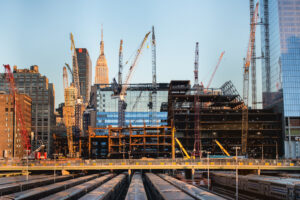
According to Cushman & Wakefield’s James Bohnaker, the new measures are expected to lift commercial construction costs by roughly 4.6%, though that figure could range from 4% to 5% depending on asset type and location.
The most significant nuance here is how tariffs propagate through the industry’s cost structure:
- Importers pay the duties, but they quickly pass those costs to contractors.
- Contractors, facing thinner margins and material shortages, shift the burden onto developers and tenants through higher bids.
- Finally, tenants feel the cumulative effect through higher rents or reduced scope in their buildouts.
This cascading effect lands hardest on office tenants, because their spaces are among the most customization-intensive in commercial real estate.
Open floorplans, modular meeting zones, upgraded HVAC and tech infrastructure—all staples of post-pandemic design—are material-heavy and labor-sensitive. Each incremental uptick in input costs magnifies the total budget.
TIAs Under Tariff Pressure: The End of Generosity?
Before tariffs, landlords were already nearing exhaustion on incentives. Now, with material costs climbing again, the purchasing power of each TIA dollar is eroding. For example:
- A $100-per-square-foot allowance negotiated in 2023 might have covered a mid-tier buildout.
- By late 2025, that same allowance might buy only 90–92% of the same quality fit-out, once adjusted for tariff-induced inflation.
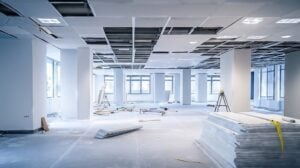
In a sense, nominal TIA levels remain “sky-high”, but their real value is falling.
This dynamic forces tenants to either add their own capital—a hard sell in an uncertain economy—or scale back on design ambitions. The result is an uneven tenant experience: trophy tenants in top-tier buildings continue to get premium spaces, while smaller or cost-sensitive tenants are priced out of full customization.
Market Polarization Deepens
The tariffs have amplified the market’s two-speed dynamic.
- Well-capitalized landlords in gateway markets (e.g., New York, San Francisco, D.C.) can absorb the extra cost and still offer robust incentives to attract relocations. Want an example? Look no further than JP Morgan’s $3 billion upgrade of their Park Ave office turned mega-corporate campus.
- Debt-stressed owners of aging assets, however, have little room left to maneuver. Their financing costs are already elevated, and the tariffs squeeze them further by increasing the cost of even modest refurbishments.
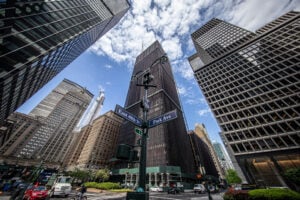
This divergence reinforces a “flight to quality” pattern: tenants prefer to move into newer, better-located buildings where landlords can offer larger TIAs and more predictable delivery timelines. Savills reports that 74% of large office leases in 2025 were relocations or new leases, not renewals—a telling sign of how buildout quality has become central to tenant decision-making.
Yet this very relocation cycle feeds back into higher overall demand for construction services, sustaining cost pressures even as the number of new developments falls.
Adaptive Forces: Offsetting and Delaying Pain
Despite these inflationary forces, there are offsetting dynamics that muted the worst-case scenario:
- Construction slowdown: Fewer active projects (only 31M sq. ft. delivered in 2024) mean less labor competition, tempering wage-driven inflation.
- Contractor flexibility: Many builders are turning to alternative suppliers or domestic materials to bypass tariffs where feasible.
- Phased buildouts: Some tenants are staging construction over longer periods to smooth cost exposure.
Still, these are stopgap measures. As Bohnaker noted, tariffs “are just one of many factors,” but they reinforce an already expensive status quo rather than reversing it.
The Broader Financial Context: Debt, Delinquency, and Risk
The tariff shock is landing in a market already under severe financial strain:
- $85 billion in office CMBS debt is now classified as distressed, with a record 11.7% delinquency rate (Trepp).
- Urban assets—those most reliant on expensive, design-heavy tenants—make up two-thirds of that distress.
- Landlords facing refinancing hurdles now must also budget for higher material and construction costs, squeezing their ability to finance tenant improvements.
This creates a vicious cycle: weaker owners offer less generous TIAs → tenants look elsewhere → occupancy drops → financing becomes even harder.

What Lies Ahead: Inflation’s Long Tail
Looking forward, tariffs are likely to extend the inflation tail in commercial construction rather than create an immediate spike. The 4–5% cost increase may unfold gradually across 2025–2026, but the psychological effect on pricing behavior—contractors padding bids, landlords hedging costs—will persist longer.
The bigger story is that the office sector’s main shock absorber—the TIA—has lost its flexibility just as costs are reaccelerating.
Landlords can’t easily raise allowances further, tenants can’t easily absorb additional outlays, and financiers are retreating from risk.
The result is a narrowing middle ground:
- Premium buildings stay competitive through capital resilience.
- Secondary assets drift toward obsolescence.
- Tenants are caught between cost containment and the desire for high-quality environments that attract workers back to the office.
Bottom Line
Tariffs did not create the office sector’s buildout crisis—but they have intensified its structural imbalance.
They add incremental cost to a system already maxed out on incentives and fragile on returns. For tenants, this means less buildout for the same allowance; for landlords, it means greater pressure to differentiate through capital strength.
The 2025 landscape is one where policy meets market fatigue—and where every percentage point of material inflation reverberates through the full commercial real estate ecosystem, from steel suppliers to tenants signing decade-long leases.
The tariffs’ real legacy may not be immediate price spikes but a gradual recalibration of how office space is conceived, financed, and occupied. As allowances lose purchasing power, tenants and landlords alike will need to rethink what constitutes value in a buildout. Expect a pivot from lavish capital spending toward strategic efficiency.
For many tenants, the next generation of deals will hinge less on the size of the check and more on the quality and certainty of delivery. Buildouts will become leaner, timelines longer, and lease structures more creative—linking incentives to occupancy performance or shared infrastructure. Landlords who can balance design ambition with cost discipline will emerge stronger, while those dependent on heavy subsidies will fall behind.