The U.S. commercial real estate market is not behaving uniformly — and that matters for enterprise real estate strategy. Let’s look at the market from a bird’s eye view.
Five data-backed realities are shaping tenant leverage heading into 2026:
- Pricing divergence is driven by liquidity and asset quality, not geography
- New supply is collapsing faster than demand is recovering
- Net absorption remains negative at the macro level
- Lower interest rates are increasing transaction velocity — not equalizing leverage
- Negotiating power is now asset-specific, not market-wide
For Fortune 1000 occupiers, this environment rewards precision, speed, and portfolio-level visibility — not broad market assumptions.
So let’s dive into these trends and discuss how to keep your portfolio nimble an well-performing in this environment.

The CRE Market Isn’t Splitting — It’s Sorting
Most commentary describes today’s commercial real estate environment as a “two-tier market.” That framing suggests a simple divide between winners and losers. The data tells a different story.
What’s happening instead is a sorting of assets and owners based on constraint — specifically, who can afford to wait and who cannot.
This sorting is driven by three measurable factors:
- Access to capital: Well-capitalized owners can refinance, carry vacancy, and delay leasing decisions. Less-capitalized owners often must trade rent, concessions, or term flexibility to secure occupancy.
- Ability to hold through uncertainty: Owners with longer investment horizons can withstand slower leasing velocity and evolving space utilization. Others are forced to reprice assets in real time.
- Flexibility to reposition assets: Buildings that can be upgraded, re-tenanted, or adapted to shifting tenant needs are retaining value. Assets without repositioning options are absorbing the bulk of pricing pressure.
As a result, pricing is adjusting selectively, not uniformly.
The market is clearing quietly — through deal terms, concessions, and asset-level repricing — rather than through broad distress or forced sales.
Pricing: Two Indexes, Two Operating Realities
If we look at CoStar’s Commercial Repeat Sale Indices (CCRSI), we can observe two distinct pricing behaviors occurring at the same time.
Premium / Core Assets (Value-Weighted Index):
- +0.4% month over month (November)
- Six consecutive monthly gains
- +1.1% quarter over quarter
- −1.3% year over year
This index is driven by larger, higher-value transactions, typically involving institutionally owned assets in liquid markets.
Smaller / Secondary Assets (Equal-Weighted Index):
- −0.9% month over month
- −0.7% quarter over quarter
- Flat year over year
This index reflects the more numerous, lower-priced transactions that dominate secondary and tertiary properties.

Why These Two Indexes Matter To Corporate Tenants
This divergence is not simply “major markets outperforming secondary markets.” It reflects who still has pricing power — and why.
- Assets with institutional liquidity and long-term relevance are being priced on their ability to withstand uncertainty, not on near-term occupancy alone.
- Assets without capital buffers are being repriced to clear — often quietly — through lower transaction values and more flexible leasing terms.
For corporate occupiers, the practical implication is clear: lease economics now vary sharply by building, even within the same submarket.
Market averages increasingly obscure:
- Where landlords are willing to concede
- Where pricing discipline is holding
- Where renewal leverage actually exists
Supply: The Construction Cliff Is A 2026–2028 Problem
Today’s availability reflects yesterday’s development decisions. The construction data now coming into focus shows that far fewer projects are replacing the space currently delivering — setting up a materially different supply environment in 2026–2028.
Key Construction Data:
- Total completions across office, retail, and industrial: 3M SF in 2025
- Down 34.2% year over year
- Q4 new property openings fell below 100M SF, the lowest level since 2013
This decline reflects a sharp reduction in projects entering and advancing through the development pipeline — not a temporary delay.
Why The Impact Is Delayed For Corporate Tenants
Current leasing conditions still benefit from:
- Projects approved prior to rate hikes
- Developments already under construction reaching completion
These deliveries create the impression of adequate supply today.
The constraint emerges later, when:
- Fewer new projects replace delivered space
- The pool of modern, functional buildings shrinks
- Tenants compete for the same subset of “approved” assets
As a result:
- Premium space tightens even if headline vacancy remains elevated
- Choice narrows faster than market statistics suggest
- Negotiating leverage shifts unevenly across buildings
This pattern is already evident in newer Class A office properties and select industrial corridors, where availability has tightened despite broader market softness.

Demand: Net-Negative Doesn’t Mean Evenly Weak
Macro Demand Snapshot
- U.S. commercial nonresidential space is projected to lose ~100M SF of net tenants in 2025
- This is the most negative absorption since 2009
The Important Nuance
Demand is not disappearing uniformly — it is rotating:
- Enterprises are consolidating footprints
- Tenants are upgrading into higher-quality assets
- Commodity space is bearing the brunt of vacancy
Recent data shows improving absorption in prime office assets, even while the broader market remains soft.
Translation: Your leverage depends on where you are moving — not just whether you are moving.
Interest Rates: Easier Capital, Uneven Impact
What Changed In 2025
- The Federal Reserve cut rates three times since September
- Target range dropped to 3.50%–3.75% by December
- Borrowing costs are now at their lowest level since 2022
What Didn’t Change
Lower rates:
- Increase transaction activity
- Improve refinancing options for strong owners
- Support pricing for premium assets
They do not:
- Force well-capitalized landlords to concede aggressively
- Restore leverage uniformly across all buildings
- Eliminate distress in secondary assets
Rate cuts increased movement — not symmetry.
What This Means For Corporate Tenants
1. Leverage Is Now Asset-Specific
The idea of a universally “tenant-friendly market” no longer holds.
Negotiating strength depends on:
- The owner’s capital position
- The asset’s long-term relevance
- How critical your tenancy is to the landlord’s strategy
2. Secondary Assets Offer Tactical Opportunity
Buildings facing:
- Refinancing pressure
- Tenant concentration risk
- Limited repositioning options
are often more willing to:
- Trade rent for occupancy
- Extend TI packages
- Reset economics at renewal
These opportunities require visibility and speed.
3. Supply Constraints Will Show Up Later — Not Now
The sharp drop in construction today increases the odds of:
- Fewer high-quality options in 2026–2028
- Less choice for ESG-, talent-, or logistics-driven requirements
- More competition for newer assets
Planning ahead matters more than reacting later.
Why Transaction Management Has Become A Strategic Control Point
The current commercial real estate environment is not just fragmented — it is asymmetric.
Pricing, supply, and leverage now vary by building, by owner, and by timing. In this kind of market, outcomes are no longer driven by where you operate, but by how quickly and consistently decisions move from insight to execution.
For large occupiers, the real risk is not misreading the market, but allowing sound strategy to erode through slow, inconsistent execution.
-
Concessions negotiated but not captured
-
Approvals delayed while leverage shifts
-
Inconsistent deal terms across similar assets
-
Portfolio decisions made on incomplete or outdated data
This is where transaction management moves from administrative support to strategic infrastructure.

What REoptimizer® Enables In Practice
REoptimizer® gives corporate real estate teams a single operational system to manage complexity at scale:
-
Asset-Level Intelligence At Portfolio Scale
Centralizes deal data across regions, asset types, and brokers so negotiations reflect real-time leverage — not market averages. -
Disciplined, Defensible Decision-Making
Standardizes underwriting assumptions, approval workflows, and deal inputs to reduce variability and governance risk. -
Faster Conversion Of Leverage Into Economics
Shortens LOI-to-close timelines so negotiated advantages are not lost to delay, shifting conditions, or internal friction. -
Consistent Economics Across The Portfolio
Enables side-by-side comparison of concessions, terms, and obligations so value is captured systematically — not deal by deal. -
Post-Signature Accountability
Ensures negotiated terms survive execution and are visible beyond the transaction, reducing leakage over the lease lifecycle.
In a market where leverage changes asset by asset, execution discipline becomes a source of leverage itself.
The Bottom Line For Enterprise Occupiers
The defining feature of today’s commercial real estate market is not volatility. It is selectivity.
Capital, supply, and demand are no longer moving together — and neither is negotiating power.
For Fortune 1000 tenants, winning in this environment requires:
-
Asset-level insight, not market generalizations
-
Portfolio-wide visibility, not regional silos
-
Faster, more disciplined execution, not reactive deal-making
Organizations that adapt their operating model — not just their strategy — will secure flexibility, control risk, and preserve value as the market continues to sort. REoptimizer® is your tool to see your entire portfolio strategically in the midst of this environment. Learn more about how it can level up your commercial real estate in 2026 and beyond.
Frequently Asked Questions
Is 2026 A Tenant Market Or A Landlord Market?
Neither, broadly speaking. Data shows leverage is asset-specific, with premium properties firming and secondary assets repricing downward.
Why Are Premium Assets Rising If Demand Is Weak?
Capital is prioritizing assets that can absorb uncertainty and remain liquid. At the same time, tenants are rotating into higher-quality space even as total footprints shrink.
How Does Reduced Construction Affect Corporate Tenants?
Lower deliveries today increase the risk of future scarcity in high-quality space, especially for tenants with modern, ESG, or operational requirements.
When Brookfield defaulted on over $1 billion in loans tied to its downtown Los Angeles office properties last year, the news spread quickly across the financial press.
Bloomberg cited “rising interest rates” and “higher borrowing costs weighed on valuations.” The Financial Times reported that property values had fallen by half, and that lenders were moving several buildings into special servicing.
But the story wasn’t just about one firm. Brookfield’s defaults—rooted in its sprawling portfolio of office towers like the Gas Company Tower, EY Plaza, America Plaza, and the 777 Figueroa Street tower—signaled a deeper shift in how commercial real estate (CRE) works in the modern era.
This wasn’t a bankruptcy. It was a business model pivot—a public admission that owning too much office space had become a liability.
And now, as Brookfield sells off billions in office assets, it’s becoming a case study in how even the most powerful owners are being forced to evolve, deleverage, and redefine success.

The Los Angeles Defaults: A Case Study in Value Erosion
In February 2024, Brookfield defaulted on loans totaling over $1 billion across its Los Angeles office portfolio, including loans backed by its once-flagship Gas Company Tower.
That 52-story building, valued at $675 million in 2021, was later appraised at just $270 million—a 60% loss in value. It soon landed in receivership, joining a growing list of high-profile Los Angeles office buildings in distress.
The same story repeated at EY Plaza, where Brookfield defaulted on a $275 million loan, and at 777 Tower, burdened with $289 million in debt before a planned $145 million sale collapsed. Another major property, the Wells Fargo Center, carried $763 million in outstanding debt set to mature within the year.
Collectively, these defaults represented less than 1% of Brookfield’s total real estate assets—but more than $1 billion in direct losses tied to some of the country’s most visible downtown office buildings. For lenders and investors, it was a chilling signal that even institutional-grade assets were not immune.

How We Got Here: The Office Market’s Fragile Economics
To understand the Brookfield defaults, it’s necessary to zoom out to the macroeconomic forces reshaping the office market nationwide.
- Office values have plummeted by 30–70% in key U.S. metros since 2020.
- Rising interest rates have doubled borrowing costs for many landlords.
- Leasing demand has declined as tenants shrink footprints and adopt hybrid work.
- Outstanding debt on office assets is expected to exceed $1 trillion by 2026, according to Morgan Stanley.
In this context, Brookfield’s decision to walk away from underwater properties was less a shock than a preview of what’s ahead.
The firm recognized, earlier than most, that paying on non-recourse loans for half-empty office towers in Los Angeles, San Francisco, and even New York no longer made financial sense.
By allowing lenders to take possession, Brookfield effectively capped its losses.
“We made the prudent choice not to continue making payments on certain non-core assets,” Brookfield spokesperson
They confirmed the defaults but emphasized that the company’s “core office holdings remain strong.” In truth, this selective retreat reflected the harsh math of modern real estate: cash flow couldn’t cover debt service, and refinancing at today’s interest rates would have been ruinous.
From Foreclosures to Fund Management: Brookfield’s 2025 Pivot
Fast forward to late 2025. Brookfield, once the largest office owner in the United States, has become one of the largest office sellers. The company is preparing to offload $10 billion in office assets by 2030 as part of a broader $45 billion real estate reduction plan, reshaping its $80 billion portfolio.
The strategy is clear:
- Sell or relinquish underperforming office properties.
- Refinance $8 billion in debt maturities coming due over the next two years.
- Double down on fund management—raising capital from investors rather than owning the properties directly.
Among the properties reportedly on the block are One Liberty Plaza in New York, One Leadenhall in London, and other mid-tier towers that no longer fit Brookfield’s definition of “super-core.”
Meanwhile, the company’s new $17 billion opportunity fund is already targeting distressed office and retail assets—potentially including some buildings it once owned. It’s a full-cycle repositioning: from borrower to buyer of bargains.

Data Doesn’t Lie: The Office Market Is Still in Decline
If Brookfield’s shift seems drastic, it’s because the numbers demand it.
According to Green Street Advisors, U.S. office property prices have fallen by 52% in major CBDs since the pandemic. In San Francisco, vacancy rates hover near 35%; in downtown Los Angeles, they’re approaching 30%.
Even prime assets are trading at cap rates unseen since 2009.
And the outlook? Still cloudy.
- Interest rates remain elevated, and lenders have become more selective.
- Special servicing volumes are up 118% year-over-year, per Trepp data.
- Nearly $300 billion in office loans will mature by the end of 2026.
This means borrowers like Brookfield—even with access to capital and deep relationships with banks—are being forced to make hard choices: sell, restructure, or default.
Lessons from Brookfield: The New Playbook for CRE Giants
The Brookfield defaults are not an isolated event but a glimpse into a broader structural evolution in commercial real estate.
1. The Era of Permanent Leverage Is Over.
For decades, firms like Brookfield and Blackstone thrived on cheap debt and long-term appreciation. That model depended on predictable cash flow and stable interest rates. Neither exists today.
2. Non-Recourse Lending Has Changed the Game.
By utilizing non-recourse loans, Brookfield could default strategically without broader balance sheet exposure. This “walk-away option” is increasingly being exercised by borrowers across markets, particularly where office values have fallen by more than 40%.
3. Portfolio Management Is Now About Subtraction, Not Addition.
Brookfield’s 2025 selloff marks the dawn of lean real estate operations. It’s not just offloading debt—it’s redefining what “core” means in a world where occupancy and financing risk dominate returns.
4. The Shift to Fund Models Is Permanent.
Institutional firms are pivoting from ownership to capital management. Instead of holding towers directly, they raise funds to invest opportunistically—minimizing exposure while keeping upside optionality.

Implications for Tenants and Corporate Occupiers
For corporate tenants, the Brookfield defaults carry clear operational lessons.
- Know Your Landlord’s Financial Health.
Buildings in special servicing or foreclosure can impact lease terms, maintenance, and renewals. Due diligence on ownership structure and outstanding debt is no longer optional. - Revisit Lease Clauses for Continuity and Control.
Tenants should negotiate protections in case of landlord default or asset sale—including continuity-of-service agreements, rights of first offer, and early termination triggers tied to building ownership changes. - Capitalize on Distress.
For tenants renewing or relocating, this period offers leverage. Landlords facing loan maturities or value erosion are increasingly open to generous concessions—free rent, build-out allowances, and flexible terms.
The Wider Market Picture: Default as Strategy, Not Failure
While Brookfield defaulted on marquee Los Angeles office buildings, it continues to expand its global funds platform and manage over $825 billion in total assets. That’s the paradox of today’s market: defaulting is not necessarily failing—it’s sometimes optimizing.
As one former Brookfield executive with direct knowledge of the firm’s debt strategy told the Financial Times, “These are not distress moves—they’re deliberate portfolio management.”
In other words, the default itself has become a financial instrument, a tool to rebalance and reprice risk in an environment where debt and property values no longer align.
What’s Next: Two Years That Will Define the Decade
Over the next two years, the office market faces its most critical test.
Between now and 2027, nearly $800 billion in commercial loans will mature—most tied to office and retail properties whose values have not recovered.
Morgan Stanley estimates that $500 billion of this debt is “at risk of refinance failure.” That means many landlords, from regional owners to global firms, will have to either inject new capital, sell at discounts, or surrender assets outright.
If the Brookfield defaults were the early warning, the Brookfield selloffs are the blueprint for survival.Firms are consolidating, deleveraging, and retooling for a leaner, more data-driven era of CRE.
The Future Belongs to the Agile
The story of Brookfield—from downtown Los Angeles defaults to a global office selloff strategy—captures the broader transformation of the commercial real estate industry.
This is no longer a market of endless expansion or trophy ownership. It’s a market where information, timing, and agility define performance.Office properties are no longer passive income streams; they are dynamic liabilities that must be managed, hedged, or repositioned.
Brookfield’s evolution—from defaulting borrower to opportunistic fund manager—proves one thing: in the new world of commercial real estate, the smartest firms aren’t the ones who never stumble—they’re the ones who immediately respond, adapt, and turn crisis into capital.
By this year, the U.S. office market had settled into a fragile balance built on expensive stability.Tenant Improvement Allowances (TIAs)—the cash landlords provide for tenant buildouts—had soared to unprecedented levels, up a whopping 112% since 2016 according to Savills and CompStak.
Of course, these allowances had become a primary lever in a sluggish leasing environment, where occupiers were reluctant to renew in outdated spaces but equally wary of committing fresh capital.
Between 2021 and 2023, these generous TIAs were a shock absorber keeping the office sector functioning.
As construction costs surged—first from pandemic-era inflation, then supply bottlenecks, then rising interest rates—landlords turned to ever-higher allowances to keep deals alive.But by early 2025, the elasticity of that support snapped.Savills found the pace of TIA growth slowing for four consecutive years, signaling a ceiling.
Landlords, strained by debt and cap-rate compression, could no longer keep subsidizing tenant fit-outs at escalating levels. In effect, the subsidy mechanism had reached its limit just as new cost pressures were emerging.
The Tariff Shock: A New Layer of Inflation
Into this delicate ecosystem came the April 2025 tariffs, introduced under the Trump administration, reigniting cost inflation that many believed was easing.
The tariffs targeted core construction inputs—steel, glass, aluminum, and lumber—materials foundational to every modern office buildout.
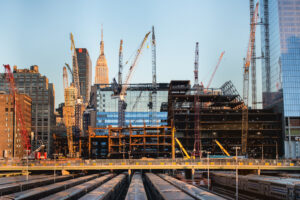
According to Cushman & Wakefield’s James Bohnaker, the new measures are expected to lift commercial construction costs by roughly 4.6%, though that figure could range from 4% to 5% depending on asset type and location.
The most significant nuance here is how tariffs propagate through the industry’s cost structure:
- Importers pay the duties, but they quickly pass those costs to contractors.
- Contractors, facing thinner margins and material shortages, shift the burden onto developers and tenants through higher bids.
- Finally, tenants feel the cumulative effect through higher rents or reduced scope in their buildouts.
This cascading effect lands hardest on office tenants, because their spaces are among the most customization-intensive in commercial real estate.
Open floorplans, modular meeting zones, upgraded HVAC and tech infrastructure—all staples of post-pandemic design—are material-heavy and labor-sensitive. Each incremental uptick in input costs magnifies the total budget.
TIAs Under Tariff Pressure: The End of Generosity?
Before tariffs, landlords were already nearing exhaustion on incentives. Now, with material costs climbing again, the purchasing power of each TIA dollar is eroding. For example:
- A $100-per-square-foot allowance negotiated in 2023 might have covered a mid-tier buildout.
- By late 2025, that same allowance might buy only 90–92% of the same quality fit-out, once adjusted for tariff-induced inflation.

In a sense, nominal TIA levels remain “sky-high”, but their real value is falling.
This dynamic forces tenants to either add their own capital—a hard sell in an uncertain economy—or scale back on design ambitions. The result is an uneven tenant experience: trophy tenants in top-tier buildings continue to get premium spaces, while smaller or cost-sensitive tenants are priced out of full customization.
Market Polarization Deepens
The tariffs have amplified the market’s two-speed dynamic.
- Well-capitalized landlords in gateway markets (e.g., New York, San Francisco, D.C.) can absorb the extra cost and still offer robust incentives to attract relocations. Want an example? Look no further than JP Morgan’s $3 billion upgrade of their Park Ave office turned mega-corporate campus.
- Debt-stressed owners of aging assets, however, have little room left to maneuver. Their financing costs are already elevated, and the tariffs squeeze them further by increasing the cost of even modest refurbishments.

This divergence reinforces a “flight to quality” pattern: tenants prefer to move into newer, better-located buildings where landlords can offer larger TIAs and more predictable delivery timelines. Savills reports that 74% of large office leases in 2025 were relocations or new leases, not renewals—a telling sign of how buildout quality has become central to tenant decision-making.
Yet this very relocation cycle feeds back into higher overall demand for construction services, sustaining cost pressures even as the number of new developments falls.
Adaptive Forces: Offsetting and Delaying Pain
Despite these inflationary forces, there are offsetting dynamics that muted the worst-case scenario:
- Construction slowdown: Fewer active projects (only 31M sq. ft. delivered in 2024) mean less labor competition, tempering wage-driven inflation.
- Contractor flexibility: Many builders are turning to alternative suppliers or domestic materials to bypass tariffs where feasible.
- Phased buildouts: Some tenants are staging construction over longer periods to smooth cost exposure.
Still, these are stopgap measures. As Bohnaker noted, tariffs “are just one of many factors,” but they reinforce an already expensive status quo rather than reversing it.
The Broader Financial Context: Debt, Delinquency, and Risk
The tariff shock is landing in a market already under severe financial strain:
- $85 billion in office CMBS debt is now classified as distressed, with a record 11.7% delinquency rate (Trepp).
- Urban assets—those most reliant on expensive, design-heavy tenants—make up two-thirds of that distress.
- Landlords facing refinancing hurdles now must also budget for higher material and construction costs, squeezing their ability to finance tenant improvements.
This creates a vicious cycle: weaker owners offer less generous TIAs → tenants look elsewhere → occupancy drops → financing becomes even harder.

What Lies Ahead: Inflation’s Long Tail
Looking forward, tariffs are likely to extend the inflation tail in commercial construction rather than create an immediate spike. The 4–5% cost increase may unfold gradually across 2025–2026, but the psychological effect on pricing behavior—contractors padding bids, landlords hedging costs—will persist longer.
The bigger story is that the office sector’s main shock absorber—the TIA—has lost its flexibility just as costs are reaccelerating.
Landlords can’t easily raise allowances further, tenants can’t easily absorb additional outlays, and financiers are retreating from risk.
The result is a narrowing middle ground:
- Premium buildings stay competitive through capital resilience.
- Secondary assets drift toward obsolescence.
- Tenants are caught between cost containment and the desire for high-quality environments that attract workers back to the office.
Bottom Line
Tariffs did not create the office sector’s buildout crisis—but they have intensified its structural imbalance.
They add incremental cost to a system already maxed out on incentives and fragile on returns. For tenants, this means less buildout for the same allowance; for landlords, it means greater pressure to differentiate through capital strength.
The 2025 landscape is one where policy meets market fatigue—and where every percentage point of material inflation reverberates through the full commercial real estate ecosystem, from steel suppliers to tenants signing decade-long leases.
The tariffs’ real legacy may not be immediate price spikes but a gradual recalibration of how office space is conceived, financed, and occupied. As allowances lose purchasing power, tenants and landlords alike will need to rethink what constitutes value in a buildout. Expect a pivot from lavish capital spending toward strategic efficiency.
For many tenants, the next generation of deals will hinge less on the size of the check and more on the quality and certainty of delivery. Buildouts will become leaner, timelines longer, and lease structures more creative—linking incentives to occupancy performance or shared infrastructure. Landlords who can balance design ambition with cost discipline will emerge stronger, while those dependent on heavy subsidies will fall behind.
Is this the end of renewal as default? In today’s market, staying put may actually cost more than moving — as hidden inflation quietly drives up your lease costs year after year.
For decades, tenants defaulted to renewing leases because it felt safer…less disruption, less capital, fewer unknowns.But in 2025, that old playbook no longer works. High vacancies, stressed landlords, and compounding rent escalations have flipped the risk equation.
Today, renewal decisions must be strategic, not automatic — because the “status quo” lease is often the most expensive one you hold.

Market Forces Are Out of Balance
The renewal landscape has changed. What used to be a straightforward decision is now a high-stakes choice.
-
U.S. office vacancy stands at roughly 20.6–20.7% as of Q2 2025 — the highest level on record (Moody’s Analytics).
-
About 24% of office mortgages mature this year, according to the Mortgage Bankers Association. Many landlords face refinancing at higher interest rates or lower valuations.
-
Office loans remain the weakest link in commercial mortgage-backed securities (Trepp), with delinquencies climbing unevenly across markets.
In simple terms, there’s more empty space and more landlord distress than at any time in modern history. That gives tenants leverage — but only if they use it.
Renewing out of habit, without benchmarking the market, means ignoring your negotiating power.
The Hidden Inflation Inside Every Renewal
Even tenants who think they’re holding steady on rent often aren’t. Escalations and pass-throughs quietly compound total cost year after year.
Base Rent Escalations
Most leases bake in 3% annual increases, a number that feels harmless but adds up fast.
Operating Expense Pass-Throughs
The bigger budget threat comes from expenses that flow through your lease — taxes, insurance, utilities, janitorial, maintenance.
-
Insurance costs rose for 25 consecutive quarters through late 2023 (Marsh Global Insurance Index).
-
While U.S. property insurance rates declined around 9% in early 2025, they’re still well above 2019 levels.
-
Taxes and insurance now represent the largest share of total building operating costs, according to BOMA benchmarks.
If your lease passes these costs through to you — as most do — your “flat renewal” is anything but flat. Without renegotiation, you’re absorbing hidden inflation every year.

Why Older Leases Are Now Out of Sync
Many tenants still sit on leases signed before or during the pandemic. Those deals no longer reflect today’s realities.
Here’s what’s changed:
-
Rent escalations have compounded for years, inflating your effective rate.
-
Concessions peaked in 2023, softened slightly in 2024, but remain materially higher than in 2019.
-
Average free rent: 8.9 months (2024) vs. 9.6 months (2023).
-
Average tenant improvement allowance: $87.51 per square foot, down from $97.55 but far higher than 2019 levels.
-
-
Vacancies are historically high, which means landlords are still competing hard for credit tenants.
If you signed in 2019 or 2020, you’re likely paying an inflated effective rent and getting none of the concessions currently available to new tenants.
Landlord Solvency: The Risk You Inherit When You Renew
Renewing isn’t just about your rent — it’s about who’s on the other side of the lease.
-
Landlords facing refinancing pressure may defer maintenance or reduce building services to conserve cash.
-
Some owners can’t refinance at all, pushing assets toward loan default or receivership.
-
Even otherwise stable landlords are often unwilling or unable to fund new TI packages or rent abatements.
Before renewing, treat your landlord like a counterparty you’re underwriting. Check when their loans mature, whether they’ve reinvested in the property, and what their debt terms look like. The strength of your landlord’s balance sheet directly affects the reliability of your lease.

When Renewals Quietly Outprice the Market
The biggest misconception in corporate real estate right now is that staying put is always cheaper.
Across most U.S. markets, effective rents for new deals have flattened or fallen, while renewal rents have continued to climb through automatic escalations and compounding pass-through costs.
2024 U.S. office data shows that although nominal asking rents have held steady, effective rents — after concessions — are now roughly 5–10% lower than 2019 levels for non-prime assets. Meanwhile, tenants still on long-term leases signed before the pandemic are often paying 15–20% more after years of escalations, with no offsetting incentives.
That divergence is reshaping tenant strategy.Corporate occupiers are no longer expanding — they’re re-allocating: consolidating footprints, upgrading to better-located or better-amenitized buildings, and resetting rent baselines in the process.
In this environment, the “cheapest” option on paper — a renewal at your current building — may actually deliver the highest total cost of occupancy once escalations, operating expenses, and foregone concessions are factored in.
The takeaway: continuity isn’t cost control. If you haven’t benchmarked your rent and incentives against the active market in the last 12–18 months, there’s a strong chance your renewal is already overpriced.
How to Pressure-Test Your Renewal Strategy
A renewal decision shouldn’t rely on instinct — it should rely on data discipline and market comparison.
Here’s how to approach it with rigor:
1. Benchmark your effective rate.
Gather recent comps or proposals in your submarket. Normalize them for effective rent by including free rent, amortized TI dollars, and estimated operating expenses. This provides an apples-to-apples comparison against your escalated rate.
2. Model your total cost of occupancy.
Base rent is only part of the story. Taxes, insurance, parking, maintenance, and deferred upgrades can add 20–30% to your total spend. iOptimize Realty’s portfolio data confirms that tenants who quantify these costs early negotiate more complete rent resets later.
3. Evaluate landlord risk.
Renewing with a highly leveraged or under-capitalized owner carries operational risk — deferred maintenance, slow response times, and uncertain reinvestment. Those soft costs can be real and material.
4. Quantify flexibility value.
Shorter lease terms, contraction rights, and assignment clauses have tangible financial value. They allow you to adapt to headcount or location changes — something many pre-pandemic leases lack.
5. Create competitive tension.
Even if you intend to stay, act as though you’re running a competitive bid. According to iOptimize Realty’s renewal data, tenants who pursue at least one credible relocation alternative achieve 10–15% stronger economic outcomes on renewals.
The goal isn’t to move for the sake of moving — it’s to ensure your renewal performs like a market-rate transaction. In 2025, mobility equals leverage, and leverage is what keeps renewals honest.

How to Make Staying Put Worth It
Renewal can still make sense — but only if you re-engineer the deal.
Treat it as a full market negotiation, not an administrative extension.
Key renewal levers:
-
Re-strike base rent to current market rates, normalized for TI and free rent.
-
Reset escalation terms. Replace 3% fixed bumps with CPI-linked increases capped at a maximum percentage.
-
Cap controllable expenses and seek carve-outs or collars on taxes and insurance.
-
Add service guarantees or remedies if landlord credit is a concern.
-
Negotiate flexibility — options to contract, expand, or assign space.
-
Start early. Tenants who begin renewals 12–18 months ahead can achieve 10–15% better outcomes.
Tenant Behavior in 2025: What the Data Shows
Two clear shifts define current tenant strategy.
1. Trading Up While Downsizing
Many occupiers are consolidating into smaller footprints but upgrading to higher-quality assets. The result is better employee experience and stronger brand positioning at equal or lower total cost.
2. Concessions Plateau, Not Collapse
While incentives have pulled back from 2023 peaks, they remain significantly richer than pre-COVID levels. Landlords are still offering months of free rent and sizable improvement allowances to secure strong credits.
In short, the market is fluid — and tenants with data-backed strategies can extract more value than ever before.
The 2025 Renewal Playbook
Before you sign anything, run your process through this checklist:
-
Re-underwrite your market. Gather at least three comparable live alternatives.
-
Audit your OPEX exposure. Model taxes, insurance, and utilities over the next three to five years.
-
Evaluate landlord credit. Identify loan maturities and potential refinancing risk.
-
Reset rent escalations. Negotiate CPI-linked or step-down structures.
-
Add flexibility. Build in contraction and expansion rights.
-
Start early. Early preparation is the single biggest driver of negotiation leverage.
Bottom Line
The “easy renewal” era is over.
In a market defined by record vacancies, shaky landlord finances, and the lingering effects of hidden inflation, staying put without analysis can cost more than moving.
Every renewal should be a competition.Your existing landlord should earn your continued tenancy by matching — or beating — what the market offers.
Renew strategically.Because in 2025, convenience is the most expensive lease clause of all.Make every renewal a win. REoptimizer® gives you the data, leverage, and clarity to turn renewals into negotiations, and negotiations into savings. Learn more about how the REoptimizer® can give your portfolio and all your renewals a razor sharp edge.
If you’re building, leasing, or investing in industrial real estate in 2025, the math has changed—fast.
A new round of tariffs is reshaping construction budgets and forcing developers and occupiers to rethink how projects get planned, priced, and delivered.
Tariffs have driven construction material costs up 8.5% to 9.6% this year, depending on the property type. Total project outlays have climbed another 4.4% to 4.8%, even before accounting for labor or financing costs.] Metals alone—steel, aluminum, copper—make up nearly two-thirds of that increase.
That means the price to build a logistics facility, distribution center, or manufacturing plant has quietly jumped by millions of dollars in less than a year.
What’s Driving the Spike
Let’s call this what it is: a policy-driven cost shock.
The federal government’s trade actions this year imposed tariffs of up to 50% on key building materials like steel, aluminum, and copper, along with 10–25% duties on softwood lumber and derivative products.
Those numbers ripple through every part of the construction ecosystem:
- Steel, aluminum, and copper have been hit with tariff rates up to 50%, impacting both raw and semi-finished products.
- Softwood lumber and timber now carry tariffs of 10% to 25%, depending on product classification.
- Structural steel projects now cost 8–12% more than they did a year ago.
- Poured-in-place concrete projects are up 5–8%.
- Steel mill products are 17.8% more expensive year-to-date, per Bureau of Labor Statistics data.
- Even copper products, critical for manufacturing and data center facilities, are up 7%.
The result is a ripple effect that moves through every link in the CRE supply chain. From HVAC systems and glazing to electrical wiring and heavy machinery, virtually every imported component carries a higher price tag.

Compounding the issue: about 40% of CRE construction materials are imported. More than half of those (52%) come from Canada, Mexico, and the EU. Domestic producers can’t meet full demand, especially for copper, where the U.S. only supplies about 60% of what it consumes.
So, the gap gets filled with higher-priced imports and the markup lands squarely on project budgets. According to Cushman & Wakefield, about 75% of tariff-driven costs get passed directly to developers, contractors, and tenants.
Industrial Developers Hit the Brakes
The industrial sector is feeling the pressure most acutely.
The total pipeline of U.S. industrial projects under construction dropped to 253 million square feet in Q1 2025, down nearly 30% year-over-year. That’s the lowest level since 2015.
Developers aren’t necessarily out of capital; they’re out of predictability. Cost volatility and financing uncertainty have forced many to slow or shelve projects entirely. Since the end of 2024, the abandonment rate for planned industrial projects has surged by 66.5%.
Lenders have taken note. Construction and heavy value-add projects now face tighter underwriting standards, higher contingency reserves, and closer scrutiny of cost assumptions.

Leasing Activity Holds—For Now
Despite the construction slowdown, leasing volume remains remarkably stable.
Industrial tenants absorbed roughly 180 million square feet in Q1 2025—modest by pandemic-era standards, but steady considering the headwinds.
Still, strategy is shifting. Many occupiers are renewing leases rather than pursuing new builds or major expansions. Others are retooling site selection to favor existing inventory or secondary markets where renovation costs are lower.
That pause in speculative construction could tighten supply further in 2026 and 2027, driving rents higher for quality logistics space. For investors, the takeaway is simple: today’s cost crunch could become tomorrow’s pricing leverage.
The Supply Chain Domino Effect
The tariff story doesn’t end at the job site. It’s also disrupting the logistics networks that industrial real estate depends on.
The Port of Los Angeles, a critical gateway for metals and building components, reported a 35% decline in arriving cargo vessels during a single week in May 2025 compared to the same week a year earlier. The slowdown compounds lead time issues, with key materials like prefabricated panels and HVAC systems facing delays of four to six weeks.
This kind of supply uncertainty is pushing developers toward regional sourcing strategies and prefabrication techniques that rely less on global shipping lanes. Hence The Rise of Reshoring.
Data Centers and Specialty Assets Take the Biggest Hit
While logistics and manufacturing projects are feeling the strain, data centers and advanced manufacturing plants are in the bullseye.
Copper, now carrying tariffs as high as 50%, is a core component in data center construction—each hyperscale facility can require up to 50,000 tons of the metal. That cost bump alone can add tens of millions of dollars to a single project.
Developers are also struggling to procure electrical and mechanical components fast enough to stay on schedule. Many are shifting to domestic subcontractors or modular systems, but capacity constraints persist.

Wider CRE Implications
Tariffs may be hitting industrial hardest, but the ripple effect is spreading across every major CRE sector:
- Office conversions and adaptive reuse projects are seeing 5–8% higher construction costs.
- Multifamily developers are reporting delays due to higher steel and concrete pricing.
- Healthcare and senior housing projects—already cost-sensitive—are re-evaluating design specs to minimize imported materials.
In short, every project that relies on steel, aluminum, or copper is now a tariff story.
How CRE Teams Are Adapting
The smartest developers, occupiers, and investors aren’t waiting for policy clarity; they’re rewriting their playbooks.
Here’s how:
- Building Tariff Buffers Into Budgets
Quarterly budget reforecasts are becoming the norm. Developers are adding 8–10% contingency layers specifically tied to material volatility and tariff exposure. - Localizing Supply Chains
More teams are contracting with regional manufacturers and domestic fabricators. This not only reduces exposure to tariffs but also shortens lead times and cuts shipping risk. - Leaning Into Prefabrication
Prefabrication and modular construction are helping offset labor and material inflation. Developers are increasingly using offsite production to control costs and accelerate timelines. - Rebalancing Lease Terms
Occupiers negotiating build-to-suit leases are pressing for cost-sharing clauses that protect against material spikes. Landlords, in turn, are demanding longer lease terms to justify higher development costs. - Using Data to Drive Procurement
Advanced CRE tech platforms are now tracking material pricing indexes and supplier trends in real time, helping procurement teams adjust sourcing decisions dynamically. - Stress-Testing Financial Models
Lenders and investors are modeling multiple tariff scenarios—sometimes as high as 12–15% cost swings—to ensure debt coverage and returns remain viable under stress.
These aren’t just tactical shifts; they’re operational ones. In the same way that ESG and resilience became core planning factors, tariff risk management is now a fundamental discipline for CRE capital deployment.

What Comes Next
No one expects tariff policy to disappear overnight. If anything, the current environment suggests that trade policy will remain a structural part of the CRE cost base for the foreseeable future.
That means the developers and occupiers who thrive won’t be those trying to outwait volatility—they’ll be the ones who plan around it.
The winners in this cycle are the ones who can forecast risk and turn it into opportunity.
The industrial sector has been the backbone of modern CRE growth for the past decade, driven by e-commerce, logistics, and manufacturing demand. Tariffs haven’t changed that fundamental story—but they’ve rewritten the margins.
The REoptimizer® View
At REoptimizer®, we’re seeing clients take a more integrated approach to real estate strategy: aligning procurement, finance, and operations to make projects more resilient.
The playbook for 2025 and beyond is clear:
- Diversify your supply channels.
- Lock in materials early.
- Use data to track cost volatility.
- Negotiate flexibility into your leases.
Tariffs may be a policy lever, but their effects are operational. The firms that can treat volatility as an input—not a surprise—will have the edge.
Because in 2025, industrial success isn’t just about what you build.
It’s about how fast you can adapt when the rules—and the costs—change overnight. Learn more about how you can get ahead of market volatility with smarter data, integrated planning, and resilient real estate decisions.
Recession talk is back.Wall Street, Washington, and boardrooms everywhere are buzzing about whether the U.S. economy is about to stumble into a downturn or if we’ll just limp along in a period of sluggish growth.
The truth is that recession risks are materially higher than they’ve been in years. And for commercial real estate (CRE), this could be another direct hit.
When the economy wobbles, it shows up fast in mortgage rates, interest rates, tenant demand, and consumer confidence.
Higher borrowing costs squeeze investors. Job insecurity changes how companies use space. Shifts in spending ripple into property values and financing costs. But could this downturn spiral into a total doom loop?
Let’s break down the latest numbers and what they mean for investors, owners, and occupiers in today’s CRE economy.
The Current Red Flags For the Market During a Recession
The data is sending some clear warning signs:
- Hiring has nearly stalled. The U.S. added just 22,000 jobs in August, while unemployment ticked up to 4.3%, the highest since 2021. That’s not a collapse, but it’s a slowdown that raises economic uncertainty.
- Layoffs are climbing. Employers announced 85,979 job cuts in August, the worst August since the Great Recession era. Year-to-date, cuts are up 66%. That’s a big hit to consumer confidence and future spending. Rising unemployment is a dead giveaway for a market on the brink of collapse.
- Recession risk indicators are flashing. UBS analysts put the chance of a recession at 93%, based on “hard data” like consumption and income trends. The yield curve—a classic signal—is still inverted.
- Households are nervous. The NY Fed reports that only 44.9% of Americans think they’d find a job quickly if laid off—the weakest confidence in over a decade. On top of this, consumer spending is down as home prices rise to levels out of reach for many Americans.
And here’s the kicker for real estate: mortgage rates remain elevated, the Federal Reserve’s policy stance is still restrictive even if cuts are on the horizon, and insurance costs—especially for coastal and climate-exposed markets—continue to rise. These three factors magnify stress across the industry, making it harder for investors to refinance, for developers to underwrite deals, and for tenants to shoulder higher occupancy costs.
Bottom line? The economy isn’t necessarily collapsing, but it’s looking “soft, soggy, weak”—to borrow UBS’s words. And when the labor market slows, real estate markets feel it fast. Economic uncertainty is challenging an already struggling real estate market.
Is There Already a Recession in Real Estate?
The housing market tends to grab headlines, but the recession in real estate story is even more dramatic in commercial sectors—especially office.
Economic instability has had the office market in a chokehold.
- Vacancies are record-high. 20.7% of U.S. office space sat empty in Q2 2025, the highest level on record.
- Utilization is still half-time. Kastle Systems’ Back-to-Work Barometer shows ~52% occupancy across major cities—better than 2023 but still far from the full-time use needed to stabilize older, commodity buildings. (Kastle Systems)
- Delinquencies rising. Trepp reports 7.23% CMBS delinquency in July 2025, the fifth straight month of increases. And it’s not just office—stress is spilling into multifamily and lodging as well. (Multi-Housing News)
- Special servicing climbing. Moody’s CRE data shows 10.4% of conduit loans in special servicing as of January, with office leading the way. Another 22% are on watchlists—they’re not delinquent yet, but they’re one step away. (Moody’s CRE)
- The maturity wall is real. The MBA estimates $957 billion in commercial and multifamily loans mature in 2025, nearly a fifth of outstanding balances. Office assets represent a disproportionate share. With interest rates still elevated, refinancing is far from straightforward. (Mortgage Bankers Association)
This is the perfect storm: higher financing costs, limited buyer demand, and weakening tenant fundamentals.
CRE is at a delicate juncture. Higher interest rates have repriced risk.
Demand is bifurcated (premium buildings with great locations and amenities still pull tenants, while obsolete properties are stuck in limbo). The market feels like two different realities at once: scarcity at the top, oversupply at the bottom.
Regional Trouble Spots: Not All Markets Are Equal
A CRED iQ analysis of $341 billion in loans across the top 50 U.S. markets shows which metros are straining under the pressure.
- Most distressed markets:
- Minneapolis–St. Paul–Bloomington (56.7%)
- Rochester, NY (44.3%)
- Portland–Vancouver–Beaverton (42.8%)
- Austin–Round Rock, TX (26.7%)
- Denver–Aurora, CO (23.5%)
- Least distressed markets:
- Stockton, CA (0.0%)
- Columbus, OH (0.2%)
- San Diego–Carlsbad–San Marcos, CA (0.2%)
- Salt Lake City, UT (0.6%)
- Oxnard–Thousand Oaks–Ventura, CA (0.9%)
The gap is striking. Some metros are staring down declining property values and distressed loans, while others are holding steady with limited supply and healthier tenants.
Take Austin’s 7700 Parmer campus: 911,000 square feet, 74% leased to blue-chip tenants like Google and Electronic Arts, and still transferred to special servicing ahead of a December loan maturity. Even “good-looking” assets are vulnerable when financing costs rise and lenders expect more equity in the deal.
Property Values: A Market of Mixed Signals
So where are prices headed?
- CRE values are off their highs. Green Street’s all-property index is up ~2.7% year over year, but still well below the 2022 peak. Think limited housing inventory on the residential side—buyers still want deals, but they’re not bidding wars anymore.
- Deals are picking back up. MSCI reports that CRE transactions were up 13% in the first half of 2025 compared to last year, with office volumes even rising 16%. Not a boom, but a sign that some buyers are returning.
- Flight to quality is real. Prime office vacancy is 14.5%, while non-prime is nearly 20%. Tenants and investors alike want the best locations and amenities, leaving commodity assets behind.
This creates a market of fewer buyers competing for average assets, but sometimes bidding wars for trophy properties. Negotiating power has shifted: tenants can demand concessions, and opportunistic investors can push for lower prices.

If a Recession Hits: What Changes?
If the U.S. enters a technical recession (two consecutive quarters of declining GDP), here’s what to expect in real estate:
- More distressed properties. Loans maturing in 2025–2026 will face higher mortgage rates and tighter credit, leading to forced sales.
- Lower prices in weaker markets. Owners without the capital to refinance or invest in upgrades will sell at discounts.
- Negotiating power shifts further. Tenants will have leverage for free rent, TI packages, and flexible lease terms.
- Bifurcation grows. High-quality properties in limited-supply markets will hold or even gain value, while outdated assets lose ground.
If a recession hits, it won’t crush every building or every market equally—but it will widen the gap.
Expect a surge in distressed properties and lower prices where debt and design can’t keep up, even as prime assets in limited-supply markets continue to attract capital and tenants. For landlords and occupiers, the winners will be those who move early, negotiate hard, and align with quality—because in a bifurcated market, standing still is the fastest way to fall behind.
Maybe Not a Great Recession—But No Time to Be Passive
The U.S. may not be heading for a full-blown housing crash or a repeat of the Great Recession, but the signs of economic instability are hard to ignore. Job losses, higher interest rates, declining home prices, and distressed properties are reshaping the playbook for both investors and occupiers.
The silver lining? In times of decreased demand and fewer buyers competing, tenants and buyers gain more negotiating power. There are deals to be found and terms to be shaped. The risk? Waiting on the sidelines while the market shifts under your feet.
Why Technology and Transparency Matter Now
Here’s where the conversation moves from macro headlines to practical execution. In a market defined by economic uncertainty, limited supply at the top end, and distressed properties at the bottom, landlords and occupiers need more than gut feel. They need real-time benchmarking and tracking tools.
That’s exactly what platforms like REoptimizer® deliver:
- Benchmarking to market: Instantly see how your rents, concessions, and lease terms stack up against current market conditions. No more negotiating blind.
- Watchlist alerts: Landlords or properties showing financial strain can be flagged early, giving tenants leverage and helping investors avoid surprises.
- Flexible lease tracking: In a world where flexible lease terms and tenant concessions are common, software helps both sides manage obligations and opportunities with clarity.
In other words, the path forward isn’t just about riding out a potential recession in real estate—it’s about making smarter, faster decisions in a market full of mixed signals. With the right data and tools, investors and occupiers can turn volatility into strategy.
REoptimizer® could be the edge your portfolio needed. Learn more today.
Distressed debt is piling up fast.
With higher interest rates, sticky inflation, and post-pandemic demand shifts, distressed debt investors are zeroing in on key sectors where financial distress is piling up.
Office loans are seeing delinquency rates near 15%, and billions in distressed securities are now under special servicing.
For corporate tenants, this isn’t just an investor problem—it’s a real estate risk. Buildings tied to shaky capital structures, cross-collateralized loans, or looming bankruptcy proceedings can impact lease stability, operations, and even future negotiating power.
So let’s unpack special servicing, delinquencies, and what it means for corporate tenants.
Distress, Delinquencies, and Special Servicing
Recent data underscores how distressed debt has surged across commercial mortgage-backed securities (CMBS), especially in office and multifamily sectors:
- CRED iQ reports a composite distress rate—combining delinquencies and special servicing—of 10.3%, though the broader CMBS distress dipped slightly in spring 2025 after months of increase
- In June, the distress rate dropped another 20 bps to just over 10.8%, with delinquency easing to 8.1% and special servicing to 10.1% .
- Yet, the special servicing rate for office buildings remains historically high: nearly 14.78%, marking a 633 bps annual jump—an urgent red flag for corporate occupiers .
These numbers underscore how distressed debt, particularly in office properties, has rippled through capital markets, presenting both risks and opportunities for tenants.

Why Office Stands Out: Remote Work, Rates, and Renewal Risks
The office sector is the epicenter of distress:
- Remote work trends, demand shocks, and refinancing challenges have pushed many assets into special servicing.
- The pronounced concentration of distressed loans in office buildings makes this a speculative investment hotspot for distressed investors, but also a minefield for long-term lessees.
“The office segment saw its largest overall distress rate increase of the year in December—rising from 15.5 % in our November print to 17.2 % in December.” -January 2025 report by CRED iQ
Who Controls Distressed Funds? The Power of Seven Servicers
A staggering 75% of specially serviced commercial real estate debt—over $50 billion across 1,600+ properties—is managed by just seven special servicing firms. These servicers shape the restructuring process, influence debt securities values, and determine the future of affected properties.
- KeyCorp Real Estate Capital Markets leads with $12.2 billion under special servicing.
- Rialto Capital Advisors and LNR Securities Holdings each manage nearly $9–10 billion, primarily across office assets.
- Others like CWCapital emphasize multi‑sector exposure (multifamily, office, lodging), while Situs Holdings handles fewer but far larger individual distressed office loans.
The distressed debt market is highly concentrated. Control lies with just a handful of powerful alternative asset managers who drive outcomes in bankruptcy proceedings, equity conversions, or capital restructuring.
They decide whether properties are restructured, foreclosed, or sold off — giving them huge influence over the distressed debt market and the future of thousands of properties.

Cross-Collateralization in Distressed Debt
One reason these seven special servicers wield such influence is the prevalence of cross-collateralized loan structures. In many CMBS transactions, multiple properties are bundled together as security for a single loan, creating what is known as cross-collateralization and, in some cases, cross-default provisions.
- Cross-collateralization means the performance of one property can directly impact the financial standing of another, even if they are in different markets or asset classes.
- For instance, a distressed office loan bundled with multifamily or retail assets can pull otherwise stable properties into the restructuring process if the office portion defaults.
According to Morningstar DBRS, nearly 25% of CMBS portfolios issued in the last five years involve cross-collateralized debt securities—a structure that amplifies both risk and complexity when distress emerges.
The Distressed Debt Market Matters to Tenants and Portfolio Managers:
Corporate tenants may find themselves in a building that, on paper, is fully leased and cash-flowing, but if that building is cross-collateralized with a distressed property elsewhere, it can still be swept into special servicing. That can trigger:
- Delayed maintenance and capital improvements as landlords divert resources toward workouts.
- Uncertainty in lease negotiations, as servicers, debt holders, and equity holders debate restructuring strategies.
- Unexpected ownership transitions, if a cross-collateralized portfolio heads into bankruptcy proceedings or an equity conversion scenario.
This web of financial entanglement underscores why distressed debt investing work is so complex for hedge funds, private equity firms, and alternative asset managers—but it also shows why corporate real estate leaders need to scrutinize not just the property’s debt, but the capital structure of the portfolio it belongs to.

Negotiating Protections: Safeguarding Corporate Tenants in a Distressed Debt Market
As the distressed debt market expands, corporate tenants cannot simply focus on base rent or square footage. They must look deeper into the capital structure of their landlords, the role of debt holders and equity holders, and whether their property is part of a cross-collateralized loan at risk of sliding into bankruptcy proceedings. The rise of distressed debt funds and alternative asset managers stepping in as new owners only heightens the need for strategic lease protections.
Key Risk Management Strategies for Tenants
- Negotiate Non-Disturbance Agreements (NDAs):
Ensure that leases survive through restructuring processes and bankruptcy protection scenarios. Non-disturbance clauses protect tenants if lenders or private equity firms take control, preventing disruption of business operations. - Service & Operating Standards Clauses:
In cases of financial distress, landlords under pressure from distressed investors or private funds may cut corners on maintenance. Lease agreements should stipulate minimum operating and service standards, enforced even if ownership transfers during capital restructuring. - Rent Abatement & Exit Flexibility:
Where unstable capital structures threaten occupancy stability, tenants can negotiate rent reduction triggers or early termination rights tied to certain financial metrics (e.g., debt service defaults or CMBS downgrades by credit rating agencies). This provides corporate occupiers with an exit strategy if property conditions or financial performance deteriorate. - Cross-Collateralization Disclosures:
Require full transparency from landlords on whether the building is part of a cross-collateralized portfolio. For example, an office tower bundled with distressed multifamily or retail debt securities may face indirect risk if those assets default. Corporate tenants should push for rights to review financing structures during investment decisions. - Landlord Transition Playbooks:
In many cases, alternative investments like distressed debt funds, hedge funds, or private equity funds step in during ownership turnover. Tenants should prepare playbooks for engaging with incoming owners to secure continuity of services, while also leveraging their role as anchor tenants to negotiate from strength. - Engage Financial Advisors & Brokerage Firms Early:
Institutional investors and private equity firms often have a seat at the table in distressed restructurings. By working with financial advisors and brokerage firms familiar with the distressed credit space, tenants gain valuable intelligence on how such securities may trade and how that influences landlord priorities.
Distressed Debt Opportunities for Corporate Tenants
- Understand the landscape of distressed debt: Identify if your buildings are serviced by KeyCorp, Rialto, LNR, CWCapital, or others. Awareness of servicer behavior is crucial for anticipating lease or operational dynamics.
- Leverage landlord distress for concessions: In unstable capital structures, landlords may prioritize occupancy over rent, potentially opening doors for better lease terms, improvement allowances, or operational control.
- Monitor market-wide distress metrics: Keep on top of CMBS distress and special servicing rates, particularly in your asset class and geography. This informs risk management and negotiation posture.
- Stay alert to credit quality and ratings: A high LTV or a negative credit outlook (as with the NYC rent-stabilized portfolio) can signal potential restructuring pressure or service degradation.
- Plan for churn in ownership: Distress often leads to lender takeovers or initial investment by alternative managers—impacting lease enforcement, property improvement, and long-term strategy.
- Assess neighborhood-level risk: The Atlanta Hidden Pines case (56% valuation drop) shows localized economic deterioration can drive distress—highlighting the need for geographic credit insight.
- Negotiate Protections in Lease Agreements: When dealing with properties tied to distressed debt or cross-collateralized portfolios, tenants should proactively negotiate lease provisions against landlord bankruptcy protection.
At the end of the day, tenants need to consider how the current environment affects their lease stability, operational continuity, and negotiating power across their portfolio. A building may appear stable today, yet if tied to a shaky capital structure, bundled into a cross-collateralized portfolio, or swept into bankruptcy proceedings, tenants can suddenly face stalled improvements, shifting ownership, or uncertainty at renewal.
That’s where REoptimizer® comes in. Our platform was built to help corporate real estate leaders cut through the noise of the distressed debt market, monitor special servicing activity, assess exposure to unstable capital structures, and proactively manage risk. By combining data-driven insights with practical negotiation strategies, REoptimizer® equips tenants to:
-
Identify risk early by tracking servicer portfolios and credit rating agency signals.
-
Leverage distress for opportunity—securing concessions, flexibility, and operational control from landlords under pressure.
-
Prepare for ownership churn with playbooks for engaging lenders, special servicers, or new alternative asset managers.
-
Negotiate protections that safeguard corporate operations, from non-disturbance agreements to exit flexibility clauses.
At REoptimizer®, we believe knowledge is negotiating power. By understanding where distress is concentrated and how it reshapes the market, corporate leaders can turn today’s uncertainty into tomorrow’s opportunity. Learn more today.
When industrial tenants chase low rent without scrutinizing operational costs, they often trigger hidden expenses that dwarf supposed savings.
Before you commit, it’s time to dig deeper. Ask the tough questions that reveal your true cost to operate, not just your cost to lease.
So without further ado, here’s a no-nonsense breakdown of the top five questions every tenant should demand clear answers to (backed by data and real-world insights.)
1. What’s My Cost Per Pallet Position?
When it comes to industrial leasing, measuring rent in square feet is a blunt instrument. It tells you what you’re paying, but not what you’re getting.
The metric that matters most is cost per usable pallet position. That’s the true benchmark of warehouse efficiency (and where major cost variance hides in plain sight.)
Why?
Because two facilities of equal square footage can have dramatically different storage yields. Factors can change your usable capacity by tens of thousands of pallet positions include:
- clear height
- racking configuration
- aisle width
- pick path strategy
Especially amongst today’s cost-sensitive supply chains, that difference translates directly into real dollars.
Prologis Industrial Strategy Report (2024), optimizing racking systems can improve usable storage by 20–30% compared to basic floor stacking.
By leveraging vertical space and reducing wasted cube, you can cut effective rent per pallet by hundreds of dollars annually, even if the base rent per square foot looks the same.
Here’s the math: imagine leasing a 100,000 SF warehouse at $5/SF, totaling $500,000 per year in rent. If your current layout provides 10,000 usable pallet positions, you’re effectively paying $50 per pallet annually.
By improving layout efficiency by 15% ( through enhanced racking, narrower aisles, and optimized battery zones ) you could add 1,500 more pallet positions, bringing the total to 11,500.
This improvement lowers your effective rent per pallet to about $43.48, a nearly 13% reduction in cost per pallet, achieved without expanding your footprint. What’s driving these improvements? For one, clear height.
Facilities with 32′ to 36′ clear can support up to five racking levels (compared to just three in a 24′ building).
Combined with very narrow aisle (VNA) configurations (as tight as 6 feet), and selective or double-deep racking systems, these design decisions make a massive impact. Just keep in mind the trade-offs: VNA requires specialized lift equipment and may impact throughput.

Another overlooked variable: layout waste.
Every oversized battery zone, underutilized staging area, or sub-optimal pick path eats into your pallet yield. That’s where tools like REoptimizer® step in: analyzing CAD layouts, calculating usable cube per SF, and delivering hard cost-per-pallet estimates based on actual racking specs. These are actual, hard outputs you can use to compare sites.
Bottom line: In a market where efficiency is cash, tenants who optimize layout before they negotiate lease rates have a clear advantage. You don’t just want the best price per square foot, you want the lowest cost per pallet that still delivers on operational throughput.
2. How Much Am I Really Spending Per Mile to Ship?
In logistics, proximity is power. And while many tenants obsess over rent per square foot, the real cost king is transportation. Your location’s impact on shipping routes can easily overshadow rent savings — and for most occupiers, it does.
According to the Council of Supply Chain Management Professionals (CSCMP) 2024 State of Logistics Report, transportation represents a staggering 63% of total logistics spend in the U.S., compared to just 14% for warehousing.
That means your building’s location relative to your customers, intermodal hubs, and labor pools is far more consequential than the base rent on your lease.
Even small shifts in location matter. A facility that’s 15 miles closer to your delivery routes can cut transportation spend by 10–15%, depending on load type and congestion patterns. And those savings aren’t abstract. On a 250,000 SF warehouse serving urban zones with daily outbound volume, that could mean over $100,000 per year. These savings come from reductions in:
- fuel
- labor hours
- equipment wear
- regulatory/toll charges in urban zones
Here’s the real math: Suppose you’re considering two sites: one at $4/SF rent, but 40 miles from your customer base, and another at $5/SF, only 15 miles away. The rent differential looks like $250,000/year.
But when REoptimizer® models the total logistics costs (including geospatial truck routing, time-of-day congestion, tolls, and weight class charges ) the remote facility could cost you an extra $350,000/year in transport. That flips the value equation on its head.
Prologis found that every 1% reduction in transportation cost delivers the same financial impact as a 15–20% cut in rent. That’s not a margin detail- that’s a strategy shift.
Site selection teams should use this insight aggressively.
Software tools like REoptimizer® now integrate routing APIs, local mileage taxes, and real-time freight benchmarks so you can run cost-per-mile projections before signing the LOI. Not just gut instinct. Not just ZIP-code generalizations. Real calculations.
3. Can the Power Grid Support My Ops — Today and Tomorrow?
Industrial real estate used to be about square footage. Now, it’s about kilowatts.
The rise of automation, electrification, and always-on logistics is accelerating energy demands in ways that most legacy industrial parks simply weren’t built to handle. It’s not just about keeping the lights on, it’s about powering robotic racking systems, electrified fleets, and 24/7 cold storage operations without interruption.

According to the U.S. Energy Information Administration (EIA), the average U.S. business faced 5.5 hours of power outage in 2022, driven largely by an aging grid and extreme weather events.
That’s a red flag for facilities that depend on automation, where downtime isn’t just inconvenient, it’s operationally and financially catastrophic.
What’s worse, the U.S. Department of Energy’s Grid Modernization Initiative has warned that many industrial zones are operating near grid capacity, requiring multi-million-dollar upgrades to support growth. Since so much of this evolution is happening at breakneck pace, it’s Unprecedented territory for negotiations and not typically costs to be funded by landlords.
The rise of electric vehicle (EV) fleet adoption and advanced warehouse tech only deepens the challenge:
- AutoStore, Ocado, and other AS/RS (Automated Storage and Retrieval System) vendors specify significant continuous power needs to support dense robotic picking systems.
- Fleet electrification mandates in states like California are driving tenants to install charging infrastructure requiring 1 to 3 MW+ of reliable power — the equivalent of powering hundreds of homes.
REoptimizer® integrates utility rate modeling and grid load mapping to help clients make informed decisions. And the results are staggering. In California, for instance, commercial electricity rates average $0.18/kWh, compared to $0.07/kWh in Louisiana. That 60%+ delta translates into six- or seven-figure annual cost differences for energy-intensive users.
A facility that lacks sufficient grid capacity today won’t be future-proof tomorrow.
4. What’s the Real Cost of Labor in This Market?
Labor is usually the most formidable expense in industrial operations, making up 40% to 60% of total operating costs, according to a 2024 Industrial Labor Report.
But in tight labor markets, that cost skyrockets (not because wages alone are higher, but because turnover, recruitment, and training multiply expenses.)
Turnover in constrained markets can reach 35% annually, with applicant-to-hire ratios ballooning to 10:3 or worse.
Cost of living and inflation compound the problem. Higher housing, transportation, and healthcare expenses push wages upward, forcing companies to pay premiums just to attract workers. For example:
- According to the Bureau of Economic Analysis (BEA, 2024), cost of living in cities like San Francisco or New York is 30–50% higher than in logistics hubs like Houston or Nashville.
- Inflation has pushed hourly wage growth in logistics sectors to over 6% annually in some urban areas, according to BLS 2024
Union presence adds another layer. Unions typically drive wages and benefits higher and reduce operational flexibility:
- States with strong union density — like California, Illinois, and New York — often see 15%–25% higher labor costs compared to non-unionized markets (Source: Bureau of Labor Statistics).
- Unionized environments increase risk of strikes or work stoppages, which translates to unpredictable downtime and higher indirect costs.
That’s why tenants need to be using platforms like REoptimizer® that integrate all of these considerations to pinpoint the bottom line for ROI including:
- Local wage data with inflation trends
- Union density and labor laws that affect bargaining power
- Turnover risk metrics and cost-to-turnover modeling
- Cost of living indices to forecast wage pressures over lease terms
Markets like Houston, Nashville, and Savannah shine because they pair deep, affordable labor pools with moderate cost-of-living and low union penetration, delivering scalability without premium wages or elevated churn.
5. Am I Leaving Millions on the Table—or Risking Tax Clawbacks?
Taxes aren’t static, and your strategy shouldn’t be either.
According to KPMG’s 2023 State Tax Index, businesses in California face an effective tax burden 12–14% higher than their counterparts in Texas or Florida. This gap can translate into millions of dollars in additional operating costs over the life of a lease.
Meanwhile, Texas offers robust incentives, including up to $2,500 per job in tax rebates and workforce training grants. For a typical 100-employee industrial campus, this can mean $100,000 to $500,000+ in annual savings—money that directly improves your bottom line.

But incentives come with complexity and risk. Missed application deadlines, mismanaged documentation, or poorly structured abatements can lead to costly clawbacks, penalties, or lost opportunities.
REoptimizer’s® platform tracks detailed regional tax incentive data, including eligibility criteria, critical deadlines, and clawback provisions. This ensures you capture every dollar available while avoiding costly pitfalls.
As the EY 2023 State Incentive Survey states“Neglecting state incentives is like leaving cash on the table.”
The bottom line: aggressive tax incentive management isn’t optional—it’s a critical lever to reduce total occupancy costs and safeguard your investment.
Bottom Line for Industrial Tenants
Chasing the lowest rent without digging into the full cost picture is a risky game. True industrial cost control demands a deeper dive—into pallet efficiency, transportation spend, power capacity, labor dynamics, and tax strategies. Each factor can add or save millions beyond your lease rate.
Before you sign, ask the hard questions. Use data-driven tools like REoptimizer® to cut through assumptions and see the real bottom line. Because in industrial real estate, it’s not just about what you pay per square foot—it’s about what it truly costs to operate and grow your business.
Make smarter choices. Lock in total cost advantage. Win the long game. Take the first step today and learn more about how REoptimizer® can level up your portfolio.
