
In a market where capital is tight, costs are volatile, and cycles are shorter, where you place your next office or industrial asset can make or break its ROI.
Demographics aren’t “soft” data; they’re the leading indicators of labor cost, operating margin, and long-term demand. Get them wrong, and you’ll be fighting wage creep, slow lease-up, and operational bottlenecks for the next decade.
Here’s your executive-grade guide to the demographic levers that matter—and the public data you can use to benchmark them before you sign. Because when you’re calculating the Total Cost of Occupancy, payroll, not rent, is the biggest line item.
Union Density
Skilled trades, technicians, and logistics professionals are the backbone of industrial operations, yet the pool of qualified workers isn’t evenly distributed. In many regions, companies are already competing fiercely for the same finite talent. Overlay rising wages, evolving work rules, and the push for reshoring, and you’ve got a site-selection equation that’s as much about people as it is about land and steel.
That’s where demographics (particularly union density) become a critical strategic variable. They shape labor costs, construction timelines, and operational flexibility from day one.

In 2024, U.S. union membership stood at 9.9%, but the spread between markets is enormous. And Unionization rates tell you more than how workers are organized…they’re a proxy for labor cost escalation, contract complexity, and operational agility.
- U.S. union membership (2024): 9.9% overall.
- High-density states: Hawaii (26.5%), New York (20.6%).
- Low-density states: South Carolina (2.3%), North Carolina (2.6%).
(Source: U.S. Bureau of Labor Statistics – Union Members 2024
Those states with the highest union density also have reputations of being the least business-friendly. And this is a direct input into your project feasibility.
- Build-out Costs: In high-union states, Project Labor Agreements (PLAs) are often standard for industrial construction. They can add 5–15% to total build costs and extend timelines due to specialized crew requirements and adherence to collective bargaining agreements.
- Wage Floors: Higher union density typically translates into higher base pay rates for skilled trades, warehouse operators, and maintenance teams, affecting both OpEx and tenant fit.
- Operational Flexibility: High-union environments can limit scheduling flexibility, cross-training opportunities, and the pace of scaling up or down based on demand.
In a tight skilled-labor market, the calculus becomes even sharper: high union density may signal both elevated wage costs and a deeper pool of well-trained workers.
So, before committing to a market, pull union membership data by both state and industry. Layer that over your labor needs and construction budget to forecast not just first-year costs, but the trajectory of your cost structure over a 5–10 year hold.
Cost of Living: The Hidden Wage Multiplier
For both industrial and office tenants, labor costs aren’t just about the prevailing wage—they’re about what it takes for workers to live within commuting distance. The Bureau of Economic Analysis’s Regional Price Parities (RPP) index is the cleanest way to benchmark cost-of-living differentials across states and metros.
High-COL markets—California (~113 RPP), New Jersey (~109)—force employers to raise salaries simply to keep purchasing power flat.
That expense pushes through to lease negotiations and occupancy costs. Low-COL states like Texas (~97) or Ohio (~92) allow payroll dollars to stretch further, but they may not have the same depth of specialized labor or infrastructure for certain office-based industries or advanced manufacturing.
Industrial impact: Higher COL markets mean bigger wage bills for plant operators, warehouse teams, and skilled trades. That can price some tenants out or lead to automation investment sooner.
Office impact: COL drives salary pressure for knowledge workers, influencing whether companies expand in place, open a satellite, or pivot to hybrid models to tap lower-cost labor pools elsewhere.
Average Income: The Wage Benchmark
Average income levels are more than a snapshot of regional prosperity—they set the baseline for wage expectations in both industrial and office sectors. The U.S. Census Bureau’s American Community Survey (ACS) provides median household and per-capita income data for every metro, giving you a clear view of what the market considers “normal” pay.
In high-income metros, employers must offer competitive compensation just to be seen as viable, even for roles with national wage medians. In lower-income areas, market-rate salaries can stretch further, but the trade-off may be a smaller pool of candidates experienced in high-complexity or high-tech environments.
Industrial impact: Higher average incomes often indicate stronger competition for skilled trades and technical roles, requiring above-median offers to secure talent.
Office impact: Markets with elevated average incomes may have a richer pool of high-skill professionals—but also a steeper payroll curve to attract and retain them.
Executives should pair average income data with occupation-specific wage stats from the BLS to identify where your pay bands align (or clash) with local expectations before finalizing site decisions.
Population Growth & Migration: Following the Workforce
Where people move, business demand follows. Texas, Florida, and North Carolina are among the biggest net in-migration winners, while California, New York, and Illinois continue to see population losses. (Source: U.S. Census Bureau – 2024)

Industrial impact: Growing populations swell the local labor pool, easing recruitment in warehousing, manufacturing, and logistics. They also boost regional consumption, increasing throughput for goods and supporting demand for distribution space.
Office impact: Population growth—especially of working-age, educated residents—expands the available talent base for corporate services, tech, and finance. Outflow from high-cost metros can create opportunities in emerging secondary markets.
Education Level & Talent Mix
When evaluating a market for industrial or office expansion, the raw headcount of available workers is only half the picture. The quality of that workforce—measured by education attainment and skill concentration—determines the types of operations you can run and how quickly you can scale them.
- Bachelor’s degree or higher: A key marker for knowledge-worker availability in office markets. Metros like Austin (~52%) and Raleigh (~51%) have deep pools for corporate, tech, and R&D roles.
- Technical and STEM concentration: For industrial tenants, the density of engineers, technicians, and IT specialists matters more. San Jose–Sunnyvale posts a STEM location quotient of 2.8—nearly triple the national average—while Detroit–Warren sits at 1.4. (Sources: U.S. Census ACS S1501; BLS STEM Employment Data
A low education or STEM concentration score doesn’t automatically disqualify a market—it just means you’ll pay for capability in other ways. That could be longer recruitment cycles, higher wage premiums, or significant training investments. In high-demand fields like industrial automation or biotech manufacturing, a shallow local skill pool can slow expansion by months or even years.
For executives considering how workforce education affects their real estate:
- If skills are abundant: Build capacity aggressively, knowing recruitment lead times will be short.
- If skills are scarce: Budget for training infrastructure, relocation incentives, or a hub-and-spoke model—placing specialized roles in a skill-rich market while supporting roles sit in lower-cost areas.
Takeaways for Tenants
Site selection in today’s CRE market isn’t guesswork—it’s data work. Demographics, labor dynamics, and cost structures are too varied (and too fluid) to evaluate with intuition alone. The smartest tenants aren’t just looking at rent—they’re layering dozens of variables:
- Union density and labor rules
- Cost of living and average income benchmarks
- Population growth and migration trends
- Education and STEM talent density
- Freight flows and market access for industrial
- Office utilization and hybrid adoption rates
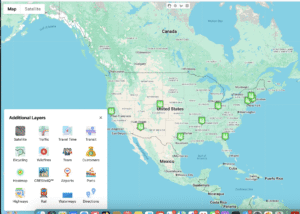
The real edge comes from seeing these factors together—on a map, in context, with real-time market comparables. That’s where portfolio and site management software like REoptimizer® changes the game. By overlaying demographic data, cost indices, and comps in one platform, tenants can instantly compare markets, model long-term operating costs, and align site choices with workforce realities.
Bottom line: The right tool turns demographic insight into competitive advantage, helping you pick not just a space, but the right space in the right market at the right time.
Learn more about how REoptimizer® changes the game of site selection, streamlining the property search and letting you decide what’s important.