The Sun Belt—stretching across the southern and southwestern portions of the continental United States from Florida to Southern California—has moved beyond a population story.
Today, it represents one of the most important growth regions shaping U.S. commercial real estate strategy.
For C-suite executives and large-scale tenants, the Sun Belt’s relevance is no longer about climate or affordability alone. It is about economic concentration, labor access, and long-term portfolio resilience in a national market defined by uneven recovery.
What Is The Sun Belt And Why Does It Matter Economically?
What are the Sunbelt States?
The Sunbelt encompasses states from Virginia and Florida west through the Gulf Coast and into Southern California and Nevada.

This is much of the southern third of the United States, generally encompassing Georgia, South Carolina, Alabama, Mississippi, Louisiana, Texas, New Mexico, Arizona, Nevada, and large portions of California.
The region even includes parts of Tennessee, Arkansas, and Oklahoma.
Major Cities in the Sunbelt
Major U.S. cities within the Sun Belt include Atlanta, Dallas, Houston, Las Vegas, Los Angeles, Miami, New Orleans, Orlando, and Phoenix.
Of the 15 fastest-growing cities in the U.S., 12 are located in the Sun Belt as of 2023.
Cities in the Sunbelt are becoming increasingly multicultural due to demographic shifts from migration.
The Sun belt Region
Coined in 1969 by political analyst Kevin Phillips, the term “Sun Belt” originally described a region benefiting from warm climates, military investment, and post–World War II industrial migration.
Over time, it has become economically central to the nation’s population growth, job creation, and capital deployment.
The Sunbelt holds roughly 50% of all Americans aged 65 and older, remaining a primary destination for retirees.
Today, the Sun Belt accounts for roughly 80% of total U.S. population growth over the past decade, a figure with direct implications for office demand, labor availability, and long-term CRE fundamentals.
And over the next decade, the Sun Belt population is expected to grow by another 11 million, while non-Sun Belt states are forecasted to rise by only 475,000.

Why Has The Sun Belt Experienced Sustained Population Growth?
Why are People Moving to the Sun Belt?
Well it’s no secret that the Sun Belt is a popular destination for retirees, particularly in states like Florida and Arizona, due to the warm climate… But in the last few years it has completely exploded in popularity.
In 2025, the Sunbelt states led in population and economic growth despite housing oversupply and rising costs. This is in the wake of pandemic-era mobility, which made the Sunbelt a top choice for millennials and young professionals seeking affordable living.
The Sun Belt is expected to account for about 55% of the national population by 2040, having held about 50% as of 2023.
This growth has been driven by a combination of domestic migration, immigration, and natural population growth. Key drivers include:
- Lower taxes and fewer labor unions compared to northern states
- Strong job creation across multiple industries
- A warm and sunny climate with milder winters
- Lower overall cost structures for both households and employers
Texas, Florida, and Arizona alone are projected to add millions of new residents by 2033, reinforcing the region’s role as a long-term demand engine for commercial real estate. For CRE leaders, sustained population growth matters because it supports utilization, not just occupancy.

Markets with expanding populations consistently outperform those dependent on tenant consolidation or flight-to-quality alone.
And while rising home prices and extreme weather risks in the Sunbelt have sparked a counter-trend of migration to northern states,
How Strong Is Job Growth In The Sun Belt Compared To The Rest Of The U.S.?
Total employment in the Sun Belt has grown by approximately 20% over the past decade—more than double the growth rate of non-Sun Belt regions.
This growth is not isolated to a single sector. Key industries driving job creation include:
- Technology and software
- Finance and insurance
- Logistics and supply chain management
- Healthcare and life sciences
- Defense, aerospace, and advanced manufacturing
Post-1945, the region benefited from an influx of military manufacturing jobs and federal government investment. That legacy continues today, with defense installations, logistics corridors, and cross-border trade with neighboring Mexico anchoring long-term employment stability.
Why Are Major Corporations Relocating To Sun Belt States?
Major corporations are relocating to Sun Belt states due to a combination of lower operating costs, favorable regulations, and labor availability. The Sun Belt has a pro-business culture, which has spurred significant private sector growth.

Compared to northeastern states and legacy coastal metros, Sun Belt markets offer:
- Predictable tax environments
- Pro-business regulatory frameworks
- Scalable office inventory
- Faster permitting and development timelines
Texas and California rank among the top five states in the nation with the most Fortune 500 companies, underscoring its critical economic presence in the international marketplace. And at the same time political power in the U.S. has shifted toward Sunbelt states due to population growth.
Industries such as aerospace, defense, and oil have boomed in the Sun Belt, contributing to its economic growth.
What Does Sun Belt Growth Mean For Office Demand?
Is office demand stronger in the Sun Belt?
While the national office market continues to normalize, Sun Belt metros have consistently outperformed the national average in net absorption.
Key structural advantages include:
- Newer office inventory requiring less capital-intensive repositioning
- Submarkets designed for hybrid utilization rather than legacy density
- Shorter commutes that support higher in-office participation
Unlike San Francisco or San Jose—where demand is increasingly concentrated in a narrow band of prime assets—Sun Belt cities support broader leasing participation across multiple submarkets, reducing volatility for large occupiers.
How Has The Sun Belt Shifted Political And Economic Power?
Sustained population growth has increased the Sun Belt’s political influence and economic importance nationally.
Many Sun Belt states now feature an emerging Republican majority, reinforcing policy priorities around infrastructure investment, lower taxes, and private-sector expansion.
For corporate real estate decision-makers, political predictability matters. Stable policy environments reduce long-term underwriting risk and support multi-cycle portfolio planning.
And this isn’t the first time the sun belt has had booming success. In fact by the 1970s, the Sun Belt became economically more important than the Northeast, driven by agricultural growth and the green revolution. Modern population explosion and influence mirror this….
How Do Demographics Shape Sun Belt CRE Strategy?
The Sun Belt attracts a broad demographic mix:
- Millennials and young professionals seeking affordability and job growth
- Retirees relocating from northern states to Florida and Arizona
- Immigrant populations contributing to higher birth rates and labor force expansion
Approximately 52% of U.S. millennials now live within the Sun Belt, reinforcing its role as both a current and future labor engine. This demographic diversity supports long-term office demand across multiple industries, not just cyclical sectors.
Environmental Constraints And Smarter Development
Do environmental challenges threaten Sun Belt growth?
Rapid growth has introduced challenges, including air pollution, water constraints, and ecosystem stress. However, these pressures are increasingly shaping smarter development rather than limiting expansion.
New building technologies, energy-efficient air conditioning systems, adaptive infrastructure, and regional planning initiatives are mitigating risk while sustaining growth. For CRE occupiers, this means newer buildings are often more efficient and resilient than legacy stock in older markets.
Why The Sun Belt Remains Central To CRE Portfolio Strategy
The Sun Belt’s role in U.S. commercial real estate is no longer speculative. Its growth is the direct result of:
- Sustained population inflows
- Above-average job creation
- Pro-business environments
- Diverse and durable economic drivers
For large tenants, the Sun Belt increasingly functions as:
- The operational backbone of national portfolios
- The primary engine for headcount expansion
- A stabilizing counterbalance to higher-cost coastal hubs
This is not a zero-sum shift. Coastal cities like New York, Los Angeles, and San Francisco remain essential—but the center of gravity for net-new demand continues to sit in the South and West.
From Macro Growth To Portfolio Precision
Understanding Sun Belt growth is now table stakes. Competitive advantage comes from precision.
CRE leaders must ask:
- Which Sun Belt submarkets are tightening fastest?
- Where does population growth outpace new supply?
- How does utilization differ by building, not just metro?
How REoptimizer® Translates Sun Belt Growth Into Action
REoptimizer® and CRESiteIQ™ help corporate real estate teams move beyond narrative and into execution.
By integrating real-time data on population growth, labor trends, absorption, and submarket performance, executives can:
- Identify where expansion is justified
- Avoid overexposure in overheated nodes
- Align real estate decisions with workforce geography
The Sun Belt is no longer just growing.
It is structurally redefining how commercial real estate portfolios are built, balanced, and optimized.
And in the next decade, the advantage will belong not to those who follow the growth—but to those who deploy capital within it intelligently. Learn how REoptimizer® levels up site selection, and widening your geographic net while only showing you the best options. If its time to model portfolio decisions, see how much REoptimizer® can strengthen the bottom line of each deal.
Learn More
In a market where capital is tight, costs are volatile, and cycles are shorter, where you place your next office or industrial asset can make or break its ROI.
Demographics aren’t “soft” data; they’re the leading indicators of labor cost, operating margin, and long-term demand. Get them wrong, and you’ll be fighting wage creep, slow lease-up, and operational bottlenecks for the next decade.
Here’s your executive-grade guide to the demographic levers that matter—and the public data you can use to benchmark them before you sign. Because when you’re calculating the Total Cost of Occupancy, payroll, not rent, is the biggest line item.
Union Density
Skilled trades, technicians, and logistics professionals are the backbone of industrial operations, yet the pool of qualified workers isn’t evenly distributed. In many regions, companies are already competing fiercely for the same finite talent. Overlay rising wages, evolving work rules, and the push for reshoring, and you’ve got a site-selection equation that’s as much about people as it is about land and steel.
That’s where demographics (particularly union density) become a critical strategic variable. They shape labor costs, construction timelines, and operational flexibility from day one.

In 2024, U.S. union membership stood at 9.9%, but the spread between markets is enormous. And Unionization rates tell you more than how workers are organized…they’re a proxy for labor cost escalation, contract complexity, and operational agility.
- U.S. union membership (2024): 9.9% overall.
- High-density states: Hawaii (26.5%), New York (20.6%).
- Low-density states: South Carolina (2.3%), North Carolina (2.6%).
(Source: U.S. Bureau of Labor Statistics – Union Members 2024
Those states with the highest union density also have reputations of being the least business-friendly. And this is a direct input into your project feasibility.
- Build-out Costs: In high-union states, Project Labor Agreements (PLAs) are often standard for industrial construction. They can add 5–15% to total build costs and extend timelines due to specialized crew requirements and adherence to collective bargaining agreements.
- Wage Floors: Higher union density typically translates into higher base pay rates for skilled trades, warehouse operators, and maintenance teams, affecting both OpEx and tenant fit.
- Operational Flexibility: High-union environments can limit scheduling flexibility, cross-training opportunities, and the pace of scaling up or down based on demand.
In a tight skilled-labor market, the calculus becomes even sharper: high union density may signal both elevated wage costs and a deeper pool of well-trained workers.
So, before committing to a market, pull union membership data by both state and industry. Layer that over your labor needs and construction budget to forecast not just first-year costs, but the trajectory of your cost structure over a 5–10 year hold.
Cost of Living: The Hidden Wage Multiplier
For both industrial and office tenants, labor costs aren’t just about the prevailing wage—they’re about what it takes for workers to live within commuting distance. The Bureau of Economic Analysis’s Regional Price Parities (RPP) index is the cleanest way to benchmark cost-of-living differentials across states and metros.
High-COL markets—California (~113 RPP), New Jersey (~109)—force employers to raise salaries simply to keep purchasing power flat.
That expense pushes through to lease negotiations and occupancy costs. Low-COL states like Texas (~97) or Ohio (~92) allow payroll dollars to stretch further, but they may not have the same depth of specialized labor or infrastructure for certain office-based industries or advanced manufacturing.
Industrial impact: Higher COL markets mean bigger wage bills for plant operators, warehouse teams, and skilled trades. That can price some tenants out or lead to automation investment sooner.
Office impact: COL drives salary pressure for knowledge workers, influencing whether companies expand in place, open a satellite, or pivot to hybrid models to tap lower-cost labor pools elsewhere.
Average Income: The Wage Benchmark
Average income levels are more than a snapshot of regional prosperity—they set the baseline for wage expectations in both industrial and office sectors. The U.S. Census Bureau’s American Community Survey (ACS) provides median household and per-capita income data for every metro, giving you a clear view of what the market considers “normal” pay.
In high-income metros, employers must offer competitive compensation just to be seen as viable, even for roles with national wage medians. In lower-income areas, market-rate salaries can stretch further, but the trade-off may be a smaller pool of candidates experienced in high-complexity or high-tech environments.
Industrial impact: Higher average incomes often indicate stronger competition for skilled trades and technical roles, requiring above-median offers to secure talent.
Office impact: Markets with elevated average incomes may have a richer pool of high-skill professionals—but also a steeper payroll curve to attract and retain them.
Executives should pair average income data with occupation-specific wage stats from the BLS to identify where your pay bands align (or clash) with local expectations before finalizing site decisions.
Population Growth & Migration: Following the Workforce
Where people move, business demand follows. Texas, Florida, and North Carolina are among the biggest net in-migration winners, while California, New York, and Illinois continue to see population losses. (Source: U.S. Census Bureau – 2024)
Industrial impact: Growing populations swell the local labor pool, easing recruitment in warehousing, manufacturing, and logistics. They also boost regional consumption, increasing throughput for goods and supporting demand for distribution space.
Office impact: Population growth—especially of working-age, educated residents—expands the available talent base for corporate services, tech, and finance. Outflow from high-cost metros can create opportunities in emerging secondary markets.
Education Level & Talent Mix
When evaluating a market for industrial or office expansion, the raw headcount of available workers is only half the picture. The quality of that workforce—measured by education attainment and skill concentration—determines the types of operations you can run and how quickly you can scale them.
- Bachelor’s degree or higher: A key marker for knowledge-worker availability in office markets. Metros like Austin (~52%) and Raleigh (~51%) have deep pools for corporate, tech, and R&D roles.
- Technical and STEM concentration: For industrial tenants, the density of engineers, technicians, and IT specialists matters more. San Jose–Sunnyvale posts a STEM location quotient of 2.8—nearly triple the national average—while Detroit–Warren sits at 1.4. (Sources: U.S. Census ACS S1501; BLS STEM Employment Data
A low education or STEM concentration score doesn’t automatically disqualify a market—it just means you’ll pay for capability in other ways. That could be longer recruitment cycles, higher wage premiums, or significant training investments. In high-demand fields like industrial automation or biotech manufacturing, a shallow local skill pool can slow expansion by months or even years.
For executives considering how workforce education affects their real estate:
- If skills are abundant: Build capacity aggressively, knowing recruitment lead times will be short.
- If skills are scarce: Budget for training infrastructure, relocation incentives, or a hub-and-spoke model—placing specialized roles in a skill-rich market while supporting roles sit in lower-cost areas.
Takeaways for Tenants
Site selection in today’s CRE market isn’t guesswork—it’s data work. Demographics, labor dynamics, and cost structures are too varied (and too fluid) to evaluate with intuition alone. The smartest tenants aren’t just looking at rent—they’re layering dozens of variables:
- Union density and labor rules
- Cost of living and average income benchmarks
- Population growth and migration trends
- Education and STEM talent density
- Freight flows and market access for industrial
- Office utilization and hybrid adoption rates
The real edge comes from seeing these factors together—on a map, in context, with real-time market comparables. That’s where portfolio and site management software like REoptimizer® changes the game. By overlaying demographic data, cost indices, and comps in one platform, tenants can instantly compare markets, model long-term operating costs, and align site choices with workforce realities.
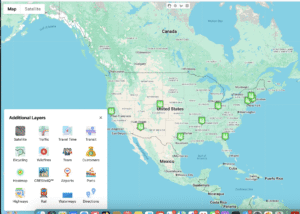
Bottom line: The right tool turns demographic insight into competitive advantage, helping you pick not just a space, but the right space in the right market at the right time.
Learn more about how REoptimizer® changes the game of site selection, streamlining the property search and letting you decide what’s important.
