
Commercial real estate is often an executive’s largest operational expense after payroll. Yet, when it comes to lease renewals, a surprising number of smart, data-driven leaders fll into a trap of convenience.
They assume that renewing with their current landlord is the path of least resistance and a simple, low-risk decision.
Unfortunately, this approach is a margin killer. Without independent market intelligence and a disciplined process, you’re negotiating in the dark, and that’s exactly where landlords want you. So, let’s stop this before it happens.
Your Renewal Window: A Strategic 12-24 Month Lead Time
For most executives, the time to engage on a lease renewal is dictated by a landlord’s renewal notice, typically sent 3-9 months before expiration.
To rely on this timeline as a tenant is a significant strategic error. It’s a window designed to benefit the landlord, not you. So, let’s talk about your optimal timing…
Tenants should be looking ahead of the lease renewal process 12 to 24 months before the lease expiration date. Why? It provides the necessary runway to:
- Conduct a Full Market Analysis: A robust market analysis is the foundation of any successful negotiation. It requires time to gather data on rental rates, vacancy trends, and tenant concessions for comparable properties.
Starting early allows you to accurately benchmark your current lease and understand your true market value. Without this data, you’re negotiating blindly and are likely to accept above-market terms. - Assess Your Real Estate Needs: Your business is dynamic. Your space requirements should be too. An early start allows for an objective assessment of whether your current footprint still serves your strategic goals.
Is it too large? Too small? Could a different layout or location improve operational efficiency or employee satisfaction? This is a strategic decision, not a tactical one. - Cultivate Leverage: The greatest leverage a tenant has in a negotiation is a credible alternative.
A 12-24 month window provides ample time to identify and evaluate other properties on the market. Your landlord will come to play if they know there are other offers on the table.
Waiting until the last minute eliminates this leverage.

The Cost of the “Easy” Option: Beyond the Base Rate
The illusion of a simple renewal masks a host of hidden costs and missed opportunities. It’s not just about the base rent. By passively accepting a renewal, businesses forgo the chance to negotiate on critical financial and operational levers, including:
- Tenant Improvement Allowances (TIA): New leases almost always include a TIA to offset the cost of customizing a new space. Renewing tenants rarely receive a comparable allowance. By not exploring new locations, you could be leaving this capital on the table, which could be used to modernize your current space. When prestige, aesthetics, and modernity matter this could pull a lot of weight with employee retention.
- Free Rent and Concessions: In competitive markets, landlords frequently offer concessions like free rent periods to attract new tenants. A proactive approach allows you to negotiate for similar incentives on a renewal, a benefit often not offered to passive tenants.
- Market-Based Reductions: Market cycles are not linear. If the market has softened since you signed your last lease, your current rent may be above the prevailing rate. Without an objective analysis, you will not have the data to challenge the proposed renewal terms.
- Lease Flexibility and Terms: The modern business environment demands flexibility. Renewing without a strategic review means you may be locking into outdated terms that do not allow for future growth, consolidation, or evolving work models.
Corporate portfolios need the software to model an extensive cost-benefit analysis of every decision. This includes when the ROI is stronger for relocation.
Consider the following example.
Sample 10-Year Scenario Analysis (50,000 sq ft, Class A space, $65/sf market rent)
| Item | Renewal Offer | Market Relocation |
| Starting Base Rent | $67.00/sf | $65.00/sf |
| Annual Escalation | 3% | 2% |
| Free Rent | 0 months | 8 months |
| TIA | $0 | $75/sf ($3.75M) |
| Opex Cap | None | 5% annual cap |
| 10-Year Net Present Value | $39.4M | $34.6M
|
Eye on Escalation: If Your Escalation is Tied to CPI, Change It.
Renewals without inflation-sensitive modeling are renewals without control.
That’s especially true if you locked in your escalation terms during a period of historically low inflation.
If you like your space, but it’s getting more expensive, your renewal is the time to do something about it. Here’s how CPI escalation is draining your bottom line:
- Compounding Cost Increases: Unlike fixed escalations, CPI-based hikes fluctuate with inflation, which has recently surged well above historical averages. A 4-7% annual escalation tied to inflation is no longer an anomaly, it’s the new baseline in many markets. Over a 5-10 year term, these adjustments can increase your rent by 20-50% or more compared to a fixed escalation rate.
- Unpredictable Budgeting: Variable escalations linked to inflation add uncertainty to long-term budgeting. Without robust financial modeling, tenants risk surprise cost spikes that erode margins and disrupt capital planning.
- Negotiation Leverage: During renewal, tenants must understand how their lease’s escalation clause compares to market norms. Some landlords are now offering capped CPI escalations or hybrid models (e.g., the lower of fixed rate or CPI) to stay competitive. Knowledge of these nuances creates an opportunity to push for protections that mitigate inflation risk.
- Lease Flexibility to Mitigate Inflation Risk: Inflation can also impact operating expenses (Opex) passed through to tenants. Negotiating caps on Opex or fixed increases on common area maintenance (CAM) fees can shield your bottom line.
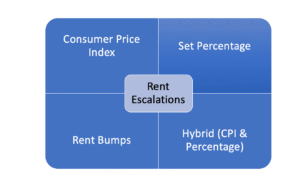
In your renewal you can reduce the risk of runaway occupancy costs by negotiating to:
- Cap CPI escalations or set a maximum annual increase to limit runaway costs.
- Switch to fixed escalations if you prefer predictable budgeting.
- Explore hybrid escalation models (e.g., the lower of CPI or a fixed rate) to balance flexibility with protection.
If you can, negotiate to one of the other three negotiation types.
When to Relocate instead of Renew
Renewals feel safe and landlords know most tenants will default to staying put. Let’s just say they price renewals accordingly.
Here’s when the math says relocation might beat renewal:
- Your Renewal Rate Is Outpacing Market – If base rent plus escalations pushes your occupancy cost above current market averages—especially in a tenant-favorable market—you’re paying a premium for familiarity.
- The Concession Gap Is Too Wide – Relocation deals often come with richer TIAs, more months of free rent, and tighter Opex caps. If the value of those incentives outweighs your moving and build-out costs in a net present value (NPV) model, moving becomes the financially stronger play.
- Long-Term Exposure Is Higher in a Renewal – Renewal clauses often relax protections you negotiated the first time. A 3% annual bump instead of 2% may seem trivial—until you multiply it across 7–10 years and see millions in additional spend.
Sure. moving isn’t convenient. It disrupts operations, costs time and money, and requires planning.
But even if you never intend to relocate, proving you could leave keeps you in control of the conversation and makes it far more likely you’ll secure renewal terms that rival a relocation deal.
Why Tenants Need Real-Time Visibility and Modeling Tools
Tenants must have the ability to see, track, and model all active leases, key dates, and costs in one centralized platform.
Software like REoptimizer® delivers this crucial capability, offering:
- Comprehensive lease data consolidation to avoid missed renewals or critical deadlines.
- Automated alerts on key dates like renewal windows, rent escalations, and option expirations.
- Scenario modeling tools that let you forecast total cost of occupancy across multiple renewal, relocation, or renegotiation options.
- Real-time market benchmarking integrated with your lease portfolio data, empowering smarter, data-driven decisions.
Without this level of visibility and modeling, tenants risk overpaying, losing leverage, or missing strategic opportunities entirely.

Takeaways for Tenants
- Start your renewal process early—12 to 24 months ahead—to maximize leverage.
- Don’t assume renewing is always cheaper; model total costs including escalations, TIAs, and concessions.
- Know when relocation beats renewal—then use that knowledge to negotiate better terms.
- Inflation-linked escalations can dramatically impact costs; negotiate caps or fixed rates where possible.
- Centralize lease data and automate key date tracking with tools like REOptimizer to maintain control and avoid surprises.
Ready to take control of your lease renewals and unlock real savings? See how REoptimizer® can arm you with the data to negotiate from a position of strength. Learn more today.