
A warehouse is only as valuable as its location.
Square footage, rent, and amenities might look good on paper, but if the site lacks access to the right transportation infrastructure, you’re lighting money on fire with every shipment.
It’s not just about how much warehouse space you lease…it’s about where that space is located, how it connects to your distribution network, and how it supports timely delivery to customers.
Because, we’ve entered a new phase of real estate investment—where access to robust transportation options is the real currency of value. Site selection has evolved from a rent-driven decision to a high-stakes exercise in logistics risk management.
Let’s break down what’s at stake—and what most tenants are missing when they think of the ideal warehouse location for their portfolio.
Transportation Costs Outweigh Rent
In most cases, transportation costs account for 50–70% of total supply chain expenses, according to the Council of Supply Chain Management Professionals (CSCMP).
Warehouse rent? Just 3–6%.
Yet too many businesses obsess over lease rates while ignoring how their chosen location sabotages logistics on a daily basis.
If your facility is even 15 miles too far from a major intermodal terminal or beltway, you’re likely overpaying for drayage, enduring longer lead times, and racking up hidden handling costs—not to mention frustrating customers with inconsistent service.
“Transportation typically costs companies 10 times what real estate costs, and that’s closer to 12 to 15 times right now.”
— Adam Roth, Executive Vice President, NAI Hiffman
Ignoring transportation costs is a strategic blind spot. And if you’re still choosing a warehouse location without accounting for intermodal access, you’re playing yesterday’s game on today’s board.

The perfect warehouse location isn’t just cheap or available—it’s part of a robust transportation infrastructure that can adapt, scale, and deliver.
The Perfect Warehouse Location Needs Intermodal Access
The most efficient warehouse operations leverage intermodal transportation—integrating truck, rail, air, and maritime shipping into one seamless system. It’s not about choosing one mode—it’s about orchestrating all of them together, from raw materials to final-mile inventory delivery.
Access to Each Leg of the Supply Chain
Each transport mode plays a role:
- Rail: Ideal for moving bulk freight over long distances. More fuel-efficient and cost-effective than road transport—moving a ton of freight 506 miles per gallon, per EPA data.
- Truck: Essential for last-mile delivery and regional warehouses. Offers easy access to urban centers but costs more per mile.
- Air: Fast but expensive. Used for high-value goods, perishables, and emergency restocking.
- Maritime: Best for volume shipping across oceans. Slower, but unmatched in cost-efficiency per unit.
The synergy of these modes only works if your warehouse is located near the right infrastructure. If your facility is isolated, cut off from a central warehouse corridor or positioned in a low-connectivity region, you’ll pay more, wait longer, and lose competitive ground.
REoptimizer® Shows You What Other Platforms Can’t
Most site selection processes rely on gut instinct, local brokers, or static demographic reports. But in a complex supply chain, that’s not enough. This is where REoptimizer® quietly flips the table.
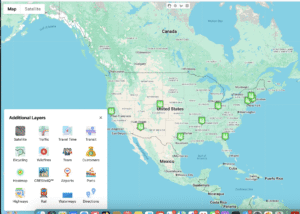
REoptimizer’s® platform exposes the real-world factors that define whether a location can actually support your business. You can instantly layer in:
- Proximity to Class I rail terminals (CSX, Union Pacific, BNSF, etc.)
- Distance to airports, seaports, and inland ports
- Major highway overlays for streamlined trucking
- Heatmaps of customer concentration, labor costs, and workforce availability
- Visibility into traffic patterns, environmental regulations, and building codes
- Filters for high-speed internet, equipment requirements, and surrounding infrastructure
Almost everyone evaluates space by price per square foot. But REoptimizer® shows you how that space performs operationally. That means you can flag existing leases that are failing to support your network—or zero in on cost-effective, strategically located facilities that reduce risk and drive performance.
Whether you’re expanding, consolidating, or simply trying to make sense of how three warehouses in the same place produce vastly different outcomes, REoptimizer® reveals the operational truth behind the lease.
The Distribution Network is Shifting
Global pressures from tariffs to reshoring are forcing supply chains to reconfigure on the fly. In 2023 alone, over 287,000 jobs were reshored to the U.S., according to the Reshoring Initiative. That’s not anecdotal—it’s a wholesale recalibration of global logistics.
Warehouses that once made sense now don’t align with modern freight flows.
In this climate, the right location isn’t just about being central—it’s about being connected.
Being near a rail yard, port, or intermodal terminal means shorter distances, reduced fuel costs, better inventory management, and improved customer satisfaction. It’s the difference between profit and pain in a market where demand changes faster than your lease term.
Regional Standouts: Where Infrastructure Drives Velocity
Some locations are naturally optimized for logistics:
- Chicago, IL: The nation’s largest inland freight hub. 47% of U.S. intermodal containers pass through here.
- Dallas-Fort Worth, TX: Centrally located with access to multiple freight corridors, major highways, and labor-rich industrial zones.
- Savannah, GA: One of the fastest-growing port cities in the U.S. with direct access to major rail lines and exploding warehouse development.
These markets consistently outperform in lead times, storage area optimization, and throughput. Warehouses in these regions often lease faster and retain tenants longer—not just because of pricing, but because of how they enhance overall efficiency.
Critical Factors That Most Companies Overlook
The hidden costs of poor site selection show up in subtle ways that eat away at your profit margin:
- Longer transport lead times increase storage and working capital costs
- Higher fuel consumption drives up per-unit shipping costs
- Labor inefficiencies caused by poor proximity to workforce clusters
- Environmental compliance issues due to mismatched zoning or outdated building codes
- Customer attrition from missed delivery windows
Choosing the right warehouse location is not a guessing game it’s a data-driven process. And yet, so many companies continue using 15-year-old spreadsheets and intuition to make multi-million-dollar decisions.

Labor Costs
In this discussion about logistics facilities, we have to mention the other factors that can make or break a warehouse location: workforce availability and cost of living. Beyond transportation, payroll has the biggest potential to significantly impact your bottom line.
Labor can be the single largest long-term operating expense in distribution facilities. This is especially true if your warehouse isn’t centrally located and you’re paying for the cost of human transportation.
Yet many tenants overlook how geography directly impacts labor access and cost:
- Wages vary significantly by region, with hourly warehouse labor costs ranging from $15/hour in rural areas to $25/hour or more in urban centers (BLS, 2025).
- Labor availability is uneven. Some high-demand markets face severe worker shortages, driving up overtime costs and turnover.
- Commute times and transit access affect recruitment and retention—if a site lacks public transit or major commuter routes, hiring gets harder.
The Takeaway: Infrastructure Is Your Competitive Edge
We’re past the point where warehouse location is a back-office consideration. It is now a frontline business decision—one that affects cost, agility, and survival.
If your warehouse isn’t positioned to support supply chain velocity, you’re not just inefficient—you’re vulnerable.
REoptimizer® quietly changes that. It shows you what works, what doesn’t, and what’s next—using infrastructure intelligence to turn warehouse site selection into a strategic weapon.
Don’t Just Lease Space. Choose Power.
Your business, your inventory, and your customers depend on more than square footage. They depend on precision, location, infrastructure, and speed.
So, start searching smarter. Filter your next facility by what really matters.
And while most site selection tools focus on surface-level data, REoptimizer® goes deeper—showing you whether a facility is positioned to succeed operationally, logistically, and financially.
By allowing you to filter properties by real-world constraints like proximity to major highways, rail hubs, airports, marine ports, labor pools, and even local environmental factors, you can identify the right warehouse location before you commit, or flag weaknesses in your existing warehouse operations before they impact your bottom line.
Want to learn more about what the right warehouse location looks like for your business? Click the link below to find out how REoptimizer® can show you today…