
Commercial real estate has officially entered a “sorting year.” Lenders are no longer just looking at property types; they are conducting “ruthless” forensic audits on Debt Service Coverage Ratios (DSCR), sponsorship liquidity, and Capex runways.
For corporate tenants with massive office and warehouse footprints, this financial pressure on landlords translates directly into operational risk. From “jingle mail” ownership transfers to the sudden evaporation of Tenant Improvement (TI) allowances, the stability of your lease is now tied to the “financeability” of your landlord’s asset.
The 2026 CRE Underwriting Outlook
For the last decade, corporate real estate (CRE) was a game of location and scale. In 2026, the game has changed to intelligence and liquidity.
As a corporate tenant managing a diverse portfolio of high-stakes office space and mission-critical warehouse hubs, you are about to feel the ripple effects of a lending market that has gone from “wait-and-see” to “search-and-destroy.”

Trepp’s research team calls it a “sorting year”—a period where the line between a stable asset and a distressed one is drawn with a red pen.
Here is the data-driven reality of how 2026’s ruthless underwriting will impact your bottom line—and why your transaction management strategy needs an immediate upgrade.
1. The DSCR Death Spiral: Why Your Rent Isn’t Enough Anymore
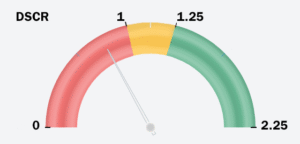
In 2021, a 1.25x DSCR was the gold standard. In 2026, lenders are recalibrating for a “higher-for-longer” rate environment. Lenders are now stress-testing assets against flatter or even negative rent growth.
-
The Impact on You: If your landlord’s loan is coming due and they can’t clear the new, higher DSCR bar, they are in “triage.”
-
The Risk: A landlord in triage mode will cut every “non-essential” expense. This means the lobby renovations stop, security shifts are reduced, and the HVAC system you complained about six months ago will continue to fail.
-
The Office/Warehouse Divide: While industrial assets generally have stronger cash flow, the “ruthless” underwriting of 2026 is hitting older distribution centers hard, forcing landlords to choose between paying the mortgage or upgrading your loading docks.
2. The “Capex Runway” Test: Is Your TI Allowance Real?
Lenders are now probing Capex runways with unprecedented scrutiny. They want to know if the money for “story” assets—those value-add warehouses or “reimagined” office spaces—is actually in the bank or just a line item in a pitch deck.
-
The “Haves” vs. the “Have-Nots”: Institutional sponsors with deep pockets are being welcomed by lenders. Small-to-mid-cap landlords are being told to “re-up” or “walk.”
-
The Tenant Trap: If you are negotiating a renewal that includes a significant Tenant Improvement (TI) allowance, beware. A landlord who cannot pass the 2026 underwriting test may sign your lease today but lack the liquidity to pay your contractors tomorrow.
3. The “Jingle Mail” Resurgence and Ownership Volatility
“Jingle mail”—the practice of a landlord mailing the keys back to the lender—is no longer a ghost story; it’s a 2026 strategy. With a “maturity wall” of loans hitting the market, many owners are opting for deed-in-lieu transfers.
A foreclosing lender could technically terminate your lease in certain jurisdictions if you are paying below-market rent.For a corporate tenant, a building’s financial distress is a direct threat to your business continuity. Use the following checklist to evaluate your current exposure:
The 2026 Corporate Portfolio Risk Checklist
When lenders apply 2026’s heightened DSCR and Capex Runway tests, they triage properties into winners and losers. As a tenant with millions in lease obligations, you must monitor these three critical factors:
-
Ownership Volatility (The Lender Takeover):
-
Office Portfolio Impact: High risk of “accidental landlords”—banks or special servicers who lack the incentive to provide a high-quality tenant experience. You may face delayed responses to lease inquiries and a lack of long-term vision for the asset.
-
Warehouse/Industrial Impact: A lower risk of total abandonment, but often leads to “loan-to-own” private equity takeovers. New owners may look for technical lease defaults or hike “pass-through” expenses to maximize short-term yield.
-
-
The Maintenance Deficit (Cost-Cutting as Survival):
-
Office Portfolio Impact: Visible degradation such as slower elevators, dated common areas, and cooling issues. This makes “return-to-office” (RTO) mandates nearly impossible to enforce for your staff.
-
Warehouse/Industrial Impact: Manifests as deferred structural maintenance. Neglecting roof repairs or parking lot integrity can lead to localized flooding or equipment damage, impacting your supply chain.
-
-
Expansion Constraints (The Capital Lockdown):
-
Office Portfolio Impact: Landlords may be fundamentally unable to fund build-outs for new floors. Even with a signed expansion option, the lack of liquidity can leave you with a half-finished shell.
-
Warehouse/Industrial Impact: A severe lack of capital for infrastructure upgrades. If you need more power for automation or cold-storage conversions, a landlord struggling to refinance will likely deny the request or demand you fund 100% of the cost.
-
Critical Strategy Note: In an era of ownership volatility, the SNDA (Subordination, Non-Disturbance, and Attornment) agreement is your most important legal shield. Without it, a foreclosing lender could technically terminate your lease in certain jurisdictions if you are paying below-market rent.