
Stagnant air, rising energy bills, and surprise equipment failures aren’t “normal warehouse problems”—they’re signs your commercial HVAC strategy isn’t matching the realities of an industrial space. Warehouse HVAC systems have to do more than cool or heat air. They must maintain fresh air, control contaminant buildup, prevent hot-air stratification near the roof, and protect occupant comfort across large, high-volume facilities.
The right solution starts with selecting commercial HVAC equipment and ventilation systems that match your building’s size, ceiling height, dock activity, internal heat loads, and air quality needs—then ensuring the installation, controls, and service plan keep performance stable over time.
Capacity And Energy Efficiency: The Two Metrics That Drive Warehouse HVAC Results
Capacity: Right-Size HVAC Systems For Real-World Loads
An undersized system can’t hold temperature during peak heat gain. An oversized system wastes energy and can short-cycle, reducing efficiency and reliability. Any “rules of thumb” are starting points only—warehouse capacity depends on factors that basic formulas miss:
-
Ceiling height and total air volume
-
Envelope performance (roof and wall construction)
-
Heat-generating equipment (conveyors, battery charging, process loads)
-
Dock doors, infiltration, and air exchange from traffic
-
Occupancy and work intensity
-
Ventilation requirements (outdoor air and exhaust replacement)
Practical takeaway: Capacity is only “right” if the air can be delivered where it’s needed. In warehouses, airflow distribution can make a correctly sized system feel undersized.

Energy Efficiency: Ratings Matter, But Controls And Airflow Often Matter More
Energy efficiency is influenced by equipment selection, but in industrial facilities, the biggest losses often come from poor airflow patterns and control strategy. Look for:
-
High-efficiency equipment where it fits your application
-
Variable-speed or staged operation for part-load efficiency
-
Tight, well-balanced ductwork and well-planned air distribution
-
Control strategies that match ventilation and conditioning to actual demand
If your system runs constantly but still can’t stabilize conditions, you likely have a distribution or ventilation problem—not just an efficiency problem.
Fresh Air And Outdoor Air: The Difference Between A Comfortable Building And A Compliance Risk
In warehouses, temperature control alone doesn’t protect operations. Without enough fresh air, you risk stagnant zones, moisture problems, airborne contaminant accumulation, and unpleasant or unsafe indoor conditions.
A strong warehouse ventilation strategy typically includes:
-
Controlled outdoor air intake to replace exhausted or stale air
-
Exhaust that removes heat or contaminants without destabilizing the building
-
Makeup air that maintains healthy pressure and reduces infiltration from unwanted sources
-
Air movement that prevents dead zones behind racking and in corners
If your facility exhausts air (process exhaust, restrooms, general exhaust) but doesn’t intentionally replace it, the building can pull air from dock doors and leaks—hurting comfort, increasing energy cost, and reducing system performance.

Air Handling Units And Outdoor Air Handling Units: When You Need Each
Air Handling Units (AHUs)
Air handling units are common in large commercial buildings and industrial facilities because they can move high volumes of conditioned air and support filtration and distribution through ductwork.
Best fit for warehouses when you need:
-
Higher airflow capacity across large spaces
-
Better filtration and consistent air distribution
-
Flexible integration with heating and cooling equipment
Outdoor Air Handling Units (OAHUs)
Outdoor air handling units are designed to manage outdoor air and deliver consistent fresh air without destabilizing indoor temperature control. In warehouses, they’re valuable when ventilation requirements are significant or when air quality control is a priority.
Best fit when you need:
-
Reliable fresh air delivery across changing occupancy or operations
-
Better control over temperature and humidity of incoming air
-
A clearer ventilation “backbone” that supports comfort and compliance
Bottom line: If “air quality,” odors, headaches, or stale air are the complaint, adding cooling capacity alone won’t fix it. Outdoor air strategy and air handling are often the real solution.
Types Of Commercial HVAC Equipment For Warehouses (Pros, Cons, And Applications)
Rooftop Units (RTUs)
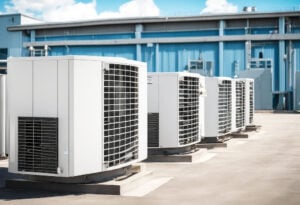
RTUs are widely used in industrial and commercial facilities because they consolidate heating and cooling into packaged units and keep equipment off the floor.
Ideal for:
-
Large warehouses needing centralized heating/cooling
-
Facilities that want simpler access for service and maintenance
Key watch-outs:
-
Dust-heavy environments can reduce performance fast without proper filtration and service
-
High ceilings can create uneven comfort unless airflow distribution is addressed
-
Roof exposure can stress equipment without a reliability-focused maintenance plan

Variable Refrigerant Flow (VRF) Systems
VRF provides zoning flexibility and efficient part-load operation, especially helpful when warehouses include offices or temperature-sensitive zones.
Ideal for:
-
Facilities with mixed-use space (office + warehouse)
-
Operations needing different comfort needs in different areas
Key watch-outs:
-
VRF still needs a ventilation plan for fresh air
-
Best results require thoughtful design, controls, and commissioning
Evaporative Cooling (Where Climate Supports It)
Evaporative systems can be cost-effective in hot-dry regions and naturally move more air through the building.
Ideal for:
-
Hot, arid climates where humidity is consistently low
Key watch-outs:
-
Not well-suited to humid regions
-
Added moisture can conflict with product or material requirements in some facilities
HVLS Fans (High Volume, Low Speed)
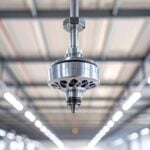
HVLS fans don’t cool air directly, but they dramatically improve air movement and destratify hot air that gets trapped near the roof—boosting comfort and improving how well conditioned air reaches the floor.
Ideal for:
-
High-ceiling warehouses with hot pockets and uneven temperatures
-
Facilities aiming to improve occupant comfort and reduce stagnant air
Key watch-outs:
-
They are a support solution—pair them with HVAC and ventilation strategy for best results
-
Placement must consider racking, lighting, and fire protection constraints

Airflow Patterns: The Most Common Reason Warehouse HVAC “Doesn’t Work”
Warehouses often fail on airflow, not equipment. Red flags include:
-
Hot upper layers and cool lower layers (stratification)
-
Stagnant corners or mezzanine zones
-
Strong airflow in some aisles and no movement in others
-
Comfort complaints near dock doors (infiltration)
-
Equipment that runs constantly but never stabilizes conditions
Fix focus: Supply and exhaust placement, outdoor air strategy, mixing/destratification, and ductwork balance usually unlock performance faster than replacing units.
Control Technology: How To Improve Efficiency Without Replacing All Equipment
Modern control strategies can meaningfully improve performance and energy efficiency:
-
Demand-based ventilation (adjust fresh air to occupancy/CO₂ and humidity)
-
Scheduling and staging (avoid full-load operation when unnecessary)
-
Thermal mapping and zone sensing (find heat pockets early)
-
Automated dampers and louvers (optimize outdoor air and pressure balance)
-
Load shifting (pre-cool/pre-heat during off-peak utility periods)
In industrial facilities, better control is often the highest-value “innovation” because it improves outcomes using existing equipment—when the airflow strategy is solid.
Ductwork And Installation: Where Performance And Efficiency Are Won Or Lost
Even industry-leading equipment underperforms with weak installation. Common performance killers:
-
Leaky or poorly sealed ductwork
-
Imbalanced supply/exhaust causing pressure problems
-
Poor diffuser and return placement creating dead zones
-
Inadequate commissioning (systems never tuned to the building)
If two facilities install similar commercial HVAC equipment but get different results, the difference is often ductwork quality, airflow planning, and control configuration.
Reliability And Service: Protecting Compressors And Preventing Costly Breakdowns
Warehouse environments are tough on HVAC equipment. Reliability depends on a preventive plan that matches your facility:
-
Regular filter changes (especially in dusty operations)
-
Coil cleaning to maintain airflow and heat transfer performance
-
Refrigerant checks and inspections to protect compressors
-
Fan/motor/belt inspections to keep air moving reliably
-
Drain and moisture management to prevent corrosion and microbial growth
Operational value: reliability is not only about comfort—it protects uptime, reduces emergency service calls, and preserves energy efficiency over time.
How To Execute Warehouse HVAC Decisions During Site Selection And Keep Them On Track
The hardest part of warehouse HVAC isn’t understanding the options—it’s ensuring the building and the project can deliver the required performance.
REoptimizer® For Site Selection In Industrial Facilities
REoptimizer® supports site selection by helping teams evaluate a warehouse’s HVAC feasibility in context—seeing how building factors and geographic considerations can affect:
-
airflow distribution potential in large-volume space
-
viability of outdoor air strategies (including outdoor air handling units)
-
constraints that affect installation and long-term efficiency
-
comfort and sustainability requirements across facilities being compared
REoptimizer® For Project Monitoring And Performance Alignment
REoptimizer® supports project monitoring by keeping performance requirements visible as designs change:
-
maintaining clarity on ventilation intent and outdoor air assumptions
-
tracking decisions that affect airflow patterns and occupant comfort
-
supporting coordination around installation, controls, and deliverables
-
reducing the chance that scope changes undermine reliability and efficiency
In short: the right system is a combination of equipment, airflow design, and controls—and REoptimizer® helps teams choose facilities that can support that solution and keep the project aligned until handoff.

Frequently Asked Questions
What Does “Commercial HVAC” Mean For Warehouses?
In this context, commercial HVAC refers to industrial-grade heating, ventilation, and cooling systems used in warehouses and distribution facilities—focused on airflow, fresh air, energy efficiency, reliability, and occupant comfort at large scale.
What Commercial HVAC Equipment Is Most Common In Warehouses?
Many warehouses use RTUs or AHUs paired with mechanical ventilation or outdoor air strategies. HVLS fans are commonly added to improve airflow and destratification.
Do Warehouses Need Outdoor Air Handling Units?
Not always, but they’re often beneficial when consistent fresh air delivery, better air quality control, or stable ventilation performance is required.
Why Is My Warehouse Still Hot Even With Cooling?
Usually because of airflow distribution problems—stratification in tall spaces, dead zones, infiltration at dock doors, ductwork leakage, or poor supply/return placement.
What Improves Warehouse HVAC Energy Efficiency The Most?
Right-sizing, fixing airflow distribution, sealing ductwork, and implementing control strategies (demand ventilation, staging, scheduling) typically drive the biggest real-world gains.