

When your company is looking for a new commercial space, every wasted site tour, every irrelevant listing, and every unnecessary email exchange costs you time, money, and momentum.
You’re busy. Your leadership team is busy. There’s no reason to lose months chasing properties that don’t fully meet your needs.
The solution? Get crystal clear on your Key Site Drivers (KSDs) before you begin your search.
KSDs are your company’s non-negotiables — the must-have criteria that define whether a property is truly worth your time. They go beyond price and square footage, helping you measure the hard-to-quantify factors that make a building the right fit. When integrated into, REoptimizer®, they can save corporate tenants countless hours while leading them to the best properties at the lowest total cost of occupancy.
If you want to cut months off your property search, avoid wasted tours, and lock in a lease that makes sense on every level, here’s what you need to know.
What Are Key Site Drivers?
In commercial real estate, everyone talks about price per square foot. But price alone doesn’t tell you how well a property will perform for your business.
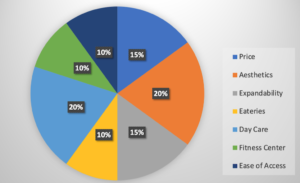
Key Site Drivers are customizable, weighted factors that help you score a building’s overall suitability. They let you compare properties on both tangible and intangible features so you can make a decision that balances cost with real-world functionality.
Think of them like Key Performance Indicators (KPIs) — but instead of measuring company performance, they measure how well a property aligns with your operational, cultural, and logistical needs.
Why KSDs Beat the “Price First” Approach
In corporate real estate, price is always a headline number, but it’s rarely the number that determines whether your lease will succeed or fail.
What’s the point of fixating on rent if the building can’t even check your must-have boxes?
CoreNet Global reports that real estate costs account for less than 10% of most organizations’ annual operating expenses, while payroll and productivity costs often exceed 80%.
That means the “cheapest” space on paper can become the most expensive over time if it hurts productivity, retention, or operational efficiency.
Consider the impact of ignoring non-price factors:
- Commute length: A study by Robert Half found that 23% of workers have quit a job due to a bad commute. That turnover cost can quickly erase rent savings.
- Amenities & environment: Gallup’s workplace research shows that employee engagement — heavily influenced by work environment — correlates directly with profitability and retention.
- Location fit: Poor location choice can increase logistics costs by double-digit percentages in industries reliant on supply chain efficiency.
Key Site Drivers (KSDs) solve this problem by giving you a quantifiable scoring system for factors that impact your bottom line long after the ink on the lease dries — accessibility, safety, amenities, prestige, expandability, and more.
When you lead with KSDs instead of price, you’re making a decision based on total value over total cost of occupancy — a far more accurate predictor of long-term ROI.
Examples of Common Key Site Drivers
Your KSDs will be unique to your business, but here are some examples we frequently see in corporate site selections:
- Corporate image & prestige – Does the building convey the right brand message?
- Location accessibility – How easy is the commute for your team?
- Security & safety – Is the area safe and well-maintained?
- Expandability – Can the space grow with your business?
- Proximity to amenities – Are there restaurants, gyms, or daycare options nearby?
- Parking ratio – Is there enough on-site parking for staff and visitors?
- Transit access – How close is it to major highways or mass transit?
- Aesthetics – Does the design support productivity and morale?, etc.
Some KSDs will be purely operational (like parking ratio), while others are cultural or employee-driven (like nearby childcare or health facilities).
How KSDs Work Inside REoptimizer®
REoptimizer® doesn’t just store your Key Site Drivers, it turns them into a dynamic, weighted scoring system that instantly shows you how each property stacks up against your priorities.
Here’s how the process works:
- Identify your KSDs – We work with you to define all essential and desirable criteria — from must-have operational needs to quality-of-life factors that boost retention.
- Assign weights – Not every factor carries the same importance. For example, expandability might be twice as critical as proximity to a gym, while access to mass transit may outweigh parking if most of your staff commutes by rail.
- Score each property in real time – As you evaluate a site, every KSD is scored according to how well the property delivers. This happens immediately — whether you’re in the office or touring on-site.
- Rank overall suitability – REoptimizer® calculates a final weighted score for each building, instantly showing your top contenders.
- See side-by-side comparisons – The software generates a visual ranking of all your comparables, with their scores broken down by KSD. You can immediately see which buildings hit all your boxes, which fall short, and exactly where the gaps are.
The result? Instead of shuffling through 30–50 “maybes,” you instantly narrow your focus to the highest-scoring properties that deliver the most value across all your priorities — not just rent.
And when it comes time to negotiate, those side-by-side comparisons become powerful leverage.
You can point to a competitor’s higher KSD score in specific areas — security, parking ratio, amenities — and use it to justify deeper concessions or a stronger tenant improvement package.
Why This Saves You Months
As discussed, in a typical search, you might start with 30–50 comparable properties. Without a KSD system, you end up touring many of them just to find out they don’t work.
With REoptimizer® and KSDs, you eliminate low-scoring sites immediately. You’re left with only the strongest candidates — and a clear record of why they made the cut.
This also sets you up for better negotiations. When landlords see that you’re systematically evaluating buildings, they know they’re competing on more than just price. That competitive pressure often leads to better concessions, more favorable terms, and lower total occupancy costs.
Who Determines the KSDs?
The most accurate KSDs come from stakeholder collaboration.
That means:
- Leadership teams to define strategic priorities
- HR for employee needs and commuting patterns
- Operations for workflow and infrastructure requirements
- Finance for budgetary parameters
For example:
- Your headquarters might weigh prestige and location heavily.
- A satellite office might prioritize parking and ease of access.
KSDs aren’t one-size-fits-all — even within your own portfolio.

Turning KSDs into Negotiating Power – Key Takeaways for Tenants
Your KSD scores aren’t just a selection tool — they’re a negotiation weapon. Once you’ve ranked your properties, here’s how to use that data to your advantage:
-
Spot gaps to create leverage – If a top contender falls short on one or two key factors, use those gaps to push for better terms.
-
Request targeted improvements – Ask for tenant improvement allowances to address missing features.
-
Negotiate price adjustments – Justify rent reductions based on measurable shortfalls in your KSD scoring.
-
Secure additional concessions – Use lower KSD performance to request extras like parking passes, extended free rent, or enhanced amenities.
-
Back every ask with data – When landlords see you have quantified comparisons, they know you’re making an informed choice — and that they’re in direct competition.
By turning KSD results into a negotiation roadmap, you ensure every shortfall becomes an opportunity to improve the deal.
See how REoptimizer® can arm you with the data to negotiate from a position of strength. Learn more today.