
By mid-2025, the office market was supposed to have stabilized. The pandemic is a memory, hybrid work has “found its equilibrium,” and cities were supposedly “coming back.”
Except… they’re not.
Across the country, from San Francisco to Dallas, Seattle to New York, landlords are waging war on impossible math, vanishing momentum, and the brutal new cost of money.
And now, for the last two years, we’ve seen what used to be unthinkable: developers who defined skylines are losing their buildings, lenders are taking control of marquee assets, and office towers once valued at $1,000 a foot are trading (when they trade at all) for a fraction of their original cost. All in all, downtown real estate isn’t bending under pressure; it’s breaking into a new shape. Let’s discuss.
The Market That Refused to Rebound
The data tells a brutal story.
- Office vacancies have reached record highs. Nationally, vacancy stands near 20%, with many urban cores well above 30%
- Leasing volume is still down 45% from 2019 levels. Even tenants that are expanding) mostly in AI, defense tech, and biotech) are selective, avoiding older, inefficient buildings.
- Values have collapsed. Green Street’s Commercial Property Price Index shows office values down nearly 40% from pre-pandemic peaks.
- Loan distress is climbing fast. Nearly $80 billion in office loans are now “at risk of default,” according to Trepp data.
Those numbers translate to real-world consequences: layoffs at development firms, stalled projects, and high-profile handovers of once-trophy assets.
Seattle’s Martin Selig, a developer who once claimed to control a third of the city’s downtown, has become a cautionary tale. The man who built Seattle’s skyline is now watching pieces of it slip away.
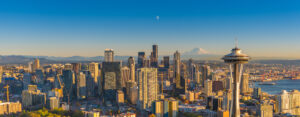
Overleveraged and overconfident, he bet on the boom lasting forever, launching multimillion-dollar trophy projects just as the market turned. When tenants disappeared and debt came due, even his newest showpieces — the green-certified 400 Westlake and the Federal Reserve redevelopment — were surrendered to lenders. A lifetime of empire-building, undone by a single cycle
But Selig isn’t alone. In San Francisco, the owners of 350 California Street handed the building to the lender. In Los Angeles, Brookfield defaulted on $784 million worth of downtown office loans. In Washington, D.C., JBG Smith has shed over 2 million square feet in distressed assets.
“At least 75 percent of downtown Seattle office owners are in some sort of financial distress… But the ones who do not have no debt.” Charlie Farra, Newmark
Different cities, same theme: the 2010s boom built towers on cheap debt. The 2020s bust is taking them back.
How the Tech Boom Built the Bubble
To understand how far the market has fallen, it helps to remember how high it climbed.
In the 2010s, the tech and Amazon boom rewired entire downtowns.

Seattle was the epicenter. Amazon alone leased or built nearly 14 million square feet of space in South Lake Union. But the ripple effects reached San Francisco’s SoMa, New York’s Hudson Yards, Austin’s Domain, and Boston’s Seaport.
Every developer wanted in.
Buildings sold for nearly $1,000 a square foot. Loans were sized on aggressive rent growth, and lenders fought to finance them. Developers built on spec, betting that “if you build it, tech will come.”
And for a while, it worked. Vacancies fell below 5 percent in many markets.
Even landlords like Selig — already battle-tested from the 1980s downturn — saw a new golden era. He leveraged fully into the cycle, raising hundreds of millions in debt to deliver “next-generation” trophy projects like 400 Westlake and the Federal Reserve Building redevelopment.
By 2019, with Amazon expanding and WeWork signing leases by the dozen, it seemed the party would never end.
Then 2020 hit.
Tech went remote, venture money froze, and the speculative demand that fueled an entire generation of development evaporated overnight. Those futuristic glass boxes that symbolized prosperity turned into monuments to a vanished market.
Now, many of the same towers built for the “collaboration revolution” are struggling to fill a single floor. The tech giants that inflated downtown economies are downsizing or decentralizing, leaving the landlords who built for them holding the bag.
The Debt Time Bomb
If the 1980s were about overbuilding, this decade’s crisis is about over-leveraging.
From 2013 to 2019, capital was practically free. Developers borrowed at sub-3% rates, pro forma rents assumed endless tenant demand, and valuations inflated accordingly.
Then Covid hit… and those optimistic spreadsheets became millstones.
Now, those loans are maturing. Refinancing at today’s 7–8% rates means debt service that often doubles. For landlords with 40–50% vacancy, that’s fatal.

Lenders are responding by tightening credit, appointing receivers, or taking back properties.
And for the first time in decades, even Class A owners are facing the same pressure once reserved for B and C assets.
This is what’s driving today’s wave of distress sales, discounted CMBS notes, and “extend and pretend” negotiations.
This isn’t a short-term slump; it’s structural.
Much of the demand that vanished in 2020 isn’t coming back. Companies have permanently reduced their office footprints, hybrid work is the norm, and remote-first hiring has decoupled growth from geography. The result is a market still priced for a pre-pandemic world, even as fundamentals have permanently shifted.
Winners and Losers in the New Market
There are still bright spots; they’re just concentrated.
- Sunbelt and suburban markets like Austin, Nashville, and Raleigh are capturing corporate relocations.
- New product wins. LEED Platinum towers, net-zero conversions, and buildings with wellness and collaboration amenities are leasing ahead of peers.
- Obsolete stock sinks. Mid-century and 1980s-vintage buildings with outdated layouts, poor air quality, or no ESG credentials are functionally un-leaseable.
- Conversions are accelerating. More than 12 million square feet of office space is under conversion to housing or mixed-use nationwide (JLL, 2025).
The new formula is simple but ruthless:If your building can’t justify why someone should commute there, it’s in trouble.
How Landlords Are Fighting Back
Some owners are doubling down on amenities and activation like gyms, rooftop lounges, flexible collaboration zones.
Others are pursuing debt restructuring or joint ventures to stay afloat until rates fall. But glossy amenities aren’t the whole story.
In today’s market, who owns the building matters as much as what’s inside it.
Behind the marketing campaigns, many landlords are facing real financial stress. Properties once backed by institutional investors are now in receivership. Loan maturities are piling up. Some buildings are on the verge of being handed back to lenders. For tenants, that means lease stability, maintenance standards, and even access to promised improvements can suddenly be at risk.
The smartest occupiers are responding with a new kind of rigor: landlord due diligence. Before signing or renewing a lease, they’re asking tougher questions — not just about square footage, but about solvency, financing, and long-term plans.
That’s where REoptimizer® plays a different kind of role: giving corporate real estate teams visibility not just into their own portfolios, but into the financial and operational health of the markets and owners they rely on.
The REoptimizer® Edge: Turning Risk Into Clarity
In an office market defined by volatility, REoptimizer® gives corporate occupiers the visibility and control they need to make data-driven decisions with confidence — not gut instinct.

Here’s how:
Portfolio-Wide Visibility
Every lease, location, and cost center — unified in one platform.
When market or ownership conditions shift, REoptimizer® flags exposure instantly, enabling faster, more informed responses.
Scenario Planning
Hybrid work. Relocations. Consolidations. Growth.
REoptimizer® models the financial and operational impact of every move — including landlord risk — so teams can stress-test outcomes before committing.
Comparative Benchmarking
By overlaying internal portfolio data with market and ownership intelligence, occupiers can see where they’re overpaying, overexposed, or underperforming — and where renegotiation makes sense.
Utilization and Performance Metrics
The platform links occupancy and operational data, revealing which spaces create value and which introduce unnecessary risk or cost.
Strategic Planning and Renewals
REoptimizer® turns renewals, expirations, and sublease opportunities into strategic levers — not surprises.
Teams gain months of lead time to act, not react, when landlord or market conditions change.
Landlord Watchlist
REoptimizer® helps corporate occupiers monitor the financial and operational health of their landlords — from loan exposure and ownership changes to occupancy and stability trends. It transforms due diligence into a living, data-driven process, ensuring tenants spot risks early and make leasing decisions based on clarity, not assumption.
In a market where ownership is shifting and uncertainty is constant, insight isn’t just power — it’s protection.
See what REoptimizer® can do for your portfolio.