

As electric vehicles (EVs) continue their steady march toward becoming the dominant mode of transportation, commercial real estate leaders face an urgent question: how quickly can portfolios adapt to meet the demands of a new generation of employees, tenants, and clients?
No longer a futuristic consideration, EV charging infrastructure has become a strategic imperative—influencing tenant attraction, lease negotiations, sustainability targets, and long-term property value.
The question is no longer “Should EV charging be part of our portfolio?” but rather “How quickly can we adapt?”
The Surging Demand for EV Infrastructure
Electric vehicle adoption is accelerating at a pace few imagined even a decade ago. Projections suggest that by 2030, EV sales could represent nearly half of new vehicle purchases in the U.S. The Edison Electric Institute estimates that 78 million EVs will be on U.S. roads by 2035, requiring over 42 million charging ports nationwide.
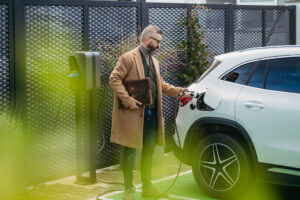
Yet today, there are only about 4 million chargers in place. PwC projects the U.S. will need 35 million public and private charge points by 2030, an eightfold increase. The market for EV supply equipment (EVSE) is expected to expand into a $100 billion industry by 2040.
This infrastructure gap creates both a challenge and an opportunity for commercial property owners. Properties that integrate charging stations early will not only keep pace with demand but will also position themselves as leaders in a fast-evolving market.
Evidence from the Workplace: A Growing Gap
Workplace charging has become one of the fastest-growing needs in commercial real estate. A recent ChargePoint and CBRE report revealed that utilization of workplace chargers is growing nearly three times faster than new station installations. In 2023 alone:
- Active charging ports grew by 22%
- Unique EV drivers increased by 57%
- Drivers per port rose 21%
This widening gap between demand and supply highlights an urgent need for landlords and corporate tenants to act.
EV adoption is reshaping commuting behaviors. Many employees now “top off” their vehicles during the workday rather than charging exclusively at home. For employers and landlords, ensuring that employees have reliable access to workplace charging has become a make-or-break factor in talent attraction and tenant satisfaction.
EV Charging as a Tenant Attraction and Retention Strategy
EV charging stations are no longer “nice-to-have” amenities—they are core tenant expectations. For businesses deciding where to locate or renew their leases, charging availability can tip the scale.
For retail centers, the advantages multiply. Publicly accessible chargers in parking garages or near key shopping areas increase dwell time and foot traffic, driving revenue for tenants. This mirrors trends seen at hospitality properties, where EV drivers often select hotels based on charging options.
GM CEO Mary Barra underscored the corporate shift,
“We believe in an all-electric future… The right thing to do was to get our entire portfolio from a light-duty perspective to be all electric by 2035.” – GM CEO Mary Barra
Companies making similar commitments expect their landlords to provide the infrastructure to support those transitions.
Meeting the Needs of Industrial Tenants and Fleet Operators
The electrification wave isn’t limited to commuters and shoppers—it’s transforming industrial and logistics tenants. Fleet operators are already investing in EV delivery vans, box trucks, and even Class 8 electric semi-trucks.

This has enormous implications for real estate:
- Power Requirements: Heavy-duty chargers can draw as much energy as an entire building. Properties must assess and upgrade their electrical capacity to handle fleet-scale charging.
- Cost Efficiency: According to CNBC, each mile traveled with diesel fuel is roughly 20% more expensive than electric energy. For fleet-heavy tenants, electrification is both an ESG commitment and a bottom-line savings opportunity.
- Competitive Differentiation: Logistics tenants choosing between sites will increasingly prioritize locations capable of hosting DC fast chargers and high-capacity vehicle ports.
Forward-looking landlords who integrate these capabilities today will secure long-term leases with fleet operators tomorrow.
Reducing Range Anxiety and Supporting ESG Goals
For many EV drivers, range anxiety—the fear of running out of charge without access to a station—remains a barrier. By installing multiple charging points in parking garages, retail spaces, and high-traffic areas, landlords and tenants can alleviate this anxiety and create a welcoming environment for EV users.
Beyond convenience, EV infrastructure directly supports sustainability and ESG objectives. Large organizations with carbon reduction commitments are turning to on-site EV charging as a measurable step toward achieving their goals. Properties with EV chargers help tenants track emissions reductions, reinforce corporate environmental commitments, and meet reporting requirements.

Commercial buildings with EV chargers may also qualify for federal funding, tax incentives, and LEED certification credits, making installations a financial win as well as a reputational one.
The Economic Payoff
For landlords, EV charging infrastructure is more than an expense—it’s an investment in new revenue streams. Blink Charging notes five key benefits for commercial real estate owners:
- Attracting high-value tenants and customers
- Generating direct revenue from charging fees
- Increasing property values through future-proof amenities
- Enhancing ESG performance and brand reputation
- Future-proofing properties against obsolescence
Emerging business models also illustrate the revenue potential. In New York City, the startup It’s Electric installs curbside Level 2 chargers that allow property owners to earn up to $3,500 annually per unit—while the company manages the equipment and operations.
Policy Momentum: Incentives and Funding Opportunities
Federal and state policies are accelerating EV infrastructure investment. The Biden Administration’s $5 billion NEVI program is funding charging corridors along highways, while the Department of Energy recently approved a $1.25 billion loan to EV go to build 7,500 fast chargers across 1,100 sites.
At the local level, tax credits, rebates, and grants are helping property owners offset installation costs. Many states also offer demand-side management incentives, reducing utility costs for properties that integrate chargers with grid-balancing technology.
For landlords, this means the timing to invest couldn’t be better. With multiple streams of incentives available, the return on EV infrastructure has never been more compelling.
How REoptimizer® Makes It Actionable
The challenge for tenants and executives isn’t just recognizing the importance of EV charging—it’s finding properties that actually meet these new standards. That’s where REoptimizer® comes in.
REoptimizer® allows users to filter properties based on specific needs and wants, including EV parking and charging infrastructure. Instead of manually sorting through dozens of properties and lease options, tenants can quickly narrow their search to only the locations that align with their sustainability goals, operational requirements, and employee needs.
Whether you’re a fleet-heavy industrial tenant prioritizing DC fast charging, a corporate office seeking employee convenience, or a retail operator looking to attract more foot traffic, REoptimizer® puts the power of choice at your fingertips. By integrating EV parking into property search filters, tenants can align real estate decisions with long-term strategies—ensuring no compromises when it comes to future-proofing their portfolio.
Recommendations for CRE Executives
For real estate leaders, the roadmap is clear:
- Audit your portfolio – Assess electrical capacity, parking layouts, and tenant demand across properties.
- Pilot projects – Start with Level 2 workplace chargers to meet growing demand; plan for DC fast chargers in industrial and fleet-heavy properties.
- Leverage incentives – Maximize ROI by pursuing federal and state funding, tax credits, and utility rebates.
- Engage tenants – Collaborate with tenants to co-invest in charging solutions, aligning costs with shared benefits.
- Use REoptimizer® – Filter properties to identify locations with EV infrastructure already in place, streamlining site selection.
- Plan for scale – Adopt modular systems that can expand as adoption grows.
- Stay ahead of technology – Monitor advancements in bidirectional charging, energy storage, and grid-interactive solutions.
The rise of electric vehicles represents one of the most profound shifts in transportation and energy infrastructure in modern history. For commercial real estate, the integration of EV charging is not just about sustainability—it’s about relevance, resilience, and revenue.
With tools like REoptimizer®, tenants and executives no longer need to guess which properties can meet these needs. By filtering for EV parking and charging infrastructure, decision-makers can ensure that real estate choices align seamlessly with long-term strategy.