
In the modern commercial real estate market, gut instinct isn’t enough.
If your team is still chasing down lease files or toggling between spreadsheets, you’re not managing your portfolio — you’re guessing.
Real estate asset management software changes that.
With one platform purpose-built to centralize your entire portfolio, you can finally streamline operations, unlock clean data, and drive better decision making across the board.
This isn’t just a tech upgrade — it’s a strategic shift. The right tool becomes a core part of your CRE tech stack, delivering data management services that help you optimize performance, stay focused, and operate like a modern portfolio leader.
Guesswork Is Costing You More Than You Think
You can’t optimize what you can’t see. And you can’t compete if you’re managing based on last quarter’s results…
The future of real estate is about visibility, speed, and control. The right real estate asset management solution gives you all three while turning your data into your greatest strategic advantage.
Because when your bottom line depends on dozens of moving parts—rent rolls, lease expirations, occupancy, OPEX, CapEx, energy usage, and more—spreadsheets simply can’t keep up.
Disjointed systems lead to:
- Delayed reporting
- Missed cash flow red flags
- Inaccurate forecasting
It’s not just a tech issue. It’s a performance issue. And it’s eroding returns across your portfolio.

Turn Data Collection into Decisions
The solution? Real estate portfolio management software designed to consolidate data across your property management, leasing, and operations functions — into one centralized platform.
That means:
- Automated data collection from existing systems
- On-demand access to cash flow performance
- Built-in dashboards that surface investment insights
- Alerts for operational inefficiencies and revenue leaks
- The ability to run scenario-based forecasting in seconds
When you manage assets in isolation, you miss the bigger picture (and the biggest savings).
Take space utilization.
Maybe one location is sitting at 55% capacity while another is at 70%.
Viewed individually, neither triggers alarm bells. But when you zoom out across your entire portfolio using integrated real estate asset management software, you start to uncover cost-saving patterns.
Let’s say you’re holding leases on five regional offices. By aggregating data collection around headcount, lease expiration dates, square footage, and NPV of the remaining leases, the system highlights a powerful insight:
You could consolidate into three properties, sublease the rest, and improve cash flow by millions over the next 24 months.
This level of analytics is impossible if you’re juggling spreadsheets or relying on fragmented property management systems. But with a centralized, AI-powered platform, you can assess financial performance, model scenarios, and make sound investment decisions backed by real-time data.
You’re no longer reacting to inefficiencies — you’re proactively identifying and capturing value.
Watertight Financial Performance Across an Entire Portfolio
Consider that the global average office utilization rate sits at 54%, up from 50% in 2024—but still well below the 79% utilization targets senior CRE professionals aim for. In real terms, over 40% of office space is typically unused on any given day—wasted cost and untapped opportunity straight out of the budget.
Let’s say your company leases 100,000 square feet of office space at $55 per RSF annually. That’s:
- Total Annual Lease Cost:
100,000 SF × $55 = $5,500,000/year
If 40% of that space goes unused, you’re essentially paying for:
- Wasted Space:
40,000 SF × $55 = $2,200,000/year in sunk cost
Over a 5-year lease term, that adds up to:
- $11,000,000 of real estate waste—
just sitting idle while draining your P&L.

The stereotype is that waste is solely a problem for office assets. Unfortunately, an industrial property can have more than its fair share of underutilized space.
The biggest culprits are usually:
- Overbuilt aisle space that prioritizes forklift access over pallet density
- Excess cube left empty due to uniform racking designed for future scale
- Static slotting and layout designs that ignore SKU throughput changes or seasonal shifts
Moreover, most facilities use only 22–27% of their cubic storage potential due to inefficient racking, clearance issues, or static layout designs that don’t adapt to changing SKU volume or mix. This gap is especially costly when buildings have 30-ft or higher ceilings — cube that’s paid for but not used.
Even warehouses optimized with Very Narrow Aisle (VNA) racking still only reach 40–60% cube utilization, while legacy designs with wide aisles often fall below 30%.
Imagine a 250,000 SF warehouse leased at $6/SF annually (~conservative for many U.S. industrial markets). That’s $1.5 million/year in rent.
- If 40% of that space is idle, you’re paying for 100,000 SF that doesn’t generate throughput — or effectively wasting $600,000/year.
- Across a multi-site portfolio, that waste compounds into seven-figure losses each year—before even accounting for labor inefficiencies or delayed workflow.
Consider this: even top-tier e-commerce operators consistently report 40–60% of supply chain disruptions traceable to poor warehouse layout or underutilization, reducing efficiency and increasing error rate.
Hard- truths about industrial efficiency:
- A utilization rate below 60% of available cube or floor is not “industry norm.” It’s a profit leak.
- Vertical space inefficiency of 30–50% means paying for rent you can’t store or operate from.
- Fixing layout waste isn’t cosmetic—it’s a ROI opportunity, not just a tactical improvement.
Most Real Estate Software Falls Short — Here’s Why
If your site selection tools aren’t built around your business priorities, then you’re not optimizing — you’re guessing.
Most commercial real estate management platforms stop at maps, listings, or generic data overlays. What they don’t do is connect the dots between your strategic drivers and the real-world attributes of industrial sites.
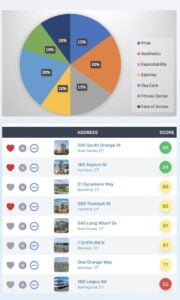
What’s missing from the usual tech stack?
Take a look at the additional layers shown in this interface. These aren’t just visual add-ons — they’re mission-critical filters for large-scale tenants:
- Travel Time – Can your workforce reach the site efficiently? Can your trucks hit delivery windows?
- Customers – Proximity to demand centers slashes shipping costs.
- CREsiteIQ™ – Proprietary data on property risk, rent trends, and expansion potential.
- Ports / Rail / Highways / Airports / Waterways – Multi-modal transport access impacts cost-per-pallet.
- Heatmap – Visualize labor availability or congestion zones in seconds.
- Team View – Coordinate across departments and decision-makers in real time.
Your priorities should drive the map.
Are you prioritizing low cost per square foot, or resilience against natural disasters? Is labor availability or speed-to-market your #1 issue?
Most CRE platforms can’t show you only the sites that deliver on your KPIs. That’s the gap.
Due Diligence = Eyes on Key Dates
In most portfolios, key lease dates are buried — hidden in 60-page documents or scattered across spreadsheets. That’s how companies miss renewal windows… and wind up stuck in holdover, paying double rent.
The REoptimizer® integrated platform flips that risk on its head.
- Every critical date is surfaced upfront — renewals, expirations, options, termination rights
- Red flags light up early — no surprises, no blown notice periods
- Opportunity signals appear in time to act — whether it’s relocating, consolidating, or renegotiating from a position of strength
Manage Smarter. Perform Stronger.
It’s time to stop managing by reaction. With REoptimizer®, your team works from one platform, built to make proactive portfolio decisions at scale.
No more missed dates, fuzzy lease obligations, or fragmented intel.
Just clear visibility, aligned actions, and maximized returns — across your entire portfolio.
If you’re serious about performance, the software you use shouldn’t slow you down.
It should be the thing that drives it.
So don’t waste any more time on software that is slowing down your multi-million dollar CRE portfolio. Click below to learn more.