
The Digital Arms Race Comes to Real Estate
The commercial real estate world is standing at a crossroads.
Artificial intelligence is revolutionizing how companies operate and redefining where and how they occupy space.
From hyperscale data centers powering machine learning models to logistics firms building AI-driven supply chains, the physical footprint of the digital economy is being rebuilt from the ground up.
For corporate tenants, this transformation is reshaping leasing strategies, operating costs, site selection priorities, and even sustainability benchmarks. In this new era, data, energy, and location form the holy trinity of corporate real estate strategy.

The Meteoric Rise of AI-Powered Infrastructure
According to Goldman Sachs, global data center power consumption will rise more than 160% by 2030, while McKinsey projects AI-ready capacity growing 33% annually. At the same time, AI workloads could account for 70% of all data center demand by decade’s end.
That’s not just a technology story—it’s a CRE one.
Every terabyte of AI processing requires physical space, cooling, and enormous power supply. Building and operating these hyperscale environments means a surge in demand for industrial land, energy infrastructure, and specialized trades like electricians, HVAC engineers, and automation specialists.
As Propmodo notes, “the ripple effect extends beyond tech jobs.” Each new facility creates construction waves, utility upgrades, and adjacent development opportunities—from housing to retail.
For tenants, that means markets once considered “peripheral” to corporate strategy are now prime real estate battlegrounds.
Where the Growth Is and Why It Matters to You
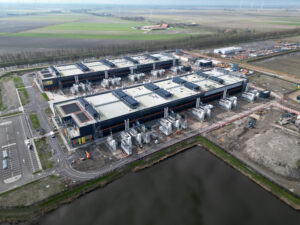
Northern Virginia remains the world’s largest data center market—hosting over 70% of global internet traffic through “Data Center Alley.” More than 380 facilities are now operational or under construction across Loudoun, Prince William, and Henrico counties.
Virginia: The Center of the Digital Universe
Virginia offers a powerful mix of:
- Tax incentives: The Data Center Retail Sales & Use Tax Exemption remains one of the nation’s most generous.
- Affordable power: Dominion Energy still delivers below-average electricity rates, even as data centers consume nearly a quarter of total statewide electricity.
- Connectivity: One of the densest fiber optic ecosystems in the world.
For corporate occupiers, this concentration matters. Companies located near data centers—particularly those dependent on cloud-based AI or latency-sensitive applications—gain significant operational advantages. Co-location is becoming the next corporate adjacency play.
New Regional Contenders
Beyond Virginia, Dallas–Fort Worth, Phoenix, Chicago, Atlanta, and Portland/Hillsboro have emerged as Tier 1B growth markets. Each offers distinct value propositions:
- Texas: Massive land availability and a deregulated power market.
- Arizona: A pro-development regulatory climate and strong grid reliability.
- Illinois/Georgia: Proximity to dense urban centers and robust connectivity networks.
For corporate tenants, these shifts are opening new options and competition for power-secure, future-proof locations.

Power Becomes the New Currency
Data centers have become the largest new load category on the U.S. grid, often requesting hundreds of megawatts per site. In Virginia alone, 2023 data center activity accounted for over 21% of total electricity sales, and similar patterns are emerging in Texas and Oregon.
But here’s the challenge: the U.S. grid wasn’t built for this. Transmission projects can take a decade or more to complete, creating a structural mismatch between data demand and power delivery.
For corporate tenants, this means power—not space—is the new constraint.
- Lease negotiations now hinge on energy delivery timelines.
- Substation adjacency is a new site-selection criterion.
- Long-term energy contracts and direct Power Purchase Agreements (PPAs) are emerging as competitive differentiators.
In short: the next corporate real estate advantage won’t come from cheaper rent—it’ll come from guaranteed, clean, reliable electricity.
Enter Nuclear and Small Modular Reactors (SMRs): The Long Game
The world’s largest cloud providers aren’t waiting around for the grid to catch up.
- Amazon Web Services (AWS) has committed to multi-billion-dollar nuclear PPAs tied to Pennsylvania’s Cumulus Data campus.
- Microsoft has inked a 20-year nuclear energy deal with Constellation Energy to power its Mid-Atlantic data centers.
- Google, partnering with the Tennessee Valley Authority, is investing in advanced (Gen-IV) nuclear and geothermal technologies.
While fully deployed SMRs are likely ~10 years away, these moves underscore one point: energy independence is becoming a strategic necessity.
Once commercialized, modular reactors could decentralize data center power generation, enabling facilities—and even adjacent industrial users—to operate off-grid or in hybrid configurations.
That means site selection may eventually follow the power, not the other way around.

CRE’s New Playbook: Follow the Energy, Not Just the Rent
The AI data boom is rewriting traditional site selection logic.
For decades, tenants prioritized labor markets, transportation corridors, and occupancy cost. Now, energy availability and reliability often outweigh those factors.
Here’s how this is playing out:
- Incentives as a differentiator:
States offering clean-energy tax breaks and equipment exemptions (like Virginia and Texas) will continue to win enterprise investment. - Power-ready = premium:
Land or campuses with deliverable megawatts are commanding double-digit rent premiums in industrial markets. - Decentralization of demand:
As AI workloads expand, tenants are looking beyond urban cores—to exurbs or secondary metros where land, water, and power are more accessible. - Energy resilience as ESG 2.0:
For corporate boards, clean, firm energy isn’t just an environmental goal—it’s a business continuity metric.
This is creating a new real estate segmentation: grid-competitive vs. grid-constrained markets.
How Corporate Tenants Should Respond
The shift isn’t theoretical—it’s already transforming corporate portfolio planning, lease terms, and capital allocations. Here’s what tenants can do now:
Start Site Selection Earlier
Power constraints are pushing lead times from 12–18 months to 24–36 months. Begin relocation or expansion discussions sooner, especially for manufacturing, logistics, or tech-heavy footprints.
Integrate Energy Procurement with Real Estate Strategy
Don’t let energy sit in a different silo. Align real estate, finance, and sustainability teams to structure long-term PPAs or renewable energy credits (RECs) tied to your leases.
Leverage Data Center Proximity
If your business depends on AI, cloud computing, or IoT analytics, proximity to hyperscale data hubs can reduce latency, improve reliability, and unlock operational efficiencies.
Use Flexibility as a Negotiating Lever
Developers and landlords are under pressure from grid delays. Tenants who can phase occupancy, share infrastructure, or adopt flexible lease terms can often negotiate better incentives and rates.
Treat Energy as a Covenant
Power availability should now be considered as material as HVAC capacity or structural load in lease documentation. Define delivery milestones and contingency provisions clearly.

The Bigger Picture: A Once-in-a-Generation Reset
The last time commercial real estate saw this level of disruption was during the rise of e-commerce, which redefined industrial space and last-mile logistics. The AI-driven data center expansion is its spiritual successor—only broader and faster.
By 2030:
- Global data center footprint will double,
- Power consumption could triple, and
- Energy infrastructure will define real estate competitiveness as much as location ever did.
For corporate tenants, the message is clear:
AI isn’t just changing your business—it’s changing your building.
Final Word: Positioning for the AI-Real Estate Convergence
As energy-intensive AI applications, edge computing, and digital manufacturing scale up, the smartest corporate tenants will be those who move early, think holistically, and partner strategically.
The next great corporate advantage won’t come from your office layout—it’ll come from where your electrons come from.
The AI boom is more than a technological leap; it’s a spatial one. And the companies that recognize this shift now will be the ones best positioned to thrive when the gridlines of the digital economy are finally redrawn.
Is your portfolio ready for the new power race?
At REoptimizer®, we help corporate tenants stay ahead of these seismic shifts—identifying opportunities to right-size, renegotiate, relocate, or capture incentives in markets positioned for AI-era growth.
Our advisors leverage national data, local expertise, and decades of tenant-side experience to align your real estate strategy with the future of work, data, and energy.
- Future-proof your footprint.
- Unlock savings before market constraints hit.
- Negotiate from a position of power—literally.
Learn more about how REoptimizer® can ensure your next lease becomes your next competitive edge.