For the Fortune 500 real estate director, a lease is more than a right to occupy; it is a long-term liability that requires active hedging. Central to this hedge is the expense stop, a mechanism that defines the boundary between a predictable overhead and an escalating variable cost.
The expense stop is the pivot point of this risk. It is a contractual provision that sets a maximum limit on the landlord’s operating expenses.
While it serves to provide a predictable “floor” for the landlord’s contribution, it simultaneously functions as a latent liability for the tenant. For the sophisticated occupier, understanding the interplay between the base year, actual expenses, and annual increases is the difference between budget stability and an unexpected multi-million dollar hit to the EBITDA.

Expense Stop: The Landlord’s Hedge and the Tenant’s Exposure
An expense stop in commercial real estate is essentially a risk-transfer mechanism. It is primarily used in Full-Service Gross Leases to protect landlords from rising costs while providing tenants with a predictable initial rent. By setting a certain amount—typically expressed per square foot—the landlord caps their financial liability.
From the landlord’s perspective, this provision ensures predictable cash flow. The risk of rising inflation, sudden spikes in utility costs, or labor increases for building expenses is transferred to the tenant.
If the actual operating expenses rise to $12 per square foot while the expense stop amount is set at $10, the tenant is responsible for the $2 difference. On a 100,000-square-foot headquarters, this “minor” fluctuation results in a $200,000 unbudgeted expense.
However, the expense stop is not inherently predatory; it can provide predictability for tenants in terms of operating expenses, allowing them to budget effectively for the first year. The risk, however, is that if the initial stop is set artificially low during lease negotiations, the tenant may be exposed to large, immediate increases in subsequent years.
Base Year: Defining the Economic Baseline
The base year is the chronological anchor of a commercial lease. While it can be any year agreed upon, it is typically the first year of the lease term. In a full service or modified gross lease, the landlord pays for all operating expenses incurred during this period. The actual amount of expenses tied to this window becomes the “floor” for the remainder of the term.
For the C-suite, the base year amount is a critical data point. If a tenant signs a lease in a building that is only 50% occupied during the base year, the actual expenses will be deceptively low. As the building fills and occupancy reaches 95%, the variable expenses—such as janitorial services, utilities, and property management fees—will skyrocket.
Without proper lease protections, such as a “Gross-Up” clause, the tenant will face significant rent increases simply because the landlord was successful in leasing the rest of the building. A sophisticated new lease negotiation must ensure the base year is adjusted to reflect a fully occupied building, creating a “realistic base year” that prevents unfair spikes in the second year and beyond.

Operating Expenses: The Anatomy of “Additional Rent”
To manage a large-scale portfolio, one must look beyond the total sum and analyze the components of building operating expenses. These generally include:
- Property Taxes: Often the largest and most volatile uncontrollable expense.
- Insurance: Subject to global market shifts and climate-related adjustments.
- Common Area Maintenance (CAM): The costs of operating shared lobbies, elevators, and parking structures.
- Property Management Fees: Usually calculated as a percentage of gross revenue.
In a full service lease, the tenant benefits from the landlord’s management of these services, but they assume the risk of any operating costs that exceed the specified expense stop. This can lead to significant, unexpected increases in total rent.
Conversely, in a net lease, the tenant pays their pro rata share of all expenses from day one. While a net lease offers more transparency, the gross lease with an expense stop is often preferred by large corporations for the initial budget certainty it provides, provided the base year stop is negotiated aggressively.
Commercial Real Estate Portfolio Strategy: Mitigation and Negotiation
A Fortune 500 tenant must approach commercial real estate leases with a defensive mindset. Because the risk of unexpected increases in property expenses is transferred to the tenant—supporting the stability of the landlord’s investment—the tenant must negotiate counter-measures.
- Negotiating the Expense Cap: While the expense stop limits the landlord’s downside, a sophisticated tenant will negotiate for an “expense cap.” This is a secondary ceiling that limits how much the tenant’s pro rata share can increase year-over-year. For example, capping annual increases on controllable operating expenses (like landscaping or security) at 5% ensures that the landlord has an incentive to manage the property efficiently.
- The Power of Audit Rights: Many tenants fail to exercise their right to verify actual expenses. Tenants should negotiate robust audit rights to ensure accuracy in the landlord’s operating expense statements. Requesting an annual audit prevents the landlord from passing through capital expenditures (which should be the landlord’s cost) as common area maintenance.
- Understanding the Base Year Lease vs. Expense Stop Amount: It is a common misconception that all commercial leases handle increases the same way. In a base year lease, the tenant is responsible for any increase in operating expenses over the actual expenses of the first year. In a lease with a fixed expense stop amount, the dollar figure is hard-coded (e.g., $10.00/SF). If the building’s actual expenses in the first year are already $11.00/SF, the tenant is effectively paying overages from the moment they move in.
Common Area Maintenance: The Friction Point
The common area maintenance (CAM) section of a lease is where most disputes arise. For a large-scale office building, CAM includes everything from HVAC maintenance to the flowers in the lobby.

Sophisticated tenants must scrutinize the definition of CAM to exclude:
- Executive salaries of the landlord’s personnel.
- Marketing costs for vacant spaces.
- Costs associated with other specific tenants’ modified gross leases.
- Taxes and insurance that should be itemized separately to ensure they are not being marked up by management fees.
By tightening these definitions, the tenant ensures that the difference they pay between the actual expenses and the base year stop represents legitimate, market-rate increases rather than landlord inefficiencies.
From Strategy to Execution: Optimizing with REoptimizer®
The most critical insight for a C-suite executive is that an expense stop is not a static figure; it is a dynamic risk that requires continuous monitoring. For organizations managing a high-volume, large-scale portfolio, manual tracking in spreadsheets is an invitation for budget leakage and missed audit windows.
To turn real estate from a passive expense into a strategic asset, forward-thinking tenants leverage REoptimizer®, a cloud-based transaction and lease management platform designed specifically for corporate tenants.
How REoptimizer® Protects Your Bottom Line:
- Centralized Expense Clarity: REoptimizer® acts as a single source of truth, centralizing all lease documents and abstracting critical data points like your base year stop, expense caps, and audit rights.
- Automated Anomaly Detection: The software provides instant visibility into overspending. By benchmarking your actual operating expenses against market data and previous years, REoptimizer® identifies red flags—such as “spiking” variable costs or miscalculated pro rata shares—before they become permanent losses.
- Audit Readiness: When it’s time to exercise your audit rights, REoptimizer® ensures you have the historical data and line-item clarity needed to hold landlords accountable, ensuring you aren’t paying for capital improvements or non-allowable CAM charges.
- Strategic Decision Support: Using interactive dashboards and AI-powered data mapping, REoptimizer® allows you to simulate “what-if” scenarios. You can see the long-term impact of rising property taxes or inflation on your entire portfolio’s occupancy costs years in advance.
Take Control of Your Portfolio Today
Don’t leave your corporate real estate budget to chance or landlord-favorable estimates. Whether you are negotiating a new high-rise lease or auditing a global portfolio, the right technology is your best defense.
Ready to see what you should be paying?
Schedule a Demo of REoptimizer® today to discover how our patented technology can identify inefficiencies, lower your CRE spend, and provide the transparency your C-suite demands.
Book a Demo
A lease is more than just a contract for space; it is a multi-million dollar bet on your landlord’s financial stability. Whether you are managing a global warehouse network or a large-scale office portfolio, your operational continuity depends on the person across the table. And in today’s volatile market, the most critical “inspection” isn’t of the brick and mortar—it’s of the debt service coverage ratio (DSCR).
If your landlord is facing financial strain, your “Class A” experience can quickly dissolve into deferred maintenance, tax liens, or even the nightmare of a mortgage loan foreclosure. Here is how sophisticated real estate investors and corporate tenants use DSCR to protect their interests and why REoptimizer® is the essential tool for flagging these risks before they become your problem.

What is DSCR (Debt Service Coverage Ratio)?
The Debt Service Coverage Ratio (DSCR) is a financial metric used by many lenders to determine a borrower’s capacity to repay a loan. In simple terms, DSCR measures whether the property generates enough cash flow to cover loan payments.
For a tenant, the landlord’s DSCR is a barometer for their ability to maintain the property. If the ratio is too low, the landlord is likely “robbing Peter to pay Paul”—diverting your monthly rent to cover current debt obligations instead of essential operating expenses.
How to Calculate DSCR
To calculate DSCR, you divide the property’s net operating income (NOI) by its total debt service:
DSCR=Total Debt ServiceNet Operating Income (NOI)
- Net Operating Income (NOI): This is the rental income minus operating expenses (such as taxes, insurance, and maintenance).
- Total Debt Service: This includes all principal and interest payments on the mortgage loan.
Benchmarks: What is an “Acceptable DSCR”?
Understanding the numbers is the first step in identifying financial difficulties in your landlord’s portfolio.
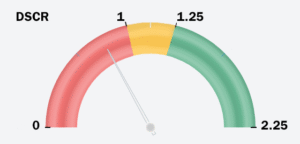
- DSCR > 1.25: This is the common industry standard for most real estate investors. It means the property generates 25% more income than is needed to cover loan payments.
- DSCR = 1.0: The property is just breaking even. One major vacancy or a spike in the annual interest rate could push the property into the red.
- DSCR < 1.0: A low DSCR indicates that the rental property’s cash flow is insufficient to cover mortgage payments.
The “Office Trap”: Why Office Tenants Face Higher Risk
For the office sector, a standard 1.25x DSCR is a starting point. Because office buildings have high tenant concentration and massive down payments required for tenant improvements (TIs), lenders often demand a minimum DSCR of 1.35x to 1.40x to approve an office mortgage loan.
The NOI Cash Flow Crisis
In the office world, Net Operating Income (NOI) is under siege. Unlike warehouse spaces with triple-net (NNN) leases that pass most costs to the tenant, office landlords often bear the brunt of:
- Skyrocketing Insurance Premiums: Insurance is a primary operating expense that has jumped 20–40% in some urban markets.
- Capital Expenditure (CapEx) vs. NOI: Standard DSCR calculation methods often exclude CapEx. However, an office landlord must spend heavily on lobbies and “amenitization” to attract tenants. If they are spending their cash on debt instead of CapEx, your building is effectively “dying on the vine.”
The Danger of Cross-Collateralization with a DSCR Loan
This is the “invisible” threat for a corporate tenant. Many large-scale office landlords use cross-collateralization, where multiple properties serve as collateral for a single mortgage loan (often called a blanket mortgage).
- The Scenario: Your office building might have a “healthy” individual DSCR of 1.30x.
- The Risk: If your landlord’s warehouse in another state loses its anchor tenant and its DSCR drops to 0.80x, the lender can trigger a cross-default.
- The Result: The lender could seize your building even if its performance is perfect. This “portfolio contagion” is why you must look beyond the single asset to the borrower’s capacity across their entire holdings.

Strategic Management: How to Audit Your Landlord
While you may not always have access to a landlord’s private tax returns, you can use the following factors to estimate their DSCR calculation:
- Analyze Market Rents: Use monthly rental income data for the property’s location to estimate the revenue.
- Monitor Tenant Turnover: If an office building has 20% of its leases expiring in the same period, the NOI is at extreme risk, which will tank the DSCR.
- Review Loan Terms: Research when the property was purchased. Loans from 2021 with low interest rates are now facing “refinancing cliffs” where the new annual interest rate will double the monthly payments.
Don’t Let Their Debt Become Your Disaster
In the current market, a strong DSCR is the ultimate sign of a reliable landlord. As a corporate tenant, you have the responsibility to understand the financial health of the entities housing your operations.
Are you ready to see the hidden risks in your CRE portfolio?
Stop guessing and start optimizing. REoptimizer® is the only transaction management software built to give corporate tenants an “institutional-grade” look at their landlords’ financial health. We don’t just help you manage leases; we help you audit the entities behind them.
Why REoptimizer® is Your Ultimate Shield:
- The Landlord Watchlist: Our platform flags landlords who are under financial strain based on real-time market data, debt maturity “cliffs,” and historical performance.
- Red & Yellow Flag Alerts: Instantly see which properties in your portfolio have a low DSCR or rising operating expenses that could trigger a service lapse.
- Cross-Collateralization Mapping: We reveal the hidden links in your landlord’s debt. If your warehouse is cross-collateralized with a failing office tower, REoptimizer® puts that risk on your dashboard before the lender sends a default notice.
- NOI Stress Testing: See how your building’s Net Operating Income holds up against shifting interest rates and inflation, giving you a clear picture of your borrower’s capacity.
Contact REoptimizer® today for a free portfolio health check. See exactly how our software can identify cross-default risks, flag high-risk debt obligations, and save you millions in hidden operational disruptions. Book a demo to see the difference it can have on your portfolio today.
Book a Demo
Frequently Asked Questions: Navigating Landlord DSCR Risk
For corporate tenants, the financial health of a landlord is just as important as the physical health of the building. Below are the most common questions regarding the debt service coverage ratio and how it impacts your investment decisions.
How do you use the DSCR formula for a commercial landlord?
To perform a dscr calculation on a potential landlord, you need to estimate the building’s Net Operating Income (NOI) and divide it by the total debt service. While you may not have their exact ledger, you can use a dscr calculator approach by researching:
- Revenue: Estimated monthly rental income based on the building’s square footage and current market rates for the property’s location.
- Expenses: Standard operating expenses (usually 25–35% of gross income for office/warehouse) including taxes, insurance, and maintenance.
- Debt: Estimated principal and interest payments based on the property’s last recorded loan amount and the prevailing interest rate at the time of financing.
What is considered an acceptable DSCR for office vs. warehouse properties?
While many lenders accept a minimum DSCR of 1.25x for general investment property, the “safety zone” varies by asset class:
- Warehouse/Industrial: Because these often have stable, long-term NNN leases, a ratio of 1.20x to 1.25x is typically an acceptable DSCR.
- Office Space: Due to higher tenant turnover and the massive down payment required for tenant improvements (TIs), savvy tenants look for a landlord with a DSCR of 1.35x or higher. Anything lower suggests the landlord may lack the liquidity to fund your next office build-out.
How does a high interest rate impact a landlord’s debt service?
The annual interest rate is the most volatile component of the dscr formula. If a landlord has a floating-rate mortgage loan or an upcoming “refinancing cliff,” a 2% jump in the interest rate can instantly drop a healthy 1.30x DSCR to a sub-1.0 financial strain level. This is why REoptimizer® tracks market cycles—to warn you when your landlord’s borrower’s capacity is shrinking.
Can I use a DSCR loan calculator to estimate landlord risk?
Yes. A dscr loan calculator is a great “reverse engineering” tool. By inputting the property’s estimated value and the current loan to value (LTV) ratios, you can determine the maximum debt service the property can handle. If the resulting monthly payments are nearly equal to the estimated monthly rent, the landlord has zero margin for error.
What are the “other factors” that can tank a property’s DSCR?
Beyond the basic dscr calculation, tenants should watch for:
- Cross-Collateralization: If your office building is tied to a struggling retail mall in the same mortgage loan pool.
- Soft Market Conditions: Rising vacancy rates in the same period that expenses like insurance and taxes are increasing.
- Capital Expenditures: One-time costs (like a roof replacement) that aren’t in the NOI but drain the cash needed to repay the loan.
Proactive Portfolio Protection
In the high-stakes world of corporate CRE, information is your only shield. Don’t wait for a “For Sale” sign or a lapse in building services to realize your landlord is in trouble.
REoptimizer® gives you the data-driven edge to:
- Flag High-Risk Landlords: Identify owners with low DSCR and heavy debt obligations.
- Optimize Deal Terms: Use landlord financial weakness as leverage for better lease protections.
- Centralize Portfolio Health: See all your office and warehouse risks in one interactive dashboard.
Learn More
Rent escalations aren’t inherently “bad.” They’re a normal part of commercial leasing meant to protect a landlord’s revenue over time. The real risk is how the escalation is structured—and how easily the language can shift volatility, compounding, and index-selection power onto the tenant.
This is why escalation clauses are one of the most common “quiet cost drivers” in a lease: the numbers often look acceptable in Year 1, but the clause can create an outsized impact by Year 7, 10, or 15. Let’s talk about how to avoid this.
What Is A Rent Escalation Clause?
A rent escalation clause defines how rent increases over the lease term, including timing (annual, every other year, at specific milestones) and the method used (index-based, fixed, hybrid, or bumps). The nuance most teams miss is that escalations are typically compounding: each increase builds on the last year’s rent, not the original base. That compounding effect is where “small” differences in language become meaningful portfolio-level budget outcomes.
Two subtle points that matter in negotiations:
-
Escalation method interacts with term length. A clause that seems tolerable in a 5-year deal can become a serious exposure in a 12–15 year deal.
-
Escalation language often includes embedded leverage. Index selection, floor/ceiling language, notice timing, and calculation method can all tilt results—without changing the headline escalation “type.”
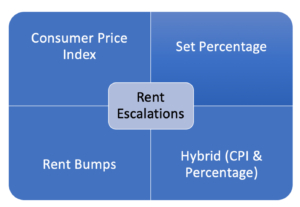
The Four Basic Types Of Rent Escalations
1. CPI Or Inflation-Based Escalations
CPI-based escalations are often presented as “fair”—rent only rises with inflation. But the practical reality is that CPI clauses can be one-sided risk transfer if they don’t include guardrails.
Where CPI gets dangerous (the nuance):
-
Index selection isn’t neutral. Landlords may specify a CPI measure or geography that best supports higher increases. Even small differences in index definition can create materially different outcomes over time.
-
CPI clauses can have “silent” floors. Some CPI clauses include a minimum increase (a floor) even when CPI is low, but still allow full upside when CPI is high. That’s not “inflation protection”—that’s asymmetry.
-
Timing matters more than most people think. CPI is usually measured over a period (e.g., year-over-year). If the clause uses a measurement window that catches an inflation spike, that spike can become embedded in the rent base going forward.
-
Compounding locks in the pain. Even if inflation cools later, the higher rent established during the spike becomes the new baseline for future increases.
How REoptimizer® helps (subtle but powerful):
-
Flags CPI escalation language and the fine print (index, geography, lookback window, floor/ceiling language)
-
Converts the clause into a plain-English summary: “Your rent increases by X, measured by Y, calculated on Z schedule, with limits of A/B”
-
Models multiple inflation scenarios so you can see how “reasonable” becomes “runaway” across the term, especially in longer leases
Negotiation angle that often works:
If CPI is on the table, push for caps and clarity (and avoid floors that create upside-only outcomes). When landlords insist on CPI, the win is often in the guardrails—not in eliminating CPI entirely.

2. Fixed Percentage Escalations
Fixed escalations are typically the most tenant-friendly option because they turn uncertainty into a schedule. But “fixed” doesn’t automatically mean “optimized”—the details still matter.
The nuance in fixed escalations:
-
Fixed is predictable, not always cheap. A fixed 3% may be a win versus CPI during high inflation—but in low-inflation periods it can cost more than what CPI would have done. The key is whether the predictability premium is worth it for your organization.
-
The compounding effect is still real. A fixed increase compounds too, so the difference between 2.5% and 3% is not linear over 10+ years.
-
Fixed escalations can hide in base rent resets. Some leases combine a fixed escalation with periodic “reset to market” language or appraisal mechanisms that function like a second escalation.
-
Fixed increases interact with concessions. A landlord may trade a slightly lower fixed escalation for changes elsewhere (free rent, TI, abatement language, operating expense treatment). The “best deal” is often the one with the best total economics, not the lowest escalation percentage.
Negotiation angle that often works:
Fixed escalations are easiest to justify internally. They also make it easier to create landlord competition because you can compare offers apples-to-apples across properties.
3. Hybrid Escalations (Fixed + CPI Triggers Or Limits)
Hybrid systems are where complexity starts doing real damage—or real good—depending on how they’re structured. A well-built hybrid can be a smart compromise in long-term deals. A poorly built hybrid can quietly recreate CPI risk while looking tenant-friendly.
The nuance in hybrids:
-
Hybrids should reduce volatility, not reintroduce it. The goal is a controlled range of outcomes. If a hybrid clause still allows large CPI swings with minimal limits, it’s not really a hybrid—it’s CPI with extra steps.
-
Trigger design is everything. A “trigger” could be CPI above a threshold, but you need to examine:
-
What measurement period is used?
-
What happens when CPI goes back down?
-
Does the escalation revert, or does it ratchet upward permanently?
-
Caps/floors can create asymmetry. A ceiling (cap) helps tenants. A floor helps landlords. Some hybrids include both—fine—unless the floor is set high and the cap is set too high to matter.
-
Hybrids can be structured as “bands.” For example: 3% unless CPI exceeds X, then 4% for that year only, then revert when CPI normalizes. That approach contains exposure better than “CPI in full if CPI exceeds X.”
Negotiation angle that often works:
Hybrids are a useful concession when landlords won’t commit to fixed increases across long terms. The tenant win is getting the hybrid to behave like a fixed schedule most years while limiting worst-case inflation exposure.

4. Rent Bumps (Set Dollar Increases)
Rent bumps are often viewed as simple, but they can carry their own nuance—especially in how frequently they occur and how they align to market dynamics.
The nuance in rent bumps:
-
Bumps can be more transparent than percentages. Stakeholders can understand “+$0.50/SF” more quickly than compounding percentages—useful for approvals and budgeting.
-
Frequency is negotiable in some markets. Annual bumps are common, but every-other-year bumps can appear when demand is lower or when landlords are trying to stabilize occupancy.
-
Bumps behave differently depending on the starting rent. A $1.00/SF bump is a larger effective percentage when starting rent is low and a smaller effective percentage when starting rent is high. That matters when comparing proposals.
-
Bumps can be paired with renewal options strategically. Tenants can sometimes negotiate different bump schedules for base term vs. renewal periods, aligning increases to business uncertainty.
Negotiation angle that often works:
If you can’t win on the bump amount, win on the timing (less frequent increases) or on other economic levers that reduce total occupancy cost.
Why CPI Escalations Tend To Be The Most Dangerous
CPI escalations feel reasonable because they’re anchored to “inflation,” which sounds objective. But CPI clauses are often where landlords can embed the most optionality and the least predictability for tenants. The biggest tenant-side risk isn’t CPI itself—it’s CPI without boundaries, combined with compounding.
REoptimizer® helps teams avoid the classic mistake: evaluating escalation clauses based on what inflation has been, rather than what it could be over the life of the lease.

How To Negotiate A More Tenant-Friendly Escalation
A strong escalation strategy typically looks like this:
-
Start with a fixed schedule preference (predictability wins internal buy-in)
-
If CPI enters the deal, contain it with clear caps and transparent definitions
-
Avoid one-way clauses (floors without meaningful caps, or ratchets that never revert)
-
Use competition to force landlords to price risk fairly
REoptimizer® supports this by turning lease language into a financial narrative: what you’re paying, when you’re paying it, and what could change under different conditions—so the negotiation isn’t emotional, it’s mathematical.
REoptimizer® Use Cases For Escalation Clauses
-
Clause Risk Flagging: Identify CPI, ratchets, floors, and hybrid triggers early—before late-stage legal review.
-
Scenario Modeling: Test inflation environments so teams can see exposure boundaries, not just the “expected” path.
-
Budget-Ready Rent Schedules: Generate stakeholder-friendly schedules that align to term, options, and renewal structure.
-
Negotiation Prep: Quantify alternatives so you can trade intelligently (e.g., escalation concessions in exchange for TI, free rent, or better renewal terms).

Schedule a demo today to see hoe REoptimizer® can level up your portfolio by strengthening each individual lease.
Book a Demo
FAQ’s Rent Escalation:
Which rent escalation is safest for tenants?
Most tenants prefer 2. Fixed Percentage Escalations because predictability reduces budget risk and approval friction.
Why can CPI escalations become expensive even if inflation falls later?
Because rent is usually compounding. A high CPI year can increase the base rent permanently, and subsequent increases build on that higher number.
Are hybrid escalations good or bad?
3Hybrids can be good when they genuinely limit volatility (caps, bands, reversion). They’re risky when they add complexity without adding real limits.
Are rent bumps better than fixed percentages?
Rent Bumps can be excellent for transparency and, in some cases, negotiable frequency. The “better” option depends on starting rent, bump size, and term length.
Commercial lease renewals are no longer a routine administrative task. In today’s office market, they are one of the most powerful—and underutilized—levers for reducing occupancy costs, improving space utilization, and reshaping a company’s real estate portfolio.
Done strategically, a renewal can unlock millions in savings, flexibility, and optionality. Done passively, it can quietly lock in outdated economics, underused space, and unnecessary risk for years.
This guide explains how to approach commercial lease renewals—and how modern portfolio intelligence tools like REoptimizer® allow tenants to make renewal decisions with clarity, leverage, and confidence.
What Is A Commercial Lease Renewal?
A commercial lease renewal is the process of extending, renegotiating, or restructuring an existing office lease before its expiration. While many leases include renewal options, exercising them without market analysis can be one of the most expensive mistakes tenants make.
A renewal should be treated as a new transaction, evaluated against current market conditions, space utilization, and long-term business strategy—not as a default continuation of the past.
Why Commercial Lease Renewals Matter Right Now
The office market didn’t just “bounce” into a new cycle—it repriced risk and value. That shows up in how landlords underwrite deals, how employees experience offices, and how finance teams judge real estate decisions.
-
Hybrid Work Changed Utilization, Not Just Attendance
It’s not simply “fewer days in-office.” It’s spikier demand (peaks midweek, valleys Monday/Friday), more cross-functional collaboration days, and greater sensitivity to layout quality. Two companies can have the same headcount and radically different space needs depending on scheduling norms, team structure, and meeting behavior.
-
Vacancy Is Elevated, But Leverage Is Uneven
Many submarkets have plenty of availability, yet best-in-class buildings can still command stronger pricing and terms because they’re winning the “flight to quality.” That means renewals aren’t about “rent down” everywhere—they’re about choosing whether you’re paying for quality, flexibility, or pure cost, and negotiating accordingly.
-
The Real Gap Is Between “Contracted Rent” And “Market Reality”
A lot of tenants are sitting in leases negotiated under very different assumptions—growth projections, in-office expectations, and rent trajectories. Even when face rent looks acceptable, the total economics can drift: escalations compound, operating expenses rise, and older leases often lack modern flexibility (givebacks, expansion rights, sublease freedom, termination options).
-
Capital Markets And Building Health Now Matter To Tenants
Lease decisions used to be mostly about space and price. Now, tenants also have to think about landlord capacity to fund improvements, maintain services, and execute capital work. Building-level financial stress can translate into operational friction—or become leverage if you understand the owner’s incentives and timing.
-
Costs To Move Or Build Out Are Higher And More Variable
The renewal vs. relocate math isn’t just about rent. It’s about TI dollars, construction timelines, permitting risk, downtime, furniture/IT, and change management. In many cases, the “cheapest rent” option loses once you model the full cost and risk to execute.
-
Leadership Teams Want Finance-Grade Decisions
CFOs and executives increasingly expect real estate choices to be justified like any other investment: NPV impact, scenario planning, risk tradeoffs, and measurable utilization—not anecdotes like “people like the building.” That’s why the renewal window is so valuable: it’s one of the few times you can make a high-impact change with a clear decision point and negotiation leverage.
Net: the renewal window is one of the only moments where tenants can reset economics, right-size intelligently (not blindly), and rebalance portfolios—but only if they have visibility into things like remaining lease NPV, true utilization by site, comparable deal terms, and relocation scenarios (exactly the inputs tools like REoptimizer® are built to centralize).

The Four Most Common Commercial Lease Renewal Mistakes
1. Treating A Renewal Like A Paperwork Exercise
Tenants often assume that staying put is the safest option. Familiarity with the space, landlord, and commute patterns can create a false sense of security.
But renewing without analysis often means:
-
Overpaying above market rent
-
Carrying excess or poorly configured space
-
Locking into outdated lease terms and escalations
A renewal is a multi-year financial commitment and should receive the same scrutiny as a new lease—sometimes more.
2. Negotiating Without Understanding True Portfolio Economics
Many tenants negotiate renewals in isolation, looking only at:
-
Current rent
-
Renewal option language
-
Short-term savings
What’s often missing is visibility into how each lease performs inside the broader portfolio.This is where modern portfolio analytics change the game.With REoptimizer®, tenants can:
-
See the remaining Net Present Value (NPV) of each lease
-
Understand how future rent escalations compound over time
-
Compare the cost of staying versus relocating or restructuring
-
Identify which locations are financial outliers
Without this data, tenants negotiate blind.
3. Ignoring Utilization And Right-Sizing Opportunities
Excess space is one of the largest hidden costs in corporate real estate.
Many organizations no longer need the same footprint they signed for years ago—but that doesn’t always mean a simple reduction. The real opportunity lies in nuanced optimization. REoptimizer® enables tenants to:
-
Measure utilization at each site
-
Identify underused locations and redundant footprints
-
Evaluate whether satellite offices can be consolidated
-
Model scenarios like combining locations into a single, higher-quality hub
Instead of asking, “How much space do we cut?” The better question is, “How should our space actually work?”
4. Failing To Leverage The Market With Real Alternatives
Landlords negotiate differently when they know a tenant has credible options.
However, “alternatives” only create leverage if they are:
-
Comparable in quality and function
-
Priced accurately on a net-effective basis
-
Evaluated alongside renewal economics
REoptimizer® allows tenants to:
-
Match renewal terms against true market comparables
-
Compare new locations side-by-side with the existing lease
-
Model total occupancy costs across multiple scenarios
-
Create defensible competition for their tenancy
This transforms negotiations from reactive to strategic.

How REoptimizer® Changes The Commercial Lease Renewal Process
Traditional renewal planning relies on spreadsheets, fragmented data, and anecdotal market knowledge. REoptimizer® replaces that with a centralized decision platform.
Portfolio-Level Intelligence
Utilization And Strategy Alignment
-
Site-level utilization insights
-
Identification of consolidation and combination opportunities
-
Alignment with hybrid work policies and growth plans
Market And Scenario Comparison
-
Comparable lease benchmarking
-
Renewal vs. relocation modeling
-
Side-by-side evaluation of multiple options
Faster, Better Decisions
-
Clear visuals for executives and finance teams
-
Scenario modeling that supports internal buy-in
-
Data-backed negotiation strategies
The result: better outcomes with less guesswork.
When Should You Start Planning A Commercial Lease Renewal?
For most office tenants, renewal planning should begin 18–36 months before lease expiration, depending on portfolio size and complexity.
Starting early allows tenants to:
-
Identify leverage well before deadlines
-
Avoid costly extensions or rushed decisions
-
Use time as a negotiating advantage
-
Align real estate decisions with broader business planning
With tools like REoptimizer®, early planning becomes practical—not overwhelming.
The Bottom Line: Renewals Are Where Portfolios Are Won Or Lost
Commercial lease renewals are no longer about simply staying or leaving. They are about optimizing an entire portfolio—financially, operationally, and strategically.
Tenants who succeed will:
-
Treat renewals as new investments
-
Use data, not assumptions
-
Understand utilization at a granular level
-
Leverage market alternatives intelligently
-
Equip themselves with the right technology and representation
REoptimizer® doesn’t replace strategy—it enables it.Want to see how it can level up your portfolio? Book a demo today.
Book a Demo
Commercial Lease Renewal FAQs
When Should I Start Planning A Commercial Lease Renewal?
Most tenants should begin planning 18–36 months before lease expiration. Starting early gives you time to benchmark the market, build internal alignment, and create real negotiating leverage—without risking costly extensions or rushed decisions.
Should I Exercise My Renewal Option Or Renegotiate?
A renewal option is not automatically the “best deal.” Many option clauses reset only some terms (or lock in above-market economics). The safest approach is to price the option against market comparables and alternative locations, then choose the path with the best net-effective outcome.
How Do I Know If I’m Overpaying Rent?
You’re likely overpaying if your lease was signed in a stronger market and has compounding escalations, or if comparable buildings are offering better economics (rent, concessions, flexibility). The most reliable test is a true side-by-side comparison of:
-
Base rent + escalations
-
Operating expenses (and caps)
-
Tenant improvement allowance
-
Free rent / abatement
-
Move, build-out, and downtime costs
What Are The Biggest Negotiation Levers In A Lease Renewal?
Most renewal wins come from negotiating the full value stack, not just rent:
-
Tenant improvement (TI) dollars
-
Free rent / rent abatement
-
Operating expense protections (caps, exclusions, audit rights)
-
Flexibility clauses (expansion, contraction, termination options)
-
Parking, signage, and amenities
-
Sublease and assignment rights
Can I Reduce My Square Footage During A Renewal?
Often, yes—but it depends on building layout, the landlord’s leasing strategy, and timing. Many tenants pursue:
-
A direct reduction (smaller suite)
-
A re-stack within the building
-
A blend-and-extend with resizing
-
A partial giveback paired with a longer term
The key is to make the new footprint worth it to the landlord (term, credit, stability, or avoided vacancy risk).
How Do I Measure Office Utilization Before A Renewal?
Utilization should reflect how people actually use the space—by day, department, and peak periods—rather than assumptions. Measuring utilization helps you avoid renewing excess space and can reveal opportunities like consolidating teams, redesigning layouts, or combining nearby satellite locations.
What Is Remaining Lease NPV And Why Does It Matter?
Remaining lease NPV (Net Present Value) estimates the value of your remaining lease obligations in today’s dollars. It helps decision-makers compare options like:
-
Renewing vs. relocating
-
Downsizing vs. reconfiguring
-
Shorter term vs. longer term
-
Paying more now vs. avoiding higher long-term cost
NPV makes “stay vs. go” a finance-grade comparison instead of a gut call.
How Can REoptimizer® Help With Lease Renewals?
REoptimizer® helps tenants turn renewals into a portfolio optimization decision by enabling you to:
-
See the remaining NPV of each lease
-
Understand escalation exposure and term risk
-
View utilization by site to identify right-sizing opportunities
-
Spot nuanced consolidation plays (like combining satellite locations)
-
Match market comparables and benchmark deal terms
-
Compare renewal vs. new location scenarios side-by-side
How Do I Create Leverage In A Renewal Negotiation?
Leverage comes from credible alternatives and a clear plan. The best path is to:
-
Identify 2–4 realistic relocation options
-
Compare them against the renewal on a net-effective basis
-
Communicate that you can execute (not just “shop around”)
-
Keep options alive until the renewal is fully documented
Do I Need A Tenant Representative For A Renewal?
It’s not required, but it’s often the difference between an average deal and an optimized one. A tenant rep brings:
-
Market benchmarks and comp visibility
-
Negotiation strategy and leverage building
-
Term and legal-risk awareness
-
Time savings and process control
What If I Wait Too Long To Start The Renewal Process?
If you wait, you risk:
-
Losing renewal rights or negotiation windows
-
Paying for expensive short-term extensions
-
Accepting unfavorable terms due to time pressure
-
Missing better market opportunities
Time is leverage—starting early protects it.
Commercial leases don’t just have “terms.” They have deadlines—and missing one can cost you renewal rights, expansion space, tenant improvement dollars, or trigger default. This guide breaks down the most important lease dates to track, what they mean, and how to stay protected.
Quick Answer: What Are The Key Dates In A Commercial Lease?
The most important dates in a commercial lease usually include:
-
Delivery Date (when the space must be ready)
-
Lease Commencement Date (when the lease legally starts)
-
Rent Commencement Date (when billing begins)
-
Rent Escalation Dates (when rent increases)
-
Option Notice Windows (renew, terminate, expand, downsize)
-
CAM / Operating Expense Reconciliation & Audit Deadlines
-
Insurance & Certificate of Insurance (COI) Renewal Dates
-
Security Deposit / Letter of Credit (LOC) Expiration & Step-Down Dates
-
Assignment/Sublease Consent & Recapture Deadlines
-
Restoration, Surrender, and Move-Out Dates
-
Termination Date and Holdover Period Triggers
If you track nothing else, track these.
Why Key Lease Dates Matter (And Why Tenants Lose Money)
Most commercial leases make it 100% the tenant’s responsibility to:
-
remember critical dates, and
-
deliver notice exactly the way the lease requires.
Landlords don’t have to remind you. And many are perfectly happy if you miss a renewal window, lose a right to expand, or default on an administrative technicality.
The Portfolio Problem: One Lease Is Manageable—Twenty Isn’t
Tracking lease dates for a single location is hard enough. Tracking them across an entire portfolio is where tenants get hurt.
Because once you scale to multiple sites, you’re no longer managing a “lease.” You’re managing a deadline ecosystem, with hard stops and serious liability.
One missed renewal window can wipe out your leverage. One missed CAM audit deadline can lock in overcharges. One delayed delivery can force holdover tenancy with penalty rent and potential damages. And spreadsheets? They don’t protect you when the real landmines are notice requirements—the exact method, address, timing, and proof that make or break your rights.
If you manage multiple locations, you need more than reminders—you need a system built for lease deadlines. REoptimizer® helps track critical dates, notice windows, escalations, and portfolio exposure in one place, so you don’t lose options, overpay rent, or get trapped in holdover. See how it can streamline your portfolio and book a demo today.
Book a Demo
The “Trigger Chain”: Dates That Control Other Dates
A best practice is to map your lease like a domino run:
Delivery Date → Lease Commencement → Rent Commencement → Escalations → Option Windows → Termination/Surrender
A surprising number of disputes come down to: which date triggered which obligation.

1. Delivery Date (When The Space Must Be Ready)
Definition: The date the landlord must deliver the premises in the condition required by the lease.
What Tenants Should Tie To The Delivery Date
-
Required Condition Standard (code-compliant, clean, safe, systems working)
-
Utilities/Services Live (HVAC, electric, water, internet readiness)
-
Punch List Process (walkthrough, deficiency list, cure timeline)
-
Remedies If Late (rent delay, per diem penalties, termination right, reimbursement)
Why It’s Critical
A late delivery can force a business into:
Tenant tip: Your lease should define “delivered” clearly—otherwise a landlord can argue the space is “ready” when it’s not ready for your operations.
2. Lease Commencement Date (When The Lease Legally Starts)
Definition: The date the lease term officially begins.
This date often controls:
-
The Lease Term End Date
-
When Options Can Be Exercised
-
When Certain Obligations Begin (insurance, maintenance responsibilities, reporting)
Watch for: “earlier of” and “later of” language. Many leases say commencement is the earlier of occupancy or a set date—meaning you might trigger obligations by moving in early.
3. Rent Commencement Date (When You Start Paying)
Definition: The date rent starts accruing—often different from lease commencement.
Common Rent Commencement Structures
Free Rent Isn’t Always Free
Many leases make free rent conditional:
-
Base Rent Only (not CAM/operating expenses)
-
Abatement Ends If You Default
-
The “Free Months” Extend The Lease Term (e.g., 120 months of paid rent becomes 132 months total)

4. Rent Escalation Dates (When Rent Increases)
Definition: The recurring date rent increases (often annually).
Common Rent Escalation Types
-
Fixed Percentage Increases
-
CPI Adjustments (with caps/floors sometimes)
-
Stepped Increases (pre-set schedule)
-
Fair Market Adjustments (typically at renewal)
Why It Matters
Escalations are cumulative—they compound across long terms. A “small” clause can become a major cost driver over 7–15 years.
Tenant tip: Track escalation dates and the formula inputs (CPI base year, index month, cap/floor, rounding rules).
5. Option Notice Windows (Renew, Terminate, Expand, Downsize)
Definition: A set window when a tenant must give notice to exercise a right.
This is the #1 category tenants miss.
Options Usually Include
-
Renewal / Extension Options
-
Early Termination Options
-
Contraction Or Downsize Options
-
Expansion Options (ROFO/ROFR or fixed space options)
The Real Trap: Notice Rules
A tenant can “send notice” and still lose the right if:
-
Notice Method Is Wrong (email not allowed)
-
Sent To The Wrong Address
-
Missed The Window By A Day
-
Lacked Required Enclosures (financials, proposed terms)
Best practice: Track both:

6. Right of First Offer (ROFO) (Expansion Timing Advantage)
Definition: Before the landlord markets certain space, they must offer it to the existing tenant first.
Key dates to track:
If you can’t respond fast, you lose the shot.
7. Right of First Refusal (ROFR) (Match A Third-Party Deal)
Definition: Landlord can market space, but must let the existing tenant match the third-party deal.
Key dates to track:
Practical difference: ROFR can slow deals, but gives the tenant a chance to “match” a real market offer.
8. CAM / Operating Expense Reconciliation And Audit Deadlines
This is one of the most expensive “hidden” date categories.
Key dates:
-
Annual Reconciliation Statement Delivery Date
-
Tenant Dispute Window (often 30–180 days)
-
Audit Request Deadline
-
Payment Due Date For Under-Billings
Tenant tip: If you miss the dispute window, many leases treat the landlord’s statement as final—even if it’s wrong.

9. Insurance Renewal And COI Deadlines
Many leases require:
-
Specific Coverage Types/Limits
-
Landlord Named As Additional Insured
-
COIs Delivered Annually or upon renewal
Key dates:
-
Policy Expiration
-
COI Delivery Deadline
-
Renewal Bind Date
Missing this can be a technical default even if you’re otherwise a perfect tenant.
10. Security Deposit / Letter Of Credit (LOC) Dates
If you have an LOC, date tracking is non-negotiable.
Key dates:
Tenants get defaulted all the time for simply failing to renew an LOC on time.
11. Assignment / Sublease Consent And Recapture Deadlines
If you plan to sublease or assign the lease:
Key dates:
-
Tenant Request Submission Date
-
Landlord Response Deadline
-
Recapture Election Deadline
-
Execution Deadline For Sublease/Assignment
12. Restoration, Surrender, And Move-Out Dates (The Endgame)
The termination date isn’t your only end-of-lease date.
Key dates:
-
Restoration Notice Deadline (landlord tells you what must be removed)
-
Decommission Start Date (IT, cabling, supplemental HVAC, signage)
-
Final Walkthrough Date
-
Key Return/Access Shutoff Date
-
Move-Out Completion Deadline

13. Termination Date And Holdover Trigger
Definition: The date the lease ends and you must be fully out.
If you stay past it, you can trigger:
Tenant tip: Track a move-out runway (60–180 days out) so surrender doesn’t become a crisis.
The Tenant’s Critical Date System (Best Practice Checklist)
To make lease date tracking actually work, log each critical date with:
-
Deadline Date
-
Earliest Notice Date (if applicable)
-
Notice Method + Address(es)
-
Owner (primary person responsible)
-
Backup Owner
-
Proof-Of-Delivery Requirement
-
Linked Lease Clause Reference
A calendar reminder alone is not enough if your lease requires certified mail to a specific address by a specific time.
FAQ: Key Dates In Commercial Leases
What is the most important date in a commercial lease?
For most tenants: Rent Commencement Date (when payments begin) and option notice deadlines (renewal/termination). These two categories drive the biggest financial outcomes.
Are lease dates the tenant’s responsibility?
In most leases, yes. The tenant is typically responsible for tracking dates and providing proper notice exactly as required.
What happens if I miss a renewal notice deadline?
You may lose the renewal option entirely and be forced to vacate or renegotiate at a much higher rent—often with reduced leverage.
Never Miss a Key Date
Tracking critical dates is a business imperative—but it’s only one part of optimizing a lease.The real advantage comes from seeing every deadline, notice window, escalation, and expansion right across your entire portfolio—before it turns into a costly mistake.
REoptimizer® is built to do exactly that: centralize your lease obligations, surface upcoming risk, and keep you ahead of renewals, CAM deadlines, LOC expirations, and holdover exposure. If you’re still relying on spreadsheets and calendar reminders, you’re one missed notice away from losing leverage.
Book a REoptimizer® demo to see how portfolio-wide critical date management actually works—and how much money and risk you can pull back into your control.
Book a Demo
CRE transaction management software is a platform that helps you run commercial real estate deals end-to-end—from requirements and site selection through negotiations, approvals, documentation, and close—so every deadline, cost, and decision is tracked in one place (instead of living in spreadsheets, inboxes, and scattered folders).
REoptimizer® is built for exactly this: centralizing portfolio data and automating reporting, alerts, and workflows so teams can move faster and negotiate from a stronger position.

Who Can Benefit from CRE Transaction Management Software?
If your organization has more than a few locations—or multiple deals happening at once—transaction management software becomes a necessity, not a “nice to have.”
Typical users include:
- Corporate Real Estate (CRE) And Portfolio Strategy teams managing growth, consolidation, relocations, and renewals
- Finance / FP&A tracking budgets, approvals, and forecast vs. actual
- Legal managing LOIs, redlines, and compliance documentation
- Operations / Workplace / Facilities aligning space with headcount and utilization
- Executives who need a clear view of deal risk, savings, and timing
REoptimizer® is positioned for enterprise teams dealing with complexity—replacing “spreadsheets, siloed systems, and manual processes” with a single system of record.
What CRE Transaction Management Software Does
At its core, CRE transaction management software helps you:
- standardize the process (repeatable workflows and checklists)
- coordinate people and deadlines (ownership, reminders, accountability)
- organize documents (versions, approvals, audit trail)
- track costs line-by-line (so overages don’t hide in the noise)
- report in real time (so leadership isn’t waiting on a “Friday spreadsheet”)
REoptimizer® adds a key layer: it’s designed to help teams compare deal economics against comps and benchmarks and generate reporting fast with templates—because the real money is won or lost in the details.

Where It Fits (And Why It’s Not The Same As Lease Management)
A simple way to think about the lifecycle:
Before The Deal: Strategy And Site Search
This is where teams define what they need and evaluate options. REoptimizer® supports this with KSDs (Key Site Drivers) and tools like CRESiteIQ™, built to analyze markets, compare sites, and visualize opportunities. More on in the next section…
During The Deal: The Transaction Itself
This is the heavy-lift phase: comps, negotiations, approvals, legal, due diligence, and getting to signature/close.
After The Deal: Lease Management
Lease management is what happens after execution—tracking key dates like renewals, expirations, options, and escalations. REoptimizer® content points out how missed key dates can create real cost and risk at portfolio scale.
Bottom line: lease management is “operate what you signed.” Transaction management is “control what you sign.”
What Are KSDs?
KSDs (Key Site Drivers) are the criteria that define what “best location” means for your business—then you weight and score them so every option can be compared objectively (not emotionally, not anecdotally, and not based on whoever toured last). Consider them your highly unique KPI’s.
REoptimizer® uses KSDs to score each property in real time and calculate a final weighted score per building, instantly ranking your top contenders side-by-side.

Why KSDs Are Invaluable (And Why Teams That Use Them Win More Often)
They Turn “Opinions” Into A Repeatable Decision System. Without KSDs, site selection usually sounds like:
- “This one feels right.”
- “The price is good, but…”
- “Leadership likes that submarket.”
KSDs force alignment upfront. You define the “must-haves” and “deal-breakers” before you tour, so your team is evaluating every property against the same standard.
They Help You Compare The Stuff That’s Hard To Measure
Price and square footage are easy. The real risk is everything else:
- Workforce access and commute patterns
- Truck access and delivery windows
- Power capacity and future expansion needs
- Column spacing, dock ratios, clear height (industrial)
- Customer proximity and logistics cost impacts
- Rent vs market comps (and trend direction)
- Total Occupancy Cost (rent + CAM/NNN + taxes + insurance + utilities)
- Current utilization vs required utilization (desk sharing, peak days)
- Adjacency needs (teams that must be near each other
- Layout efficiency (loss factor, usable vs rentable SF)
REoptimizer’s® KSD approach is designed specifically to capture those “hard-to-quantify” drivers and make them scorable—so the best site isn’t just the cheapest, it’s the lowest total cost of occupancy and best operational fit.

They Save Time By Eliminating Bad-Fit Tours Early
One of the most expensive mistakes companies make is touring before they’ve defined what matters most. REoptimizer calls this out directly: teams waste time touring warehouses without clear KSDs—then end up revisiting assumptions mid-process. When KSDs are set first, you filter faster and only tour buildings that can realistically win.
They Strengthen Negotiations Because You Know Your Leverage
When you can prove (with scoring) that multiple buildings meet your needs, negotiations change:
- You’re selecting from the strongest options and negotiating from leverage.
- You can back up concession requests with evidence, using comps plus the operational requirements that drive real value.
- You reduce waste by not paying extra for features that don’t move the needle for your business.
Because Reoptimizer® scores contenders side-by-side and ranks them instantly, your team walks into negotiation with clarity: what matters, what doesn’t, and what you can walk away from.
They Keep The Portfolio Aligned With The Business (Not Just The Deal)
The biggest value of KSDs isn’t picking a building—it’s ensuring every location decision supports the business:
- growth plans
- service levels
- labor strategy
- cost targets
- utilization and waste reduction
REoptimizer’s® broader positioning is exactly this: giving teams visibility into overspending and underused space, then translating that into action through dashboards and metrics—so site decisions don’t live in a one-time spreadsheet, they become an operational advantage.
How REoptimizer® Makes KSDs Practical (Not Just A Worksheet)
Here’s the difference between “having KSDs” and using KSDs:
- Score Each Property In Real Time: As you evaluate a site, REoptimizer scores how well it delivers on each KSD—immediately, even while touring.
- Rank Overall Suitability: REoptimizer calculates a weighted score per building and instantly highlights top contenders.
- Expand Site Intelligence With CRESiteIQ™: For location strategy, CRESiteIQ™ helps define what matters and compare sites using many data points (example categories include demographics, income, fuel costs, population trends, and more).

Why Your Portfolio Needs CRE Transaction Management Software
In CRE, savings (or losses) don’t come from “being organized.” They come from making better decisions earlier and catching issues before they get locked into the deal.
Transaction management software helps you:
- Avoid missed deadlines that weaken leverage
- Prevent “death by a thousand line items” (fees, escalations, TI, concessions, operating assumptions)
- Benchmark against comps instead of negotiating blind
- Expose underutilization and waste so the portfolio improves over time
REoptimizer® specifically highlights eliminating wasted effort by centralizing data and automating alerts/workflows—so teams spend time on strategy, not chasing updates.
Why Spreadsheets Don’t Work For Transaction Management
Spreadsheets are fine for a single deal. They fail when you’re handling:
- Multiple stakeholders and approvals
- Changing versions of assumptions and documents
- Market comps, benchmarks, and reporting needs
- Utilization/waste measurement across a portfolio
That’s why REoptimizer® focuses on replacing spreadsheets and siloed tools with a centralized platform and automation.
FAQs
What Is CRE Transaction Management Software?
It’s software that manages the full commercial real estate deal process—tasks, deadlines, documents, approvals, and costs—from strategy through close, so nothing falls through the cracks.
How Is CRE Transaction Management Different From Lease Management?
Lease management is post-signature administration (key dates, escalations, compliance). Transaction management covers the whole process where the economics and terms are created.
Who Needs CRE Transaction Management Software?
Any company with a multi-location portfolio or frequent transactions—especially when deals involve finance, legal, operations, and leadership approvals.
How Does REoptimizer® Help With CRE Transaction Management?
REoptimizer® helps enterprise teams centralize portfolio data and automate reporting, alerts, and workflows—and supports site selection and deal evaluation with KSD scoring and related tools.
What Is CRESiteIQ™?
CRESiteIQ™ is a REoptimizer® tool for site selection, built to analyze markets, compare sites, and visualize opportunities in one platform.
What Are Key Site Drivers (KSDs) In Commercial Real Estate?
KSDs are your business’s weighted location criteria—used to score and compare properties objectively so you can identify the best-fit sites faster.
Why Should KSDs Be Weighted?
Because not all criteria matter equally. Weighting prevents teams from over-prioritizing “nice-to-haves” (or the loudest opinion) over the drivers that actually impact cost, operations, and performance.
How Does REoptimizer Use KSDs?
REoptimizer® scores each property against your KSDs in real time and produces a final weighted score to rank contenders side-by-side.
Learn more about REoptimizer® today.
Learn More
Corporate tenants have spent the last two years hyper-focused on flexibility, operating costs, consolidation, and hybrid strategy. Fair—those issues matter. But while everyone was busy right-sizing their footprint, something far more consequential was happening behind the scenes: Landlords started defaulting. In large numbers.
In office markets, valuations have fallen by double-digits and weaker assets in certain urban cores are being written down far more aggressively.
Meanwhile, refinancing pressure on commercial loans is acute — making the need for tenant protections like the SNDA all the more urgent.
And here’s the part tenants tend to miss: If your landlord defaults, your lease is only as strong as the protections you negotiated—most importantly, the SNDA.
No SNDA? You can lose your space, your rights, your security deposit, and months of operational continuity. All because a lender’s mortgage lien outranks your leasehold interest.
This is not theoretical. This is the modern commercial real estate landscape.
Never Lease a Commercial Property Without an SNDA (Subordination Non Disturbance and Attornment) Agreement
An SNDA—Subordination, Non-Disturbance, and Attornment Agreement—is the legal document that decides who you are and what you are entitled to when a lender forecloses on the commercial property you occupy.

It governs the relationship between you (the tenant), the property owner, and the landlord’s lender, and it becomes critical when the landlord’s property ends up in a foreclosure sale.
Here’s the fast breakdown:
1. Subordination Provision: Where You Rank in the Food Chain
Every commercial loan comes with a lender’s security interest—a mortgage or deed of trust that automatically sits above your lease unless you negotiate otherwise.
If your lease is subordinate:
- The lender’s rights have priority.
- Your lease can be terminated in a foreclosure.
- You have no inherent right to stay in the leased property.
Without an SNDA, the hierarchy is simple: Mortgage > Lease.
And that means the lender can treat your existing lease as optional.
2. Non-Disturbance Agreement: The Clause That Saves You From Eviction
With a proper non-disturbance clause, the lender agrees not to throw you out when they take ownership. This ensures that:
- Your tenant’s rights remain intact.
- Your operations continue uninterrupted.
- Your workforce and equipment stay put.
- Your security deposit doesn’t vanish into a black hole of litigation.
In other words: If you’re paying rent, you stay. Period.
This is the core protection large corporate tenants need—but don’t always get.

3. Attornment Agreement: Accepting the New Landlord Without Losing Leverage
When lenders foreclose and become the new owner, the attornment provision requires the tenant to recognize them as the landlord.
It’s not as scary as it sounds. It keeps your lease alive and forces continuity.
But attornment must be paired with strong non-disturbance rights, or you’ve effectively agreed to report to a landlord who isn’t obligated to keep you.
Say Goodbye to Your Lease in a Foreclosure Sale
The “foreclosed office tower” storyline is becoming normal. Receivers are stepping in faster. Commercial lenders are enforcing rights more aggressively. Loan documents are driving the real outcomes—not the lease.
For corporate tenants, this means:
1. Traditional “Class A Stability” Assumptions Are Gone
Even trophy properties with strong sponsorship are facing refinancing hurdles and valuation write-downs.
2. Lease Provisions You Ignored Now Determine Survival
The SNDA is the difference between:
- Staying through foreclosure, or
- Being treated as collateral damage.
3. Without an SNDA, You Have No Real Negotiating Power With the New Owner
If a purchaser at foreclosure doesn’t like your rent schedule? Without an SNDA, they can simply remove you.
4. Security Deposits Become Vulnerable
If the landlord burns through them during financial distress, recovery becomes a legal war you don’t want to fund.

The Uncomfortable Truth: Most Tenants Don’t Realize They’re Exposed
You’d be shocked at how many large enterprises occupy commercial real estate without an SNDA. Why? Because historically:
- Landlords resisted offering it
- Lenders didn’t want to negotiate it
- Tenants assumed it was “standard enough”
And truthfully, the market was stable enough for the gamble to pay off—until now. Entering the 2026 landscape: Not having an SNDA is a material operational risk.
And CFOs are starting to ask about it—because they should.
Where the Leverage Has Shifted to the Tenant
Here’s the good news: This is one of the most tenant-favored markets in 30 years.
Vacancy is still elevated. Landlords are fighting to retain every square foot of occupancy. Commercial lenders want in-place rent streams. And because of that… This is the moment to negotiate SNDAs with actual teeth.
Corporate tenants can—and should—demand:
- Broader non-disturbance protections
- Lender’s consent on material landlord actions
- Security deposit tracking and safeguards
- Limits on lender step-in liability
- Clarification on insurance proceeds
- Preservation of key lease provisions through foreclosure
You have leverage. Use it before the next wave of landlord defaults hits.

What Savvy Corporate Tenants Are Doing Right Now
Modern occupiers aren’t waiting for their landlord to run out of cash. They’re conducting proactive portfolio reviews:
1. Auditing Every Lease for SNDA Presence & Quality
Not all SNDAs are equal. Some are window dressing; some actually protect you.
2. Requesting Lender Information on At-Risk Properties
Tenants can—and should—know who controls the mortgage loan, where it stands, and whether distress is imminent. This includes any loans that are crosscollateralized with other properties (that could be at risk.
3. Pre-Negotiating SNDA Terms Before Renewals or Expansions
A renewal without an SNDA in 2025 is… bold.
4. Stress-Testing Building Ownership Structures
If the borrower is exposed, you are exposed. It’s that simple.
5. Embedding SNDA Requirements in Corporate Real Estate Policy
Standardizing this prevents future oversight.
The Hard Reality: If Foreclosure Happens Without an SNDA, You’re Playing Defense
Here’s how it looks without protection:
- Lender forecloses
- Property ownership transfers
- Your lease becomes subordinate
- Leasehold interest = not guaranteed
- New landlord decides whether to honor it
- You negotiate from zero leverage
This is when tenants say things like:“We thought the lease protected us.” It doesn’t. The SNDA does. Given the scale of distress in commercial real estate, sophisticated tenants are treating SNDAs the way they treat:
- Audit rights
- Operating expense caps
- Relocation clauses
- Security instrument review
- Landlord’s lender notifications
Essential—not optional. As office assets continue to trade hands through workouts and foreclosure sales, the SNDA is becoming the backbone of tenant continuity.
The SNDA Isn’t Fine Print Anymore — It’s a Survival Strategy
The tenants who will actually win in this market are the ones who understand a simple truth: Real estate risk no longer lives with the landlord. It lives with the lender.
In the mortgage. In the lien. In the loan documents you never see.
That’s why the SNDA matters. It’s the only document that protects your leasehold interest when ownership changes, loans go sideways, or a foreclosure reshuffles the deck.
Most tenants only discover their exposure after a lender becomes their new landlord. REoptimizer® exists so you never end up in that position.
With REoptimizer®, you get the data visibility and risk intelligence your lease agreements don’t show you:
- Identify which landlords are most likely to default—before it becomes your problem.
- Flag leases missing critical protections across your entire portfolio.
- Model foreclosure and refinancing risk for every address you occupy.
- Benchmark terms market-by-market, so you know when to push harder.
- Strengthen your negotiating position with lenders, landlords, and purchasers.
- Protect business continuity in a market where ownership is changing faster than tenants realize.
This is no longer about optimizing space—it’s about securing it. Don’t wait for a lender to introduce themselves as your new landlord. Use REoptimizer® to lock down your position now—before the market forces your hand. Learn more today.
Learn More
If you manage a national footprint or oversee a large corporate real estate portfolio today, you already know this truth: flexibility is the most valuable resource you have left. And nothing in your lease agreement influences that flexibility more than the sublease clause—the single contract provision that can save you millions, or cost you millions, depending on how well it was negotiated.
In 2025–2026, subleasing is a strategic lever, a risk-control mechanism, and in many cases the only way to get ahead of space you no longer need.
But here’s the problem: most tenants don’t realize their sublease rights have been slowly weakened by landlord-friendly drafting, vague definitions, and “standard” language that’s anything but.
We’ll break down what’s changed, why it matters, and what corporate tenants must do now if they want their sublease agreement to work when it counts.
The Office Market Has Shifted (and So Has the Power Dynamic)
Let’s start with the facts.
- U.S. office vacancy fell to 18.8% in Q3 2025, marking the first year-over-year improvement since before the pandemic.
- National availability sits at 22.8%, with 3% of that being sublet space—still elevated but no longer ballooning.
- In several major markets (Los Angeles, Manhattan, Dallas), sublease supply has declined year-over-year for the first time in half a decade.
So what does this mean for enterprise tenants?
- Landlords are no longer in panic mode, and approvals are tightening.
- Lenders are more active, meaning landlords closely enforce anything tied to rights, approval, or income stability.
- Tenants still hold leverage, but that leverage now comes from contract clarity, not market distress.
In 2023, you might have gotten a “yes” simply because the building needed bodies. In 2025, you’ll get a “yes” only if your contract actually requires one. This is why the sublease clause is no longer back-of-the-binder material…
Negotiating Sublease Rights in the Original Lease
A properly negotiated clause gives the original tenant options:
- Reduce unused premises without paying for dead space
- Bring in a new tenant that covers rent payments
- Strategically downsize during M&A, restructuring, AI-driven shifts, or headcount changes
- Avoid being forced into a premature termination or buyout
But when the clause is weak?
- Every approval becomes discretionary
- The landlord gains veto power
- Timelines stretch
- Costs increase
- And if the subtenant fails to pay, the landlord comes straight to you
All while you continue to pay monthly rent, operating expenses, utilities, and maintenance under the master lease. That’s exposure, plain and simple.

The Five Most Dangerous Sublease Traps in Today’s Market
1. When The Landlord’s Consent to Sublease Is Not Consent
Most leases contain some version of:
“Landlord’s consent shall not be unreasonably withheld or delayed.”
But unless your clause defines:
- A strict number of days for the landlord to respond in writing
- What information the tenant must provide
- Whether non-response is deemed consent
- A limit on any administrative fee
…the landlord can simply sit on the request. And when you’re the one paying the monthly rent on unused space, every day costs money.
Watch for red flags:
- No defined response timeline
- No deemed-approval mechanism
- Requirements for “complete” information without defining what “complete” means
- A vague “review fee” that can morph into a profit center
This one seems small. It’s not. It’s the difference between a 30-day sublease process and a six-month one.

2. Use Restrictions That Shrink Your Subtenant Pool
Your original lease agreement likely has a permitted-use clause. But many landlords tie the sublease clause to that same narrow definition.
Examples include:
- “Use only for legal practice”
- “Office use for financial services”
- “Software development operations only”
Congratulations—you’ve now limited your subleased premises to a tiny sliver of the market.And the landlord typically reserves the right to deny subleasing to:
- Current tenants in the building
- Competitors
- Anyone the landlord is “in discussion with”
- Businesses outside your original use
This is one of the biggest killers of sublease deals. The modern tenant wishes for flexibility, but the contract says otherwise.
What you need instead:
- General office use as the permitted use for subtenants
- The ability to sublease to existing tenants unless there’s a documented conflict
- Removal of subjective terms like “in landlord’s sole discretion” or “active negotiations”
3. Economic Landmines: Recapture and Payment Flow from New Tenant
Here’s where the biggest financial damage occurs.
Recapture Rights
A shockingly large number of leases allow the landlord to terminate and recapture the space you want to sublet.
Sometimes that helps you. Sometimes it leaves you paying rent on space you no longer control.
Rent Payment Flow
Some leases force the subtenant to pay the landlord directly.
This is fine unless:
- The landlord misapplies payments
- The subtenant fails to pay and you, the original tenant, remain fully liable
- The landlord collects profit share before reimbursing your costs
- The security deposit rules are unclear
Precision matters here.
4. The Original Tenant Is Liable for Everything (Unless You Fix It)
This is the rule in 99% of subleases:
The original tenant remains responsible for all obligations under the master lease.
Meaning:You are responsible for the subtenant’s behavior.
- If they damage the property: you pay.
- If they violate rules: you cure.
- If they don’t pay rent: you pay.
- If they break the law or breach: you’re liable.
To protect yourself, your sublease must:
- Require the subtenant agrees to every obligation in your master lease
- Include indemnities
- Require restoration to reasonable wear
- Assign maintenance, daily operations, and utilities to the subtenant
- Require additional insurance
- Allow you to seek payment directly if anything goes wrong
If not, you are essentially taking on a risk-bearing partner who isn’t sharing the risk.
5. The Procedural Landmines: Notices, Dates, Governing Law
These are the details tenants overlook—and regret later. Look for:
- Governing law in the wrong state
- Missing attachments to your lease agreement
- Sublease templates that don’t match the master lease
- Undated, unsigned, or incomplete sublease agreements
- Conflicting language between your lease, consent, and sublease forms
One mismatched paragraph can give the landlord legal grounds to reject an otherwise perfect sublease.
What Corporate Tenants Should Do Now
1. Conduct a Portfolio-Wide Sublease Rights Audit
Identify:
- Where consent language is weak
- Where recapture rights exist
- Where use restrictions limit the subtenant pool
- Where notice procedures are outdated
- Where profit-sharing is vague or aggressive
- Where governing law is tenant-unfriendly
This audit protects your balance sheet before you need it.
2. Use Renewals to Renegotiate
Landlords often won’t cut face rent, but they will trade:
- Clearer sublease rights
- Better timelines
- Broader use permissions
- Profit-sharing that actually accounts for your costs
Contract clarity is a meaningful concession in today’s market.
3. Build a Standard Corporate Sublease Template
Your standard template should include:
- Back-to-back obligations matching the master lease
- Maintenance, utilities, and operational duties
- Rent flow mechanics
- Indemnity and liability protection
- Clear deposit and restoration rules
- Compliance with state laws and governing law language
- Proper covenant alignment
- Clear clauses for notices, signatures, and timelines
Every large tenant should have this pre-approved and ready.
4. Use Data to Decide When to Sublet, Terminate, or Restructure
Market conditions vary dramatically. Data should drive whether you:
- Sublet
- Do a partial buyout
- Terminate early
- Blend & extend
- Hold space for future expansion
- Restructure the master lease
Portfolio strategy should never be guesswork.
5. Treat Landlords as Partners—But Read the Contract Like a Litigator
Landlords are cooperative today……but they will enforce every clause of your agreement to the letter.Be collaborative—but be precise.
Making Sure Your Lease Agreement Benefits You
Think of the sublease clause like the business continuity rider on a commercial insurance policy. You hope you never use it—but if you do, you want coverage. Yet many tenants treat it like fine print.
This is exactly why REoptimizer® exists.
When your portfolio has hundreds of moving parts—and every lease, clause, and obligation can impact millions—you need a system that keeps the details aligned with the strategy. REoptimizer® gives corporate tenants the visibility, data, and control to evaluate space, model sublease options, track obligations, and make the right decision before the contract becomes a constraint.
If agility is the goal, REoptimizer® is the tool that operationalizes it. Learn more today.
Learn More
The office market has changed faster than leases have, and many companies are stuck holding terms that belong in another decade. Meanwhile, office utilization has hovered around 50–60% for the last two years. National vacancy is over 20%—the highest ever recorded.
All of this matters because it directly impacts how much leverage you have.(Spoiler: more than you think.)
And leverage is not about squeezing a few dollars off base rent. Leverage lives in the clauses—the fine print you won’t think about until you’re trapped by it.
So instead of talking around trends, let’s talk about the eight clauses that actually determine whether your lease becomes an asset or a liability. If a lease fails you, it’s almost always because one of these eight wasn’t nailed down.
Let’s go straight in.
1. The Sublease Clause
In a world where office usage changes quarterly, not annually, being able to offload extra space is gold. But most sublease clauses sound helpful while being mostly useless in practice.The classic trap?“ Landlord’s consent shall not be unreasonably withheld.” Sounds fine. Then you realize “unreasonable” might mean different things to someone trying to preserve their rent roll.
What tenants really need is simple:
-
A hard deadline for approval (10 business days)
-
Objective criteria (financial stability—not “vibe check”)
-
The right to sublease at any rate without landlord profit-sharing
-
No requirement to use the landlord’s broker

And here’s the part people miss: Your sublease rights are only as good as your usage clause. If your lease says “for use as a law office,” congratulations—you can only sublease to another law office. Which is a perfect segue into…
2. The Usage Clause
This one doesn’t get much attention, but it should. A narrow usage clause is a very elegant cage. Examples of clauses that will haunt you later:
-
“General office use for tenant’s specific purpose”
-
“Corporate headquarters activities”
-
“Administrative operations of tenant only”
That language looks harmless when you sign.Ten years later you’re begging for flexibility. A strong usage clause should be:
-
Broad (“general office use”)
-
Future-proof (covers ancillary, hybrid, or flexible uses)
-
Sublease-friendly (no industry-specific limitations)
If you want options later, you have to defend them now.
3. The Tenant Improvement Allowance
TI allowances look great on paper.But this is where companies accidentally finance the landlord’s building problems. Landlords love “cold shell delivery” because it forces your TI dollars to pay for basics:
-
HVAC
-
Bathrooms
-
Lighting
-
Insulation
-
Fire/life safety
Suddenly, 40–60% of your TI disappears before you’ve picked out a single finish. In today’s market—where landlord cash issues are increasing—TI protections are more important than ever.
You want:
-
A guaranteed warm vanilla shell
-
A detailed breakdown of what TI dollars can (and cannot) be used for
-
30-day reimbursement deadlines
-
The right to place all TI funds in third-party escrow
Escrow is no longer “aggressive.” It’s called “I don’t want my buildout held hostage by your refinancing problems.”

4. Rent Escalation
Most tenants focus on the base rent. But the increase on the rent—the escalation—is where the real pain hides. Uncapped CPI escalations were common in 2021–2022. Then inflation hit 9%. Now landlords are pushing again for CPI-based increases “because the market is volatile.” Exactly why you shouldn’t agree to it.
What tenants need:
Left unchecked, a bad escalation clause can cost more than the actual rent discount you negotiated at the beginning.
5. Expense Stops
Operating expenses are never stable—especially in buildings facing declining occupancy. Landlords compensate by shifting costs to tenants through tricky expense stop mechanics.Watch out for:
-
Low base years that guarantee overages
-
95% gross-up assumptions in buildings that are 55% occupied
-
No audit rights
-
No transparency into controllable vs. uncontrollable expenses
Sophisticated tenants now demand:
-
Stabilized base years
-
Audit and challenge rights
-
Caps on controllable expenses
-
Full transparency into gross-up calculations
If you don’t negotiate this clause, your landlord effectively gets a blank checkbook with your name on it.

6. SNDA (The Clause That Decides Whether Your Lease Survives a Foreclosure)
If your landlord defaults, your lease isn’t automatically protected. Without an SNDA, a lender can wipe you off the rent roll—even if you’ve never missed a payment.
In a year where billions in debt maturities are hitting distressed office buildings, this is not theoretical.
Tenants need:
The non-disturbance piece is the part that keeps your operations intact if ownership changes. Without it? Your lease is only as strong as your landlord’s balance sheet.
7. The Self-Help Clause
When maintenance is delayed or ignored, tenants suffer immediately—downtime, productivity loss, employee complaints, safety issues.
In distressed buildings, non-essential repairs are often the first thing to disappear.
A strong self-help clause lets you:
-
Fix critical problems yourself
-
After a short cure period (10 days)
-
And deduct the cost from rent
-
With no cap on the amount
Without it, you’re paying full rent while suffering through landlord neglect.With it, you can keep your operations running even if ownership is slipping
8. Early Termination Rights
Let’s clear up one of the biggest misconceptions in corporate real estate: There is no easy out of a commercial lease. Not one.
Once executed, the tenant is typically responsible for the full remaining rent obligation—regardless of operational changes, headcount shifts, or strategic restructuring—unless an exit mechanism has been deliberately negotiated in advance.
This is why early termination rights have become a standard expectation among sophisticated corporate tenants. They are not conveniences; they are essential risk-management tools.Business planning cycles have become significantly shorter in recent years, while lease terms remain long and inflexible. Hybrid work patterns, shifting space utilization, M&A activity, and ongoing cost optimization are now regular features of enterprise strategy. Without a structured termination path, a long-term lease can quickly become misaligned with organizational needs and financially burdensome.
Key Components of a Well-Structured Early Termination Clause
To be effective—and enforceable—an early termination clause should incorporate the following elements:
1. Adequate Notice Period (Typically 6–12 Months)
A defined notice window balances the tenant’s need for flexibility with the landlord’s need for operational predictability. Without a clearly outlined timeline, exercising the right becomes difficult or open to dispute.
2. A Buyout Formula Based on Net Present Value (NPV)
This is the foundational component. Buyouts based on the full, undiscounted rent stream are neither financially reasonable nor truly usable.
An NPV-based calculation reflects the actual economic value of future rent and creates a buyout structure that both parties can plan around.
3. The Ability to Satisfy Only Unamortized Landlord Costs
Many large tenants now negotiate the option to terminate by paying only:
-
The remaining amortization of the tenant improvement (TI) allowance
-
Any unamortized leasing commissions
-
Outstanding free-rent concessions
This approach aligns the termination cost with the landlord’s actual unrecovered investment rather than the entire rent obligation.
4. Clearly Defined Trigger Events
A termination right is only as effective as its applicability. Modern clauses often tie the right to objective business conditions, such as:
-
Corporate restructuring or relocation
-
Workforce or operational changes
-
Mergers, acquisitions, or divestitures
-
Material changes in workplace strategy
-
Landlord financial distress or failure to perform obligations
These triggers ensure the clause provides meaningful strategic flexibility rather than a theoretical option.
Takeaways for Tenants
In a market defined by uncertainty, the most costly mistake a corporate tenant can make is treating a lease as static. Every clause—whether it governs flexibility, financial exposure, or operational continuity—directly shapes your long-term risk profile. The companies that succeed in this environment are the ones that negotiate proactively, understand the full financial impact of their terms, and secure the protections that allow their real estate to evolve with their business.
If your lease is a liability today, it’s because you didn’t have the data yesterday.
REoptimizer® gives corporate tenants the ability to forecast risk, evaluate termination structures, quantify operating expenses, and understand the true long-term cost of every clause. One platform. Total clarity. Better decisions. Learn more today.
Learn More
Is this the end of renewal as default? In today’s market, staying put may actually cost more than moving — as hidden inflation quietly drives up your lease costs year after year.
For decades, tenants defaulted to renewing leases because it felt safer…less disruption, less capital, fewer unknowns.But in 2025, that old playbook no longer works. High vacancies, stressed landlords, and compounding rent escalations have flipped the risk equation.
Today, renewal decisions must be strategic, not automatic — because the “status quo” lease is often the most expensive one you hold.

Market Forces Are Out of Balance
The renewal landscape has changed. What used to be a straightforward decision is now a high-stakes choice.
-
U.S. office vacancy stands at roughly 20.6–20.7% as of Q2 2025 — the highest level on record (Moody’s Analytics).
-
About 24% of office mortgages mature this year, according to the Mortgage Bankers Association. Many landlords face refinancing at higher interest rates or lower valuations.
-
Office loans remain the weakest link in commercial mortgage-backed securities (Trepp), with delinquencies climbing unevenly across markets.
In simple terms, there’s more empty space and more landlord distress than at any time in modern history. That gives tenants leverage — but only if they use it.
Renewing out of habit, without benchmarking the market, means ignoring your negotiating power.
The Hidden Inflation Inside Every Renewal
Even tenants who think they’re holding steady on rent often aren’t. Escalations and pass-throughs quietly compound total cost year after year.
Base Rent Escalations
Most leases bake in 3% annual increases, a number that feels harmless but adds up fast.
Operating Expense Pass-Throughs
The bigger budget threat comes from expenses that flow through your lease — taxes, insurance, utilities, janitorial, maintenance.
-
Insurance costs rose for 25 consecutive quarters through late 2023 (Marsh Global Insurance Index).
-
While U.S. property insurance rates declined around 9% in early 2025, they’re still well above 2019 levels.
-
Taxes and insurance now represent the largest share of total building operating costs, according to BOMA benchmarks.
If your lease passes these costs through to you — as most do — your “flat renewal” is anything but flat. Without renegotiation, you’re absorbing hidden inflation every year.

Why Older Leases Are Now Out of Sync
Many tenants still sit on leases signed before or during the pandemic. Those deals no longer reflect today’s realities.
Here’s what’s changed:
-
Rent escalations have compounded for years, inflating your effective rate.
-
Concessions peaked in 2023, softened slightly in 2024, but remain materially higher than in 2019.
-
Average free rent: 8.9 months (2024) vs. 9.6 months (2023).
-
Average tenant improvement allowance: $87.51 per square foot, down from $97.55 but far higher than 2019 levels.
-
Vacancies are historically high, which means landlords are still competing hard for credit tenants.
If you signed in 2019 or 2020, you’re likely paying an inflated effective rent and getting none of the concessions currently available to new tenants.
Landlord Solvency: The Risk You Inherit When You Renew
Renewing isn’t just about your rent — it’s about who’s on the other side of the lease.
-
Landlords facing refinancing pressure may defer maintenance or reduce building services to conserve cash.
-
Some owners can’t refinance at all, pushing assets toward loan default or receivership.
-
Even otherwise stable landlords are often unwilling or unable to fund new TI packages or rent abatements.
Before renewing, treat your landlord like a counterparty you’re underwriting. Check when their loans mature, whether they’ve reinvested in the property, and what their debt terms look like. The strength of your landlord’s balance sheet directly affects the reliability of your lease.

When Renewals Quietly Outprice the Market
The biggest misconception in corporate real estate right now is that staying put is always cheaper.
Across most U.S. markets, effective rents for new deals have flattened or fallen, while renewal rents have continued to climb through automatic escalations and compounding pass-through costs.
2024 U.S. office data shows that although nominal asking rents have held steady, effective rents — after concessions — are now roughly 5–10% lower than 2019 levels for non-prime assets. Meanwhile, tenants still on long-term leases signed before the pandemic are often paying 15–20% more after years of escalations, with no offsetting incentives.
That divergence is reshaping tenant strategy.Corporate occupiers are no longer expanding — they’re re-allocating: consolidating footprints, upgrading to better-located or better-amenitized buildings, and resetting rent baselines in the process.
In this environment, the “cheapest” option on paper — a renewal at your current building — may actually deliver the highest total cost of occupancy once escalations, operating expenses, and foregone concessions are factored in.
The takeaway: continuity isn’t cost control. If you haven’t benchmarked your rent and incentives against the active market in the last 12–18 months, there’s a strong chance your renewal is already overpriced.
How to Pressure-Test Your Renewal Strategy
A renewal decision shouldn’t rely on instinct — it should rely on data discipline and market comparison.
Here’s how to approach it with rigor:
1. Benchmark your effective rate.
Gather recent comps or proposals in your submarket. Normalize them for effective rent by including free rent, amortized TI dollars, and estimated operating expenses. This provides an apples-to-apples comparison against your escalated rate.
2. Model your total cost of occupancy.
Base rent is only part of the story. Taxes, insurance, parking, maintenance, and deferred upgrades can add 20–30% to your total spend. iOptimize Realty’s portfolio data confirms that tenants who quantify these costs early negotiate more complete rent resets later.
3. Evaluate landlord risk.
Renewing with a highly leveraged or under-capitalized owner carries operational risk — deferred maintenance, slow response times, and uncertain reinvestment. Those soft costs can be real and material.
4. Quantify flexibility value.
Shorter lease terms, contraction rights, and assignment clauses have tangible financial value. They allow you to adapt to headcount or location changes — something many pre-pandemic leases lack.
5. Create competitive tension.
Even if you intend to stay, act as though you’re running a competitive bid. According to iOptimize Realty’s renewal data, tenants who pursue at least one credible relocation alternative achieve 10–15% stronger economic outcomes on renewals.
The goal isn’t to move for the sake of moving — it’s to ensure your renewal performs like a market-rate transaction. In 2025, mobility equals leverage, and leverage is what keeps renewals honest.

How to Make Staying Put Worth It
Renewal can still make sense — but only if you re-engineer the deal.
Treat it as a full market negotiation, not an administrative extension.
Key renewal levers:
-
Re-strike base rent to current market rates, normalized for TI and free rent.
-
Reset escalation terms. Replace 3% fixed bumps with CPI-linked increases capped at a maximum percentage.
-
Cap controllable expenses and seek carve-outs or collars on taxes and insurance.
-
Add service guarantees or remedies if landlord credit is a concern.
-
Negotiate flexibility — options to contract, expand, or assign space.
-
Start early. Tenants who begin renewals 12–18 months ahead can achieve 10–15% better outcomes.
Tenant Behavior in 2025: What the Data Shows
Two clear shifts define current tenant strategy.
1. Trading Up While Downsizing
Many occupiers are consolidating into smaller footprints but upgrading to higher-quality assets. The result is better employee experience and stronger brand positioning at equal or lower total cost.
2. Concessions Plateau, Not Collapse
While incentives have pulled back from 2023 peaks, they remain significantly richer than pre-COVID levels. Landlords are still offering months of free rent and sizable improvement allowances to secure strong credits.
In short, the market is fluid — and tenants with data-backed strategies can extract more value than ever before.
The 2025 Renewal Playbook
Before you sign anything, run your process through this checklist:
-
Re-underwrite your market. Gather at least three comparable live alternatives.
-
Audit your OPEX exposure. Model taxes, insurance, and utilities over the next three to five years.
-
Evaluate landlord credit. Identify loan maturities and potential refinancing risk.
-
Reset rent escalations. Negotiate CPI-linked or step-down structures.
-
Add flexibility. Build in contraction and expansion rights.
-
Start early. Early preparation is the single biggest driver of negotiation leverage.
Bottom Line
The “easy renewal” era is over.
In a market defined by record vacancies, shaky landlord finances, and the lingering effects of hidden inflation, staying put without analysis can cost more than moving.
Every renewal should be a competition.Your existing landlord should earn your continued tenancy by matching — or beating — what the market offers.
Renew strategically.Because in 2025, convenience is the most expensive lease clause of all.Make every renewal a win. REoptimizer® gives you the data, leverage, and clarity to turn renewals into negotiations, and negotiations into savings. Learn more about how the REoptimizer® can give your portfolio and all your renewals a razor sharp edge.
Learn More