
Over the last 18 months, Northern Virginia has turned blockbuster, land-grab headlines into a new normal.
Amazon just paid $700 million for 188 acres in Bristow (Prince William County) to plant another hyperscale campus.
A week earlier, SDC Capital Partners agreed to $615 million for 97 acres in Leesburg (Loudoun County)—roughly $6.3 million per acre, a jaw-dropping comp that would have seemed fanciful even a few years ago.
And it’s not just land. In late August, Google said it will invest $9 billion through 2026 to expand cloud and AI infrastructure across Virginia, including a new Chesterfield County data center and expansions in Loudoun and Prince William.
The company was blunt about why: surging AI workloads and the need for more capacity, delivered fast.
Zoom out and the scale is staggering. By mid-2025, reputable market trackers ranked Northern Virginia the largest data center market on Earth, with colocation vacancy scraping ~0.7% and total installed capacity pushing 4.9 gigawatts—and still growing.
In plain English: there’s almost nothing left to lease, so everyone is racing to build.
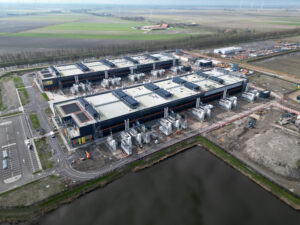
Why is Virginia the Data Center Hub?
Path dependence meets physics. This region’s advantage is a 30-year story of being in the right place with the right fiber, power, policies, and people. Let’s take a peek at why Virginia is the country’s data center capital:
- Network gravity. The Dulles Technology Corridor took root in the 1990s around MAE-East, one of the first major internet exchange points. Once early traffic concentrated here, it pulled in carriers, clouds, and capital—making Ashburn “the bullseye of America’s internet,” as writer Andrew Blum popularized. Today that legacy translates into the densest mix of fiber routes and interconnection in the country.
- Public-policy tailwinds. Virginia’s Retail Sales & Use Tax Exemption for data center equipment—on the books since 2010 and extended through 2035—cuts tens of millions in upfront costs per campus, provided minimum jobs and capex thresholds are met. Of course the data center industry has found footing in this regulatory environment.
- Speed to power and data center infrastructure. Utilities and co-ops built out transmission and substation infrastructure at a pace few markets matched. Dominion Energy is now lifting five-year capex to $50.1B in part to meet datacenter-driven load, a candid acknowledgement that AI-era demand is changing grid math.
- Talent and suppliers. From Reston to Ashburn, the ecosystem of data center alley runs deep—consultants, commissioning agents, fabricators, heavy civil, switchgear specialists, and a workforce pipeline anchored by regional institutions. That density reduces cycle risk and compresses delivery schedules, a quiet but enormous advantage when AI procurement cycles move in quarters, not years.
Northern Virginia is the biggest, fastest-growing interconnection and cloud region—a market reality that shows up in build rates.

The Money Moves Building Data Center Alley
These deals aren’t just big; they’re strategic signals about how hyperscalers are thinking.
- Amazon, Bristow ($700M). The Devlin Technology Park assembly illustrates a new frontier: sites beyond the Ashburn core but still close enough to major transmission and fiber. The spread east-west along I-66 and the I-95 corridor is real—and increasingly necessary given land scarcity and substation queues in the heart of Data Center Alley.
- SDC Capital, Leesburg ($615M for 97 acres). Institutional capital is comfortable buying fully zoned, power-adjacent dirt at record per-acre prices. Translation: the option value of a permitted, grid-served parcel in Loudoun may be higher than the value of a standing but constrained asset elsewhere.
- Google, $9B across Virginia. Hyperscalers are hedging against grid constraints by diversifying across the state (Chesterfield, PW, Loudoun) and pairing investments with local energy initiatives and efficiency programs. It’s a playbook we’ll see others copy.
On the demand side, the numbers border on surreal. Primary market supply in North America hit 8,155 MW in H1 2025—+43% YoY—yet vacancy fell to 1.6%, and 10-MW-plus deals saw pricing jump up to 19% in just six months. Northern Virginia is the pace car for those curves.
The Data Center Market Has Its Own Friction
Where there’s that much capex, there’s bound to be contention.

Prince William County’s Digital Gateway—envisioned as a multi-gigawatt corridor—won approval after a 27-hour hearing in 2023, only to have a judge void the rezoning this August on public notice grounds. Appeals are underway, and some acreage will almost certainly be developed over time, but the episode underscores a new reality: community process risk is now a core underwriting line-item.
Meanwhile, power is the constraint everyone whispers (or shouts) about. Dominion’s filings and earnings calls make clear that AI-era loads are reshaping investment plans, and independent reporting across the region connects data center growth to upward pressure on electric bills.
Expect more regulatory scrutiny, especially as Richmond’s political balance shifts and leaders promise lower residential rates while asking data centers to “pay their fair share.”
CRE Significance of the Largest Data Center Market
Because digital infrastructure is the new anchor tenant—not in your office tower, but across your region’s power grid, land market, and municipal budget.
In Virginia, the spillovers are already obvious:
- Industrial & land pricing. Since 2020, a significant share of the D.C. region’s delivered industrial square footage has been data center build-to-suit, crowding other uses and repricing land. The SDC and Amazon comps effectively reset Loudoun and PW County values for power-served, zoned sites. Developers of traditional logistics or light manufacturing now compete with hyperscale capex for dirt and entitlements.
- Tax bases and mill rates. Loudoun’s budget documents and civic analyses show data centers are now the dominant contributor to local taxes—driven largely by personal property taxes on server equipment—allowing headline property tax rates to fall even as revenues climb. That fiscal dynamic can lower carrying costs for homeowners and businesses alike, but it also introduces concentration risk for local governments if the cycle ever wobbles.
- Power as a site-selection variable for everything. When a county’s spare capacity is spoken for by 10–50 MW blocks, every other project—from biomanufacturing to chip packaging to electrified logistics—must navigate longer lead times and larger deposits for interconnection, plus potential rate adjustments. Reuters has already chronicled how utilities are retooling capex to chase this load; the opportunity is huge, but the queue is real.
- Office, retail, and housing by second-order effects. Data centers don’t bring armies of daily workers, but ecosystem employment (engineers, fit-out trades, specialty manufacturers) drives household formation and service spending. In submarkets near new campuses (think Bristow, parts of the I-95 corridor), expect new single-family and townhome demand, service retail, and a premium for power-reliable, fiber-rich office flex that can host contractors and OEMs during multi-year build cycles.
- Policy and permitting premiums. After Prince William’s court ruling, fully entitled sites with clear notice records and community benefits packages should trade at a policy certainty premium. Entitlement risk has always been priced; now it’s front-and-center in Northern Virginia underwriting.
- Artificial Intelligence as the New Demand Driver: AI’s rise is turning the Virginia data center ecosystem into the backbone of global cloud computing. The more the world leans on machine learning, the more these facilities—located along the Dulles Technology Corridor and beyond—will be prioritized for construction and expansion. The growth trajectory is exponential: as AI workloads multiply, so does the need for low-latency cloud regions and massive data storage capacity. Local organizations and universities are already pivoting, offering specialized training in high-voltage systems, cooling technologies, and edge-network management to sustain this surge. What began as a regional advantage has become a global imperative.

The Next Chapter: Where Does This Go?
It’s fair to ask: how far can Virginia’s data center boom really go? Every few months, another headline lands—Amazon, Google, or a cloud provider announces billions in new investment—and yet the pace keeps accelerating. But even the world’s largest data center market can’t grow forever without friction.
1. Beyond Ashburn
The heart of Data Center Alley in Loudoun County is running out of developable land, forcing expansion south and west toward Prince William County, Fairfax County, and the I-95 corridor. These new frontiers offer cheaper land and room to breathe, but the tradeoff is thinner transmission, longer lead times, and heavier reliance on Dominion Energy. That makes strategic location and utility coordination the new currency of the data center industry. Future sites will hinge on access to power, connectivity, and talent—often near logistics routes and Dulles International Airport for global reach.
2. Power, Carbon, and Cost
The growth of artificial intelligence is reshaping how operators think about energy. Training large models isn’t just compute-intensive—it’s power-intensive, driving new kinds of data center infrastructure. Expect to see Virginia data centers experimenting with on-site generation, battery storage, and renewable power purchase agreements to stay cost-competitive and carbon-compliant.
Energy efficiency will become a differentiator as much as location. Cloud computing giants and colocation providers like Digital Realty are already designing next-generation facilities with advanced cooling systems and AI-assisted load balancing to reduce strain on the grid.
3. Innovation at the Edge
The next evolution won’t just be about scale—it’ll be about location and innovation. As workloads decentralize, smaller data centers closer to end users—so-called “edge nodes”—will complement the hyperscale hubs. That could mean new development in secondary markets across Northern Virginia, supported by local organizations, community colleges, and a growing skilled workforce.
In short, the data center capital of the world isn’t slowing down—it’s adapting. Virginia’s mix of infrastructure, access, and institutional know-how keeps it at the core of the global internet. The question isn’t if growth continues, but how smartly it’s managed. Because from cloud to AI, the digital economy still depends on something very physical—land, power, and people.
The Ripple Effect on Commercial Real Estate
Every data center in Virginia represents more than just square footage—it’s a long-term anchor for the region’s digital infrastructure and a catalyst for new CRE dynamics. As hyperscalers chase proximity to cloud networks, land values in Loudoun County and Prince William County continue to climb, while industrial and flex developers rethink site strategies around power availability and grid reliability.
For investors, developers, and occupiers trying to navigate this evolving landscape, visibility is everything. That’s where tools like REoptimizer® and CRESiteIQ™ come in. These platforms leverage real-time market data, geospatial analytics, and power infrastructure mapping to help users quantify site potential, assess data center proximity, and evaluate cost-of-power implications before a deal is ever signed.
In a world where the next great data center hub might rise just a few miles from today’s frontier, decision-making needs to be faster, sharper, and more data-driven. REoptimizer® and CRESiteIQ™ turn that complexity into clarity—bridging the gap between commercial real estate intelligence and the new world of digital infrastructure strategy.
After decades of offshoring and just-in-time efficiency, U.S. companies are re-examining what it means to own their supply chains.
The next phase of industrial strategy isn’t about chasing cheaper labor overseas; it’s about control, resilience, and proximity.
And the reshoring initiative represents a full-scale corporate realignment reshaping where production happens, how capital is deployed, and what industrial real estate looks like.
Between now and 2028, the U.S. is entering what economists are calling a “reindustrialization window,” a rare convergence of policy, technology, and executive intent that’s pulling manufacturing back home.
But while the movement is powerful, it’s not without friction. For business leaders, tenants, site selectors, and industrial investors, understanding how reshoring plays out in real estate terms is now essential.
The Momentum: Business Leaders Taking Action
The reshoring initiative that once sounded aspirational has matured into measurable activity. According to 2025 outlook data, 29% of US companies are actively reshoring sourcing or production, up sharply from prior years.
Meanwhile, the share of CEOs planning to reshore operations within three years jumped another 15% year-over-year, signaling a decisive shift from strategy to execution.
That corporate intent is reverberating across the global supply chain. 59% of contract manufacturers now report they’ve either reshored production for clients, are in the process, or are quoting new reshoring projects. These cases mark a systemic recalibration in how manufacturing companies think about risk and reliability.

By 2026, 65% of companies expect to buy most key items from regional suppliers, nearly doubling the rate from just a few years ago. For business leaders responsible for keeping factories running, reshoring is powerful risk management.
The Reshoring Initiative and US Jobs
Over the next few years, reshoring momentum is expected to show up where it matters most — in jobs.
Roughly 174,000 new manufacturing positions tied to reshoring and foreign direct investment are projected for 2025, most of them in high- and medium-tech sectors.
That means growth is concentrated in industries like semiconductors, EV batteries, solar manufacturing, and transportation equipment — industries where automation, precision, and proximity to customers outweigh the search for cheap labor.
Federal policy has amplified that momentum. The Inflation Reduction Act and CHIPS and Science Act have been catalytic, turning tax incentives into real investment triggers.

From late 2024 through early 2025, semiconductor projects accounted for only 5% of all reshoring/FDI announcements but captured two-thirds of total foreign capital investment — roughly $102.6 billion. That’s a staggering figure, even in capital-intensive manufacturing.
States are competing hard.
Texas, South Carolina, and Mississippi are projected to lead the nation in reshored jobs this year, with Mississippi alone forecasted to surpass 12,000 new manufacturing positions.
Each of these markets combines a pro-business regulatory environment, labor availability, and access to infrastructure — all key factors in reshoring decisions.
For real estate investors, those jobs translate directly into space absorption.
A single 1,000-employee advanced manufacturing plant can command millions of square feet of high-spec industrial real estate. Add logistics, suppliers, and service providers, and the ripple effect extends across entire industrial corridors.
Why Now: A Combination of Policy, Risk, and Technology
The resurgence of domestic manufacturing is about the failure of the old model to absorb shocks.
After the pandemic exposed the fragility of global supply chains, companies started measuring not just cost, but continuity.
Geopolitical risk has surged to the top of executive agendas.
The share of CEOs citing it as a top reshoring driver has jumped 50% year-over-year, and tariffs have exploded as a motivator — up 454% in 2025 data. The so-called “China +1” strategy (diversifying supply chains away from China while keeping one foot in Asia) is now operationalized by 35% of firms.
This new corporate strategy is prioritizing supply chain resiliency as a competitive advantage.
Business executives increasingly recognize that regionalizing production helps balance efficiency with control. Shorter lead times reduce risk, simplify management, and deliver flexibility that pure cost-cutting can’t.
Forty percent of OEMs now say they’re willing to pay a 10–20% premium to shorten delivery times by five weeks. That’s a complete reversal of decades of cost-centric thinking. By 2026, as much as a quarter of global trade could relocate to new production regions — a tectonic shift in trade flows and logistics infrastructure.
Automation and the Skilled Workforce Puzzle
If the last industrial revolution was about offshoring, this one is about automation. The cost gap between the U.S. and low-cost countries is narrowing not because labor is cheaper, but because machines are smarter.
The global industrial robotics market is projected to hit $81.4 billion by 2028, closing the productivity divide and enabling reshored factories to operate with fewer, higher-skilled employees.

But technology alone can’t fill the talent gap. 28% of manufacturers cite labor shortages as a primary constraint on reshoring. Nearly half say it could take up to three years to fully staff new manufacturing plants. Compounding the issue, 72% report that outdated technology keeps them from attracting younger workers — a generational barrier as much as an operational one.
This is where industrial policy meets workforce development. Reshoring without education investment is an incomplete process. Skilled workforce pipelines — through community colleges, technical training, and corporate partnerships — are becoming as critical as infrastructure grants. The White House and state governments are responding with strategic incentives, but aligning workforce, capital, and capacity remains a delicate balance.
The Real Estate Impact: Strategic Footprints
For occupiers and investors in industrial real estate, reshoring is reshaping what, where, and how manufacturing space is built.
- Footprint Evolution
The era of massive, labor-dense factories is fading. New manufacturing plants are smaller, smarter, and more automated. Power capacity, data connectivity, and automation readiness now drive location decisions as much as highway access. - Geographic Diversification
While legacy industrial hubs like the Midwest and Sun Belt remain attractive, reshoring projects are spreading production to nontraditional markets — particularly those with affordable land, improving logistics, and a willing workforce. Secondary and tertiary cities with solid infrastructure and education resources are punching above their weight. - Incentive-Driven Site Selection
Tax incentives, energy credits, and streamlined permitting have become central to corporate strategy. Real estate decisions are increasingly tied to industrial policy — from the Inflation Reduction Act to state-level grants that help companies offset higher domestic costs. - Supply Chain Adjacency
Occupiers are clustering near suppliers to shorten supply chain loops. This “local-within-local” model — where manufacturing, assembly, and distribution sit within a few hundred miles — reduces exposure to logistics risk and strengthens supply chain resiliency. For landlords, that means growing demand for well-located, midsized industrial facilities rather than distant mega-centers. - Infrastructure as a Differentiator
Power reliability, broadband, and transportation infrastructure are now part of the corporate location strategy. Markets that can guarantee uptime will command premium rents. Automation requires not just square footage, but stability — and investments in grid and road capacity are fast becoming decisive factors.
The Contradictions: Growth Meets Friction
Despite the momentum, reshoring remains complex. The Kearney Reshoring Index shows that imports from low-cost Asian countries still grew faster than U.S. domestic output in 2024, suggesting that while the reshoring effort is expanding, it’s also encountering resistance. For some firms, it’s a “pause and reassess” moment — balancing ambition against cost pressures and labor availability.
U.S. manufacturing remains 10–50% more expensive than offshore competitors, even after accounting for logistics savings. Without broader reform (from permitting to energy to workforce readiness) reshoring manufacturing could plateau below its potential.

And yet, the momentum persists. Executives understand the economic risk of over-reliance on overseas production. The pandemic, trade disruptions, and regulatory volatility have underscored the importance of regional supply chains. In many cases, the question isn’t whether to reshore — it’s how to make the transition efficient.
Key Takeaways for Industrial Stakeholders
- Reshoring is real — and accelerating. With nearly a third of U.S. companies now executing reshoring strategies, this is no longer theoretical.
- Industrial real estate is ground zero. The push to bring manufacturing back is transforming demand patterns, building design, and corporate site strategy.
- Workforce is the new wildcard. Automation helps, but the skilled workforce gap could be the limiting factor of the decade.
- Policy alignment matters. Industrial policy and tax incentives are the new drivers of private investments. Tenants and developers who can align their projects with federal and state sponsors will capture the upside.
- Resilience is the new efficiency. In an economy defined by uncertainty, reshoring is less about nostalgia and more about risk management — building a supply base that bends, not breaks.
The Outlook: Manufacturing’s Future Is Local — and Strategic
In short, the next decade of U.S. manufacturing growth won’t look like the last. It will be more strategic, more distributed, and far more integrated with the real estate decisions that make it possible.
Reshoring is the new wave… a multi-year reallocation of capital that will determine which portfolios outperform, and which get left behind.
The winners will be the companies that can match manufacturing strategy with real estate agility.
REoptimizer® helps you do exactly that.
If your manufacturing or logistics footprint is evolving, now is the time to benchmark your locations, re-evaluate occupancy costs, and capture the incentives that will shape the next decade of industrial growth.
Learn more about how REoptimizer® helps industrial occupiers align reshoring strategy with real estate performance.
