
The headlines of the last few years have vacillated between “the office is dead” and “the Great Return.” However, for corporate tenants managing large-scale, complex portfolios, the reality is far more nuanced. As we move into 2026, the data reveals a landscape defined not by a universal recovery, but by regional divergence and the solidification of a “new seasonal norm.”
According to recent data from Placer.ai, December 2025 marked the busiest holiday-season office month since the pandemic. Yet, national attendance remains 33.1% below 2019 levels. For the modern real estate executive, this isn’t just a statistic—it’s a signal to rethink footprint strategy, lease expirations, and the technology used to manage them.

The Bifurcation of the American Office Market
The recovery is not happening at the same speed everywhere. If your portfolio spans from Miami to San Francisco, you aren’t managing one real estate strategy; you’re managing two different worlds.
The Leaders: Sunbelt and Financial Hubs
The “flight to quality” and “flight to the sun” are no longer just theories. The top-performing markets have one thing in common: business-friendly environments and a high concentration of industries that value face-to-face interaction.
-
Miami (-10.9% from 2019): Miami remains the gold standard for office recovery. With the smallest gap in the nation, the “Wall Street South” movement has proven to be durable rather than a temporary migration.
-
Dallas (-18.8% from 2019): A powerhouse for corporate relocations and a hub for diversified logistics and finance, Dallas continues to outperform the national average significantly.
-
New York (-19.6% from 2019): Despite the high cost of living, NYC’s financial core has pulled the city back toward the 80% recovery mark, driven by aggressive return-to-office mandates from major banking institutions.
The Laggards: Tech Hubs and Urban Cores
On the opposite end of the spectrum, cities heavily reliant on the tech sector or those with long commute times continue to struggle.
-
Chicago (-47.6%): The widest gap in the nation, suggesting a fundamental shift in how the Midwest’s largest business hub utilizes its downtown core.
-
San Francisco (-44.8%): While still far from 2019 levels, San Francisco saw a staggering 17.9% year-over-year increase in 2024. This suggests a “rebound from the bottom” fueled by the AI boom.
-
Denver (-44.7%): Despite its lifestyle appeal, Denver’s office recovery has plateaued, showing only 0.6% growth year-over-year.

Understanding the “December Dip” and Seasonal Norms
Placer.ai’s latest report highlights a phenomenon called “the solidification of a new post-Covid seasonal norm.” In December 2025, visits per working day reached post-pandemic highs, yet overall attendance dipped compared to the autumn months.
For corporate tenants, this is a critical insight. The dip wasn’t a setback; it was a choice. Many employers are now easing in-office expectations during December to accommodate holiday travel.
Why this matters for your portfolio:
-
HVAC and Operations: If 30% of your office is empty for 1/12th of the year, are your building systems optimized for that vacancy?
-
Employee Value Proposition: Flexibility is becoming seasonal. If you are leasing 100,000 square feet, but your staff only utilizes 40,000 in December, the “cost per utilized square foot” skyrockets.
The Intersection of Office and Warehouse Space
For tenants managing mixed portfolios that include both high-tier office properties and massive warehouse footprints, the data suggests a symbiotic relationship.
In markets like Dallas and Miami, the strength of the office sector often mirrors the strength of the logistics sector. As more corporations move their headquarters to these hubs, the demand for regional distribution centers follows.

However, the “recovery” in these two asset classes looks very different:
-
Office: Recovery is measured by human presence and foot traffic.
-
Warehouse: Recovery is measured by throughput and vacancy rates.
The challenge for 2026 is managing the “Hybrid Creep.” As office mandates tighten, the need for integrated logistics—supporting employees who may be working from various locations—remains high. If your transaction management doesn’t account for the geographic proximity of your office talent to your warehouse operations, you are leaving money on the table.
The “Hybrid Creep” and the 2026 Outlook
Looking ahead, Placer.ai predicts a steady climb in office visits. This isn’t necessarily due to “Big Bang” return-to-office announcements, but rather “Hybrid Creep.”
This is the gradual increase of required days—from two to three, then three to four—often without a formal change in policy. This creates a “shadow demand” for space.
Critical considerations for 2026:
-
Lease Flexibility: With San Francisco and Chicago showing such volatile year-over-year swings, long-term, rigid leases are becoming liabilities.
-
Portfolio Right-Sizing: If national visits are down 33%, but your portfolio hasn’t shrunk by at least 20%, you may be over-leveraged in under-utilized assets.
-
Data-Driven Negotiations: You cannot negotiate a lease in 2026 using 2019 data. You need real-time foot traffic data and market-specific recovery metrics to push back on landlords.
Strategies for Portfolio Optimization in a Divergent Market
How should a corporate tenant respond to this data? It comes down to three pillars: Consolidation, Relocation, and Optimization.
-
Consolidate in Laggard Markets: In cities like Chicago or Denver, where recovery is stalled, tenants have the upper hand. This is the time to consolidate multiple satellite offices into a single, high-amenity “Class A” trophy space at a discounted rate.
-
Lock in Rates in Growth Markets: In Miami and Dallas, the window for “pandemic pricing” has closed. If you have upcoming expirations in these hubs, move early.
-
Leverage Technology for Transaction Management: You cannot manage a 50-property portfolio using spreadsheets. The delta between the “best” and “worst” markets is now over 35%. That margin is where your profit (or loss) lives.

Don’t Guess—Optimize with REoptimizer®
The Placer.ai data proves that the “national average” is a myth. To successfully manage a large-scale portfolio in 2026, you need granular, market-specific insights and a platform that can turn that data into actionable deals.
The complexity of today’s market—balancing office recovery trends, warehouse demand, and “hybrid creep”—requires more than just a broker. It requires a system.
REoptimizer® is the critical transaction management software designed for the modern corporate tenant. We help you:
-
Visualize Portfolio Gaps: See exactly where your space utilization lags behind market recovery trends.
-
Optimize Deal Flow: Standardize your transaction process across different regions, ensuring you get “Miami-level” precision in every market.
-
Reduce Occupancy Costs: Identify underperforming assets and execute on disposals or renegotiations before the “Hybrid Creep” makes them obsolete.
The office isn’t dead, but the old way of managing it is. In a world of 33% national vacancy gaps and 17% year-over-year surges, you need a tool that moves as fast as the market.
Ready to see how your portfolio stacks up against the latest recovery data? [Request a demo of REoptimizer® today] and start optimizing your deals for the new normal.
The Sun Belt—stretching across the southern and southwestern portions of the continental United States from Florida to Southern California—has moved beyond a population story.
Today, it represents one of the most important growth regions shaping U.S. commercial real estate strategy.
For C-suite executives and large-scale tenants, the Sun Belt’s relevance is no longer about climate or affordability alone. It is about economic concentration, labor access, and long-term portfolio resilience in a national market defined by uneven recovery.
What Is The Sun Belt And Why Does It Matter Economically?
What are the Sunbelt States?
The Sunbelt encompasses states from Virginia and Florida west through the Gulf Coast and into Southern California and Nevada.

This is much of the southern third of the United States, generally encompassing Georgia, South Carolina, Alabama, Mississippi, Louisiana, Texas, New Mexico, Arizona, Nevada, and large portions of California.
The region even includes parts of Tennessee, Arkansas, and Oklahoma.
Major Cities in the Sunbelt
Major U.S. cities within the Sun Belt include Atlanta, Dallas, Houston, Las Vegas, Los Angeles, Miami, New Orleans, Orlando, and Phoenix.
Of the 15 fastest-growing cities in the U.S., 12 are located in the Sun Belt as of 2023.
Cities in the Sunbelt are becoming increasingly multicultural due to demographic shifts from migration.
The Sun belt Region
Coined in 1969 by political analyst Kevin Phillips, the term “Sun Belt” originally described a region benefiting from warm climates, military investment, and post–World War II industrial migration.
Over time, it has become economically central to the nation’s population growth, job creation, and capital deployment.
The Sunbelt holds roughly 50% of all Americans aged 65 and older, remaining a primary destination for retirees.
Today, the Sun Belt accounts for roughly 80% of total U.S. population growth over the past decade, a figure with direct implications for office demand, labor availability, and long-term CRE fundamentals.
And over the next decade, the Sun Belt population is expected to grow by another 11 million, while non-Sun Belt states are forecasted to rise by only 475,000.

Why Has The Sun Belt Experienced Sustained Population Growth?
Why are People Moving to the Sun Belt?
Well it’s no secret that the Sun Belt is a popular destination for retirees, particularly in states like Florida and Arizona, due to the warm climate… But in the last few years it has completely exploded in popularity.
In 2025, the Sunbelt states led in population and economic growth despite housing oversupply and rising costs. This is in the wake of pandemic-era mobility, which made the Sunbelt a top choice for millennials and young professionals seeking affordable living.
The Sun Belt is expected to account for about 55% of the national population by 2040, having held about 50% as of 2023.
This growth has been driven by a combination of domestic migration, immigration, and natural population growth. Key drivers include:
- Lower taxes and fewer labor unions compared to northern states
- Strong job creation across multiple industries
- A warm and sunny climate with milder winters
- Lower overall cost structures for both households and employers
Texas, Florida, and Arizona alone are projected to add millions of new residents by 2033, reinforcing the region’s role as a long-term demand engine for commercial real estate. For CRE leaders, sustained population growth matters because it supports utilization, not just occupancy.

Markets with expanding populations consistently outperform those dependent on tenant consolidation or flight-to-quality alone.
And while rising home prices and extreme weather risks in the Sunbelt have sparked a counter-trend of migration to northern states,
How Strong Is Job Growth In The Sun Belt Compared To The Rest Of The U.S.?
Total employment in the Sun Belt has grown by approximately 20% over the past decade—more than double the growth rate of non-Sun Belt regions.
This growth is not isolated to a single sector. Key industries driving job creation include:
- Technology and software
- Finance and insurance
- Logistics and supply chain management
- Healthcare and life sciences
- Defense, aerospace, and advanced manufacturing
Post-1945, the region benefited from an influx of military manufacturing jobs and federal government investment. That legacy continues today, with defense installations, logistics corridors, and cross-border trade with neighboring Mexico anchoring long-term employment stability.
Why Are Major Corporations Relocating To Sun Belt States?
Major corporations are relocating to Sun Belt states due to a combination of lower operating costs, favorable regulations, and labor availability. The Sun Belt has a pro-business culture, which has spurred significant private sector growth.

Compared to northeastern states and legacy coastal metros, Sun Belt markets offer:
- Predictable tax environments
- Pro-business regulatory frameworks
- Scalable office inventory
- Faster permitting and development timelines
Texas and California rank among the top five states in the nation with the most Fortune 500 companies, underscoring its critical economic presence in the international marketplace. And at the same time political power in the U.S. has shifted toward Sunbelt states due to population growth.
Industries such as aerospace, defense, and oil have boomed in the Sun Belt, contributing to its economic growth.
What Does Sun Belt Growth Mean For Office Demand?
Is office demand stronger in the Sun Belt?
While the national office market continues to normalize, Sun Belt metros have consistently outperformed the national average in net absorption.
Key structural advantages include:
- Newer office inventory requiring less capital-intensive repositioning
- Submarkets designed for hybrid utilization rather than legacy density
- Shorter commutes that support higher in-office participation
Unlike San Francisco or San Jose—where demand is increasingly concentrated in a narrow band of prime assets—Sun Belt cities support broader leasing participation across multiple submarkets, reducing volatility for large occupiers.
How Has The Sun Belt Shifted Political And Economic Power?
Sustained population growth has increased the Sun Belt’s political influence and economic importance nationally.
Many Sun Belt states now feature an emerging Republican majority, reinforcing policy priorities around infrastructure investment, lower taxes, and private-sector expansion.
For corporate real estate decision-makers, political predictability matters. Stable policy environments reduce long-term underwriting risk and support multi-cycle portfolio planning.
And this isn’t the first time the sun belt has had booming success. In fact by the 1970s, the Sun Belt became economically more important than the Northeast, driven by agricultural growth and the green revolution. Modern population explosion and influence mirror this….
How Do Demographics Shape Sun Belt CRE Strategy?
The Sun Belt attracts a broad demographic mix:
- Millennials and young professionals seeking affordability and job growth
- Retirees relocating from northern states to Florida and Arizona
- Immigrant populations contributing to higher birth rates and labor force expansion
Approximately 52% of U.S. millennials now live within the Sun Belt, reinforcing its role as both a current and future labor engine. This demographic diversity supports long-term office demand across multiple industries, not just cyclical sectors.
Environmental Constraints And Smarter Development
Do environmental challenges threaten Sun Belt growth?
Rapid growth has introduced challenges, including air pollution, water constraints, and ecosystem stress. However, these pressures are increasingly shaping smarter development rather than limiting expansion.
New building technologies, energy-efficient air conditioning systems, adaptive infrastructure, and regional planning initiatives are mitigating risk while sustaining growth. For CRE occupiers, this means newer buildings are often more efficient and resilient than legacy stock in older markets.
Why The Sun Belt Remains Central To CRE Portfolio Strategy
The Sun Belt’s role in U.S. commercial real estate is no longer speculative. Its growth is the direct result of:
- Sustained population inflows
- Above-average job creation
- Pro-business environments
- Diverse and durable economic drivers
For large tenants, the Sun Belt increasingly functions as:
- The operational backbone of national portfolios
- The primary engine for headcount expansion
- A stabilizing counterbalance to higher-cost coastal hubs
This is not a zero-sum shift. Coastal cities like New York, Los Angeles, and San Francisco remain essential—but the center of gravity for net-new demand continues to sit in the South and West.
From Macro Growth To Portfolio Precision
Understanding Sun Belt growth is now table stakes. Competitive advantage comes from precision.
CRE leaders must ask:
- Which Sun Belt submarkets are tightening fastest?
- Where does population growth outpace new supply?
- How does utilization differ by building, not just metro?
How REoptimizer® Translates Sun Belt Growth Into Action
REoptimizer® and CRESiteIQ™ help corporate real estate teams move beyond narrative and into execution.
By integrating real-time data on population growth, labor trends, absorption, and submarket performance, executives can:
- Identify where expansion is justified
- Avoid overexposure in overheated nodes
- Align real estate decisions with workforce geography
The Sun Belt is no longer just growing.
It is structurally redefining how commercial real estate portfolios are built, balanced, and optimized.
And in the next decade, the advantage will belong not to those who follow the growth—but to those who deploy capital within it intelligently. Learn how REoptimizer® levels up site selection, and widening your geographic net while only showing you the best options. If its time to model portfolio decisions, see how much REoptimizer® can strengthen the bottom line of each deal.
Learn More
The U.S. office market is showing real signs of stabilization after several unpredictable years. As of October, year-to-date office sales reached nearly $43 billion, with transactions averaging $191 per square foot, according to CommercialCafe. Those numbers matter because they confirm a steady upward shift: both office pricing and quarterly sales totals have been recovering consistently since the market hit bottom in early 2024.
What’s driving this momentum is a subtle but important change in investor behavior. Buyers are re-entering the office sector—not because every challenge has been solved, but because pricing has reset, hybrid work patterns are clearer, and the risk-reward balance is becoming more attractive. Capital is returning thoughtfully instead of cautiously.
That renewed activity isn’t spread evenly across the country. A small group of cities accounts for the largest share of U.S. office sales, signaling where investors see the strongest mix of stability, long-term demand, and value opportunities. These markets offer a useful roadmap for understanding where office investment is gaining traction in 2025.
Below is a data-driven look at the cities recording the highest office sales volumes today—and the market forces shaping their performance.
1. Manhattan — $6.4 Billion in Sales Volume
Manhattan leads the nation with $6.4 billion in office transaction volume—more than any other city by a wide margin. The market’s scale, liquidity, and global relevance continue to pull in capital even as many older buildings face significant challenges.
What’s driving activity:
- A pronounced flight-to-quality, with investors targeting Class A towers and amenitized buildings.
- Deep international interest, especially for long-term holds.
- A wide gap between top-tier assets and older, less-efficient buildings—creating both premium pricing and steep discounts.

Despite hybrid work, Manhattan remains the corporate headquarters capital of the U.S. Investors are leaning into two parallel strategies:
- Core acquisition of modern, well-located assets that continue to outperform the market.
- Repositioning or conversion plays in older Midtown and Downtown properties where valuations have reset dramatically.
Manhattan isn’t a uniformly strong office market—but it’s still the most investable one, and the transaction volumes reflect that.
2. Bay Area — $4.4 Billion in Sales Volume
The Bay Area recorded $4.4 billion in office sales, signaling renewed optimism around a region that has seen some of the largest pandemic-era corrections. From Silicon Valley to San Francisco, investors are recalibrating expectations—not ignoring volatility, but betting on the region’s long-term innovation engine.
Key trends shaping the market:
- Tech companies are gradually rebuilding office footprints, prioritizing collaboration-focused layouts.
- Class A buildings with ESG and tech-friendly infrastructure remain the most desirable.
- Older assets in San Francisco’s core are trading at some of their steepest discounts in more than a decade.
What keeps investors engaged is the Bay Area’s economic foundation:
- AI and machine learning firms continue to expand.
- University-driven innovation remains unmatched.
- Venture capital investment has begun to reaccelerate in 2024–2025.
The market is still finding bottom in some pockets, but buyers with multi-year timelines increasingly view this as an entry point rather than a risk zone.

3. Washington, D.C. — $3.6 Billion in Sales Volume
Washington, D.C. posted $3.6 billion in sales, highlighting the region’s reputation as one of the country’s most stable major office markets. Unlike tech-heavy metros, D.C.’s downturn has been more muted, supported by the government workforce and a diversified professional services ecosystem.
Why D.C. continues to attract investment:
- Federal tenancy offers a stabilizing anchor in an otherwise unpredictable national office environment.
- Submarkets like NoMa, Navy Yard, and the Wharf continue to benefit from mixed-use development and transit access.
- Investors are actively pursuing conversion-ready properties, supported by strong multifamily demand.
While pricing corrections have occurred, they’ve been more orderly than in coastal gateway markets. Investors see D.C. as a safe harbor—not immune to hybrid pressures, but less exposed to cyclical highs and lows. With steady job growth in government contracting, cybersecurity, and consulting, the region remains one of the country’s most durable demand centers.

4. Denver — Pricing Reset With Renewed Opportunity
Denver doesn’t rank in the top three for total volume, but it stands out for the dramatic shift in pricing—and what that signals for the broader office market. After peaking at $300 per square foot in 2022, Denver’s office transactions in 2025 have averaged $125 per square foot.
That pricing reset has reshaped investor sentiment.
Why Denver is still attracting buyers despite the pullback:
- Strong long-term fundamentals tied to population growth, talent migration, and lifestyle-driven corporate relocation.
- A diverse employer base spanning tech, aerospace, energy, and professional services.
- The ability to acquire assets at much lower basis points, giving investors room to remodel, reposition, and modernize.
Denver represents the story of many second-tier office markets: pricing has corrected faster than fundamentals. For buyers, that means opportunity remains—even if near-term leasing conditions are still uneven.

Emerging Markets to Watch
Outside the top-volume metros, several markets are gaining investor attention for their resilience and long-term upside. These cities didn’t crack the top-dollar rankings but show increasing movement beneath the surface.
Markets drawing growing interest include:
- Dallas–Fort Worth — fueled by corporate in-migration and large-scale development.
- Atlanta — supported by strong Sun Belt population growth and diversified industry.
- Miami — benefiting from inbound capital, financial sector expansion, and higher demand for Class A space.
What these markets share:
- Favorable business climates
- Fast-growing populations
- Moderating but steady office absorption
- Pricing that remains accessible compared to coastal gateway cities
They may not lead the country in raw sales numbers, but they increasingly lead investor shortlists—especially for buyers seeking growth at a discount.
Conclusion: A Market Repricing Toward Long-Term Stability
The geography of office investment in 2025 reveals a sector that is neither collapsing nor roaring back—it’s recalibrating. Buyers are more selective, markets are repricing, and the gap between resilient regions and challenged ones is widening.
Yet the year’s nearly $43 billion in sales activity points to a fundamental truth: the office market is not disappearing. It is transforming.
What comes next will be shaped by:
- How pricing continues to settle
- How hybrid work stabilizes
- How cities adapt older buildings to new uses
- Where employers choose to concentrate talent over the next decade
Investors are already signaling the next chapter: one defined not by aggressive speculation but by disciplined strategy, realistic underwriting, and confidence in the markets that can offer long-term relevance.
The result is a sector moving—gradually—toward a new, more sustainable baseline.
As the office sector resets, real estate strategy matters more than ever. Understanding market shifts is one thing—acting on them with precision is another.
That’s where REoptimizer® can help.
Whether you’re evaluating space needs, planning future locations, or reassessing your office portfolio, REoptimizer® gives you:
-
Data-driven market intelligence to spot opportunities early
-
Scenario modeling tools to compare locations and costs
-
Portfolio optimization insights aligned with hybrid work realities
-
Strategic guidance for long-term real estate planning
If the office market is entering a new chapter, now is the time to make sure your strategy is built for it. Explore how REoptimizer® can support your next move.
Miami’s industrial market has spent the last several years reshaping itself into one of the most competitive logistics environments in the United States — not through hype, but through consistent performance. Since 2020, the region has demonstrated a steady combination of rent growth, tightening vacancy, and durable demand across nearly every major submarket. Q3 2025 continues that pattern, and for large corporate occupiers, the signal is clear: Miami requires a more strategic, data-driven approach to footprint planning.
Below, we break down the trends that matter most for decision-makers — and what they mean for tenant strategies going forward.
Rents Continue Rising — And Not by Accident
Q3 2025 marked the fifth consecutive quarter of rental growth, with average direct asking rents reaching $17.59 psf NNN, up 21 basis points from Q2. That might not sound dramatic, but in the industrial world, five straight quarters of increases is meaningful. It illustrates a market that is neither cooling nor plateauing; instead, it’s demonstrating resilience even as deliveries continue.
What’s more striking is the rent bifurcation that has been building since 2020. Core submarkets such as Airport West, Medley, and Kendall command $9–$11 psf premiums over their 2020 rents. The report’s submarket comparison shows:
-
Kendall at $22.04 psf
-
Central Dade at $22.71 psf
-
Airport West at $19.58 psf
-
Meanwhile, relatively more affordable pockets like Hialeah remain at $14.63 psf
For occupiers, the takeaway is not simply that rents are high. It’s that Miami’s pricing structure has become more stratified, making location decisions more financially consequential. Choosing the right submarket can translate to millions in occupancy cost differences over a multi-year term.
Vacancy Remains Low Enough to Give Landlords Confidence
Market-wide vacancy landed at 5.8%, with direct vacancy at 5.5% and sublet space at just 0.3%. Sublet availability often serves as a pressure-release valve in tight markets; here, that valve is barely cracked open.

Vacancy by submarket tells an even clearer story:
-
Kendall: 1.4%
-
Hialeah: 3.1%
-
South Dade: 3.4%
-
Northeast Dade: 6.9%
-
Northwest Dade: 8.3% (highest in the region)
Even the submarkets with higher vacancy are not “soft” by national standards. Everything sits firmly within what analysts would categorize as landlord-favorable conditions.
For corporate occupiers, this means fewer options, shorter decision timelines, and a leasing environment where competing tenants often circle the same viable spaces. If your organization values optionality, Miami will challenge that preference.
Absorption Rebounds, Signaling Renewed Demand
One of the most important Q3 metrics is the rebound in demand. Net absorption reached 670,459 square feet, more than doubling Q2’s total. This is not a spike driven by one outsized deal; it reflects a broad re-engagement from tenants across diverse sectors.
Notable transactions from the quarter include:
-
The American Bottling Co. – 150,600 sf
-
Amcar Freight – 126,101 sf
-
United States Postal Service – 86,867 sf
-
Vista Color Corp – 75,000 sf (renewal)
These deals span manufacturing, logistics, freight, and service providers — a healthy sign that the demand base is diversified rather than dependent on one driver.
This level of absorption, combined with low vacancy, suggests that Miami’s market position is not cyclical noise; it’s structural.

New Construction Is Active — But Still Not Loosening the Market
Year-to-date deliveries total 2.2 million square feet, and another 3.8 million square feet are under construction. That’s a substantial pipeline for a geographically constrained region.
However, current data shows that ongoing deliveries aren’t easing fundamentals:
-
Vacancy decreased 20 bps quarter-over-quarter
-
Rents increased for the fifth straight quarter
-
Absorption absorbed supply without a rise in available space
In short: supply is coming, but demand is keeping pace. And because Miami’s development capacity is limited by land availability, this pattern is unlikely to change materially in the near term.
Some Submarkets Are Tightening Faster Than Others
Drilling into the submarket data reveals important patterns for occupiers evaluating site selection:
1. Kendall & Central Dade: Highest Rents + Lowest Availability
With rents above $22 psf and vacancy between 1.4% and 5.6%, these infill submarkets offer operational advantages (population density, proximity to consumption), but at a cost. Expect minimal concessions and a very limited inventory of modern product.
2. Hialeah & Northeast Dade: Value Submarkets Gaining Momentum
Hialeah’s 3.1% vacancy and $14.63 psf rent make it a relative bargain. Northeast Dade, at $15.70 psf, showed notable absorption as well. These submarkets may become increasingly competitive if pricing in northwest and central areas continues climbing.
3. Northwest Dade: More Availability, Still Rising Rents
With the highest vacancy (8.3%), Northwest Dade offers more immediate options, but rents remain elevated at $16.31 psf. As newly delivered product comes online, this may become the “value with breathing room” submarket for large-scale occupiers.
4. Airport West & Medley: Core Logistics Hubs Stay in Demand
Airport West alone has 61.9 million square feet of existing inventory and 2.4 million square feet under development. These locations remain the heartbeat of Miami’s distribution network. Rents remain elevated but justified by access advantages.
For executives managing multi-site footprints, submarket positioning is a core strategic variable.

Investment Activity Reinforces Long-Term Stability
One of the clearest indicators of Miami’s sustained strength is investor behavior. In Q3:
-
Miami led Florida with $687M in industrial sales
-
Average pricing achieved $276 psf — the highest in the state
-
Major institutional investors like Terreno Realty and Link Logistics remained active buyers
This sets an important tone: institutions are pricing Miami as a premium industrial market — and their underwriting assumptions typically reflect long-term rent growth and low structural vacancy.
For occupiers, institutional ownership has two implications:
-
Lease negotiations become more standardized and more formal
Large owners tend to keep tight ranges on concessions, term flexibility, and TI allowances. -
Operating expenses may increase
Enhanced asset management, capital improvements, and stricter maintenance schedules typically follow institutional acquisition.
Neither of these is inherently negative. But they require occupiers to forecast total occupancy costs — not just base rent — more rigorously.
What This Means for Corporate Occupiers
Based on Q3 performance and broader market patterns, Miami demands a more proactive, more analytical approach. The strategies that worked five years ago are unlikely to perform well today.
Here’s what large tenants need to prioritize:
1. Start Renewals Earlier and Model Multiple Scenarios
Given 5.8% vacancy and minimal sublet availability, waiting to approach a renewal until the final 12 months of a lease is risky. Early engagement allows:
-
Cost modeling across multiple submarkets
-
Exploration of off-market options
-
Better positioning against competing tenants
Miami is a market where optionality shrinks quickly.
2. Run a Submarket-Level Cost-of-Operations Analysis
The report’s rent disparities can materially impact:
-
Transportation and labor costs
-
Delivery times
-
Inventory positioning
-
Customer proximity
-
Workforce access
A location at $14.63 psf vs. $22.71 psf isn’t just a rent difference — it’s a supply chain design choice.
3. Evaluate New Construction Early — Not Late
With 3.8 million square feet in the pipeline, Class A options exist or will exist soon. But many of these:
-
Deliver with pre-leasing already in place
-
Lease ahead of shell completion
-
Come at a premium but provide operational advantages (clear heights, loading ratios, energy efficiency)
The companies evaluating new builds now will have the first pick of suitable layouts.

4. Leverage Multi-Market Strategy to Optimize Miami Exposure
If high rents in core Miami aren’t essential to operations, consider:
-
Hybrid strategies (bulk storage outside Miami + last-mile inside Miami)
-
Shift of non-time-sensitive operations into value submarkets
-
Shorter terms in constrained areas to maintain agility
Miami’s density and growth make it a high-value node, but not every function needs to sit within the highest-cost zones.
5. Strengthen Data-Driven Portfolio Planning
With rents having risen for five consecutive quarters and core submarkets holding price premiums since 2020, occupiers should:
-
Model future rent escalations
-
Analyze occupancy cost inflation
-
Use scenario planning for long-term commitments
Cost predictability is becoming harder — and therefore more essential.
Positioning for the Next Phase of Miami’s Industrial Evolution
Miami’s industrial market is not defined by volatility or dramatic swings. Instead, Q3 2025 affirms a pattern of steady, durable, and broad-based strength. The region continues to cement its place as Florida’s premier logistics hub, supported by land constraints, diversified demand, and sustained investor confidence.
For corporate tenants, the opportunity lies in adapting early. Those who treat Miami simply as “another logistics node” will pay a premium for it. Those who treat Miami as a strategic, data-intensive occupancy challenge will unlock better—often significantly better—long-term outcomes.
The industrial market is evolving. Tenant strategy needs to evolve with it.This is where intelligence becomes a differentiator.
REoptimizer® gives occupiers the visibility, modeling power, and comparative insight needed to navigate Miami’s evolving landscape (while mapping comparisons to other markets) with intention rather than reaction. If the next phase of your strategy requires clearer decisions, stronger leverage, and fewer surprises, this is the platform built to deliver it. Learn more how this tool can give your portfolio the razor sharp edge it needs.
Let’s start with the headline: Orlando absorbed 1.52 million square feet in Q3 2025, one of its strongest performances in the past several years.
After a brief negative quarter in Q2, the bounce-back was both emphatic and healthy. Year-to-date, absorption hit 2.07 million square feet, signaling that tenant demand never disappeared; it merely paused for breath.
Vacancy fell from 7.8% in Q2 to 7.4% in Q3, despite 2.36 million square feet of new inventory arriving year-to-date. That is not the profile of a market struggling with oversupply. That’s the profile of a market stretching before the next sprint.
From a macro standpoint, Orlando’s demand machine remains unmatched in Florida. The market logged:
-
1.8% population growth (highest in the state)
-
2.3% job growth (also the highest)
For corporate occupiers, this is a rare double win: labor depth + consumer proximity = operational efficiency.
It’s everything distribution networks want, wrapped in a sun-belt tax environment and topped with an endless supply of new residents ordering packages online.

Rents Are Calming Down—but Don’t Get Too Comfortable
After several years of rent inflation strong enough to give CFOs heartburn, the market finally exhaled. Asking rents averaged $11.18 PSF NNN, a 2.7% year-over-year decline.Before tenants break out the champagne, let’s clarify: This is a softening, not a correction.
Industrial rents in Orlando are still far above pre-pandemic levels, and there’s little evidence they’ll retreat much further. The slight drop reflects:
-
Modestly slower lease-up of new big-box inventory
-
Developers recalibrating supply
-
Some landlord realism returning after a very long victory lap
Warehouse/distribution space averaged $10.80 PSF, while flex held much higher ground at $15.37 PSF. Flex, as usual, insists it is special—and the market continues to indulge it.
For corporate occupiers, the temporary rent reprieve means one thing: It’s a strategically advantageous moment to make moves—before demand accelerates again and landlords regain leverage.
The Great Mid-Bay Migration: A Structural Shift in Orlando’s Industrial DNA
Forget everything you thought you knew about Orlando’s development pipeline. The market is undergoing a quiet but consequential transformation.
The new development darlings? 50,000–199,000 SF mid-bay buildings.
According to Q3 data:
-
Mid-bay (50–199k SF) accounted for 55% of all 2025 deliveries
-
Small-bay (<50k SF) and big-box (200k+ SF) projects have significantly contracted
This isn’t by accident. Developers are reacting to:
-
Land constraints that make sprawling big-box footprints harder to replicate
-
Slower lease-up of mega-warehouses as demand normalizes
-
Tenant clustering around infill, mid-sized, more operationally flexible assets
This shift is enormously relevant for national occupiers.
Why Mid-Bay Matters for Tenants
Mid-bay isn’t the “compromise” size—it’s increasingly the power size.
-
Big enough for automation, racking optimization, and multi-functional logistics.
-
Small enough to access infill labor pools, urban nodes, and tight delivery networks.
-
Flexible enough to accommodate shifting supply chain strategies (micro-fulfillment, regional redundancy, near-shoring effects).
Call it the “Goldilocks zone” of industrial real estate. And Orlando is building more of it than ever.
Vacancy Is a Tale of Two Markets: Tight Infill vs. Big-Box Drag
At the metro level, vacancy sits at 7.4%, but the nuance beneath that number is where tenants find both risk and opportunity.
The Submarket Standouts
-
Davenport: 1.7% vacancy (basically full)
-
Southwest: 3.2%
-
NE Orange County: 3.5%
-
Silver Star Corridor: 4.9%, with significant rent premiums
These are Orlando’s tightest, most strategically valuable nodes—true infill markets.
Meanwhile:
-
Northwest Orlando sits at a hefty 19.4% vacancy,
-
University/East Side is at 13.4%, driven largely by big-box availabilities.
This bifurcation is reshaping tenant strategy. Corporate occupiers wanting distribution efficiency, labor access, and last-mile performance are increasingly willing to pay premiums for infill positioning. Meanwhile, large-format users can negotiate more aggressively in the Northwest and East Side, where supply is more abundant.

Investment Market: Still Active
Despite higher interest rates and macro uncertainty, investor appetite for Orlando industrial refuses to die quietly. Q3 saw several noteworthy sales:
-
EQT Real Estate paid $37.8M ($129/SF)
-
LRC Properties acquired a portfolio for $158/SF
-
McCraney and Fort Capital remained active in institutional-grade assets
Translation: Institutional capital still sees Orlando as a long-term winner—even if pricing comes with slight indigestion.
For tenants, this points to one consistent reality: Institutional owners = disciplined concessions.
Not stingy, but certainly not writing love letters of tenant improvement packages either.
Leasing Activity: Mid-Sized Deals Drive the Quarter
Big-box mega deals weren’t the stars this quarter; mid-sized activity took center stage:
-
Ferguson Enterprises: 342,720 SF
-
407 Sports: 71,228 SF
-
Several direct leases in the 50–75k SF range
This leasing pattern underscores the broader demand theme: Users are seeking flexibility, reach, workforce access, and better delivery geometry—not necessarily the biggest box on the market.

Orlando Is Entering “Its Network Optimization Era.”
For tenants with national or regional footprints, the trends emerging in Orlando are not local quirks—they’re part of a broader national pattern:
-
Re-balancing distribution nodes
-
Emphasizing speed-to-consumer
-
Diversifying inventory positions
-
Seeking labor-rich markets
-
Favoring mid-sized footprints
-
Deprioritizing overscaled mega-centers
Orlando happens to check these boxes exceptionally well.
What Tenants Need to Know
1. Rent Softening Is Temporary—Seize the Moment
Landlords have blinked. Very slightly. This is a negotiation window, not a long-term trend. Strike while the vacancy profile still favors leverage.
2. Mid-Bay Options Will Fill Fast in 2026
With 55% of new product falling into the mid-bay range, tenants that rely on this format should:
-
Place hold options early
-
Engage in forward commitments
-
Align network timing with 2025–2026 delivery cycles
Mid-bay is the new battleground.
3. Labor Is Orlando’s Secret Weapon
Population growth + job growth = sustainable warehouse staffing.Orlando leads the state in both, making it a hedge against labor volatility elsewhere.
If your HR department is quietly crying about labor shortages in other markets, Orlando is your salve.
4. Infill Supply Is Tight—and Getting Tighter
If last-mile or regional service metrics matter:
-
Focus on Davenport, Southwest, Airport/Southeast, NE Orange County
-
Expect rent premiums
-
Expect competition
-
Expect faster lease-up
The market rewards proximity, not just square footage.

5. Big-Box Tenants Have Negotiation Power
With Northwest at 19.4% vacancy, 200k+ SF users can:
-
Push for TI flexibility
-
Demand rent stabilization
-
Target aggressive free rent structures
-
Compete landlord against landlord
This is one of the few big-box tenant-friendly windows in Florida.
6. Build-to-Suit May Be More Rational Than You Think
Given land constraints and the limited pipeline of high-quality big-box options, some tenants may find build-to-suit economics surprisingly competitive—particularly for automation-heavy users.
The Bottom Line: Orlando Isn’t Slowing Down—It’s Getting Smarter
Q3 2025 shows a market that’s growing up:
-
Demand is consistent, not chaotic
-
Rents are easing, not collapsing
-
Development is strategic, not speculative
-
Vacancy is balanced, not distressed
For tenants with a regional distribution strategy, an e-commerce footprint, or a Southeast optimization initiative, Orlando is no longer just a “good idea.” It’s a strategic anchor point—a market delivering workforce, resiliency, and reach at the exact moment national supply chains are reinventing themselves.
The opportunity is not that rents fell 2.7%. The opportunity is that Orlando’s fundamentals are strengthening while landlord confidence is paused.That window won’t stay open long. Because in a cycle where timing, leverage, and clarity determine outcomes, tenants who act strategically will lock in the best opportunities before the next wave of demand hits.
REoptimizer® helps you do exactly that.
Whether you’re:
-
evaluating a regional distribution hub,
-
benchmarking rents against real-time comps,
-
modeling multi-market scenarios, or
-
preparing for negotiations in a tightening mid-bay landscape,
REoptimizer® gives you the analytics, visibility, and decision support tools to capitalize—while the window is still open. Smart markets reward smart strategy. Learn more about this strategy today.
The Sun Belt—that wide swath from Florida to California, spanning the southern and southwestern portions of the continental United States—has done something rare in commercial real estate: it turned a short-term pandemic migration into a long-term structural advantage.
Corporate relocations, investor confidence, and demographic strength have converged to make these markets—Dallas, Atlanta, Charlotte, Nashville, and Tampa—the operational backbone of a national recovery that’s finally taking shape.
So, can a region built on sunshine, affordability, and migration momentum keep carrying the weight of America’s office recovery? Let’s discuss.
Demographic Growth in Sunbelt States
Let’s start with the numbers:
- Texas gained roughly 470,000 new residents in 2024.
- Florida, North Carolina, and Tennessee also ranked among the top five states for net in-migration.
- Together, Sun Belt states captured over two-thirds of all domestic population growth last year, while California and New York saw combined outflows topping 600,000 people, according to the U.S. Census Bureau.
This represents a complete rebalancing of the national labor market. Of course companies are paying attention.
Every relocation brings new employees, new tax revenue, and new leasing demand. And this abundant population growth—fueled by milder winters, lower costs, and fewer labor unions—continues to compound year after year. In fact, migration numbers continue to crawl upward even after the rapid growth in the immediate wake of the pandemic.
It’s why analysts now call the Sun Belt one of the most important growth regions in the country.
The Southern United States Labor Market
Talent drives location strategy. The latest Labor Department data shows why employers are staying put:
- Dallas-Fort Worth: +4.3% job growth year-over-year
- Atlanta: +3.1%
- Nashville: +3.9%
These rates far exceed the national average, and they aren’t driven by low-wage sectors.
According to Moody’s Analytics, nearly 60% of all job additions in finance, insurance, and technology in 2025 came from southern metros—especially Dallas, Charlotte, and Tampa.

That’s a powerful signal for office demand. When white-collar hiring expands faster than housing supply, office absorption inevitably follows.
Executives are finding that the Sun Belt’s growth gives them what coastal markets can’t:
- A deep bench of knowledge workers at a sustainable cost.
- A pipeline of graduates from expanding universities in Texas, Florida, and the Carolinas.
- A workforce that values the hybrid model—but still shows up.
On top of this, high return-to-office rates get to the heart of structural truths: shorter commutes, newer buildings, and more manageable costs of living make it easier for employees to choose the office voluntarily.
Office Performance: Stability Beneath the Headlines
While the national office vacancy rate still hovers above 18%, the Sun Belt is operating on a different curve, with eight consecutive quarters of positive leasing momentum in markets like Raleigh, Charlotte, and Orlando, according to Highwoods Properties.
And rent growth tells the same story:Uptown Dallas, Midtown Atlanta, and Charlotte’s South End all saw 4–6% annual rent increases, while rents in some northern states and coastal metros stayed flat.The region’s growth has also been rooted in: fewer new deliveries, a better tenant mix, and a deeper talent pipeline are translating into real pricing power for landlords.
Capital Follows Conviction
Investors have been quick to translate demographic trends into balance-sheet moves.
- Sun Belt-focused REITs like Cousins Properties, Highwoods, and Piedmont Realty Trust have outperformed national office REITs by 20%+ year-to-date, according to Green Street Advisors.
- Cap rates have compressed 10–20 basis points in Charlotte and Tampa, signaling fresh investor confidence.
- Cushman & Wakefield reports that 48% of all U.S. office transactions in 2025 occurred in the Sun Belt.
These are long-term positioning bets. And as the federal government re-channels infrastructure and defense funding to southern metros, institutional investors see a repeat of the post-World War II playbook, when many military manufacturing jobs and defense industries created enduring local economies in South Carolina, New Mexico, and southern California.
That same ecosystem—strong universities, modern infrastructure, and pro-business policy—now fuels knowledge-based industries and corporate relocations.
Quality of Life and Labor
It’s easy to say the Sun Belt wins on cost. What’s less obvious—and more compelling—is how quality of life reinforces corporate productivity.
The southern United States offers something rare: urban depth without urban fatigue.
Cities like Dallas, Charlotte, and Nashville now pair walkable cores with housing affordability, a combination that’s hard to replicate in older northeastern states.
Add in warmer climates, lower energy costs, and access to neighboring Mexico’s manufacturing corridors, and you’ve got an ecosystem where supply chains, talent pools, and executive quality of life all align.
It’s why, even as Los Angeles and New York regain footing, the Sun Belt continues to win the net-new office footprint battle.Corporate leaders can scale operations in the South while keeping a presence in coastal “signal markets.”
Think of it as right-sizing America’s office geography:
- The Sun Belt provides the operational base.
- The coasts serve as client and capital hubs.
- Together, they form a more distributed but efficient national network.
Structural Tailwinds and the Next Decade
The data points to a durable foundation, not a fleeting cycle.
- Brookings Institution projects that 7 of the 10 fastest-growing large metros from 2025–2035 will be in the Sun Belt.
- Urban Land Institute’s “Emerging Trends in Real Estate 2025” ranks Dallas, Austin, Nashville, and Atlanta among the top markets for office investment prospects.
- Developers describe the current tenant mindset as a “flight-to-value” rather than simply “flight-to-quality.” Companies want Class A experience without coastal overhead.
Even environmental challenges—from water stress to air pollution—are shaping smarter development. New farming and building technologies, adaptive energy systems, and regional cooperation are helping mitigate those risks while sustaining growth.
Add to that the emerging Republican majority in many Sun Belt states, and you get a policy landscape consistently focused on low taxes, business incentives, and infrastructure expansion.
The region’s economic prosperity now rests as much on political predictability as it does on population growth.
National Comparison: A Broader Office Comeback
Let’s be clear: the U.S. office market isn’t just healing in one region. It’s finally showing signs of a national recovery, with momentum spreading beyond the Sun Belt.
Q3 2025 U.S. Office Figures show the tide turning:
- Net absorption hit roughly 16 million square feet nationwide — the strongest quarterly gain since 2019.
- Vacancy ticked down to 18.8%, the first annual improvement in five years.
- And leasing velocity is rising in nearly every major market from New York to Dallas to Denver.
There’s clear signals that tenants are re-entering the market with confidence, albeit strategically. Moving forward there’s an unmistakable favoring of quality, flexibility, and locations that align with talent.
New York Is Proving Its Resilience
Even after losing residents to the Sun Belt during the pandemic, New York City’s office market is staging a credible comeback.
Here’s what the data says:
- 8.3 million SF of new leasing in Q3 2025 — up 51% from the five-year quarterly average.
- 3.7 million SF of positive absorption just this quarter; nearly 9 million SF year-to-date.
- Availability dropped to 16.6%, down more than 270 bps in a year — the tightest since 2019.
Prime towers are leading the charge. Finance, law, and tech tenants are consolidating into best-in-class space — smaller footprints, better buildings, and longer terms. It’s a cyclical rebound, powered by rent resets and a return to in-person collaboration at the top of the market.
So no, the Sun Belt isn’t growing at New York’s expense anymore. They’re both climbing — just for different reasons.
The Sun Belt’s Growth Is Structural
The southern United States is still where the center of gravity sits for long-term demand. The growth here is structural, not cyclical — baked into migration, job creation, and cost advantage.
While New York’s rebound depends on high-end consolidation, the Sun Belt’s expansion comes from broad-based economic momentum across multiple metros — Dallas, Charlotte, Nashville, Tampa, Raleigh — all posting positive absorption and steady rent growth.
This region benefits from:
- Continuous population inflows and expanding labor pools.
- A steady stream of corporate relocations from higher-cost metros.
- More affordable, modern office inventory — meaning less need for expensive repositioning.
It’s not a zero-sum game anymore. The market is re-balancing.Coastal hubs are stabilizing, and Sun Belt markets are scaling,forming a more geographically diversified, resilient office landscape.

Why It Matters for Corporate Real Estate Strategy
Executives planning 2026 portfolios should take note:
- National recovery ≠ uniform recovery. The strength is uneven — Sun Belt metros are leading in occupancy and rent growth, while coastal markets recover selectively through top-tier assets.
- Talent geography drives everything. The same migration that reshaped residential demand continues to pull corporate footprints south.
- Diversification is resilience. The modern CRE portfolio is barbell-shaped — pairing coastal “signal hubs” like New York and San Francisco with operational anchors in the Sun Belt.
The story isn’t “Sun Belt vs. New York.”
It’s “Sun Belt and New York” — two halves of a national recovery that’s finally, after years of drift, starting to look sustainable.
The Next Phase of Portfolio Intelligence
For CRE leaders, the new office cycle isn’t just about where demand returns — it’s about how intelligently you position for it.
The national recovery is real, but it’s geographically uneven and behaviorally complex. Sun Belt markets are expanding on structural tailwinds, while coastal metros are normalizing around efficiency, density, and high-value space.
That’s where REoptimizer® and CRESiteIQ™ come in.
Both platforms help corporate real estate teams move beyond gut instinct — giving executives the data clarity to balance cost, utilization, and workforce location strategy across a fragmented market.
Using real-time analytics from CRESiteIQ™, occupiers can visualize migration trends, absorption velocity, and lease-expiration risk across metros — revealing where space is tightening and where incentives are widening. And with scenario modeling, portfolio managers can layer in cost, commute, and workforce data to right-size their national footprint — deciding which Sun Belt anchors to expand and which coastal hubs to streamline.
In practice, this means:
- Doubling down in metros where labor supply and utilization are outpacing national averages.
- Maintaining key relationship hubs (New York, Boston, San Francisco) for brand and capital visibility.
- Building optionality — short-term leases, flexible space, and data-driven subleasing — where market signals remain volatile.
The lesson of 2025 isn’t just that office demand is coming back.It’s that portfolio intelligence now drives competitive advantage.Executives who pair national insight with hyperlocal data — and the tools to act on both — will lead the next chapter of CRE strategy.
REoptimizer® and CRESiteIQ™ aren’t just tracking the rebound.They’re powering the next generation of geographically smart portfolios — where every lease, every city, and every square foot is a strategic decision. Learn more about how CRESiteIQ™ streamlines site selection like never before.Learn More
Florida’s been on a roll.
For years, the Sunshine State has built a reputation as one of the most business-friendly places in the country — no state income tax, competitive corporate taxes, pro-growth policies, and sunshine in more ways than one. When the pandemic scrambled where and how companies operate, Florida became a magnet. Firms relocated headquarters, expanded logistics footprints, and snapped up office space from Miami to Tampa to Orlando.
And now, that friendly environment just got friendlier — especially if you’re a tenant. Let’s discuss how the repeal of the state’s commercial lease sales tax changes the game for office and industrial users.
A Big CRE Tax is Gone
As of October 1, 2025, tenants across Florida no longer have to pay a state sales tax on commercial leases.That’s a huge deal for businesses.
Until now, Florida was the only state in the country that taxed businesses simply for renting commercial space.
The so-called “business rent tax,” created back in the 1960s, hit almost every type of commercial property — office, industrial, retail — and even applied to many of the extra line items baked into modern leases.
If you leased space in Florida, you weren’t just paying tax on base rent. You were also paying tax on CAM charges, insurance, utilities, property-management fees, and even real-estate taxes passed through by your landlord.
For large occupiers, that translated to six- or seven-figure annual costs.
Governor Ron DeSantis signed the repeal into law in June 2025, and it officially took effect this fall. The Florida Department of Revenue confirmed that the change wipes out both the state sales tax and county surtaxes on commercial leases.
Analysts estimate tenants will save around $900 million a year, collectively. (CoStar News).
Breaking Down What Changes (And What Doesn’t)
Here’s the simple version:
- What’s gone: the sales tax on commercial real-estate rent and related pass-throughs (for occupancy periods starting October 1, 2025 or later).
- What stays: short-term residential leases, storage, parking, and equipment rentals remain taxable under separate laws.
- Who wins: any business leasing office, warehouse, or flex space in Florida.
The nuance matters. The repeal applies to occupancy periods beginning on or after October 1 — not the payment date. So, if you paid October rent early but it covered September occupancy, that old tax still applies. Prepaid rent for periods starting October or later? No tax due.
Landlords also have to retool their billing systems to make sure they’re not accidentally charging sales tax after that date — and tenants should double-check invoices.
What This Means for Industrial Tenants
Florida’s industrial sector has been one of the state’s biggest economic engines since 2020.
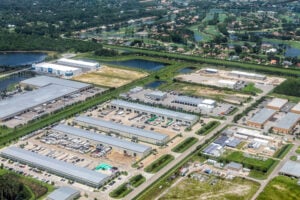
According to Q1 2025 Industrial Figures, the state recorded over 4.5 million square feet of positive net absorption and maintained a robust 23.9 million sq ft under construction. Average asking rents reached $11.43 per sq ft, up nearly 9 percent year-over-year, reflecting steady demand from logistics, manufacturing, and e-commerce operators.
Those same companies — the ones leasing big-box warehouses in Lakeland, Jacksonville, or along the I-4 corridor — now get a quiet but powerful boost from the lease tax repeal. Under the previous rules, Florida levied a 2 percent state sales tax (plus local surtaxes) on commercial rent. That charge extended to CAM, insurance, and property-tax pass-throughs, which make up a meaningful share of total occupancy costs in most NNN industrial leases.
Starting October 1, 2025, that layer disappears. The impact isn’t flashy, but it’s financially real. For example, a tenant occupying 500,000 sq ft at roughly $12.50 per sq ft all-in would have paid about $150,000–$175,000 annually in lease-related sales tax, depending on county surtaxes.
Over a 10-year term, that’s $1.5–$1.7 million kept inside the business instead of remitted to the state. The takeaway for industrial occupiers is straightforward: Florida’s already-competitive logistics market just got cheaper to operate in.
It also improves Florida’s competitive position when companies run site-selection models against other Sunbelt markets.
Texas might still win on land availability, but Florida just erased a recurring tax expense that often tipped the scales.
What This Means for Office Tenants
The office world is a little different, but the benefit is just as tangible.
For multi-tenant buildings, landlords typically gross up operating expenses and pass them through based on a tenant’s share of the building. Those line items — janitorial, management fees, repairs, security — were all previously taxed. Starting this fall, they’re not.
That makes Florida offices slightly cheaper to occupy at a time when companies are re-evaluating what “right-sizing” really means. For tenants expanding into markets like Miami, Tampa, or Orlando, it’s one more reason the math works.
It also simplifies negotiations. Without the sales-tax line, deals can focus on the true economics — base rent, tenant-improvement dollars, and renewal flexibility — instead of calculating “tax on rent on pass-throughs.”
The Ripple Effects:
Easier modeling: CFOs and real-estate teams can now model Florida sites more cleanly. No extra step for sales tax on rent, no need to layer it into TCO formulas. For large portfolios comparing states, that clarity matters.
Portfolio expansion: Many companies that planted a flag in Florida after 2020 are now looking to grow. With this tax gone, expansion economics improve — whether that’s an extra industrial building on a logistics campus or additional office space in a mixed-use hub.
Lease clean-up time: Now’s the moment to check your leases. Any clause that says “tenant shall pay sales tax on rent” needs an update. So do your AP systems and CAM-reconciliation templates.
Landlords’ accounting software may lag; tenants should flag invoices that still include the old tax after October 1.
And for tenants negotiating renewals or new space, this is leverage. Ask for updated language confirming no tax will be charged on rent or pass-throughs, and a refund if it is.

What Tenants Should Do Now
If you’re a tenant with Florida operations (or planning to expand there), here’s your quick checklist:
- Audit your leases. Flag every Florida lease referencing “sales tax” or “business rent tax.” Update those clauses.
- Confirm with landlords. Make sure invoices for occupancy starting October 1, 2025, no longer include sales tax.
- Update your models. Remove the tax line from your TCO and NPV calculations for Florida locations.
- Communicate with finance/AP. Train teams on the timing rule — tax is based on occupancy month, not payment date.
- Use the moment. If you’re negotiating renewals or expansions, leverage the cost savings in rent discussions.
The Bottom Line for Tenants
Florida has always marketed itself as open for business. The repeal of its decades-old lease tax takes that slogan from marketing to reality.
For office and industrial tenants, this is a rare kind of win: a genuine, no-strings-attached reduction in occupancy cost. It’s cleaner books, easier modeling, and more cash to reinvest in operations.
So if your company moved to Florida during the pandemic or is thinking about expanding there now, it’s worth revisiting your real-estate strategy. The market was already hot — and after this change, it’s only heating up.
Smarter Site Selection Starts Here
Changes like Florida’s lease-tax repeal are exactly the kind of hidden factors that can make or break a location strategy.
CRESiteIQ™ by REoptimizer® tracks every one of them — from shifting tax policies and labor costs to transportation access and local market trends — so you’re never making decisions in the dark.
Whether you’re comparing warehouse sites across states or balancing rent savings against workforce reach, Site IQ surfaces the real numbers behind each option.
How the 2025 Economic Divide Is Reshaping Real Estate Strategy
National economic headlines suggest the U.S. economy is chugging along fine: 3.8% GDP growth and 4.3% unemployment would normally point to stability.
But as Moody’s latest state-by-state analysis shows, the story beneath the surface is deeply uneven.
Only 15 states, including California, Texas, and New York, are expanding. 22 states have slipped into recession, and another 13 are “treading water.”In short, nearly three-quarters of the country is either shrinking or stagnating economically.
For commercial real estate (CRE) professionals, that split has direct implications: leasing demand, tenant stability, and capital flow are now highly regionalized—and asset performance is diverging sharply.
The New Geography of Growth
The economic imbalance isn’t evenly distributed.States like California, Texas, and New York (each ranking among the top 11 economies in the world) are propping up the national average. Their scale masks weaker conditions across much of the country.

By contrast, much of the country is struggling with slower industrial output, declining migration, and tighter fiscal conditions. Louisiana, Tennessee, Kansas, and Missouri have all tipped into recession territory, as manufacturing and construction activity retreat and labor markets soften. States like Georgia and Arizona are treading water—held back by cooling housing markets and tepid consumer spending that neutralize gains in logistics and manufacturing. The result is a bifurcated economy: a handful of coastal and high-growth states are keeping the national figures afloat, while large portions of the Midwest and South are already in a localized downturn.
That means the traditional CRE logic of “following national indicators” no longer works.
Today’s tenants and investors need granular, state-level intelligence to make portfolio decisions.
For tenants, it’s about stability:
- In growing states, expect continued rent growth and competitive renewals.
- In contracting states, landlords may offer more flexible terms or incentives to retain occupancy.
For investors and landlords, it’s about concentration risk:
- Portfolios overweighted in slow-growth or agricultural-heavy states could face rising vacancy and downward pressure on valuations.
- Diversifying into logistics or tech-adjacent markets like Texas, Florida, North Carolina, and Colorado can balance exposure.
Debt and the Consumer Connection
Household debt has reemerged as a key drag on regional performance.
Americans now hold over $1 trillion in credit card debt, $496 billion in auto loans, and $1.8 trillion in student loans—near record highs.
In states already in recession—Arkansas, Oklahoma, and West Virginia—that debt burden is suppressing local consumer spending, reducing demand for retail, small-business space, and service-oriented office users.
Meanwhile, higher-income households in expanding states continue to spend, supporting urban retail and mixed-use redevelopment. This growing divide means real estate fundamentals are now tied more closely to household balance sheets than macro GDP figures.

The Wage Gap That Shapes Leasing Demand
Federal Reserve data highlights the same pattern: wage growth is +14% for top quartile earners but –1% for bottom quartile earners. Put differently: the lowest-paid workers are barely keeping pace with inflation, while high-wage earners continue to make real income gains.
That imbalance affects tenant mix and space utilization across asset types:
Industrial & logistics: Regions anchored by high-paying industries—advanced manufacturing, information tech, life sciences—are sustaining footprint expansion even in a soft economy, as firms backfill operations or relocate to lower-cost sites with skilled labor pools.
Retail (especially neighborhood / small-format)
Weak wage growth at the lower end constrains discretionary spending in less affluent markets, multiplying pressure on local retailers and smaller tenants. In mid- and lower-income ZIP codes, store closures, downsizing, and increased vacancy have become common.
Office (suburban, hybrid-first markets)
Markets that combine diversified job bases (finance + energy + tech) and flexible work cultures are recovering more quickly. In contrast, regions dependent on one-sector employment or older core downtowns are lagging in backfill, rent collection, and tenant stability.

What It Means for CRE Strategy
1. Portfolio Diversification Is No Longer Optional
In previous cycles, regional recessions could be offset by national recovery trends. In today’s patchwork economy, that buffer is gone.Tenants and landlords must diversify not just by geography but by sector resilience—for instance, industrial and logistics properties tied to e-commerce or data infrastructure tend to outperform service-heavy markets during regional contractions.
2. Focus on Financial Durability of Tenants
In “recession states,” credit risk rises even when occupancy remains steady.
Landlords should stress-test tenant rosters for exposure to vulnerable industries (agriculture, traditional manufacturing, discretionary retail) and prioritize longer-term leases with financially stable occupiers.
3. Reassess Rent Growth Expectations
Markets like Florida, Texas, and North Carolina can still sustain mid-single-digit rent growth, but secondary markets in the Midwest and Southeast may see flat or negative rent trajectories through 2026. Updating pro formas now prevents valuation shocks later.
4. Prepare for Cap Rate Divergence
As regional fundamentals split, cap rates will no longer move uniformly. Investors are already pricing greater risk premiums into stagnant or contracting economies.
Expect 50–100 basis point spreads to open between resilient and recessionary states by mid-2026.
5. The Flight to Quality Is Taking Many Forms
As the economic divide deepens, capital and occupiers alike are gravitating toward markets that demonstrate consistent growth, wage stability, and fiscal strength. This new “flight to quality” is not just about asset class—it’s about geographic quality. Investors are concentrating in states such as Texas, Florida, and North Carolina, where diversified economies and population inflows continue to support absorption and rent growth. Meanwhile, capital is retreating from regions in contraction, where slower job creation and fiscal pressure are eroding property performance.
Within each market, the pattern repeats: tenants are consolidating into newer, efficient, and well-located buildings that reduce operating costs and future-proof against economic swings, while older, commodity-grade assets face steeper vacancies and discounted pricing. The result is a widening performance gap both between states and within them—a two-tier market where liquidity, leasing demand, and valuation strength all concentrate in “quality” locations. For CRE strategists, understanding that flight pattern is now central to capital deployment and portfolio defense.
CRE Tech Insight: Data Over Headlines
For decision-makers, the biggest mistake is relying on national averages.
Tools like REoptimizer® are built to analyze localized real estate fundamentals, integrating leasing data, rent comps, and energy costs—so tenants and investors can pinpoint which markets still offer upside.
By aligning macro data (like Moody’s state-level recession analysis) with building-level intelligence, users can quickly see:
- Which facilities face higher renewal risk.
- Where expansion will deliver the best ROI.
- How regional energy and labor conditions affect occupancy cost.
This data-first approach is now essential to staying ahead of regional economic divergence.

Signals to Watch in 2026
- Utility and Power Infrastructure:
States investing heavily in power resilience (e.g., Texas, Arizona, and Nevada) are attracting both data centers and manufacturing tenants—stabilizing CRE demand even during economic cooling. - Consumer Credit Delinquencies:
Rising defaults in lower-income states will be an early indicator of retail and service-space stress. - Wage Momentum and Migration:
States that retain top quartile earners (Texas, Florida, Colorado) will likely remain CRE outperformers through the next cycle. - Public Incentives and Tax Policy:
Expect expanding states to continue courting industrial users through incentives, while fiscally stressed states tighten budgets—affecting project timelines and permitting.
The Takeaway: A Tale of Two CRE Markets
America’s economy is no longer moving in unison—and neither is its real estate market.
For every California, Texas, or Florida pushing ahead, there are multiple states retrenching or stalling.
For tenants, that means prioritizing stability, infrastructure, and labor quality over headline rents.
For owners and investors, it means favoring resilient metros and preparing for regional divergence in pricing, liquidity, and absorption.
Next Step: Rethink Your Portfolio Strategy with REoptimizer®
In a market where performance now hinges on the quality of your location and leases, precision beats scale. REoptimizer® empowers CRE leaders to quantify that divide—mapping every asset against real-time regional economic data, wage trends, and growth forecasts to reveal where portfolios are overexposed and where opportunity still runs ahead of the curve.
Pinpoint underperforming markets, model recession risk, and redirect capital toward regions still expanding. The economy may be fragmented—but your strategy doesn’t have to be.
Start your portfolio analysis today with REoptimizer®.
If you’re watching where households (and capital) are heading in 2025, the story is impossible to miss: Texas is dominating the rest of the country.
In a new GoBankingRates study of the 50 fastest growing cities with the most affordable climates in America, Texas claimed 12 slots on the list, including #1 overall (Frisco). That’s nearly a quarter of the country’s top performers in one state.
And this rapid growth isn’t concentrated among the usual suspects and larger cities like Austin. Secondary and even tertiary markets (Denton, Edinburg, Killeen) are showing the kind of population and affordability dynamics that investors can’t afford to ignore.
For portfolios, this isn’t just trivia. It’s a roadmap of where cash flow, population changes, household spending power, and long-term demand curves are heading.
Most Alluring State? Texas Wins By Far.
With 3 Texan cities ranking on the list of top 5 and 6 out of the top ten, the Lone Star domination is hard to ignore.
Let’s look a bit deeper at the headline stats of the fastest growing cities.
- Frisco, TX (#1): 26.9% five-year population growth, 4% one-year growth. Median income $146K, with renters spending just under $47K/year on total living costs.
- McKinney (#3): 16.6% growth over five years, strong income-to-cost spread.
- Allen (#5) and League City (#7): steady gains with homeowners keeping meaningful leftover savings after expenses.
- Round Rock (#10): riding Austin’s halo but still under national cost averages.
Even Austin (#35) makes the cut despite its reputation for pricing out locals… proof that the Texas affordability narrative still holds weight when benchmarked against national averages.
The point? Texas is delivering growth at every level of its metro hierarchy. For portfolio owners, this strong economy means opportunities not just in major urban hubs but in adjacent secondary markets that punch well above their weight.

Population Growth in the Sunbelt
Step back and the broader Sun Belt migration machine is still firing.
With the fastest growing cities, Arizona placed Goodyear (#2), Chandler (#18), and others.
Florida slipped in Lakeland (#37) and Jacksonville (#50). North Carolina, Nevada, Tennessee —all showing up.
The Sun Belt’s momentum isn’t a blip — it’s the continuation of a multi-decade demographic shift that accelerated post-2020.
Fueled by affordable housing, pro-growth tax regimes, year-round warm weather, and diversified job creation in industries like healthcare, logistics, and tourism, the region continues to pull new residents away from high-cost coastal hubs — and it’s doing so at a pace that looks structural, not cyclical.
But Texas’s dominance is different. And of course the warm weather and no state income tax helps. Beyond even those pulls, its really the combination of affordability, economic diversity, and infrastructure capacity that creates a flywheel effect:
- Affordability keeps households moving in.
- Corporate relocations (tech, logistics, manufacturing) create job anchors.
- Municipal tax bases expand, funding further growth.
When you can map that cycle across a dozen cities in one state, you’re looking at a structural advantage, made more tangible by dozens of corporate headquarter relocations.
What the National Data Is Really Telling Us
The study boils the analysis down to two questions investors should care about:
- Are people moving in? (short- and long-term population growth)
- Can they actually afford to live there? (income versus rent or mortgage costs)
When you overlay those metrics with data from Zillow, BLS, and the Fed, the signal is straightforward: markets with both rising demand and household spending capacity are the ones positioned to outperform.
Put differently: growth without affordability is a bubble; affordability without growth is stagnation. The winners are the cities that deliver both.
New Residents Flock to Areas of Low Taxes
It’s not just rents and mortgages pulling people south. States like Texas, Florida, and Tennessee levy no personal income tax, creating thousands in annual savings for households earning $120K+. But the calculus goes deeper:
- Corporate income taxes are lower or nonexistent in many Sun Belt states, making them magnets for relocations and expansions.
- Sales and property tax structures often shift the load in ways that still net out cheaper for both households and employers compared to high-tax states.
- Regulatory environments are leaner, reducing cost and friction for growth industries like tech, logistics, and manufacturing.
This creates a double arbitrage: households boost disposable income while companies improve margins — a powerful flywheel for sustained in-migration and job creation. Migration today isn’t just about chasing employment opportunities; it’s about optimizing the after-tax, after-housing equation for both workers and the firms that employ them.

For investors, that means tax regimes aren’t just background noise: they’re a material factor in underwriting and portfolio strategy.
Portfolio Implications: Benchmark to Fastest Growing Places or Fall Behind
If you’re holding or acquiring assets, the implications are clear:
- Benchmark Growth vs. Affordability: Where do your markets sit relative to these trends? Are households in your metros gaining ground, or losing it?
- Spot the Halo Markets: Don’t just chase Austin — look at Round Rock, Denton, and Killeen, where spillover growth comes with better entry pricing.
- Stress-Test Rents Against Incomes: Rising incomes in Frisco can support rent escalations. Stagnant income growth in other metros? That’s where concessions creep in.
- Factor in Tax Competitiveness: Net in-migration is disproportionately favoring low-tax states. That’s structural, not cyclical.
Sophisticated portfolios already know: demographics lead demand, and affordability caps it. If you’re not tracking both, you’re flying blind.
The Bigger Picture: The Last Decade Redraws the U.S. Growth Map
What’s happening in 2025 is a reshuffling of the U.S. growth deck. Coastal gateways are still magnets for capital, but the real velocity is shifting inland and southward. Secondary markets are no longer “alternative plays” — they’re becoming the main show for yield, stability, and household growth.
And here’s the kicker: these aren’t temporary pandemic-era relocations. This is structural realignment, reinforced by policy, tax, and affordability advantages. Texas is just the clearest example.
Population growth is aligning with affordability, and how that combination is redrawing the U.S. growth map.
From larger cities like Fort Worth and Austin to smaller communities such as Round Rock or Denton, the data shows a clear migration pattern: households and businesses are seeking out affordable housing, strong economies, and year-round lifestyle advantages.
The data couldn’t be clearer. Households are migrating. Costs matter. Taxes matter. And the winners are metros that marry growth with affordability.
If your portfolio strategy isn’t benchmarking against these shifts, you’re not just missing opportunity — you’re taking on risk you may not even see yet.
That’s where REoptimizer® comes in. We help you benchmark your assets against demographic and cost trends, population growth, track migration corridors, and model tax impacts — so you’re not reacting to change, you’re getting ahead of it.
REoptimizer®: Your Edge in Fast-Growth Markets
If you’re managing assets in this environment, the challenge is simple: are you positioned where the growth is?
With REoptimizer®, you can track population data, growth rates, tax regimes, and affordability trends across metro areas and smaller city markets alike.
Whether it’s new residents moving into Sun Belt regions in the coming years, or service industries expanding in secondary markets, we give you the tools to compare, stress-test, and benchmark against national data and regional shifts.
The fastest-growing places in the country are pulling capital, families, and industries at record speed. Don’t just watch the trend — explore it, measure it, and align your portfolio with it.Optimize now, before the market does it for you. If you want a deeper look into how REoptimizer® can supercharge your portfolio, click the button below for more information.
When industrial tenants chase low rent without scrutinizing operational costs, they often trigger hidden expenses that dwarf supposed savings.
Before you commit, it’s time to dig deeper. Ask the tough questions that reveal your true cost to operate, not just your cost to lease.
So without further ado, here’s a no-nonsense breakdown of the top five questions every tenant should demand clear answers to (backed by data and real-world insights.)
1. What’s My Cost Per Pallet Position?
When it comes to industrial leasing, measuring rent in square feet is a blunt instrument. It tells you what you’re paying, but not what you’re getting.
The metric that matters most is cost per usable pallet position. That’s the true benchmark of warehouse efficiency (and where major cost variance hides in plain sight.)
Why?
Because two facilities of equal square footage can have dramatically different storage yields. Factors can change your usable capacity by tens of thousands of pallet positions include:
- clear height
- racking configuration
- aisle width
- pick path strategy
Especially amongst today’s cost-sensitive supply chains, that difference translates directly into real dollars.
Prologis Industrial Strategy Report (2024), optimizing racking systems can improve usable storage by 20–30% compared to basic floor stacking.
By leveraging vertical space and reducing wasted cube, you can cut effective rent per pallet by hundreds of dollars annually, even if the base rent per square foot looks the same.
Here’s the math: imagine leasing a 100,000 SF warehouse at $5/SF, totaling $500,000 per year in rent. If your current layout provides 10,000 usable pallet positions, you’re effectively paying $50 per pallet annually.
By improving layout efficiency by 15% ( through enhanced racking, narrower aisles, and optimized battery zones ) you could add 1,500 more pallet positions, bringing the total to 11,500.
This improvement lowers your effective rent per pallet to about $43.48, a nearly 13% reduction in cost per pallet, achieved without expanding your footprint. What’s driving these improvements? For one, clear height.
Facilities with 32′ to 36′ clear can support up to five racking levels (compared to just three in a 24′ building).
Combined with very narrow aisle (VNA) configurations (as tight as 6 feet), and selective or double-deep racking systems, these design decisions make a massive impact. Just keep in mind the trade-offs: VNA requires specialized lift equipment and may impact throughput.

Another overlooked variable: layout waste.
Every oversized battery zone, underutilized staging area, or sub-optimal pick path eats into your pallet yield. That’s where tools like REoptimizer® step in: analyzing CAD layouts, calculating usable cube per SF, and delivering hard cost-per-pallet estimates based on actual racking specs. These are actual, hard outputs you can use to compare sites.
Bottom line: In a market where efficiency is cash, tenants who optimize layout before they negotiate lease rates have a clear advantage. You don’t just want the best price per square foot, you want the lowest cost per pallet that still delivers on operational throughput.
2. How Much Am I Really Spending Per Mile to Ship?
In logistics, proximity is power. And while many tenants obsess over rent per square foot, the real cost king is transportation. Your location’s impact on shipping routes can easily overshadow rent savings — and for most occupiers, it does.
According to the Council of Supply Chain Management Professionals (CSCMP) 2024 State of Logistics Report, transportation represents a staggering 63% of total logistics spend in the U.S., compared to just 14% for warehousing.
That means your building’s location relative to your customers, intermodal hubs, and labor pools is far more consequential than the base rent on your lease.
Even small shifts in location matter. A facility that’s 15 miles closer to your delivery routes can cut transportation spend by 10–15%, depending on load type and congestion patterns. And those savings aren’t abstract. On a 250,000 SF warehouse serving urban zones with daily outbound volume, that could mean over $100,000 per year. These savings come from reductions in:
- fuel
- labor hours
- equipment wear
- regulatory/toll charges in urban zones
Here’s the real math: Suppose you’re considering two sites: one at $4/SF rent, but 40 miles from your customer base, and another at $5/SF, only 15 miles away. The rent differential looks like $250,000/year.
But when REoptimizer® models the total logistics costs (including geospatial truck routing, time-of-day congestion, tolls, and weight class charges ) the remote facility could cost you an extra $350,000/year in transport. That flips the value equation on its head.
Prologis found that every 1% reduction in transportation cost delivers the same financial impact as a 15–20% cut in rent. That’s not a margin detail- that’s a strategy shift.
Site selection teams should use this insight aggressively.
Software tools like REoptimizer® now integrate routing APIs, local mileage taxes, and real-time freight benchmarks so you can run cost-per-mile projections before signing the LOI. Not just gut instinct. Not just ZIP-code generalizations. Real calculations.
3. Can the Power Grid Support My Ops — Today and Tomorrow?
Industrial real estate used to be about square footage. Now, it’s about kilowatts.
The rise of automation, electrification, and always-on logistics is accelerating energy demands in ways that most legacy industrial parks simply weren’t built to handle. It’s not just about keeping the lights on, it’s about powering robotic racking systems, electrified fleets, and 24/7 cold storage operations without interruption.

According to the U.S. Energy Information Administration (EIA), the average U.S. business faced 5.5 hours of power outage in 2022, driven largely by an aging grid and extreme weather events.
That’s a red flag for facilities that depend on automation, where downtime isn’t just inconvenient, it’s operationally and financially catastrophic.
What’s worse, the U.S. Department of Energy’s Grid Modernization Initiative has warned that many industrial zones are operating near grid capacity, requiring multi-million-dollar upgrades to support growth. Since so much of this evolution is happening at breakneck pace, it’s Unprecedented territory for negotiations and not typically costs to be funded by landlords.
The rise of electric vehicle (EV) fleet adoption and advanced warehouse tech only deepens the challenge:
- AutoStore, Ocado, and other AS/RS (Automated Storage and Retrieval System) vendors specify significant continuous power needs to support dense robotic picking systems.
- Fleet electrification mandates in states like California are driving tenants to install charging infrastructure requiring 1 to 3 MW+ of reliable power — the equivalent of powering hundreds of homes.
REoptimizer® integrates utility rate modeling and grid load mapping to help clients make informed decisions. And the results are staggering. In California, for instance, commercial electricity rates average $0.18/kWh, compared to $0.07/kWh in Louisiana. That 60%+ delta translates into six- or seven-figure annual cost differences for energy-intensive users.
A facility that lacks sufficient grid capacity today won’t be future-proof tomorrow.
4. What’s the Real Cost of Labor in This Market?
Labor is usually the most formidable expense in industrial operations, making up 40% to 60% of total operating costs, according to a 2024 Industrial Labor Report.
But in tight labor markets, that cost skyrockets (not because wages alone are higher, but because turnover, recruitment, and training multiply expenses.)
Turnover in constrained markets can reach 35% annually, with applicant-to-hire ratios ballooning to 10:3 or worse.
Cost of living and inflation compound the problem. Higher housing, transportation, and healthcare expenses push wages upward, forcing companies to pay premiums just to attract workers. For example:
- According to the Bureau of Economic Analysis (BEA, 2024), cost of living in cities like San Francisco or New York is 30–50% higher than in logistics hubs like Houston or Nashville.
- Inflation has pushed hourly wage growth in logistics sectors to over 6% annually in some urban areas, according to BLS 2024
Union presence adds another layer. Unions typically drive wages and benefits higher and reduce operational flexibility:
- States with strong union density — like California, Illinois, and New York — often see 15%–25% higher labor costs compared to non-unionized markets (Source: Bureau of Labor Statistics).
- Unionized environments increase risk of strikes or work stoppages, which translates to unpredictable downtime and higher indirect costs.
That’s why tenants need to be using platforms like REoptimizer® that integrate all of these considerations to pinpoint the bottom line for ROI including:
- Local wage data with inflation trends
- Union density and labor laws that affect bargaining power
- Turnover risk metrics and cost-to-turnover modeling
- Cost of living indices to forecast wage pressures over lease terms
Markets like Houston, Nashville, and Savannah shine because they pair deep, affordable labor pools with moderate cost-of-living and low union penetration, delivering scalability without premium wages or elevated churn.
5. Am I Leaving Millions on the Table—or Risking Tax Clawbacks?
Taxes aren’t static, and your strategy shouldn’t be either.
According to KPMG’s 2023 State Tax Index, businesses in California face an effective tax burden 12–14% higher than their counterparts in Texas or Florida. This gap can translate into millions of dollars in additional operating costs over the life of a lease.
Meanwhile, Texas offers robust incentives, including up to $2,500 per job in tax rebates and workforce training grants. For a typical 100-employee industrial campus, this can mean $100,000 to $500,000+ in annual savings—money that directly improves your bottom line.
But incentives come with complexity and risk. Missed application deadlines, mismanaged documentation, or poorly structured abatements can lead to costly clawbacks, penalties, or lost opportunities.
REoptimizer’s® platform tracks detailed regional tax incentive data, including eligibility criteria, critical deadlines, and clawback provisions. This ensures you capture every dollar available while avoiding costly pitfalls.
As the EY 2023 State Incentive Survey states“Neglecting state incentives is like leaving cash on the table.”
The bottom line: aggressive tax incentive management isn’t optional—it’s a critical lever to reduce total occupancy costs and safeguard your investment.
Bottom Line for Industrial Tenants
Chasing the lowest rent without digging into the full cost picture is a risky game. True industrial cost control demands a deeper dive—into pallet efficiency, transportation spend, power capacity, labor dynamics, and tax strategies. Each factor can add or save millions beyond your lease rate.
Before you sign, ask the hard questions. Use data-driven tools like REoptimizer® to cut through assumptions and see the real bottom line. Because in industrial real estate, it’s not just about what you pay per square foot—it’s about what it truly costs to operate and grow your business.
Make smarter choices. Lock in total cost advantage. Win the long game. Take the first step today and learn more about how REoptimizer® can level up your portfolio.
