How the 2025 Economic Divide Is Reshaping Real Estate Strategy
National economic headlines suggest the U.S. economy is chugging along fine: 3.8% GDP growth and 4.3% unemployment would normally point to stability.
But as Moody’s latest state-by-state analysis shows, the story beneath the surface is deeply uneven.
Only 15 states, including California, Texas, and New York, are expanding. 22 states have slipped into recession, and another 13 are “treading water.”In short, nearly three-quarters of the country is either shrinking or stagnating economically.
For commercial real estate (CRE) professionals, that split has direct implications: leasing demand, tenant stability, and capital flow are now highly regionalized—and asset performance is diverging sharply.
The New Geography of Growth
The economic imbalance isn’t evenly distributed.States like California, Texas, and New York (each ranking among the top 11 economies in the world) are propping up the national average. Their scale masks weaker conditions across much of the country.

By contrast, much of the country is struggling with slower industrial output, declining migration, and tighter fiscal conditions. Louisiana, Tennessee, Kansas, and Missouri have all tipped into recession territory, as manufacturing and construction activity retreat and labor markets soften. States like Georgia and Arizona are treading water—held back by cooling housing markets and tepid consumer spending that neutralize gains in logistics and manufacturing. The result is a bifurcated economy: a handful of coastal and high-growth states are keeping the national figures afloat, while large portions of the Midwest and South are already in a localized downturn.
That means the traditional CRE logic of “following national indicators” no longer works.
Today’s tenants and investors need granular, state-level intelligence to make portfolio decisions.
For tenants, it’s about stability:
- In growing states, expect continued rent growth and competitive renewals.
- In contracting states, landlords may offer more flexible terms or incentives to retain occupancy.
For investors and landlords, it’s about concentration risk:
- Portfolios overweighted in slow-growth or agricultural-heavy states could face rising vacancy and downward pressure on valuations.
- Diversifying into logistics or tech-adjacent markets like Texas, Florida, North Carolina, and Colorado can balance exposure.
Debt and the Consumer Connection
Household debt has reemerged as a key drag on regional performance.
Americans now hold over $1 trillion in credit card debt, $496 billion in auto loans, and $1.8 trillion in student loans—near record highs.
In states already in recession—Arkansas, Oklahoma, and West Virginia—that debt burden is suppressing local consumer spending, reducing demand for retail, small-business space, and service-oriented office users.
Meanwhile, higher-income households in expanding states continue to spend, supporting urban retail and mixed-use redevelopment. This growing divide means real estate fundamentals are now tied more closely to household balance sheets than macro GDP figures.

The Wage Gap That Shapes Leasing Demand
Federal Reserve data highlights the same pattern: wage growth is +14% for top quartile earners but –1% for bottom quartile earners. Put differently: the lowest-paid workers are barely keeping pace with inflation, while high-wage earners continue to make real income gains.
That imbalance affects tenant mix and space utilization across asset types:
Industrial & logistics: Regions anchored by high-paying industries—advanced manufacturing, information tech, life sciences—are sustaining footprint expansion even in a soft economy, as firms backfill operations or relocate to lower-cost sites with skilled labor pools.
Retail (especially neighborhood / small-format)
Weak wage growth at the lower end constrains discretionary spending in less affluent markets, multiplying pressure on local retailers and smaller tenants. In mid- and lower-income ZIP codes, store closures, downsizing, and increased vacancy have become common.
Office (suburban, hybrid-first markets)
Markets that combine diversified job bases (finance + energy + tech) and flexible work cultures are recovering more quickly. In contrast, regions dependent on one-sector employment or older core downtowns are lagging in backfill, rent collection, and tenant stability.

What It Means for CRE Strategy
1. Portfolio Diversification Is No Longer Optional
In previous cycles, regional recessions could be offset by national recovery trends. In today’s patchwork economy, that buffer is gone.Tenants and landlords must diversify not just by geography but by sector resilience—for instance, industrial and logistics properties tied to e-commerce or data infrastructure tend to outperform service-heavy markets during regional contractions.
2. Focus on Financial Durability of Tenants
In “recession states,” credit risk rises even when occupancy remains steady.
Landlords should stress-test tenant rosters for exposure to vulnerable industries (agriculture, traditional manufacturing, discretionary retail) and prioritize longer-term leases with financially stable occupiers.
3. Reassess Rent Growth Expectations
Markets like Florida, Texas, and North Carolina can still sustain mid-single-digit rent growth, but secondary markets in the Midwest and Southeast may see flat or negative rent trajectories through 2026. Updating pro formas now prevents valuation shocks later.

4. Prepare for Cap Rate Divergence
As regional fundamentals split, cap rates will no longer move uniformly. Investors are already pricing greater risk premiums into stagnant or contracting economies.
Expect 50–100 basis point spreads to open between resilient and recessionary states by mid-2026.
5. The Flight to Quality Is Taking Many Forms
As the economic divide deepens, capital and occupiers alike are gravitating toward markets that demonstrate consistent growth, wage stability, and fiscal strength. This new “flight to quality” is not just about asset class—it’s about geographic quality. Investors are concentrating in states such as Texas, Florida, and North Carolina, where diversified economies and population inflows continue to support absorption and rent growth. Meanwhile, capital is retreating from regions in contraction, where slower job creation and fiscal pressure are eroding property performance.
Within each market, the pattern repeats: tenants are consolidating into newer, efficient, and well-located buildings that reduce operating costs and future-proof against economic swings, while older, commodity-grade assets face steeper vacancies and discounted pricing. The result is a widening performance gap both between states and within them—a two-tier market where liquidity, leasing demand, and valuation strength all concentrate in “quality” locations. For CRE strategists, understanding that flight pattern is now central to capital deployment and portfolio defense.
CRE Tech Insight: Data Over Headlines
For decision-makers, the biggest mistake is relying on national averages.
Tools like REoptimizer® are built to analyze localized real estate fundamentals, integrating leasing data, rent comps, and energy costs—so tenants and investors can pinpoint which markets still offer upside.
By aligning macro data (like Moody’s state-level recession analysis) with building-level intelligence, users can quickly see:
- Which facilities face higher renewal risk.
- Where expansion will deliver the best ROI.
- How regional energy and labor conditions affect occupancy cost.
This data-first approach is now essential to staying ahead of regional economic divergence.

Signals to Watch in 2026
- Utility and Power Infrastructure:
States investing heavily in power resilience (e.g., Texas, Arizona, and Nevada) are attracting both data centers and manufacturing tenants—stabilizing CRE demand even during economic cooling. - Consumer Credit Delinquencies:
Rising defaults in lower-income states will be an early indicator of retail and service-space stress. - Wage Momentum and Migration:
States that retain top quartile earners (Texas, Florida, Colorado) will likely remain CRE outperformers through the next cycle. - Public Incentives and Tax Policy:
Expect expanding states to continue courting industrial users through incentives, while fiscally stressed states tighten budgets—affecting project timelines and permitting.
The Takeaway: A Tale of Two CRE Markets
America’s economy is no longer moving in unison—and neither is its real estate market.
For every California, Texas, or Florida pushing ahead, there are multiple states retrenching or stalling.
For tenants, that means prioritizing stability, infrastructure, and labor quality over headline rents.
For owners and investors, it means favoring resilient metros and preparing for regional divergence in pricing, liquidity, and absorption.
Next Step: Rethink Your Portfolio Strategy with REoptimizer®
In a market where performance now hinges on the quality of your location and leases, precision beats scale. REoptimizer® empowers CRE leaders to quantify that divide—mapping every asset against real-time regional economic data, wage trends, and growth forecasts to reveal where portfolios are overexposed and where opportunity still runs ahead of the curve.
Pinpoint underperforming markets, model recession risk, and redirect capital toward regions still expanding. The economy may be fragmented—but your strategy doesn’t have to be.
Start your portfolio analysis today with REoptimizer®.
If you’re watching where households (and capital) are heading in 2025, the story is impossible to miss: Texas is dominating the rest of the country.
In a new GoBankingRates study of the 50 fastest growing cities with the most affordable climates in America, Texas claimed 12 slots on the list, including #1 overall (Frisco). That’s nearly a quarter of the country’s top performers in one state.
And this rapid growth isn’t concentrated among the usual suspects and larger cities like Austin. Secondary and even tertiary markets (Denton, Edinburg, Killeen) are showing the kind of population and affordability dynamics that investors can’t afford to ignore.
For portfolios, this isn’t just trivia. It’s a roadmap of where cash flow, population changes, household spending power, and long-term demand curves are heading.
Most Alluring State? Texas Wins By Far.
With 3 Texan cities ranking on the list of top 5 and 6 out of the top ten, the Lone Star domination is hard to ignore.
Let’s look a bit deeper at the headline stats of the fastest growing cities.
- Frisco, TX (#1): 26.9% five-year population growth, 4% one-year growth. Median income $146K, with renters spending just under $47K/year on total living costs.
- McKinney (#3): 16.6% growth over five years, strong income-to-cost spread.
- Allen (#5) and League City (#7): steady gains with homeowners keeping meaningful leftover savings after expenses.
- Round Rock (#10): riding Austin’s halo but still under national cost averages.
Even Austin (#35) makes the cut despite its reputation for pricing out locals… proof that the Texas affordability narrative still holds weight when benchmarked against national averages.
The point? Texas is delivering growth at every level of its metro hierarchy. For portfolio owners, this strong economy means opportunities not just in major urban hubs but in adjacent secondary markets that punch well above their weight.

Population Growth in the Sunbelt
Step back and the broader Sun Belt migration machine is still firing.
With the fastest growing cities, Arizona placed Goodyear (#2), Chandler (#18), and others.
Florida slipped in Lakeland (#37) and Jacksonville (#50). North Carolina, Nevada, Tennessee —all showing up.
The Sun Belt’s momentum isn’t a blip — it’s the continuation of a multi-decade demographic shift that accelerated post-2020.
Fueled by affordable housing, pro-growth tax regimes, year-round warm weather, and diversified job creation in industries like healthcare, logistics, and tourism, the region continues to pull new residents away from high-cost coastal hubs — and it’s doing so at a pace that looks structural, not cyclical.
But Texas’s dominance is different. And of course the warm weather and no state income tax helps. Beyond even those pulls, its really the combination of affordability, economic diversity, and infrastructure capacity that creates a flywheel effect:
- Affordability keeps households moving in.
- Corporate relocations (tech, logistics, manufacturing) create job anchors.
- Municipal tax bases expand, funding further growth.
When you can map that cycle across a dozen cities in one state, you’re looking at a structural advantage, made more tangible by dozens of corporate headquarter relocations.
What the National Data Is Really Telling Us
The study boils the analysis down to two questions investors should care about:
- Are people moving in? (short- and long-term population growth)
- Can they actually afford to live there? (income versus rent or mortgage costs)
When you overlay those metrics with data from Zillow, BLS, and the Fed, the signal is straightforward: markets with both rising demand and household spending capacity are the ones positioned to outperform.
Put differently: growth without affordability is a bubble; affordability without growth is stagnation. The winners are the cities that deliver both.
New Residents Flock to Areas of Low Taxes
It’s not just rents and mortgages pulling people south. States like Texas, Florida, and Tennessee levy no personal income tax, creating thousands in annual savings for households earning $120K+. But the calculus goes deeper:
- Corporate income taxes are lower or nonexistent in many Sun Belt states, making them magnets for relocations and expansions.
- Sales and property tax structures often shift the load in ways that still net out cheaper for both households and employers compared to high-tax states.
- Regulatory environments are leaner, reducing cost and friction for growth industries like tech, logistics, and manufacturing.
This creates a double arbitrage: households boost disposable income while companies improve margins — a powerful flywheel for sustained in-migration and job creation. Migration today isn’t just about chasing employment opportunities; it’s about optimizing the after-tax, after-housing equation for both workers and the firms that employ them.

For investors, that means tax regimes aren’t just background noise: they’re a material factor in underwriting and portfolio strategy.
Portfolio Implications: Benchmark to Fastest Growing Places or Fall Behind
If you’re holding or acquiring assets, the implications are clear:
- Benchmark Growth vs. Affordability: Where do your markets sit relative to these trends? Are households in your metros gaining ground, or losing it?
- Spot the Halo Markets: Don’t just chase Austin — look at Round Rock, Denton, and Killeen, where spillover growth comes with better entry pricing.
- Stress-Test Rents Against Incomes: Rising incomes in Frisco can support rent escalations. Stagnant income growth in other metros? That’s where concessions creep in.
- Factor in Tax Competitiveness: Net in-migration is disproportionately favoring low-tax states. That’s structural, not cyclical.
Sophisticated portfolios already know: demographics lead demand, and affordability caps it. If you’re not tracking both, you’re flying blind.
The Bigger Picture: The Last Decade Redraws the U.S. Growth Map
What’s happening in 2025 is a reshuffling of the U.S. growth deck. Coastal gateways are still magnets for capital, but the real velocity is shifting inland and southward. Secondary markets are no longer “alternative plays” — they’re becoming the main show for yield, stability, and household growth.
And here’s the kicker: these aren’t temporary pandemic-era relocations. This is structural realignment, reinforced by policy, tax, and affordability advantages. Texas is just the clearest example.
Population growth is aligning with affordability, and how that combination is redrawing the U.S. growth map.
From larger cities like Fort Worth and Austin to smaller communities such as Round Rock or Denton, the data shows a clear migration pattern: households and businesses are seeking out affordable housing, strong economies, and year-round lifestyle advantages.
The data couldn’t be clearer. Households are migrating. Costs matter. Taxes matter. And the winners are metros that marry growth with affordability.
If your portfolio strategy isn’t benchmarking against these shifts, you’re not just missing opportunity — you’re taking on risk you may not even see yet.
That’s where REoptimizer® comes in. We help you benchmark your assets against demographic and cost trends, population growth, track migration corridors, and model tax impacts — so you’re not reacting to change, you’re getting ahead of it.
REoptimizer®: Your Edge in Fast-Growth Markets
If you’re managing assets in this environment, the challenge is simple: are you positioned where the growth is?
With REoptimizer®, you can track population data, growth rates, tax regimes, and affordability trends across metro areas and smaller city markets alike.
Whether it’s new residents moving into Sun Belt regions in the coming years, or service industries expanding in secondary markets, we give you the tools to compare, stress-test, and benchmark against national data and regional shifts.
The fastest-growing places in the country are pulling capital, families, and industries at record speed. Don’t just watch the trend — explore it, measure it, and align your portfolio with it.Optimize now, before the market does it for you. If you want a deeper look into how REoptimizer® can supercharge your portfolio, click the button below for more information.
In a market where capital is tight, costs are volatile, and cycles are shorter, where you place your next office or industrial asset can make or break its ROI.
Demographics aren’t “soft” data; they’re the leading indicators of labor cost, operating margin, and long-term demand. Get them wrong, and you’ll be fighting wage creep, slow lease-up, and operational bottlenecks for the next decade.
Here’s your executive-grade guide to the demographic levers that matter—and the public data you can use to benchmark them before you sign. Because when you’re calculating the Total Cost of Occupancy, payroll, not rent, is the biggest line item.
Union Density
Skilled trades, technicians, and logistics professionals are the backbone of industrial operations, yet the pool of qualified workers isn’t evenly distributed. In many regions, companies are already competing fiercely for the same finite talent. Overlay rising wages, evolving work rules, and the push for reshoring, and you’ve got a site-selection equation that’s as much about people as it is about land and steel.
That’s where demographics (particularly union density) become a critical strategic variable. They shape labor costs, construction timelines, and operational flexibility from day one.

In 2024, U.S. union membership stood at 9.9%, but the spread between markets is enormous. And Unionization rates tell you more than how workers are organized…they’re a proxy for labor cost escalation, contract complexity, and operational agility.
- U.S. union membership (2024): 9.9% overall.
- High-density states: Hawaii (26.5%), New York (20.6%).
- Low-density states: South Carolina (2.3%), North Carolina (2.6%).
(Source: U.S. Bureau of Labor Statistics – Union Members 2024
Those states with the highest union density also have reputations of being the least business-friendly. And this is a direct input into your project feasibility.
- Build-out Costs: In high-union states, Project Labor Agreements (PLAs) are often standard for industrial construction. They can add 5–15% to total build costs and extend timelines due to specialized crew requirements and adherence to collective bargaining agreements.
- Wage Floors: Higher union density typically translates into higher base pay rates for skilled trades, warehouse operators, and maintenance teams, affecting both OpEx and tenant fit.
- Operational Flexibility: High-union environments can limit scheduling flexibility, cross-training opportunities, and the pace of scaling up or down based on demand.
In a tight skilled-labor market, the calculus becomes even sharper: high union density may signal both elevated wage costs and a deeper pool of well-trained workers.
So, before committing to a market, pull union membership data by both state and industry. Layer that over your labor needs and construction budget to forecast not just first-year costs, but the trajectory of your cost structure over a 5–10 year hold.
Cost of Living: The Hidden Wage Multiplier
For both industrial and office tenants, labor costs aren’t just about the prevailing wage—they’re about what it takes for workers to live within commuting distance. The Bureau of Economic Analysis’s Regional Price Parities (RPP) index is the cleanest way to benchmark cost-of-living differentials across states and metros.
High-COL markets—California (~113 RPP), New Jersey (~109)—force employers to raise salaries simply to keep purchasing power flat.
That expense pushes through to lease negotiations and occupancy costs. Low-COL states like Texas (~97) or Ohio (~92) allow payroll dollars to stretch further, but they may not have the same depth of specialized labor or infrastructure for certain office-based industries or advanced manufacturing.
Industrial impact: Higher COL markets mean bigger wage bills for plant operators, warehouse teams, and skilled trades. That can price some tenants out or lead to automation investment sooner.
Office impact: COL drives salary pressure for knowledge workers, influencing whether companies expand in place, open a satellite, or pivot to hybrid models to tap lower-cost labor pools elsewhere.
Average Income: The Wage Benchmark
Average income levels are more than a snapshot of regional prosperity—they set the baseline for wage expectations in both industrial and office sectors. The U.S. Census Bureau’s American Community Survey (ACS) provides median household and per-capita income data for every metro, giving you a clear view of what the market considers “normal” pay.
In high-income metros, employers must offer competitive compensation just to be seen as viable, even for roles with national wage medians. In lower-income areas, market-rate salaries can stretch further, but the trade-off may be a smaller pool of candidates experienced in high-complexity or high-tech environments.
Industrial impact: Higher average incomes often indicate stronger competition for skilled trades and technical roles, requiring above-median offers to secure talent.
Office impact: Markets with elevated average incomes may have a richer pool of high-skill professionals—but also a steeper payroll curve to attract and retain them.
Executives should pair average income data with occupation-specific wage stats from the BLS to identify where your pay bands align (or clash) with local expectations before finalizing site decisions.
Population Growth & Migration: Following the Workforce
Where people move, business demand follows. Texas, Florida, and North Carolina are among the biggest net in-migration winners, while California, New York, and Illinois continue to see population losses. (Source: U.S. Census Bureau – 2024)
Industrial impact: Growing populations swell the local labor pool, easing recruitment in warehousing, manufacturing, and logistics. They also boost regional consumption, increasing throughput for goods and supporting demand for distribution space.
Office impact: Population growth—especially of working-age, educated residents—expands the available talent base for corporate services, tech, and finance. Outflow from high-cost metros can create opportunities in emerging secondary markets.
Education Level & Talent Mix
When evaluating a market for industrial or office expansion, the raw headcount of available workers is only half the picture. The quality of that workforce—measured by education attainment and skill concentration—determines the types of operations you can run and how quickly you can scale them.
- Bachelor’s degree or higher: A key marker for knowledge-worker availability in office markets. Metros like Austin (~52%) and Raleigh (~51%) have deep pools for corporate, tech, and R&D roles.
- Technical and STEM concentration: For industrial tenants, the density of engineers, technicians, and IT specialists matters more. San Jose–Sunnyvale posts a STEM location quotient of 2.8—nearly triple the national average—while Detroit–Warren sits at 1.4. (Sources: U.S. Census ACS S1501; BLS STEM Employment Data
A low education or STEM concentration score doesn’t automatically disqualify a market—it just means you’ll pay for capability in other ways. That could be longer recruitment cycles, higher wage premiums, or significant training investments. In high-demand fields like industrial automation or biotech manufacturing, a shallow local skill pool can slow expansion by months or even years.
For executives considering how workforce education affects their real estate:
- If skills are abundant: Build capacity aggressively, knowing recruitment lead times will be short.
- If skills are scarce: Budget for training infrastructure, relocation incentives, or a hub-and-spoke model—placing specialized roles in a skill-rich market while supporting roles sit in lower-cost areas.
Takeaways for Tenants
Site selection in today’s CRE market isn’t guesswork—it’s data work. Demographics, labor dynamics, and cost structures are too varied (and too fluid) to evaluate with intuition alone. The smartest tenants aren’t just looking at rent—they’re layering dozens of variables:
- Union density and labor rules
- Cost of living and average income benchmarks
- Population growth and migration trends
- Education and STEM talent density
- Freight flows and market access for industrial
- Office utilization and hybrid adoption rates
The real edge comes from seeing these factors together—on a map, in context, with real-time market comparables. That’s where portfolio and site management software like REoptimizer® changes the game. By overlaying demographic data, cost indices, and comps in one platform, tenants can instantly compare markets, model long-term operating costs, and align site choices with workforce realities.
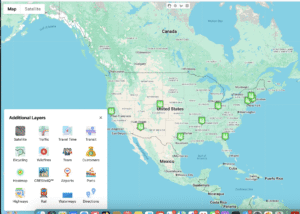
Bottom line: The right tool turns demographic insight into competitive advantage, helping you pick not just a space, but the right space in the right market at the right time.
Learn more about how REoptimizer® changes the game of site selection, streamlining the property search and letting you decide what’s important.
